
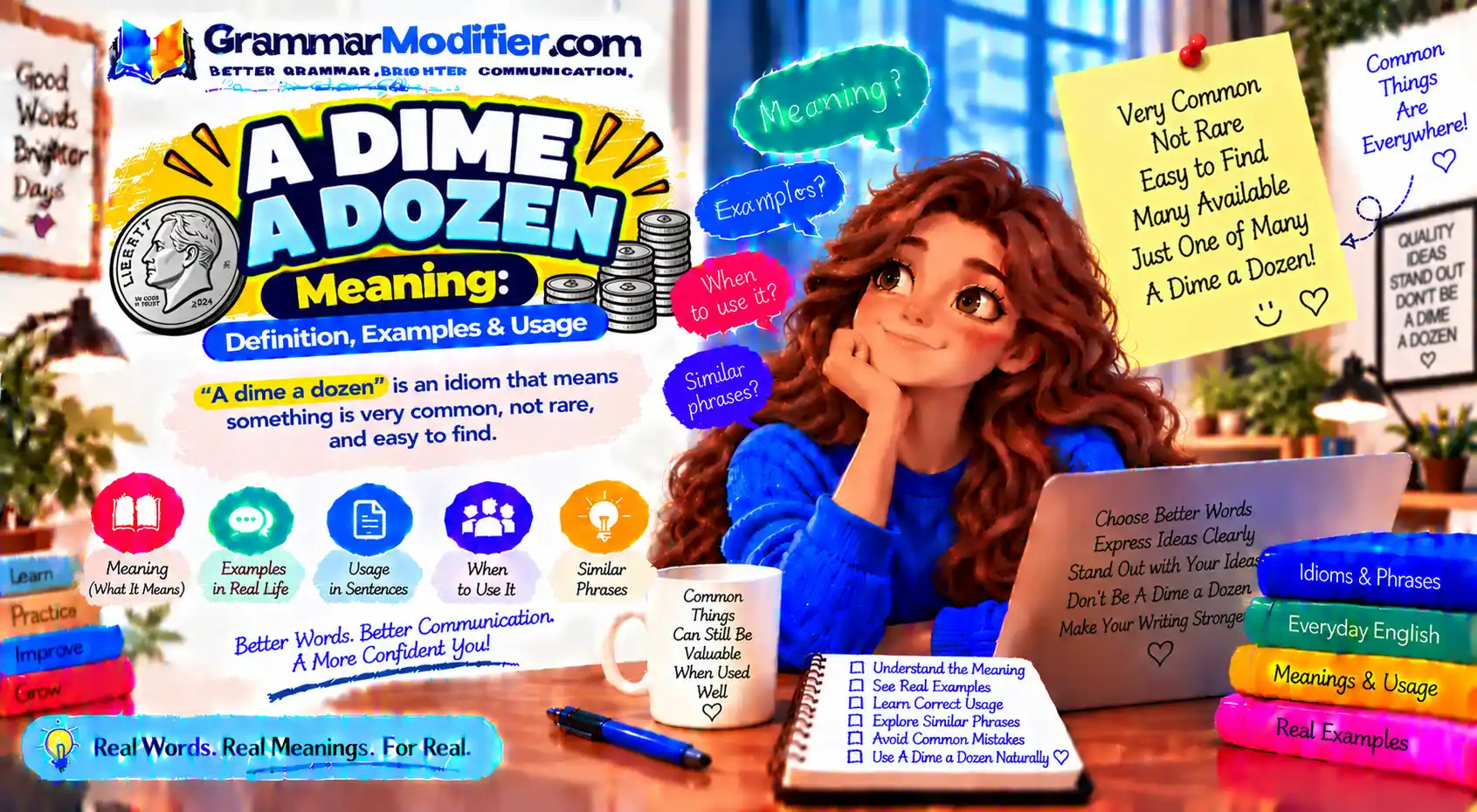
English learners often see a dime a dozen in American conversations, books, articles, and online writing. The idiom means something is very common, plentiful, or easy to find.
This guide explains how to use the expression naturally. You’ll learn its meaning, tone, sentence patterns, synonyms, common mistakes, American English usage, and British equivalents.
Quick Answer
A dime a dozen means something is very common, plentiful, and easy to find. It can also suggest that something isn’t especially rare, unique, or valuable.
TL;DR
- A dime a dozen means very common or plentiful.
- It often suggests something isn’t especially special.
- It doesn’t simply mean “cheap.”
- The phrase is common in American English.
- It can sound dismissive when describing people.
- Two a penny and ten a penny are British equivalents.
A Dime a Dozen Meaning
A dime a dozen is an idiom for something that is very common or plentiful. Because it is easy to find, it may seem less special or valuable.
The phrase doesn’t require a literal price of ten cents. Modern speakers normally use it figuratively when discussing things that appear in large numbers.
- Meaning: very common or plentiful
- Availability: easy to find
- Rarity: low
- Perceived value: often limited
- Tone: sometimes dismissive
- Typical use: informal conversation and writing
- Example: Generic phone cases are a dime a dozen.
What Does “A Dime a Dozen” Really Mean?
The central idea is abundance. When similar things are everywhere, people may view them as less unusual or distinctive.
The phrase doesn’t always mean something is worthless. It usually comments on how common something is and may imply that finding another example isn’t difficult.
- “Online tutorials are a dime a dozen.”
- “Good ideas are a dime a dozen.”
- “Tourist souvenirs are a dime a dozen.”
- “Basic design skills are a dime a dozen.”
- “Unique handmade pieces aren’t a dime a dozen.”
- “Rare collectibles aren’t a dime a dozen.”
- “A dime a dozen” focuses on abundance.
- The surrounding context determines the strength of the criticism.
Is “A Dime a Dozen” an Idiom?
Yes. A dime a dozen is an idiomatic expression because its modern meaning isn’t simply about buying twelve things for ten cents.
The words create a figurative idea of something being plentiful and inexpensive. Today, the phrase normally describes things that are easy to find rather than an actual purchase.
- “Similar apps are a dime a dozen.”
- “Cheap souvenirs are a dime a dozen.”
- “Ideas are a dime a dozen.”
- “Generic products are a dime a dozen.”
- “One-of-a-kind artwork isn’t a dime a dozen.”
- The phrase doesn’t require an actual dime.
- It doesn’t require exactly twelve objects.
- Its meaning depends on the surrounding context.
How to Use “A Dime a Dozen” in a Sentence
The expression commonly follows a form of be, including is, are, was, and were. It usually describes a subject that is common or widely available.
A useful sentence pattern is subject + be + a dime a dozen. It can also follow verbs such as become or seem.
- “These products are a dime a dozen.”
- “Online courses are a dime a dozen.”
- “Similar restaurants are a dime a dozen here.”
- “Generic designs have become a dime a dozen.”
- “Those books were a dime a dozen.”
- “Trendy apps can become a dime a dozen.”
- “Reliable repair shops aren’t a dime a dozen.”
- “Good opportunities aren’t always a dime a dozen.”
A Dime a Dozen Examples
The best way to understand this idiom is to see how different contexts change its meaning.
It can describe products, ideas, jobs, trends, opportunities, skills, and many other things. The common thread is that similar examples are plentiful.
- Products: Generic phone cases are a dime a dozen.
- Restaurants: Similar restaurants are a dime a dozen in this neighborhood.
- Ideas: Good ideas are a dime a dozen without strong execution.
- Jobs: Entry-level job applications can be a dime a dozen.
- Trends: Social media trends are a dime a dozen.
- Books: Similar business books are a dime a dozen.
- Skills: Basic design skills are a dime a dozen today.
- Opportunities: Small opportunities can be a dime a dozen.
- Souvenirs: Tourist souvenirs are a dime a dozen.
- Online content: Short videos are a dime a dozen.
- Apps: Similar mobile apps are a dime a dozen.
- Products: Mass-produced decorations can be a dime a dozen.
Common Mistakes With “A Dime a Dozen”
One common mistake is treating the expression as a direct synonym for cheap. The idiom focuses on abundance, although it can also suggest limited value.
Another mistake is using it for something rare or unique. That creates the opposite meaning.
- Incorrect: This rare painting is a dime a dozen.
- Better: This rare painting is one of a kind.
- Incorrect: This item costs ten cents, so it’s a dime a dozen.
- Better: This item is inexpensive.
- Incorrect: This product is dime a dozen.
- Better: This product is a dime a dozen.
- Incorrect: The phrase always means worthless.
- Better: The phrase usually suggests commonness and limited distinction.
- Incorrect: My friend is a dime a dozen.
- Better: People with similar skills are common.
- Incorrect: This unique design is a dime a dozen.
- Better: This unique design is rare.
- Incorrect: Use the idiom in every formal document.
- Better: Choose a neutral expression for formal writing.
Is “A Dime a Dozen” Positive or Negative?
The expression is often neutral-to-negative or dismissive. It can suggest that something isn’t rare, distinctive, or especially valuable.
Context matters. Describing souvenirs as a dime a dozen may sound casual, while describing someone’s talent that way can sound insulting.
- Neutral: Similar products are a dime a dozen.
- Dismissive: Skilled workers are a dime a dozen.
- Stronger criticism: Good ideas are a dime a dozen.
- Safer formal wording: These products are widely available.
- Neutral alternative: Similar products are common.
- Positive contrast: Original designs are harder to find.
- Personal descriptions require care.
- Tone depends heavily on context.
A Dime a Dozen vs. Cheap
Cheap usually describes price or cost. A dime a dozen describes abundance and can imply that something isn’t especially distinctive.
Something can be cheap without being common. Something can also be common without being inexpensive.
| Expression | Main idea |
|---|---|
| A dime a dozen | Very common and often not distinctive |
| Cheap | Low price or cost |
| Common | Frequently encountered |
| Rare | Uncommon or difficult to find |
| One of a kind | Completely distinctive |
- “This shirt is cheap” focuses on price.
- “These shirts are a dime a dozen” focuses on abundance.
- “Cheap” can describe one item.
- “A dime a dozen” usually describes a category.
- The idiom may imply limited value.
- “Cheap” doesn’t always carry that implication.
- Use “cheap” when price is the main point.
- Use the idiom when abundance is the main point.
A Dime a Dozen vs. Common
Common is usually more neutral than a dime a dozen. It simply means something occurs or appears frequently.
The idiom adds a stronger suggestion that abundance makes something less unusual or special.
- Common: This type of bird is common here.
- A dime a dozen: Similar souvenirs are a dime a dozen.
- “Common” works well in formal writing.
- The idiom sounds more conversational.
- “Common” doesn’t necessarily criticize value.
- The idiom can sound dismissive.
- Both expressions can describe widespread things.
- Choose “common” when you want a neutral tone.
Synonyms for A Dime a Dozen
Several words can communicate a similar idea, but their tones aren’t identical.
Common is neutral, while run-of-the-mill often suggests something ordinary or unremarkable. Plentiful focuses on quantity rather than value.
- Common — found often
- Commonplace — ordinary and frequently encountered
- Plentiful — available in large amounts
- Abundant — existing in large quantities
- Widespread — found across many places
- Ordinary — not unusual or special
- Typical — normal for a particular group
- Run-of-the-mill — ordinary and not distinctive
- Ubiquitous — appearing almost everywhere
- Numerous — existing in large numbers
Opposites of A Dime a Dozen
The opposite idea involves rarity, scarcity, or uniqueness. These words describe things that aren’t easy to find.
Choosing the right opposite depends on what you want to emphasize. Rare focuses on frequency, while unique focuses on distinctiveness.
- Rare — not commonly found
- Uncommon — not frequently encountered
- Scarce — difficult to find because supply is limited
- Unique — unlike anything else
- One of a kind — completely distinctive
- Exceptional — unusually special or impressive
- Valuable — having significant worth
- Limited — available only in small amounts
- Exclusive — restricted or difficult to access
- Distinctive — noticeably different from others
A Dime a Dozen in American English
A dime a dozen is commonly recognized as a US and North American English idiom. It appears naturally in everyday American conversation and informal writing.
American speakers can use it for products, ideas, opportunities, skills, trends, and services. It usually sounds more natural in conversational language than in formal academic writing.
For formal writing, alternatives such as common, widespread, plentiful, or readily available may sound more neutral.
- Informal: “Similar apps are a dime a dozen.”
- Neutral: “Similar apps are widely available.”
- Informal: “These designs are a dime a dozen.”
- Formal-neutral: “These designs are relatively common.”
- Conversational writing often allows the idiom.
- Formal writing may benefit from a more precise alternative.
A Dime a Dozen vs. the British Equivalent
American English commonly uses a dime a dozen. British English has related expressions such as two a penny and ten a penny.
The expressions share the basic idea of something being very common or having limited value. They aren’t literal word-for-word translations.
- American English: a dime a dozen
- British English: two a penny
- British English: ten a penny
- “Those products are a dime a dozen.”
- “Those products are ten a penny.”
- Both expressions suggest abundance.
- Both can imply limited value.
- Regional vocabulary changes the expression.
- The intended meaning remains broadly similar.
Is “Dime-a-Dozen” Hyphenated?
The standard idiom is normally written a dime a dozen when it follows a noun or linking verb.
When the expression comes directly before a noun as a compound modifier, dime-a-dozen can be used to show that the words work together.
- “Those products are a dime a dozen.”
- “These books are a dime a dozen.”
- “It was another dime-a-dozen sequel.”
- “The market has many dime-a-dozen products.”
- The unhyphenated form is the standard idiom.
- Hyphens can clarify a compound modifier before a noun.
- Follow the style guide used by your publication.
- Don’t add hyphens automatically in every use.
Where Did “A Dime a Dozen” Come From?
The expression draws on an old commercial image involving twelve items sold for ten cents. That idea naturally suggested something plentiful and inexpensive.
The modern figurative meaning developed from that image. The exact historical path is less certain than the phrase’s present-day meaning, so specific origin claims should be treated carefully.
The important language point is straightforward: the expression moved from a literal pricing image to a figurative description of things that are common and not especially scarce.
Quick Practice With A Dime a Dozen
Use the phrase when abundance is the main idea. If you’re only talking about price, cheap or inexpensive may be more accurate.
Try these examples and decide whether the idiom fits.
- Fits: Generic phone cases are a dime a dozen.
- Doesn’t fit: This rare painting is a dime a dozen.
- Fits: Similar online courses are a dime a dozen.
- Doesn’t fit: That unique sculpture is a dime a dozen.
- Fits: Trendy apps are a dime a dozen.
- Doesn’t fit: This limited-edition watch is a dime a dozen.
- Fits: Tourist souvenirs are a dime a dozen.
- Doesn’t fit: This one-of-a-kind necklace is a dime a dozen.
- Remember: The central idea is abundance.
- Remember: The phrase can suggest limited distinction.
- Remember: It is common in informal American English.
- Remember: Use a neutral synonym when the tone feels too dismissive.
FAQs
What does “a dime a dozen” mean?
A dime a dozen means something is very common, plentiful, or easy to find. It can also suggest that similar things aren’t especially rare or distinctive.
Is “a dime a dozen” an American phrase?
Yes. The expression is commonly associated with US and North American English. British English has related expressions such as “two a penny” and “ten a penny.”
Does “a dime a dozen” mean cheap?
Not exactly. Cheap focuses on price, while a dime a dozen focuses on abundance and can suggest limited uniqueness.
Is “a dime a dozen” rude?
It can be. The phrase may sound dismissive when you use it to describe someone’s talent, work, or abilities.
Can you use “a dime a dozen” in formal writing?
You can, but it may sound conversational. In formal writing, common, widespread, plentiful, or readily available may be better choices.
What is a synonym for “a dime a dozen”?
Useful alternatives include common, commonplace, plentiful, abundant, widespread, ordinary, and run-of-the-mill. The best choice depends on the intended tone.
What is the opposite of “a dime a dozen”?
Common opposites include rare, scarce, unique, exceptional, and one of a kind. These expressions emphasize limited availability or distinctiveness.
Conclusion
A dime a dozen means something is very common, plentiful, or easy to find. It can also suggest that something isn’t especially rare or distinctive.
Use the phrase when abundance is the main idea, and consider its tone before describing people or their abilities. When you need a neutral alternative, choose common, widespread, or plentiful.