
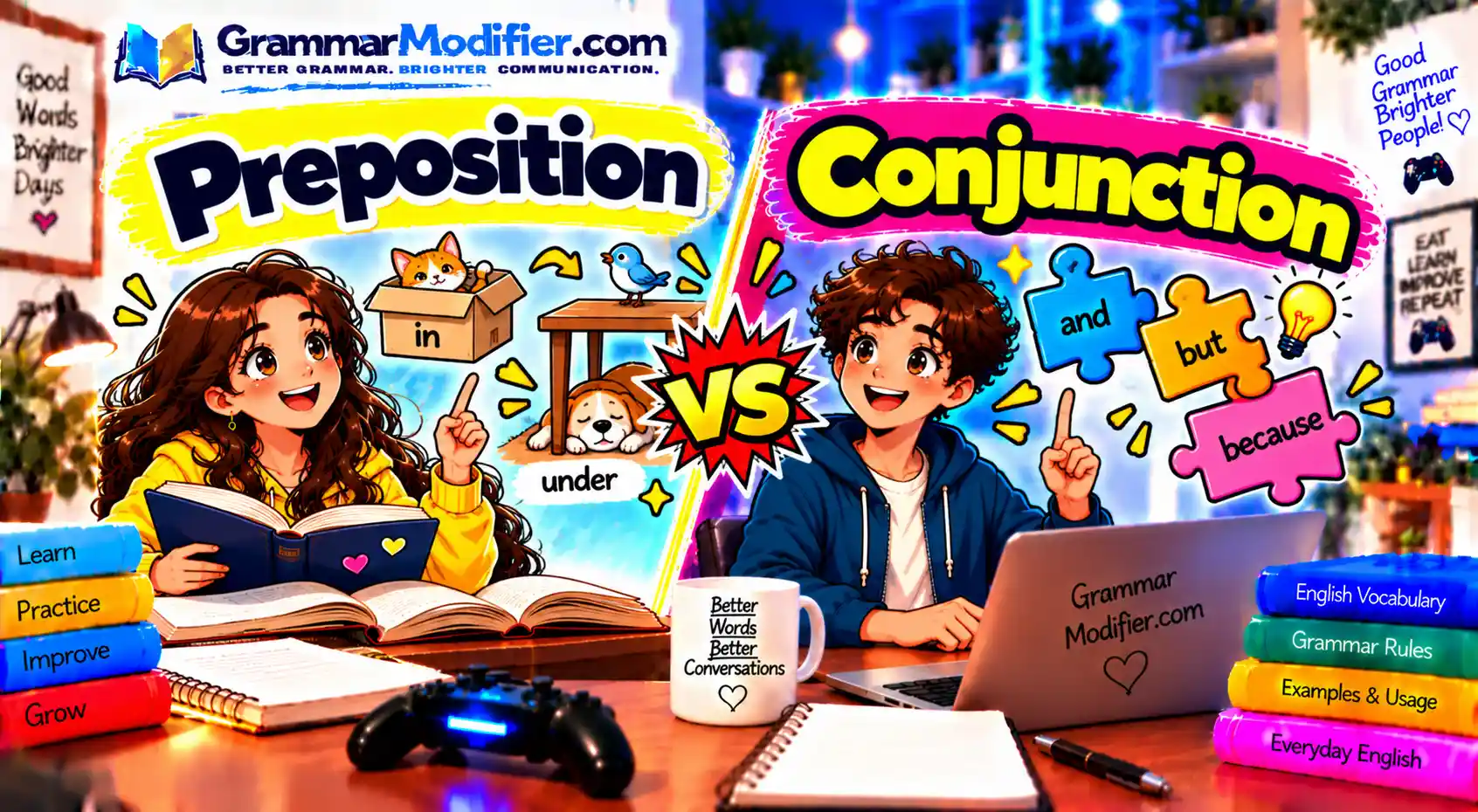
Have you ever wondered why before, after, and since sometimes introduce a short phrase and sometimes introduce a whole clause?
Look at these sentences:
- We finished our homework before dinner.
- We finished our homework before dinner started.
Both are correct. However, in traditional school grammar, before is a preposition in the first sentence and a subordinating conjunction in the second.
The difference comes from the words that follow it.
Understanding preposition vs. conjunction helps you write clearer sentences, connect ideas naturally, and avoid common mistakes with words like because, because of, although, despite, during, and while.
In this guide, you will learn what prepositions and conjunctions are, how they differ, and how to identify them in real sentences. You will also find 40 numbered examples, comparison tables, easy grammar rules, common mistakes, practice questions, and FAQs.
Quick Answer: Preposition vs. Conjunction
A preposition typically introduces a phrase that expresses a relationship involving time, place, direction, cause, or another meaning. A conjunction connects words, phrases, or clauses.
Compare:
- The bag is under the chair. — Under is a preposition.
- I bought tea and coffee. — And is a coordinating conjunction.
- We stayed home because it rained. — Because is a subordinating conjunction.
- We left after lunch. — After is traditionally a preposition.
- We left after lunch ended. — After is traditionally a subordinating conjunction.
Some modern grammar frameworks classify words like after as prepositions in both constructions.
Easy memory trick: Prepositions express relationships; conjunctions connect grammatical units.
TL;DR: Preposition vs. Conjunction
- Prepositions often introduce phrases describing time, place, direction, cause, or purpose.
- Conjunctions join words, phrases, or clauses.
- Common prepositions include in, on, at, under, between, beside, and during.
- Common conjunctions include and, but, or, because, although, if, and unless.
- In traditional grammar, before, after, since, and until may be prepositions or subordinating conjunctions.
- The best way to identify them is to examine their function and sentence structure.
| Feature | Preposition | Conjunction |
|---|---|---|
| Main job | Expresses a relationship | Connects grammatical units |
| Common words | In, on, under, during | And, but, because, although |
| Typical structure | Preposition + noun phrase | Conjunction + connected unit or clause |
| Time example | Before lunch | Before lunch began |
| Cause example | Because of traffic | Because traffic was heavy |
| Main question | What relationship does it express? | What does it connect or introduce? |
Preposition vs. Conjunction: Quick Difference
The simplest way to understand preposition vs. conjunction is to look at the structure of the sentence.
A preposition commonly introduces a noun phrase.
For example:
“She arrived after the meeting.”
Here, after introduces the noun phrase the meeting.
A subordinating conjunction introduces a dependent clause in traditional grammar.
“She arrived after the meeting ended.”
Here, after introduces the clause the meeting ended.
Quick Comparison
| Preposition use | Conjunction use |
|---|---|
| Before dinner | Before dinner started |
| After school | After school ended |
| Since Monday | Since the course began |
| Until midnight | Until the clock struck midnight |
Three Easy Identification Steps
Step 1: Find the word you want to identify.
Step 2: Check what follows it or what it connects.
Step 3: Decide whether it introduces a relational phrase, joins equal grammatical units, or introduces a dependent clause.
For example:
“She studied in the library because she had a test.”
In introduces the noun phrase the library. Because introduces the dependent clause she had a test.
Important: These tests describe traditional school grammar. Some modern grammars use different word-class labels for certain clause-introducing words.
What Is a Preposition?
A preposition is a word that commonly introduces a phrase expressing a relationship between its complement and another part of the sentence.
Prepositions can show place, time, direction, movement, cause, purpose, means, and other relationships.
Prepositions of Place
These describe where something is located.
Examples:
- The cat is under the bed.
- The picture hangs above the sofa.
- She stood beside her friend.
Prepositions of Time
These describe when something happens.
Examples:
- The meeting starts at nine.
- We arrived before lunch.
- She worked during the weekend.
Prepositions of Direction
These describe movement or direction.
Examples:
- He walked into the room.
- They traveled toward the city.
- The children ran across the field.
Prepositions of Cause and Purpose
Some prepositions express reasons or purposes.
Examples:
- The flight was delayed because of fog.
- She studied for the exam.
- The event was canceled due to bad weather.
Common Prepositions Chart
| Preposition | Example | Meaning |
|---|---|---|
| In | In the box | Inside |
| On | On the table | Surface or position |
| At | At noon | Specific time |
| Under | Under the chair | Lower position |
| Between | Between two houses | Position |
| Before | Before dinner | Earlier time |
| After | After lunch | Later time |
| Into | Into the room | Movement inward |
| During | During class | Time period |
| Because of | Because of rain | Reason |
Key point: Prepositions do more than describe physical locations. They can also express time, reason, manner, comparison, and other relationships.
What Is a Conjunction?
A conjunction is a word or construction that connects grammatical units or introduces a dependent clause.
Conjunctions help writers combine information and explain relationships between ideas.
Traditional grammar recognizes three major groups: coordinating conjunctions, subordinating conjunctions, and correlative conjunctions.
Coordinating Conjunctions
Coordinating conjunctions connect words, phrases, or clauses of equal grammatical status.
A popular memory trick is FANBOYS:
- For — reason
- And — addition
- Nor — negative alternative
- But — contrast
- Or — choice
- Yet — contrast
- So — result
Examples:
“She likes tea and coffee.”
“He was tired, but he continued.”
Subordinating Conjunctions
These introduce dependent clauses in traditional grammar.
Common examples include because, although, if, when, while, and unless.
“I stayed home because I felt sick.”
“Although it was raining, we went outside.”
Correlative Conjunctions
Correlative conjunctions work in pairs.
Common examples include both … and, either … or, neither … nor, and not only … but also.
“Both Sarah and Emma attended.”
“Either call me or send a message.”
Conjunction Comparison Chart
| Type | Examples | Function |
|---|---|---|
| Coordinating | And, but, or | Joins equal units |
| Subordinating | Because, although, if | Introduces dependent clauses |
| Correlative | Either … or | Connects paired alternatives |
Remember: Conjunctions make it easier to combine ideas without writing many short, disconnected sentences.
Preposition vs. Conjunction Comparison Chart
Prepositions and conjunctions sometimes express similar meanings, but their grammatical roles differ.
Main Differences
| Question | Preposition | Conjunction |
|---|---|---|
| What does it do? | Introduces a relational phrase | Connects units or introduces a clause |
| What commonly follows it? | A noun phrase | A word, phrase, or clause |
| Can it express time? | Yes | Yes |
| Can it express cause? | Yes | Yes |
| Can it join equal units? | Not normally | Yes |
| Example | During the meeting | While the meeting continued |
| Example | Because of the rain | Because it rained |
Preposition Example
“The children played after school.”
After school tells us when the children played.
Conjunction Example
“The children played after school ended.”
In traditional grammar, after introduces the dependent clause school ended.
Both in One Sentence
“We waited at the station until the train arrived.”
Here, at is a preposition introducing the station. In traditional grammar, until is a subordinating conjunction introducing the train arrived.
Why This Matters
Choosing the correct structure makes your writing more natural.
Correct:
“We stayed home because of the storm.”
Also correct:
“We stayed home because the storm was dangerous.”
Writing tip: Learn the patterns that follow each word instead of memorizing definitions alone.
How to Identify a Preposition in a Sentence
You can often identify a preposition by examining the phrase it introduces.
Test 1: Look for a Noun Phrase
“The keys are on the desk.”
On introduces the desk.
Test 2: Check the Relationship
“She arrived before noon.”
Before expresses a time relationship.
Test 3: Look for Direction
“He walked through the tunnel.”
Through describes the route of movement.
Test 4: Look for Cause
“The match was canceled because of the storm.”
Because of introduces a noun phrase expressing the cause.
Test 5: Identify the Entire Prepositional Phrase
“She sat beside her brother.”
The full prepositional phrase is beside her brother.
Can a Preposition Appear at the End?
Yes.
“Who are you talking to?”
The preposition to appears at the end, while its understood complement is represented by who earlier in the question.
Ending a sentence with a preposition is not automatically incorrect in English.
Key takeaway: A preposition’s function matters more than its position.
How to Identify a Conjunction in a Sentence
Conjunctions connect grammatical units or introduce dependent clauses.
Test 1: Look for Connected Words
“I bought apples and oranges.”
And connects two nouns.
Test 2: Look for Connected Independent Clauses
“She was tired, but she continued working.”
But connects two independent clauses.
Test 3: Look for a Reason Clause
“I stayed home because I was sick.”
Because introduces a dependent clause explaining the reason.
Test 4: Look for a Condition
“If you practice, you will improve.”
If introduces a conditional clause.
Test 5: Look for Paired Connectors
“Either Sarah or Emma will present.”
Either … or connects two alternatives.
Independent vs. Dependent Clauses
An independent clause can stand alone as a complete sentence.
“I stayed home.”
A dependent clause generally cannot stand alone as a complete sentence.
“Because it was raining.”
Together:
“I stayed home because it was raining.”
Quick Identification Chart
| Sentence | Word | Traditional classification |
|---|---|---|
| She arrived after lunch. | After | Preposition |
| She arrived after lunch ended. | After | Subordinating conjunction |
| Tea and coffee are available. | And | Coordinating conjunction |
| We stayed home because it rained. | Because | Subordinating conjunction |
Important: Not every conjunction introduces a clause. Coordinating conjunctions can also connect individual words and phrases.
20 Examples of Prepositions in Sentences
These examples show how prepositions express place, time, movement, cause, and other relationships.
Prepositions of Place
- The keys are on the table.
- The cat slept under the chair.
- She stood beside her friend.
- The ball rolled behind the sofa.
- The store is between two buildings.
Prepositions of Time
- The meeting begins at noon.
- We arrived before dinner.
- She called after lunch.
- He has lived here since 2020.
- They talked during the break.
Prepositions of Direction and Movement
- She walked into the room.
- The children ran across the field.
- He drove toward the airport.
- We traveled through the mountains.
- The bird flew over the fence.
Other Common Prepositions
- She bought flowers for her mother.
- The match was canceled because of rain.
- He succeeded through hard work.
- The book was written by a historian.
- Everyone attended except Daniel.
Remember: Prepositions can describe where, when, how, why, or in what direction something happens.
20 Examples of Conjunctions in Sentences
These examples show coordinating, subordinating, and correlative conjunctions.
Coordinating Conjunctions
- I bought apples and oranges.
- She was tired, but she kept working.
- Would you like tea or coffee?
- He was hungry, so he made dinner.
- The task was difficult, yet she finished it.
Subordinating Conjunctions
- I stayed home because I was sick.
- Although it was raining, we went outside.
- If you practice, you will improve.
- Call me when you arrive.
- She listened while he explained the plan.
Time and Condition Conjunctions
- We left after the movie ended.
- Finish your homework before you watch TV.
- Wait here until the bus arrives.
- Since you are ready, we can begin.
- You can join us unless you have other plans.
Correlative Conjunctions
- Both Sarah and Emma attended.
- Either call me or send a text.
- Neither the manager nor the assistant was available.
- She is not only talented but also hardworking.
- I don’t know whether he will stay or leave.
Key point: Conjunctions help express addition, contrast, choice, cause, time, and condition.
Types of Prepositions in English Grammar
Prepositions can be grouped according to the relationships they express.
Prepositions of Place
These describe location.
Examples include in, on, under, beside, and between.
“The bag is under the desk.”
Prepositions of Time
These describe when something happens.
Examples include at, on, in, before, after, and during.
“The meeting starts at nine.”
Prepositions of Direction
These describe movement or direction.
Examples include to, into, toward, through, and across.
“She walked toward the station.”
Prepositions of Cause
These express reasons.
Examples include because of, due to, and owing to.
“The flight was delayed because of fog.”
Prepositions of Manner or Means
These explain how something happens.
Examples include by, with, and through.
“She opened the package with scissors.”
Simple vs. Complex Prepositions
A simple preposition usually consists of one word.
Examples: in, on, at, under.
A complex preposition contains more than one word.
Examples: because of, in front of, according to.
| Type | Examples | Sentence |
|---|---|---|
| Place | Under, beside | Under the table |
| Time | Before, during | Before dinner |
| Direction | Into, toward | Into the room |
| Cause | Because of | Because of rain |
| Means | By, with | With a key |
| Complex | In front of | In front of the house |
Grammar tip: These categories describe meanings, so one preposition can belong to more than one group depending on the sentence.
Types of Conjunctions in English Grammar
Traditional grammar recognizes three major types of conjunctions.
Coordinating Conjunctions
These connect words, phrases, or clauses of equal grammatical status.
Examples: and, but, or, nor, yet, so, for.
“She enjoys reading and writing.”
Subordinating Conjunctions
These introduce dependent clauses.
Examples: because, although, if, unless, when, while.
“Although she was tired, she finished the project.”
Correlative Conjunctions
These work in pairs.
Examples:
- Both … and
- Either … or
- Neither … nor
- Not only … but also
“Both the teacher and the students were ready.”
Conjunction Types Comparison
| Type | Examples | Function |
|---|---|---|
| Coordinating | And, but, or | Connects equal units |
| Subordinating | Because, although, if | Introduces dependent clauses |
| Correlative | Either … or | Connects paired alternatives |
Are However and Therefore Conjunctions?
However, therefore, and moreover are usually classified as conjunctive adverbs or linking adverbs rather than coordinating conjunctions.
Correct:
“She was tired; however, she continued.”
Also correct:
“She was tired. However, she continued.”
A comma alone is not enough to join two independent clauses with however.
Comma Rules for Conjunctions
Rule 1: Use a comma before a coordinating conjunction that joins two independent clauses.
“She studied hard, and she passed the test.”
Rule 2: Do not automatically use a comma when joining two words.
“I bought apples and oranges.”
Rule 3: Use a comma after an introductory dependent clause.
“Although it was raining, we went outside.”
Rule 4: A dependent clause following the main clause often needs no comma.
“We went outside although it was raining.”
Writing tip: Punctuation depends on sentence structure, not just the presence of a conjunction.
Words That Can Be Prepositions or Conjunctions
Some words can introduce noun phrases or clauses. In traditional grammar, their classification may change depending on what follows them.
Before: Preposition vs. Conjunction
Preposition:
“We arrived before dinner.”
Conjunction:
“We arrived before dinner started.”
After: Preposition vs. Conjunction
Preposition:
“She called after lunch.”
Conjunction:
“She called after lunch ended.”
Since: Preposition vs. Conjunction
Preposition:
“He has lived here since 2020.”
Conjunction:
“He has lived here since he graduated.”
Until: Preposition vs. Conjunction
Preposition:
“We waited until midnight.”
Conjunction:
“We waited until the clock struck midnight.”
Comparison Table
| Word | Preposition use | Conjunction use |
|---|---|---|
| Before | Before the meeting | Before the meeting began |
| After | After lunch | After lunch ended |
| Since | Since Monday | Since the course began |
| Until | Until sunset | Until the sun set |
Why Do Grammar Books Sometimes Disagree?
Traditional school grammar often classifies words like before, after, since, and until according to the structure they introduce.
Some modern grammar frameworks classify them as prepositions in both uses.
For example:
“After lunch” contains a noun phrase complement.
“After lunch ended” contains a clause complement.
Under the modern analysis, after remains a preposition in both sentences.
Important: Both sentences are correct English. The disagreement concerns grammatical classification, not whether the sentences are acceptable.
Preposition vs. Conjunction: Clauses and Phrases
Understanding phrases and clauses makes the traditional distinction easier.
What Is a Phrase?
A phrase is a word or group of words functioning as a grammatical unit.
A prepositional phrase commonly contains a preposition and its complement.
Example:
“After the meeting“
What Is a Clause?
A clause contains a predicate and, in ordinary finite clauses, a subject.
Example:
“After the meeting ended“
Here, the meeting is the subject and ended is the verb.
Phrase vs. Clause Comparison
| Phrase | Clause |
|---|---|
| Before dinner | Before dinner started |
| After school | After school ended |
| Since Monday | Since the course began |
| Until sunset | Until the sun set |
Because vs. Because Of
Use because before a finite clause.
“She stayed home because she was sick.”
Use because of before a noun phrase.
“She stayed home because of her illness.”
During vs. While
Use during before a noun phrase.
“She called during the meeting.”
Use while before a clause.
“She called while the meeting was taking place.”
Although vs. Despite
Use although before a clause.
“Although she was tired, she continued.”
Use despite before a noun phrase or suitable -ing construction.
“Despite her tiredness, she continued.”
“Despite feeling tired, she continued.”
Key takeaway: Recognizing noun phrases and clauses helps you choose the right word and structure.
Common Preposition vs. Conjunction Mistakes
Writers sometimes confuse prepositions and conjunctions because certain expressions have similar meanings.
Common Mistakes Chart
| Incorrect or awkward | Correct | Explanation |
|---|---|---|
| Because the rain, we stayed home. | Because of the rain, we stayed home. | Use because of before a noun phrase |
| Because of it rained, we stayed home. | Because it rained, we stayed home. | Use because before a clause |
| Despite it was cold, we went out. | Although it was cold, we went out. | Use although before a clause |
| Although the rain, we played. | Despite the rain, we played. | Use despite before a noun phrase |
| During I was studying, she called. | While I was studying, she called. | Use while before a clause |
| I was tired, however I continued. | I was tired; however, I continued. | Avoid a comma splice |
Mistake 1: Because vs. Because Of
Incorrect:
“We stayed home because the rain.”
Correct:
“We stayed home because of the rain.”
Also correct:
“We stayed home because it rained.”
Mistake 2: Although vs. Despite
Incorrect:
“Despite it was cold, we went outside.”
Correct:
“Although it was cold, we went outside.”
Also correct:
“Despite the cold weather, we went outside.”
Mistake 3: During vs. While
Incorrect:
“During I was studying, she called.”
Correct:
“While I was studying, she called.”
Also correct:
“She called during my study session.”
Mistake 4: Joining Independent Clauses Incorrectly
Incorrect:
“I was tired, I continued working.”
Correct:
“I was tired, but I continued working.”
Also correct:
“I was tired; however, I continued working.”
Mistake 5: Adding Unnecessary Commas
Usually unnecessary:
“I bought apples, and oranges.”
Better:
“I bought apples and oranges.”
When and joins two simple nouns, a comma is generally unnecessary.
Easy Memory Tricks
- Preposition = Relationship
- Conjunction = Connection
- Because + clause: Because it rained.
- Because of + noun phrase: Because of rain.
- During + noun phrase: During class.
- While + clause: While class continued.
- Although + clause: Although it was cold.
- Despite + noun phrase: Despite the cold weather.
Best tip: Check what follows the word and how it functions in the sentence.
Preposition vs. Conjunction Practice Quiz
Choose the best answer using traditional school grammar.
Questions
1. Which word is a preposition in “The cat slept under the bed”?
A. Slept
B. Under
C. Cat
D. The
2. Which word is a coordinating conjunction in “She was tired, but she continued”?
A. Tired
B. Continued
C. But
D. She
3. Which sentence uses because correctly?
A. We stayed home because the rain.
B. We stayed home because it rained.
C. We stayed home because of it rained.
D. We stayed home because raining.
4. In “We arrived before sunset,” how is before traditionally classified?
A. Conjunction
B. Preposition
C. Pronoun
D. Noun
5. Which sentence uses during correctly?
A. During I studied, she called.
B. During she arrived, we left.
C. She called during the meeting.
D. During it rained, we waited.
6. Which sentence correctly joins two independent clauses?
A. She was tired, she continued.
B. She was tired, but she continued.
C. She was tired, however she continued.
D. She was tired because of she continued.
Answers and Explanations
1. B — Under. It introduces the noun phrase the bed and shows location.
2. C — But. It connects two independent clauses and shows contrast.
3. B — We stayed home because it rained. Because introduces a clause.
4. B — Preposition. In traditional grammar, before introduces the noun sunset.
5. C — She called during the meeting. During introduces a noun phrase.
6. B — She was tired, but she continued. The comma and coordinating conjunction correctly join the clauses.
Answer Key: 1-B | 2-C | 3-B | 4-B | 5-C | 6-B
Frequently Asked Questions
What is the main difference between a preposition and a conjunction?
A preposition typically introduces a phrase showing a relationship, such as under the table. A conjunction connects grammatical units, as in tea and coffee or because it rained. Some words have different classifications depending on the grammar framework.
Can a word be both a preposition and a conjunction?
Yes, in traditional grammar. Words such as before, after, since, and until are commonly called prepositions before noun phrases and subordinating conjunctions before clauses. Some modern grammars analyze them as prepositions in both uses.
Is because a preposition or conjunction?
Because is traditionally a subordinating conjunction when it introduces a clause, as in “because it rained.” Because of is a complex preposition, as in “because of the rain.” Informal uses such as “because science” also exist.
Is before a preposition or conjunction?
In traditional grammar, before is a preposition in “before dinner” and a subordinating conjunction in “before dinner started.” Modern grammatical analyses may classify both uses as prepositional.
What are five examples of prepositions?
Five common prepositions are in, on, at, under, and between. They can show relationships involving location, time, or position.
What are five examples of conjunctions?
Five common conjunctions are and, but, or, because, and although. They connect words, phrases, or clauses and express relationships such as addition, contrast, choice, and reason.
What is the difference between during and while?
During normally introduces a noun phrase, as in “during class.” While introduces a clause, as in “while the teacher was speaking.” Both can express time, but their grammatical structures differ.
How can I identify prepositions and conjunctions easily?
Look at the structure and function. A preposition often introduces a noun phrase that expresses a relationship. A conjunction connects grammatical units or introduces a dependent clause. Be careful with words such as before, after, since, and until, which have different analyses across grammar frameworks.
Conclusion and References
Understanding preposition vs. conjunction helps you build clearer and more accurate English sentences.
A preposition typically introduces a phrase showing a relationship involving place, time, direction, cause, or another meaning.
A conjunction connects words, phrases, or clauses and helps show relationships such as addition, contrast, reason, condition, and time.
The most useful beginner rule is to examine the structure following the word.
Compare:
- Before dinner — Traditionally a prepositional phrase.
- Before dinner started — Traditionally a conjunction introducing a clause.
Remember that modern grammatical frameworks sometimes classify these structures differently. The important skill is understanding how the word works in context.
Practice with real sentences, check whether the following words form a noun phrase or clause, and pay attention to common pairs such as because/because of, although/despite, and while/during.
Final memory rule: Prepositions express relationships; conjunctions connect grammatical units.