
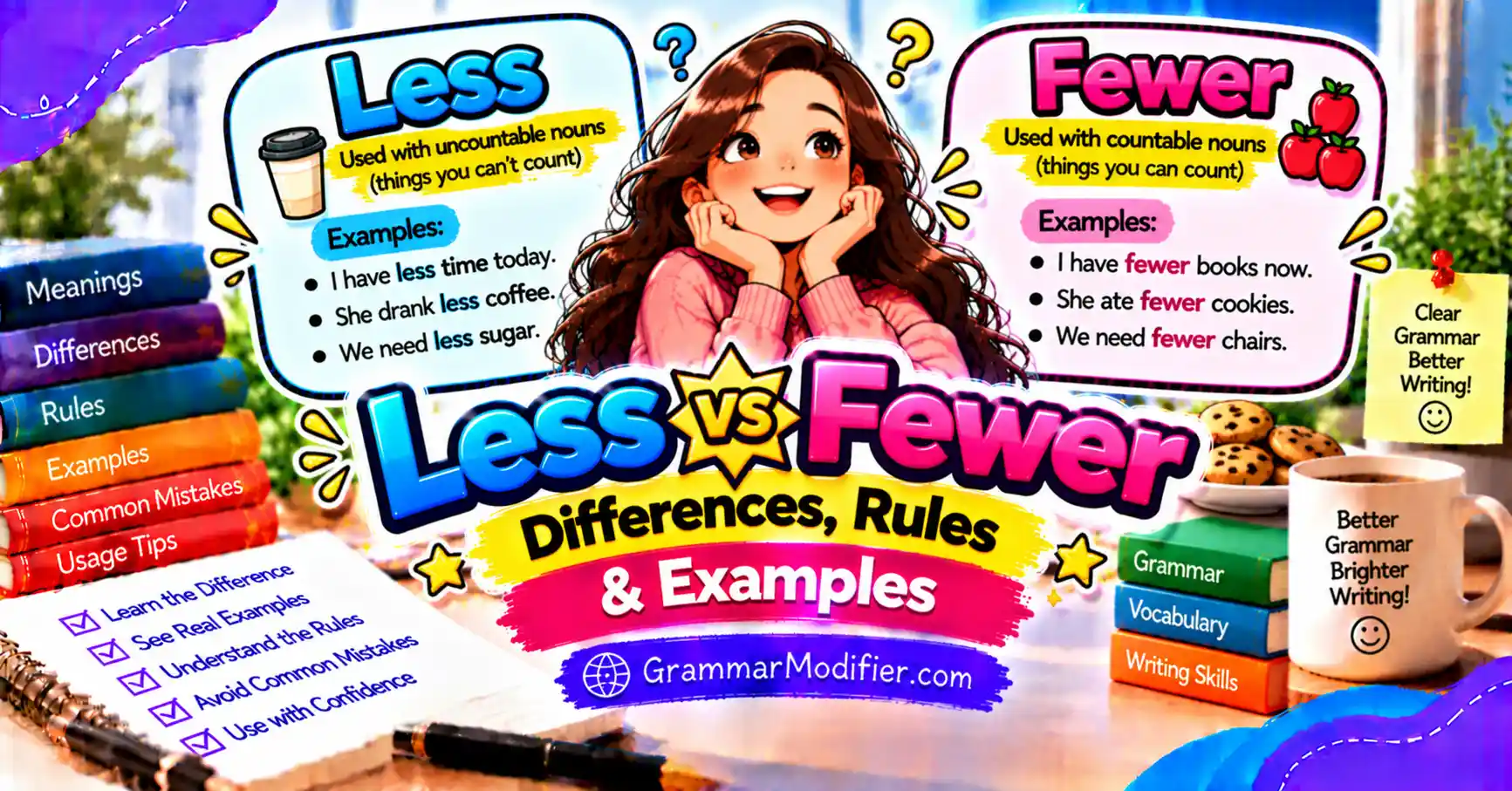
Should you say less people or fewer people? What about less money, fewer mistakes, or 10 items or less? These expressions can be confusing because less and fewer both describe a smaller quantity.
The basic rule is simple: Use fewer for things you can count individually and less for amounts you measure. However, English has a few important exceptions, especially with time, money, distance, and everyday expressions.
Quick Answer: Less vs Fewer
Less describes a smaller amount or degree, while fewer describes a smaller number of individual things.
- Less water — Water is usually measured, not counted.
- Fewer bottles — Bottles can be counted individually.
- Less money — Money is treated as an overall amount.
- Fewer coins — Coins are separate, countable objects.
- Less traffic — Traffic describes an overall amount.
- Fewer cars — Cars can be counted.
Easy memory trick: If you can ask “How many?”, use fewer. If you can ask “How much?”, use less.
This rule works in most situations, although measurements and certain established expressions behave differently.
Table of Contents
- Less vs Fewer: Key Differences
- What Does Less Mean?
- What Does Fewer Mean?
- Countable and Uncountable Nouns
- When to Use Less or Fewer
- Less Than vs Fewer Than
- Important Exceptions
- Less vs Fewer in Everyday English
- Less Of vs Fewer Of
- Formal and Informal Usage
- Common Grammar Mistakes
- How to Remember the Difference
- Practice Quiz
- Frequently Asked Questions
- Conclusion
Less vs Fewer: Key Differences
Both words are comparative quantifiers. They compare quantities and tell us that something has decreased.
The difference is usually the type of noun they describe.
| Feature | Less | Fewer |
|---|---|---|
| Main meaning | A smaller amount | A smaller number |
| Used with | Usually uncountable nouns | Usually plural countable nouns |
| Basic question | How much? | How many? |
| Comparative form of | Little | Few |
| Correct example | Less milk | Fewer glasses |
| Another example | Less homework | Fewer assignments |
| Common exception | Less than five miles | One fewer ticket |
Consider these two sentences:
There is less traffic today.
There are fewer cars on the road today.
Both sentences describe a similar situation. However, traffic is an uncountable noun, while cars is a plural countable noun.
That is why the first sentence uses less and the second uses fewer.
What Does Less Mean?
Less is the comparative form of little. It describes a smaller amount, quantity, or degree.
We usually use it with uncountable nouns, including substances, feelings, and general concepts.
Examples of Less in Sentences
- I drink less coffee in the evening.
- We need less sugar in this recipe.
- There was less noise after the children left.
- She has less free time during the school year.
- This project requires less effort.
- The second explanation provides less information.
Less Can Also Modify Adjectives and Adverbs
Less does not always describe a noun. It can also modify an adjective or adverb to show a lower degree.
For example:
- This phone is less expensive than the other one.
- I feel less nervous before exams now.
- He visits his grandparents less often.
- The instructions are less confusing after the revision.
In these sentences, less describes a degree rather than a number of objects.
What Does Fewer Mean?
Fewer is the comparative form of few. It describes a smaller number of individual people, objects, or events.
It usually appears with plural countable nouns.
Examples of Fewer in Sentences
- Fewer students attended class on Friday.
- We made fewer mistakes on the second test.
- The library has fewer books than before.
- I received fewer emails this morning.
- The new route has fewer traffic lights.
- Our team scheduled fewer meetings this month.
Each noun represents something that can be counted separately.
For example, you can count one meeting, two meetings, or three meetings. Therefore, fewer meetings is the natural choice.
Countable and Uncountable Nouns
To understand less vs fewer, you need to recognize two important noun categories.
Countable Nouns
A countable noun names something you can count individually.
Examples include:
- One apple, three apples
- One chair, five chairs
- One student, twenty students
- One question, ten questions
Use fewer when comparing smaller numbers of these items.
Example: Our classroom has fewer desks this year.
Uncountable Nouns
An uncountable noun, also called a mass noun, describes something not normally counted as separate units.
Examples include:
- Water
- Rice
- Furniture
- Information
- Advice
- Traffic
- Homework
- Money
Use less when comparing smaller amounts of these nouns.
Example: We received less information than expected.
Side-by-Side Comparison
| Use Less | Use Fewer |
|---|---|
| Less water | Fewer water bottles |
| Less furniture | Fewer chairs |
| Less homework | Fewer assignments |
| Less traffic | Fewer vehicles |
| Less luggage | Fewer suitcases |
| Less food | Fewer meals |
| Less money | Fewer dollar bills |
| Less work | Fewer tasks |
Important: The noun determines the choice, not the general topic.
For example, furniture is uncountable, but chairs are countable. You can say less furniture or fewer chairs, depending on what you mean.
When to Use Less or Fewer
When you’re unsure which word to choose, follow these three steps.
Step 1: Find the Noun
Identify what is being compared.
Example: We need ___ plates.
The noun is plates.
Step 2: Decide Whether You Can Count It
Can you count individual plates?
Yes. You can have one plate, two plates, or ten plates.
Step 3: Choose the Correct Word
Because plates is countable, use fewer.
Correct sentence: We need fewer plates.
Now consider another sentence:
We need ___ water.
Water is normally measured as an amount, so the correct choice is less.
Correct sentence: We need less water.
This simple method works for most everyday comparisons.
Less Than vs Fewer Than
The phrases less than and fewer than both introduce comparisons.
Traditionally, fewer than is preferred when comparing numbers of individual countable items, while less than is used for amounts and measurements.
Examples of Fewer Than
- Fewer than ten students completed the assignment.
- Fewer than five people attended the meeting.
- Fewer than twenty tickets remain.
- Fewer than six cars were parked outside.
Examples of Less Than
- The movie lasted less than two hours.
- The jacket costs less than $50.
- The park is less than three miles away.
- The package weighs less than five pounds.
Notice that hours, miles, and pounds are plural nouns.
Why is less acceptable?
Because these expressions treat time, distance, and weight as measured quantities, not simply collections of individual objects.
Important Exceptions to the Less vs Fewer Rule
The countable-versus-uncountable rule is useful, but it does not explain every natural English expression.
Several common patterns deserve special attention.
Less With Time
When time is viewed as a duration, less is the normal choice.
Examples:
- We have less than ten minutes.
- The trip took less than an hour.
- She finished the project in less than two days.
However, fewer works when you’re counting separate time units or scheduled activities.
Example: I worked fewer hours this week.
Here, the sentence compares the number of hours worked.
Less With Money
Use less when money represents a total amount.
Examples:
- I spent less than $100.
- This meal costs less than $20.
- We have less money available this month.
Use fewer when counting individual currency items.
Example: I have fewer five-dollar bills than yesterday.
Less With Distance and Weight
Distance and weight are generally treated as measured quantities.
Examples:
- The school is less than a mile away.
- We walked less than five miles.
- The suitcase weighs less than twenty pounds.
These are standard expressions even though some units appear in plural form.
One Less vs One Fewer
Both one less and one fewer can be correct with singular countable nouns.
Examples:
- We have one less problem to solve.
- There is one fewer student in the class.
- That’s one less thing to worry about.
One less is especially common in everyday speech. One fewer may sound more formal in some contexts.
Less With Percentages
Percentage expressions depend partly on what is being compared.
When comparing a percentage as a numerical value, less than is natural.
Example: Less than 30% of the budget remains.
When describing a smaller number of individual items, fewer may be preferable.
Example: Fewer than 30 of the 100 students attended.
In statistical writing, less than also occurs with counts, so context and editorial style matter.
Less vs Fewer in Everyday English
Some of the most confusing expressions appear in ordinary conversations, shopping, and workplace writing.
Less People or Fewer People?
Fewer people is the preferred choice in formal American English because people are countable.
Preferred: Fewer people attended the concert.
Informal: Less people attended the concert.
The second sentence may occur in casual speech, but the first is safer for school assignments and professional writing.
Less Money or Fewer Money?
Less money is correct because money is an uncountable noun.
Correct: I have less money this month.
Incorrect in ordinary usage: I have fewer money this month.
However, you can say fewer coins, fewer bills, or fewer payments.
10 Items or Less or Fewer?
You have probably seen supermarket checkout signs reading “10 Items or Less.”
Traditional grammar guidance prefers “10 Items or Fewer” because items are countable.
However, “10 Items or Less” is an established and widely understood expression.
If you’re writing a formal notice and want to follow the traditional rule, choose 10 items or fewer.
Less Mistakes or Fewer Mistakes?
Fewer mistakes is preferred because mistakes are countable.
Correct: I made fewer mistakes on today’s quiz.
Nonstandard in formal writing: I made less mistakes on today’s quiz.
You can count individual mistakes, so fewer follows the traditional rule.
Less Of vs Fewer Of
Both expressions are possible, but they refer to different kinds of quantities.
Use less of when discussing a smaller portion or amount of something.
Examples:
- I ate less of the cake.
- We used less of the paint.
- She understood less of the lesson than expected.
Use fewer of when discussing a smaller number from a group of countable items or people.
Examples:
- Fewer of the students finished early.
- Fewer of these books are available.
- Fewer of my friends live nearby now.
The same countability distinction still applies.
Formal and Informal English
In formal writing, it is generally best to follow the traditional distinction between less and fewer.
This is especially helpful in essays, academic assignments, reports, and professional communication.
| Informal Expression | Preferred Formal Expression |
|---|---|
| Less people attended | Fewer people attended |
| Less mistakes were made | Fewer mistakes were made |
| Less cars were parked | Fewer cars were parked |
| Less questions remained | Fewer questions remained |
However, not every use of less with a countable expression is wrong.
Phrases such as one less problem, less than five minutes, and less than $50 are established in standard English.
American vs British English
The basic distinction between less and fewer is the same in American English and British English.
Both varieties use fewer with plural countable nouns and less with uncountable nouns. Both also recognize familiar measurement expressions and informal exceptions.
The difference is usually a matter of context or editorial style rather than a separate American or British grammar rule.
Common Less vs Fewer Mistakes
Most mistakes happen when writers overlook whether the noun is countable.
The following table shows common errors and their preferred corrections in formal English.
| Incorrect or Nonstandard | Preferred Correction | Reason |
|---|---|---|
| Less books | Fewer books | Books are countable |
| Fewer water | Less water | Water is uncountable |
| Less students | Fewer students | Students are countable |
| Fewer information | Less information | Information is uncountable |
| Less chairs | Fewer chairs | Chairs are countable |
| Fewer furniture | Less furniture | Furniture is uncountable |
| Less questions | Fewer questions | Questions are countable |
| Fewer traffic | Less traffic | Traffic is uncountable |
A Common Mistake With Measurements
Some learners apply the countability rule too strictly and assume that less than five miles must be incorrect.
But this is a standard expression because it describes a measured distance.
Correct: The store is less than five miles away.
Also correct: We made fewer than five trips to the store.
The first sentence measures distance. The second counts trips.
How to Remember Less vs Fewer
The easiest memory trick is:
Fewer = How many?
Less = How much?
Try these pairs:
- How many cookies? Fewer cookies.
- How much milk? Less milk.
- How many assignments? Fewer assignments.
- How much homework? Less homework.
- How many vehicles? Fewer vehicles.
- How much traffic? Less traffic.
Another helpful trick is to replace the noun with a related one.
For example:
Less coffee describes the amount of coffee.
Fewer cups of coffee describes the number of cups.
The topic stays the same, but the noun changes the grammar.
Less vs Fewer Practice Quiz
Choose the correct word for each sentence.
- We need (less / fewer) chairs for the meeting.
- She drinks (less / fewer) coffee than before.
- There were (less / fewer) people at the event.
- The trip took (less / fewer) than two hours.
- I received (less / fewer) messages today.
- This recipe needs (less / fewer) salt.
- We made (less / fewer) stops on the way home.
- The package weighs (less / fewer) than ten pounds.
Answers and Explanations
| Question | Answer | Explanation |
|---|---|---|
| 1 | Fewer | Chairs are countable. |
| 2 | Less | Coffee is treated as an amount. |
| 3 | Fewer | People are countable. |
| 4 | Less | Two hours describes a duration. |
| 5 | Fewer | Messages are individual items. |
| 6 | Less | Salt is an uncountable substance. |
| 7 | Fewer | Stops can be counted. |
| 8 | Less | Ten pounds describes a measured weight. |
If you answered all eight correctly, you understand both the basic rule and its most common measurement exceptions.
Frequently Asked Questions
Is it less people or fewer people?
Fewer people is preferred in formal English because people are countable. Although less people appears in casual speech, fewer is the safer choice in edited writing.
Can less be used with countable nouns?
Yes. Less appears in accepted expressions such as one less problem and less than five minutes. It also occurs with plural count nouns in informal speech and some numerical expressions.
Why is it fewer mistakes instead of less mistakes?
Mistakes are individual events that can be counted. Therefore, fewer mistakes follows the traditional rule for plural countable nouns.
Is it less than 100 people or fewer than 100 people?
Fewer than 100 people is the traditional formal choice because people are countable. Less than 100 people also appears in numerical and statistical usage, but fewer is a good choice for careful formal writing.
Is it fewer hours or less hours?
Both can appear, depending on the meaning. Fewer hours emphasizes a smaller number of hours, as in I worked fewer hours this week. Less than three hours treats time as a measured duration.
Is one less grammatically correct?
Yes. One less is an accepted expression with singular countable nouns. For example, We have one less question to answer is natural English.
Can fewer be used without a noun?
Yes. When the noun is clear from context, fewer can stand alone.
Example: We expected twenty guests, but fewer arrived.
Here, fewer means fewer guests.
What is the easiest way to remember less vs fewer?
Ask whether you’re talking about how many or how much. Use fewer for individual countable things and less for amounts. Remember that measurements and certain familiar expressions have exceptions.
Conclusion
The main difference between less vs fewer comes down to how a quantity is understood. Fewer usually describes a smaller number of individual items, while less describes a smaller amount or degree.
When you’re unsure, identify the noun and ask whether you can count it. Then consider exceptions involving time, money, distance, and singular nouns. With a little practice, choosing between less and fewer becomes much easier.
References and Further Reading
- Merriam-Webster: Fewer vs. Less — Historical usage and common exceptions.
- Cambridge Dictionary: Less and Fewer — Grammar rules and usage patterns.
- MLA Style Center: Fewer versus Less — Formal writing guidance and numerical comparisons.