
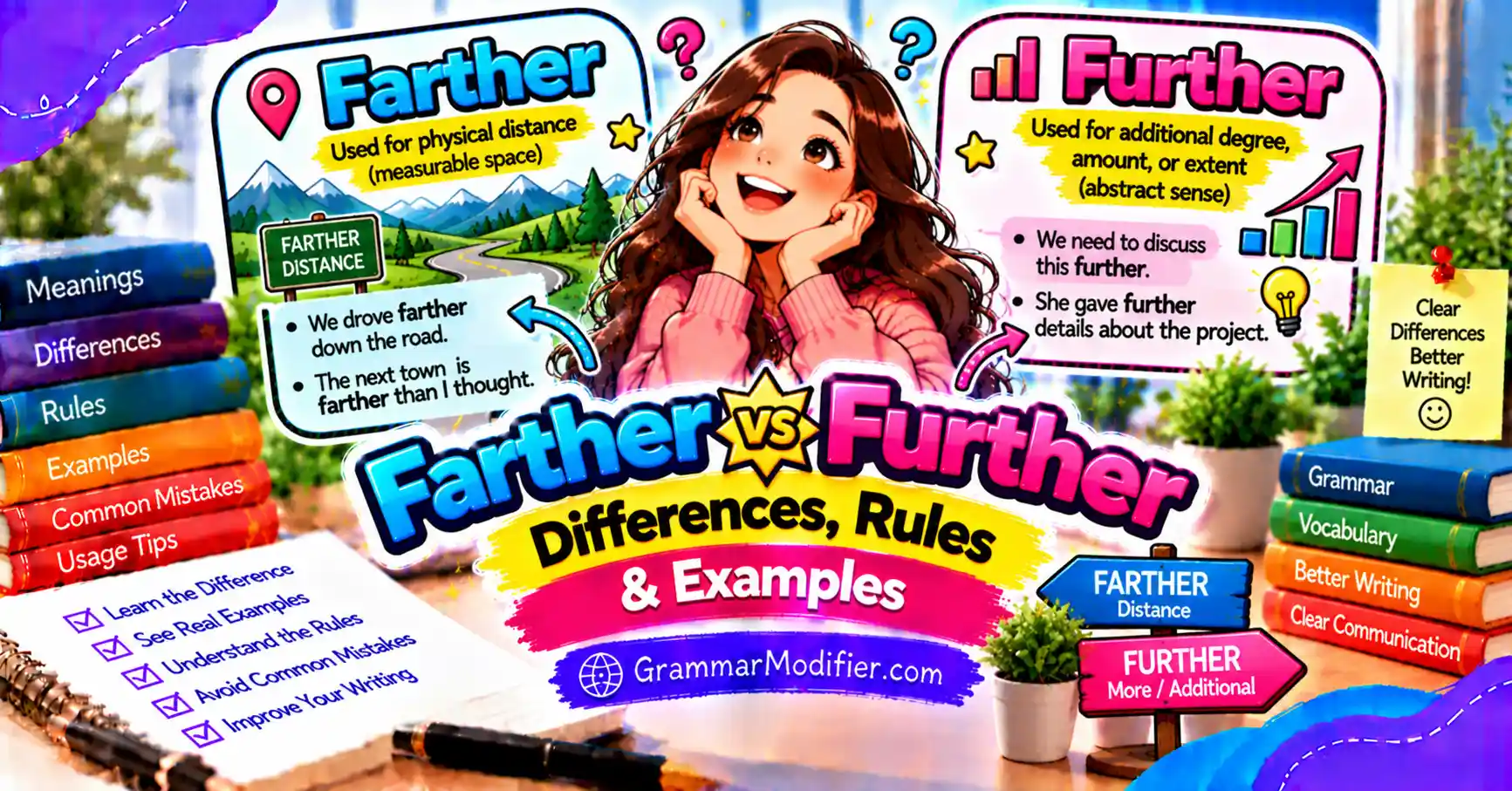
Is it farther away or further away? Should you ask for further information or farther information? These two words can be confusing because they share a meaning but aren’t interchangeable in every sentence.
Here’s the simplest rule: Farther usually refers to physical distance, while further often means additional, continued, or to a greater extent. Both words can describe physical distance, though. Understanding that overlap will help you avoid common mistakes.
Quick Answer
Farther is commonly preferred when comparing physical distances, such as walking farther down a street. Further is used for additional information, continued action, greater progress, and figurative distance. However, further is also correct for physical distance.
Compare these examples:
- Farther: The park is farther from my house.
- Further: We need further details.
- Further: Let’s discuss the problem further.
- Further: She wants to further her education.
- Both correct: We walked farther. / We walked further.
Memory trick: Think farther = physical distance and further = additional or more.
TL;DR
- Farther usually emphasizes measurable physical distance.
- Further commonly means additional, more, or to a greater extent.
- Both words are acceptable for physical distance.
- Further can function as an adjective, adverb, or verb.
- Use further information, not farther information.
- Farthest and furthest follow similar patterns, but they also overlap.
Table of Contents
- Farther vs Further: Main Differences
- What Does Farther Mean?
- What Does Further Mean?
- When to Use Farther
- When to Use Further
- Can Farther and Further Be Interchanged?
- Farther Away vs Further Away
- Further as an Adjective, Adverb, and Verb
- Further Information vs Farther Information
- Further Along vs Farther Along
- Common Expressions With Further
- Further vs Furthermore
- Farthest vs Furthest
- American vs British English
- Common Mistakes
- How to Remember the Difference
- Practice Quiz
- Frequently Asked Questions
- Conclusion
Farther vs Further: Main Differences
Farther and further are both comparative forms of far. They can describe a greater distance from a place or point.
The clearest difference appears when further means additional, to a greater extent, or to advance something. Farther is not normally used for those meanings.
| Feature | Farther | Further |
|---|---|---|
| Physical distance | Yes | Yes |
| Figurative distance | Sometimes | Commonly preferred |
| Additional information | No | Yes |
| Continued action | Not normally | Yes |
| Progress or development | Less common | Common |
| Used as a verb | No | Yes |
| Example | Walk farther | Discuss further |
Key takeaway: For physical distance, farther is a useful American English preference. For additional information or continued action, choose further.
What Does Farther Mean?
Farther means at, to, or a greater distance. It is commonly associated with physical movement and location.
In American English, farther is often preferred when distance can be measured in miles, feet, yards, or kilometers.
Farther as an Adjective
As an adjective, farther describes a more distant person, place, or object.
Examples:
- The farther entrance is closed.
- We chose the farther parking lot.
- The farther shore was difficult to see.
Farther as an Adverb
As an adverb, farther describes movement or position at a greater distance.
Examples:
- We walked farther than expected.
- She threw the ball farther than her brother.
- The hikers traveled farther into the forest.
- Move your chair farther from the table.
In these sentences, farther emphasizes physical distance.
What Does Further Mean?
Further can mean more distant, additional, or to a greater extent. It can also describe progress or advancement.
Unlike farther, further can function as a verb meaning to advance, promote, or develop something.
Further Meaning Additional
- We need further information.
- The teacher requested further explanation.
- Please provide further details.
- The project requires further research.
Further Meaning Continued Action
- Let’s discuss the issue further.
- The team investigated the problem further.
- We should explore this idea further.
Further Meaning Advancement
- She hopes to further her career.
- He took extra classes to further his education.
- The organization works to further its mission.
Further is the natural choice in these examples because the meaning is not simply physical distance.
When to Use Farther
Use farther when comparing measurable physical distances. This includes travel, sports, directions, and locations.
It is especially useful when a sentence describes how far someone or something moves.
Everyday Examples
Travel: We drove farther than planned.
Directions: The pharmacy is farther down the street.
Sports: Maya kicked the soccer ball farther than Liam.
Location: The airport is farther from downtown than the train station.
Movement: The children ran farther along the beach.
Farther With Distance Measurements
Farther can appear when distances are expressed in miles, feet, or other units.
- The second trail extends farther into the mountains.
- We traveled farther than five miles before stopping.
- The new school is farther away from our neighborhood.
Writing tip: If you’re describing a physical distance and want a consistent American English style, farther is a good default.
When to Use Further
Use further when you mean additional, more, to a greater extent, or continued progress.
It is common in school assignments, professional emails, reports, and everyday conversations.
Further for Additional Information
- Please contact us for further assistance.
- We need further clarification.
- The report includes further details.
Further for Continued Action
- Let’s examine the results further.
- The police investigated the matter further.
- We should discuss this proposal further.
Further for Progress
- The new program will further students’ understanding.
- She wants to further her professional development.
- The company hopes to further its goals.
Replacing further with farther in these sentences would be incorrect or unnatural.
Can Farther and Further Be Interchanged?
Yes. Farther and further can often be used interchangeably when describing physical distance.
The traditional classroom rule favors farther for measurable distance, but major dictionaries recognize further as an acceptable alternative.
Examples Where Both Are Correct
| Farther | Further |
|---|---|
| We walked farther. | We walked further. |
| The station is farther away. | The station is further away. |
| Drive farther down the road. | Drive further down the road. |
| She traveled farther north. | She traveled further north. |
| The hikers went farther. | The hikers went further. |
These sentence pairs express essentially the same meanings.
When They Are Not Interchangeable
When further means additional, continued, or to advance, farther is not a suitable replacement.
Correct: We need further research.
Incorrect: We need farther research.
Correct: She wants to further her education.
Incorrect: She wants to farther her education.
Important: The distinction depends on meaning and grammatical function, not just whether a sentence describes movement.
Farther Away vs Further Away
Both farther away and further away are grammatically correct when describing physical distance.
In American English, farther away is often preferred, but further away is also widely used and accepted.
Example Comparison
Sentence 1: The library is farther away than the supermarket.
Sentence 2: The library is further away than the supermarket.
Both sentences mean that the library is at a greater physical distance.
Which Should You Choose?
For formal American writing, farther away is a useful choice when discussing measurable distance.
However, further away is not incorrect. You don’t need to change it automatically when proofreading.
Further as an Adjective, Adverb, and Verb
One reason further appears in more expressions than farther is that it has three common grammatical functions.
It can describe a noun, modify an action, or act as the main verb in a sentence.
Further as an Adjective
As an adjective, further often means additional.
Examples:
- We need further instructions.
- The manager requested further information.
- No further action is required.
Further as an Adverb
As an adverb, further can mean to a greater extent or at a greater distance.
Examples:
- Let’s discuss the matter further.
- We traveled further into the mountains.
- She explained the process further.
Further as a Verb
As a verb, further means to help something advance, develop, or succeed.
Examples:
- He took online courses to further his education.
- The project will further scientific research.
- She hopes to further her career.
Remember: Farther is not used as a standard modern verb.
Further Information vs Farther Information
Further information is correct because further means additional in this expression.
Farther information is not standard English because information is not being compared by physical distance.
Common Expressions
| Correct Expression | Meaning |
|---|---|
| Further information | Additional information |
| Further details | More details |
| Further discussion | Continued discussion |
| Further assistance | Additional help |
| Further research | More research |
| Further explanation | Additional explanation |
| Further questions | More questions |
| Further action | Additional action |
Examples in Professional Writing
- Please email us if you need further assistance.
- The committee requested further discussion.
- We will provide further updates next week.
These expressions are common in American business and academic English.
Further Along vs Farther Along
Both expressions can describe physical position, but further along is especially common when discussing progress.
The intended meaning determines which expression sounds more natural.
Physical Distance
The gas station is farther along this road.
The gas station is further along this road.
Both sentences are correct because they describe a physical location.
Figurative Progress
We’re further along in the project than expected.
This means the project has made more progress.
She’s further along in her studies.
This means she has reached a more advanced stage.
Memory tip: When describing progress in a project, career, or education, further along is usually the better choice.
Common Expressions With Further
Several everyday English expressions use further in ways that do not involve measurable distance.
Learning these phrases will help you recognize natural usage.
Until Further Notice
Until further notice means until another announcement or instruction is given.
Example: The community pool is closed until further notice.
This phrase commonly appears in public announcements, workplace notices, and school communications.
Nothing Could Be Further From the Truth
This idiom means that a statement is completely false.
Example: Some people think the exam is easy, but nothing could be further from the truth.
The expression describes figurative distance from the truth.
Look No Further
Look no further means you have found what you need and do not need to continue searching.
Example: If you’re looking for a beginner grammar guide, look no further.
Further Your Career
To further your career means to take steps that help your professional development.
Example: She earned a certification to further her career.
Further to Your Email
Further to your email is a formal expression meaning following up on or with reference to an earlier message.
Example: Further to your email, I have attached the requested documents.
This wording is more characteristic of British business English. In American English, “Following up on your email” usually sounds more natural.
Further vs Furthermore
Further and furthermore can both introduce additional information, but they do not work in exactly the same ways.
Furthermore is a connecting adverb meaning in addition or moreover. It commonly introduces another supporting point in formal writing.
Examples With Furthermore
- The course is affordable. Furthermore, it offers flexible scheduling.
- The plan saves money. Furthermore, it reduces waste.
- The instructions are clear. Furthermore, they include helpful examples.
Examples With Further
- We need to examine the issue further.
- Further, the report identifies several financial risks.
The second example is possible in formal writing, but furthermore often sounds clearer when introducing an additional argument.
Key difference: Use further for additional extent or continued action. Use furthermore to connect an additional point to a previous statement.
Farthest vs Furthest
Farthest and furthest are superlative forms related to farther and further.
Both can describe the greatest physical distance. Furthest is also common when discussing figurative extent or progress.
Farthest Examples
- That house is the farthest from the school.
- She ran the farthest during practice.
- This is the farthest point on our route.
Furthest Examples
- This is the furthest we’ve progressed.
- The discussion reached its furthest point.
- We traveled to the furthest village.
Comparison Table
| Comparative | Superlative | Common Usage |
|---|---|---|
| Farther | Farthest | Physical distance |
| Further | Furthest | Physical or figurative distance |
These are common preferences, not strict restrictions. Both farthest and furthest can describe physical distance.
American vs British English
The basic meanings of farther and further are similar in American and British English.
However, speakers and writers may prefer different forms when discussing physical distance.
American English
American usage guides often recommend farther for measurable physical distance and further for additional or figurative meanings.
Example: We drove farther than expected.
British English
British English commonly uses further for physical distance as well as other meanings.
Example: We drove further than expected.
Both sentences are correct in either variety.
Further Education
In British English, further education also has a specific educational meaning. It generally refers to education after compulsory secondary schooling that is not classified as higher education.
In American English, further your education usually means continuing your studies or gaining additional qualifications.
Common Farther vs Further Mistakes
The most common mistakes involve using farther when further means additional information, continued action, or advancement.
Another mistake is assuming that further cannot describe physical distance. It can.
| Incorrect Expression | Correct Expression | Reason |
|---|---|---|
| Farther information | Further information | Means additional |
| Farther details | Further details | Means more details |
| Farther research | Further research | Means additional research |
| Farther your career | Further your career | Further is the verb |
| Farther assistance | Further assistance | Means additional help |
| Farther discussion | Further discussion | Means continued discussion |
Don’t Overcorrect Physical Distance
We walked further down the road is correct.
You may prefer farther for physical distance, but further is also accepted.
The goal is to choose the word that best fits your meaning and writing style, not to apply a simplified rule without exceptions.
How to Remember Farther vs Further
Use this memory trick:
Farther = Far away
Further = More, additional, or advance
When you’re unsure, ask yourself three questions:
- Am I describing physical distance? Farther is a good default, but further may also work.
- Do I mean additional or to a greater extent? Use further.
- Do I mean to advance or develop something? Use further as a verb.
Everyday Examples
- Farther: We drove farther than yesterday.
- Further: We need further details.
- Farther: The beach is farther away.
- Further: Let’s discuss this further.
- Further: She hopes to further her career.
Farther vs Further Practice Quiz
Choose the preferred word for each sentence.
- The airport is (farther / further) from our house.
- Please contact us for (farther / further) information.
- She wants to (farther / further) her education.
- Let’s discuss the issue (farther / further).
- The hikers walked (farther / further) than yesterday.
- The office is closed until (farther / further) notice.
- We’re (farther / further) along in our research.
- The store is (farther / further) down the street.
Answers and Explanations
| Question | Answer | Explanation |
|---|---|---|
| 1 | Farther preferred | Physical distance; further is also correct |
| 2 | Further | Means additional information |
| 3 | Further | Verb meaning advance |
| 4 | Further | Means to a greater extent |
| 5 | Farther preferred | Physical distance; further is also correct |
| 6 | Further | Fixed expression |
| 7 | Further | Describes progress |
| 8 | Farther preferred | Physical location; further is also correct |
Important: Questions 1, 5, and 8 allow both words. Farther is simply the traditional American preference.
Frequently Asked Questions
What is the main difference between farther and further?
Farther is usually preferred for measurable physical distance. Further means additional, to a greater extent, or more advanced. Both words can describe physical distance.
Is it farther away or further away?
Both expressions are grammatically correct. Farther away is often preferred in American English for physical distance, but further away is also standard.
Can further be used for physical distance?
Yes. Further can describe physical distance in both American and British English.
Example: We walked further into the forest.
Can farther be used for figurative distance?
Yes, in some contexts. Although further is generally preferred for figurative distance, farther has also been used figuratively. The distinction is a useful writing convention rather than an absolute rule.
Is it further information or farther information?
Further information is correct because further means additional. Farther information is not standard English.
Is further a verb?
Yes. Further can function as a verb meaning to advance, develop, or promote something.
Example: She hopes to further her career.
What is the difference between further and furthermore?
Further can describe additional extent, distance, or continued action. Furthermore is mainly used to introduce another supporting point or argument.
Is it farthest or furthest?
Both words can describe the greatest physical distance. Farthest is often preferred for measurable distance, while furthest is also used for figurative progress or extent.
Conclusion
The difference between farther vs further becomes easier when you focus on meaning. Farther is a useful choice for physical distance, while further is the standard word for additional information, continued action, and advancement.
Remember that both words can describe distance. You don’t need to treat further away as incorrect. Instead, use the traditional distinction as a practical guide and pay attention to expressions such as further information, further discussion, and further your career.
With these rules, examples, and practice questions, you can choose between farther and further confidently in everyday American English.
References and Further Reading
- Merriam-Webster: Further vs. Farther — Usage distinctions, history, and exceptions.
- Cambridge Dictionary: Farther, Farthest or Further, Furthest? — Comparative forms and common usage.
- Chicago Manual of Style: Further and Farther — Editorial guidance on the traditional distinction.