
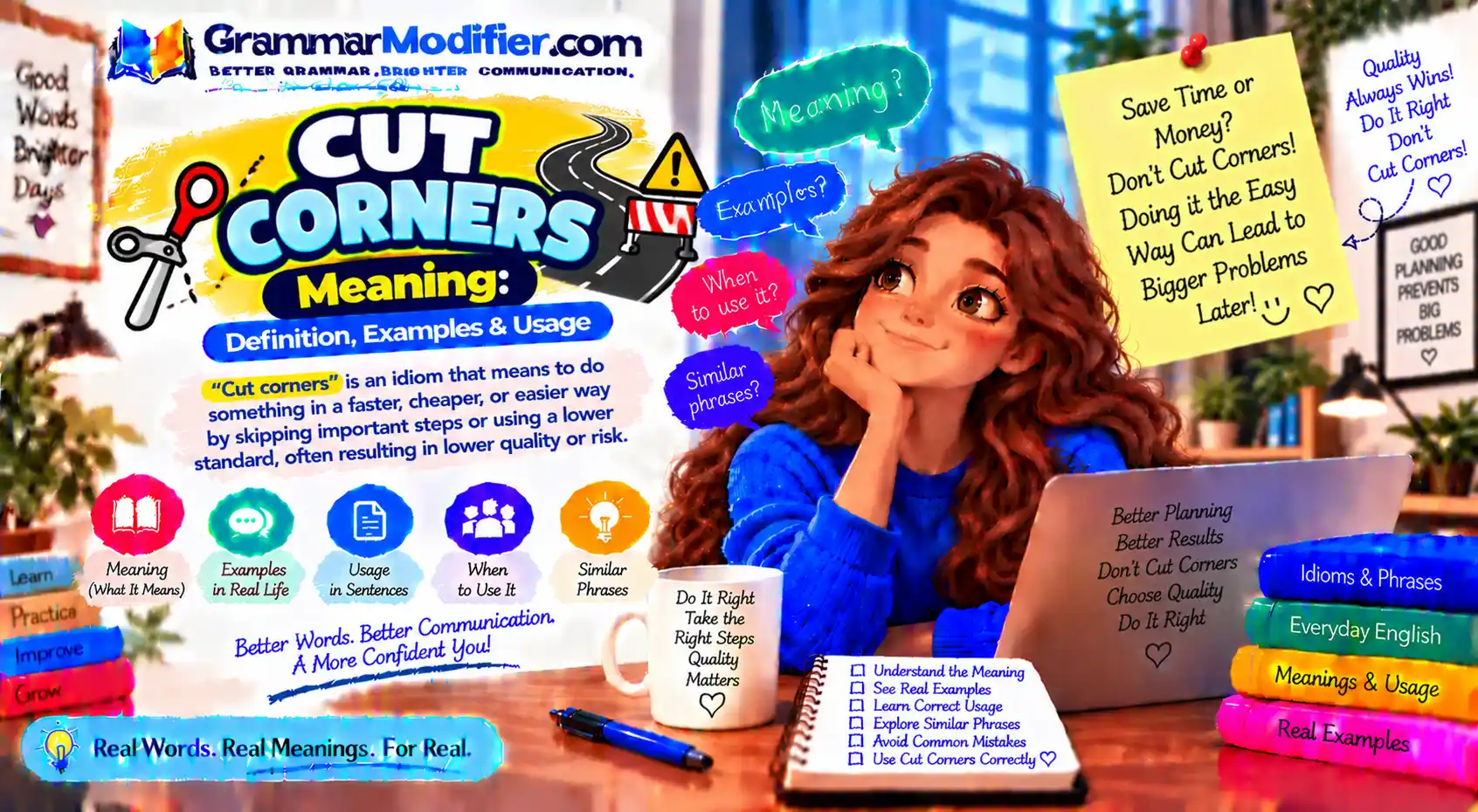
Meta Description: Learn the meaning of “cut corners,” how to use it, examples, synonyms, origin, grammar forms, and differences from similar expressions.
Feature Image Prompt: Realistic English-learning desk with an open grammar book, notebook, pen, and handwritten notes explaining “Cut Corners.”
Alt Text: English learner studying the meaning and usage of the idiom cut corners.
Caption: Learn how “cut corners” is used in everyday American English.
Description:
This guide explains the meaning, grammar, examples, synonyms, and usage of “cut corners.”
It helps English learners understand its negative meaning and use the expression naturally.
Quick Answer
Cut corners means doing something faster, cheaper, or more easily by skipping necessary steps or lowering expected standards. It usually suggests that quality, safety, care, or proper procedure has been sacrificed.
TL;DR
• Cut corners means taking a shortcut that sacrifices something important.
• The expression usually has a negative or critical meaning.
• Use cut corners on + noun for an affected area.
• Use cut corners by + verb-ing to explain the shortcut.
• Take shortcuts can be neutral, but cut corners usually isn’t.
• Streamline means improving efficiency without removing necessary steps.
What Does “Cut Corners” Mean?
Cut corners means doing something in an easier, faster, or cheaper way by skipping a necessary step. The result may be lower quality or less thorough than expected.
The phrase can describe work, school projects, business tasks, repairs, safety procedures, and everyday responsibilities. It usually suggests that someone chose convenience over doing the job properly.
• Example: The contractor cut corners to finish the project early.
• Example: Don’t cut corners when checking important documents.
• Example: The company cut corners on quality testing.
• Example: She never cuts corners on her schoolwork.
• Example: We can’t cut corners on safety.
• Example: They cut corners to reduce costs.
• Example: The team cut corners by skipping the final review.
• Example: He refused to cut corners, even under pressure.
Cut Corners as an English Idiom
Cut corners is an English idiom because its common meaning isn’t simply about physically cutting corners. The phrase uses a literal image to describe a figurative action.
The idea is that someone takes a shorter route through a task. However, that shorter route usually means something necessary has been sacrificed.
• Literal idea: taking a shorter route around a corner.
• Figurative meaning: taking an improper shortcut through a task.
• It can involve saving time.
• It can involve saving money.
• It can involve reducing effort.
• It can involve skipping procedures.
• It can involve lowering quality.
• It often carries a critical or disapproving tone.
How to Use “Cut Corners” in a Sentence
Use cut corners when someone chooses an easier method that sacrifices an expected standard. It works naturally in everyday conversation, workplace communication, and general writing.
The verb changes according to the subject and tense. Remember that cut has the same form in the present and simple past.
• Present: They cut corners whenever deadlines become tight.
• Third person: He cuts corners when he’s under pressure.
• Past: They cut corners during the renovation.
• Present progressive: They are cutting corners to finish early.
• Present perfect: The company has cut corners before.
• Future: We won’t cut corners to meet the deadline.
• Negative: She doesn’t cut corners on important work.
• Question: Are they cutting corners to save money?
Cut Corners on Something: Meaning and Pattern
The pattern cut corners on + noun tells you where the person reduced care, quality, effort, or standards.
This pattern is common when discussing work, safety, materials, preparation, training, testing, and maintenance.
• cut corners on safety
• cut corners on quality
• cut corners on testing
• cut corners on training
• cut corners on maintenance
• cut corners on preparation
• cut corners on materials
• cut corners on documentation
For example, “The company cut corners on safety” suggests that the company failed to maintain an expected safety standard.
Cut Corners by Doing Something
You can use cut corners by + verb-ing to explain exactly how someone took the shortcut.
The word by introduces the method. The verb that follows by normally uses the -ing form.
• They cut corners by skipping the final inspection.
• She cut corners by leaving out important details.
• He cut corners by using cheaper materials.
• We cut corners by rushing the final review.
• The team cut corners by removing a testing step.
• They cut corners by ignoring the usual procedure.
• I won’t cut corners by skipping the preparation.
• The company cut corners by reducing quality checks.
This structure is useful because it explains not only that someone cut corners, but also how they did it.
Is “Cut Corners” Always Negative?
Cut corners is usually negative because it suggests that something important was sacrificed. The negative meaning comes from the loss of quality, care, safety, accuracy, or completeness.
A shortcut isn’t automatically an example of cutting corners. If a faster method keeps the necessary standards, words such as streamline or take a shortcut may fit better.
• Efficient: We streamlined the process without reducing quality.
• Cutting corners: We skipped the required quality check.
• Efficient: She found a faster way to organize the files.
• Cutting corners: She left important files unreviewed.
• Efficient: He used a quicker method to solve the problem.
• Cutting corners: He left out necessary calculations.
• Efficient: They removed unnecessary paperwork.
• Cutting corners: They removed a required approval step.
Cut Corners vs. Take Shortcuts
Take shortcuts and cut corners are related, but they don’t always mean the same thing.
A shortcut can be perfectly sensible. Cut corners usually means that the shortcut has compromised something that should have been preserved.
| Expression | Usual Meaning | Tone |
|---|---|---|
| Take a shortcut | Use a faster route or method | Often neutral |
| Cut corners | Skip something necessary | Usually negative |
| Streamline | Make a process more efficient | Usually positive |
| Skimp | Use too little or spend too little | Usually negative |
| Rush | Do something too quickly | Often negative |
For example, finding a quicker way to organize files is a shortcut. Skipping an important review to finish faster is cutting corners.
Cut Corners vs. Streamline
Streamline means making something simpler or more efficient. It doesn’t normally suggest that necessary standards have been removed.
Cut corners has a different implication. It suggests that someone made the process easier by sacrificing something important.
• Streamline: Remove unnecessary steps.
• Cut corners: Skip necessary steps.
• Streamline: Improve efficiency.
• Cut corners: Reduce standards.
• Streamline: Simplify a process carefully.
• Cut corners: Rush a process carelessly.
• Streamline: Can have a positive meaning.
• Cut corners: Usually has a negative meaning.
Example:
“The company streamlined its approval process” suggests a carefully improved process.
“The company cut corners on approvals” suggests that required steps were skipped.
Cut Corners vs. Skimp
Skimp means using too little of something or spending too little on it. Cut corners is broader and can involve skipped procedures, incomplete work, or reduced care.
These expressions sometimes overlap, especially when money or materials are involved.
• Skimp on materials: Use too few or cheaper materials.
• Cut corners on materials: Reduce proper care or quality.
• Skimp on training: Provide too little training.
• Cut corners on training: Skip important training steps.
• Skimp on spending: Spend less than necessary.
• Cut corners: Use an inadequate shortcut.
• Skimp focuses strongly on quantity or resources.
• Cut corners focuses strongly on the method or process.
Grammar Forms of “Cut Corners”
The verb cut is irregular. Its base form and simple past form are both cut.
This means you should never write “cutted corners.” The correct form is “cut corners.”
• Base form: cut corners
• Present: They cut corners.
• Third person: She cuts corners.
• Past: They cut corners yesterday.
• Past participle: They have cut corners before.
• Present participle: They are cutting corners.
• Infinitive: to cut corners
• Noun form: corner-cutting
Compare these examples:
Correct: They cut corners last year.
Incorrect: They cutted corners last year.
Correct: The company has cut corners before.
Correct: The company is cutting corners now.
“Cut Corners” in American English
Cut corners is natural and widely understood in American English. You can use it in everyday speech, workplace discussions, journalism, and general writing.
The expression is not limited to casual conversation. However, a very formal document may benefit from a more precise phrase.
• “Don’t cut corners on this project.”
• “The company was accused of cutting corners.”
• “We need to finish quickly without cutting corners.”
• “They refused to cut corners on quality.”
• “The deadline shouldn’t encourage corner-cutting.”
• “The team found a faster process without cutting corners.”
• “He was criticized for cutting corners.”
• “We need efficiency, not corner-cutting.”
Formal and Informal Use
You can use cut corners in both spoken and written English. Its meaning is clear, but its critical tone may not fit every formal situation.
In formal writing, a more precise phrase can sometimes explain the problem better. For example, fail to follow procedures clearly identifies what went wrong.
• Everyday: “Don’t cut corners.”
• Workplace: “We cannot cut corners on testing.”
• Business: “The team cannot cut corners to meet the deadline.”
• Formal: “The procedure must not compromise quality.”
• Formal: “All required steps must be followed.”
• Report style: “Several required procedures were omitted.”
• Conversation: “They really cut corners.”
• Formal alternative: “They failed to meet the required standard.”
Common Mistakes With “Cut Corners”
Learners sometimes use cut corners for every shortcut. That’s too broad because some shortcuts improve efficiency without causing a problem.
Another common mistake involves the past tense. The past form of cut is still cut, not cutted.
• Wrong: He cutted corners on the project.
• Correct: He cut corners on the project.
• Wrong: She cut corners by working efficiently.
• Better: She cut corners by skipping necessary checks.
• Wrong: He cut corners about safety.
• Better: He cut corners on safety.
• Wrong: They are cut corners.
• Correct: They are cutting corners.
• Wrong idea: Every shortcut means cutting corners.
• Correct idea: Cutting corners usually means sacrificing something necessary.
Examples of “Cut Corners” in Everyday English
The phrase works in many everyday situations. The best examples show both the shortcut and the standard that was sacrificed.
This makes the meaning easier to understand than memorizing a definition alone.
• School: He cut corners by skipping the final proofreading.
• Work: The team cut corners to meet the deadline.
• Construction: The builder cut corners on materials.
• Cooking: She cut corners by skipping several preparation steps.
• Cleaning: He cut corners by cleaning only visible areas.
• Maintenance: They cut corners on routine inspections.
• Business: The company cut corners on quality checks.
• Projects: We shouldn’t cut corners just to finish today.
• Writing: She cut corners by submitting her work without proofreading.
• Repairs: They cut corners by ignoring a necessary repair.
Origin of “Cut Corners”
The phrase has a literal image behind it. Someone taking a route around a corner can travel a shorter distance by moving closer to the corner.
The figurative meaning developed from this idea of taking a shorter route. Historical sources document literal uses before later figurative applications became established.
An American example from 1831 has been cited in discussions of the phrase’s history. Historical sources differ on exactly how the figurative meaning developed, so the safest explanation connects the modern idiom to the idea of taking a shorter route.
• Literal idea: Take a shorter route around a corner.
• Result: Save time or distance.
• Figurative idea: Shorten a process.
• Possible benefit: Save time, money, or effort.
• Possible problem: Skip something necessary.
• Modern meaning: Do something less thoroughly.
• Common tone: Critical or disapproving.
• Modern use: Common in everyday English.
Synonyms and Related Expressions
Several expressions are related to cut corners, but they aren’t perfect substitutes. The best choice depends on whether the action is efficient, careless, cheap, rushed, or incomplete.
Understanding these differences helps you choose more precise English.
• Take shortcuts: Use a faster method or route.
• Skimp: Use too little or spend too little.
• Rush: Do something too quickly.
• Do a rush job: Finish something quickly and often carelessly.
• Compromise standards: Allow quality requirements to fall.
• Take the easy way out: Avoid difficulty or effort.
• Streamline: Make a process more efficient.
• Follow procedures: Complete something according to the expected process.
FAQs
What does “cut corners” mean?
Cut corners means doing something faster, cheaper, or easier by skipping necessary steps or lowering standards. It usually suggests a loss of quality, care, or thoroughness.
Is “cut corners” an idiom?
Yes. Cut corners is a common English idiom with a figurative meaning. It normally describes taking a shortcut that sacrifices something important.
Is “cut corners” always negative?
The expression is usually negative or critical. If a faster method preserves the required quality, take a shortcut or streamline may be more appropriate.
What is the difference between “cut corners” and “take shortcuts”?
Take shortcuts can describe a neutral or useful faster method. Cut corners usually suggests skipping something necessary or reducing an expected standard.
Can I use “cut corners” in formal writing?
Yes. The expression is acceptable in many forms of written English. For highly formal documents, phrases such as fail to follow procedures may provide greater precision.
What does “cut corners on” mean?
It identifies the area where someone reduced care or standards. For example, cut corners on safety means failing to maintain the expected level of safety.
What is the past tense of “cut corners”?
The past tense is cut corners because the past form of cut is also cut. For example, “They cut corners during the project.”
Conclusion
Cut Corners Meaning is easiest to remember as a shortcut that sacrifices something important. The phrase usually describes lower quality, skipped steps, reduced care, or failure to follow an expected standard.
When using it, don’t confuse every shortcut with cutting corners. Practice with patterns such as cut corners on and cut corners by + verb-ing, then compare them with take shortcuts, streamline, and skimp.