
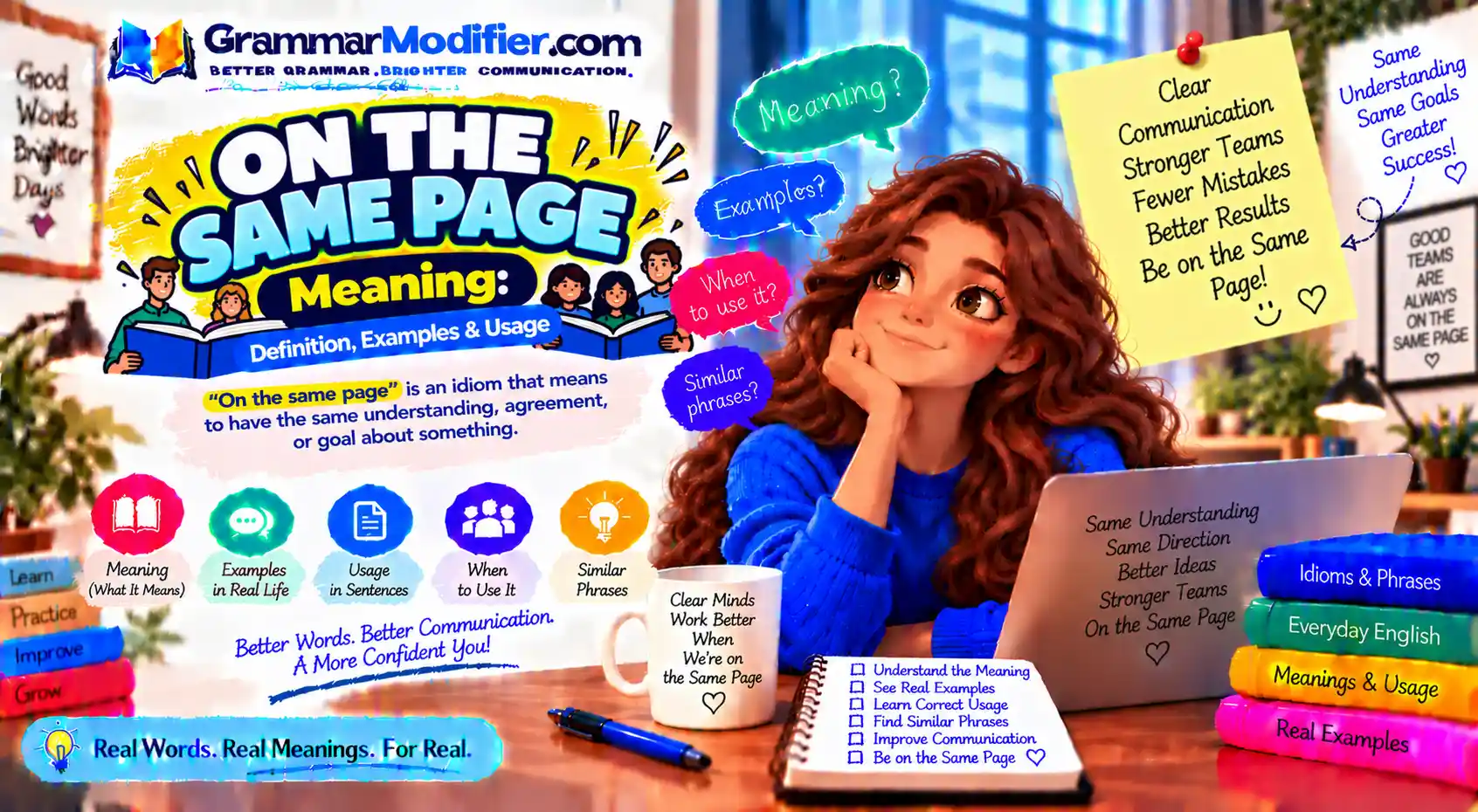
On the same page is a common English idiom that means sharing an understanding, expectation, goal, or agreement. It is especially common in American conversations, teamwork, meetings, and everyday planning.
The phrase can describe complete agreement, but it doesn’t always mean people agree about every detail. Sometimes they simply understand the situation in the same way.
Quick Answer
On the same page means having the same understanding or agreement about something. For example, “We’re on the same page about the deadline” means everyone understands and accepts the same deadline.
TL;DR
• On the same page means shared understanding or agreement.
• It commonly describes people working toward a shared goal.
• Get on the same page means reach shared understanding.
• Not on the same page means different understanding or expectations.
• Use on, not “in,” in this fixed expression.
• The phrase doesn’t always mean complete agreement.
What Does On the Same Page Mean?
On the same page means that two or more people understand something similarly. It can also mean they agree about a goal, plan, expectation, or decision.
The phrase is useful when people need clarity. You might hear it before a meeting, during a family discussion, or while planning a group project.
• “We’re on the same page about the deadline.”
• “Are we on the same page about the plan?”
• “I think we’re finally on the same page.”
• “The team is on the same page about the goal.”
• “My brother and I are on the same page about the trip.”
• “Let’s make sure everyone is on the same page.”
• “They weren’t on the same page about the instructions.”
• “The meeting helped us get on the same page.”
Is On the Same Page an Idiom?
Yes, on the same page is commonly treated as an English idiom. Its figurative meaning goes beyond the literal idea of sharing a physical page.
Literally, people can be on the same page of a book. Figuratively, they can share the same understanding, expectations, or direction.
• Literal: “The answers are on the same page.”
• Figurative: “The teachers are on the same page about the new rules.”
• Literal meaning: physically located on one page.
• Figurative meaning: sharing an understanding or agreement.
• The surrounding context usually makes the meaning clear.
• The idiomatic form is especially common in conversations about cooperation.
• It can describe individuals, teams, families, or organizations.
• It can refer to one issue without implying total agreement.
On the Same Page in American English
In American English, on the same page commonly describes agreement or a shared understanding. Collins defines the American English sense around agreement and harmonious working relationships, while Oxford connects it with agreement about what people are trying to achieve.
The expression is particularly natural in workplace communication. People use it when discussing plans, responsibilities, deadlines, goals, and next steps.
• “Are we on the same page about the deadline?”
• “We’re on the same page about the project’s goal.”
• “The teams are finally on the same page.”
• “Let’s make sure we’re on the same page.”
• “Everyone needs the same information to stay on the same page.”
• “We’re on the same page about what happens next.”
• “The managers weren’t on the same page about the schedule.”
• “The discussion helped everyone become on the same page.”
How to Use On the Same Page in a Sentence
The most common structure is be on the same page. The verb be changes according to the subject and tense.
You can also use related structures such as get on the same page and make sure we’re on the same page.
• “I am on the same page as you.”
• “We are on the same page about the project.”
• “She was on the same page with her team.”
• “They weren’t on the same page about the deadline.”
• “Let’s get on the same page before we begin.”
• “I want to make sure we’re on the same page.”
• “The meeting helped keep everyone on the same page.”
• “Are you on the same page about our next step?”
On the Same Page Examples
The phrase works in many everyday situations. The subject can be a family, friendship, classroom, team, or workplace.
The exact meaning depends on the topic being discussed. Someone can be on the same page about one issue while disagreeing about another.
• Family: “We’re on the same page about the vacation.”
• Friends: “We’re on the same page about where to meet.”
• School: “The students are on the same page about the assignment.”
• Travel: “Let’s make sure we’re on the same page about departure time.”
• Sports: “The players need to be on the same page.”
• Planning: “We’re on the same page about Saturday’s plans.”
• Group project: “Our team is on the same page about the presentation.”
• Decision-making: “Everyone is on the same page about the next step.”
On the Same Page at Work
On the same page is especially common in American workplace communication. It helps people discuss shared goals, expectations, responsibilities, and decisions.
The phrase is natural in meetings and conversations. In very formal writing, however, a more precise expression may sometimes communicate the idea better.
• “Are we all on the same page about the deadline?”
• “Let’s get on the same page before contacting the client.”
• “The sales and design teams need to be on the same page.”
• “I want everyone on the same page about responsibilities.”
• “We’re on the same page regarding the project’s main goal.”
• “The meeting helped us get on the same page.”
• “Please confirm that we’re on the same page about the next steps.”
• “The project slowed down because the teams weren’t on the same page.”
Get on the Same Page Meaning
Get on the same page means reaching a shared understanding or agreement. It describes a movement from different views toward greater alignment.
This differs slightly from be on the same page. The first describes becoming aligned, while the second describes an existing state of alignment. Plain English also uses “get on the same page” for developing a common understanding.
• “We need to get on the same page before deciding.”
• “Let’s meet tomorrow and get on the same page.”
• “The discussion helped us get on the same page.”
• “I called this meeting so we could get on the same page.”
• “The new instructions should help everyone get on the same page.”
• “We need to get on the same page about our goals.”
• “The manager brought the team together to get on the same page.”
• “Let’s clarify the details and get on the same page.”
Not on the Same Page Meaning
Not on the same page means people don’t share the same understanding, information, expectations, or agreement.
It doesn’t always describe a serious disagreement. Sometimes one person simply has different information from another person.
• “We’re not on the same page about the deadline.”
• “The two teams aren’t on the same page yet.”
• “I think we’re not on the same page about this issue.”
• “They weren’t on the same page about who was responsible.”
• “The confusion showed that we weren’t on the same page.”
• “We’re on the same page about the goal, but not the method.”
• “The manager realized everyone wasn’t on the same page.”
• “Let’s discuss this because we’re clearly not on the same page.”
On the Same Page vs. On the Same Wavelength
On the same page usually focuses on shared understanding, plans, expectations, or agreement. On the same wavelength often suggests similar thinking or an easy mutual understanding.
The two expressions overlap, but they aren’t identical.
• On the same page: “We’re on the same page about the deadline.”
• On the same wavelength: “My friend and I are on the same wavelength.”
• Use on the same page for plans and expectations.
• Use on the same wavelength for similar ways of thinking.
• Both can describe good communication.
• Neither requires identical opinions about everything.
• “We share the same goal, but our methods differ.”
• “We understand each other’s ideas very easily.”
Synonyms for On the Same Page
Several phrases can express a similar idea. The best choice depends on whether you mean agreement, coordination, or similar thinking.
• In agreement — direct and neutral.
• In sync — natural and conversational.
• Aligned — common in professional communication.
• In accord — more formal.
• On the same wavelength — similar thinking.
• Of one mind — strong agreement.
• In harmony — cooperation or agreement.
• Sharing a common understanding — clear and formal.
Is On the Same Page Formal or Informal?
On the same page is common and natural in American English. It works especially well in conversations, meetings, teamwork, and everyday workplace communication.
For highly formal writing, you may prefer a more specific phrase. Aligned, in agreement, or share a common understanding can sound more precise.
• Conversational: “Are we on the same page?”
• Workplace: “Let’s make sure we’re on the same page.”
• More formal: “Let’s confirm that we share a common understanding.”
• More formal: “Both departments are aligned on the proposed schedule.”
• Direct: “We agree about the deadline.”
• Precise: “We have the same expectations regarding the deadline.”
• Casual: “I think we’re on the same page.”
• Formal: “Both parties appear to have reached an agreement.”
Common Mistakes With On the Same Page
The expression has a fixed structure. English learners most often change the preposition or remove the article.
Using the complete phrase will make your sentence sound more natural.
• ❌ “We are in the same page.”
• ✓ “We are on the same page.”
• ❌ “Let’s get on same page.”
• ✓ “Let’s get on the same page.”
• ❌ “Are you at the same page?”
• ✓ “Are you on the same page?”
• ❌ “We are same page about the plan.”
• ✓ “We are on the same page about the plan.”
• ❌ “I am on same page with you.”
• ✓ “I am on the same page as you.”
• ❌ “We’re on the same pages.”
• ✓ “We’re on the same page.”
On the Same Page With or About?
Both with and about can follow the expression, but they usually provide different information.
With can identify the person or group involved. About can identify the topic or issue under discussion.
• “I’m on the same page with my manager.”
• “We’re on the same page about the deadline.”
• “She isn’t on the same page with her team.”
• “They’re on the same page about the project.”
• “Are you on the same page with us?”
• “Are we on the same page about the budget?”
• “The teams are on the same page regarding the goal.”
• “Let’s make sure we’re on the same page about the next step.”
On the Same Page vs. Same Opinion
Being on the same page doesn’t always mean having exactly the same opinion. It can mean that people agree on a goal while preferring different methods.
This distinction matters because the phrase often describes shared direction, not complete agreement about every detail.
• “We’re on the same page about the goal.”
• “We disagree about how to reach that goal.”
• “We’re on the same page about the deadline.”
• “We have different opinions about the design.”
• “We’re on the same page about what needs to happen next.”
• “We don’t have identical opinions, but we understand each other.”
• “The team agrees on the goal but differs on the method.”
• “They share expectations even though their personal views differ.”
On the Same Page in Professional Writing
The expression is perfectly natural in many workplace conversations. However, professional writing sometimes benefits from greater precision.
Choose wording based on what you actually mean rather than replacing the idiom automatically.
• Use aligned for shared direction.
• Use in agreement for direct agreement.
• Use shared understanding for common interpretation.
• Use same expectations when discussing standards or outcomes.
• Use agreed when a decision has actually been accepted.
• Use consistent understanding when clarity matters.
• Use on the same page when a conversational tone is appropriate.
• Avoid vague wording when a specific statement would be clearer.
Origin and History of On the Same Page
The exact origin of the idiomatic expression is uncertain. One widely discussed explanation connects it with people reading from the same book, document, or sheet of music.
Other explanations connect the expression with classrooms and group settings. Because the literal wording existed before its modern figurative use, the precise origin cannot be stated with certainty.
The figurative meaning developed around the idea of people following the same information or direction. Today, the expression is widely understood as a phrase for shared understanding and agreement.
Practical Tips for Using On the Same Page
Use the phrase when people need a shared understanding. Add the topic after about or regarding when the context isn’t already clear.
Remember that the expression can describe partial agreement. People may share a goal without agreeing about every method or detail.
• Use on the same page for shared understanding.
• Use get on the same page for reaching alignment.
• Use not on the same page for different expectations.
• Use about to identify the topic.
• Use with to identify a person or group.
• Use regarding for a slightly more formal tone.
• Use aligned when professional wording is more suitable.
• Use in agreement when direct agreement is your meaning.
• Don’t assume it means complete agreement.
• Choose specific wording when the phrase feels too vague.
FAQs
What does “on the same page” mean?
On the same page means sharing an understanding, expectation, goal, or agreement about something. It often means that people understand what is happening in a similar way.
Can you be on the same page without agreeing?
Yes. People can share the same information or expectations without agreeing about every opinion or method. For example, a team can agree on its goal but disagree about how to reach it.
Is “on the same page” an idiom?
Yes. It is commonly treated as an English idiom because its figurative meaning goes beyond physically sharing a page. It describes shared understanding or agreement.
Is “on the same page” formal or informal?
It is common and natural in American English, especially in conversations and workplace settings. More formal writing may use aligned, in agreement, or share a common understanding.
What is the difference between “on the same page” and “on the same wavelength”?
On the same page often focuses on plans, expectations, information, or agreement. On the same wavelength more often describes similar thinking or natural mutual understanding.
What is another way to say “on the same page”?
Depending on context, you can use in agreement, in sync, aligned, or sharing a common understanding. Choose the alternative that matches your intended meaning.
Is it “on the same page” or “in the same page”?
The standard idiomatic expression is on the same page. For example, say, “We’re on the same page about the project,” not “We’re in the same page.”
Conclusion
On the same page is a useful English idiom for shared understanding, expectations, goals, or agreement. It works naturally in American English, especially in conversations, teamwork, and workplace communication.
Remember the three core patterns: be on the same page, get on the same page, and not on the same page. Practice each one in your own sentence to make the expression part of your everyday English.
Read More: