
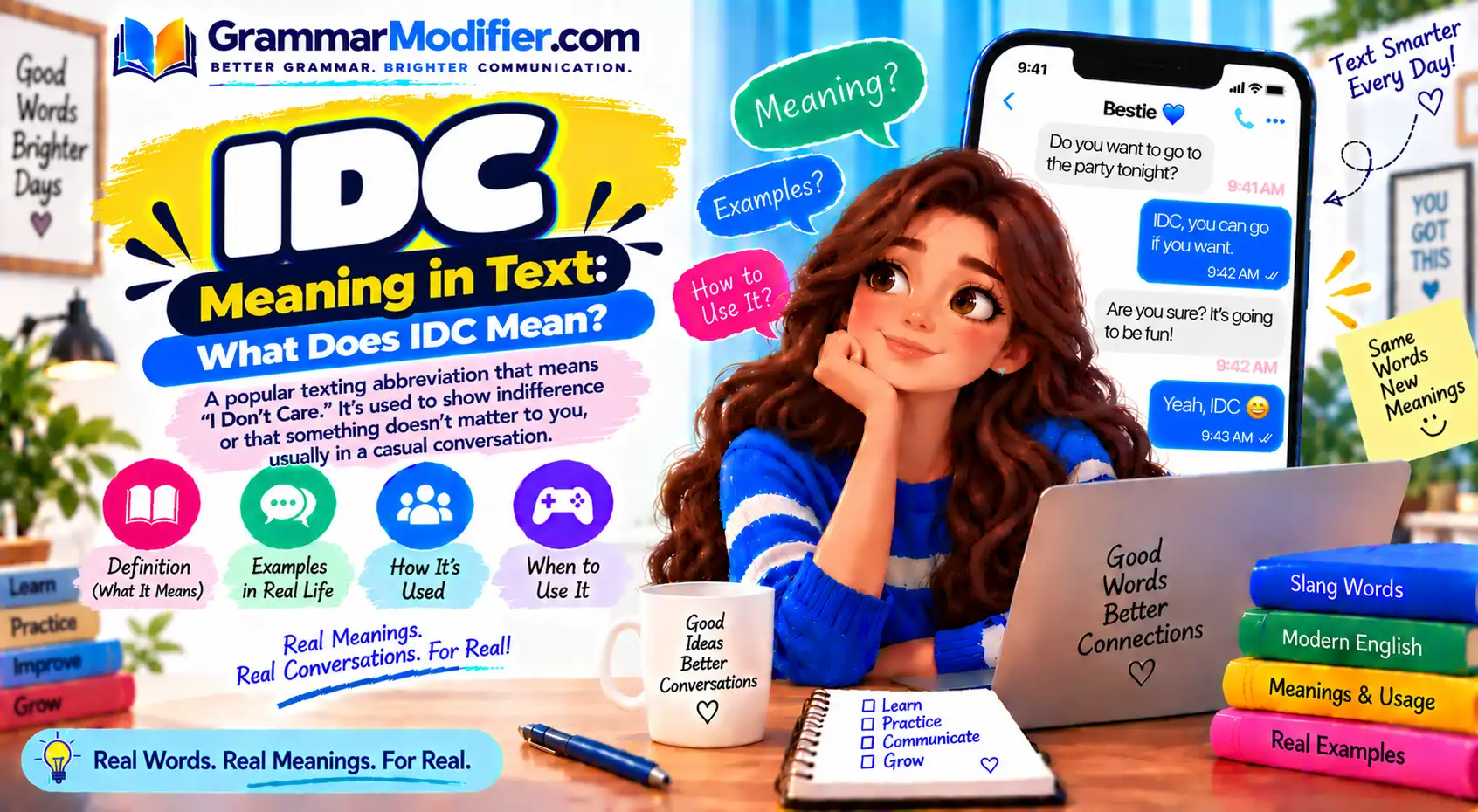
If you’ve seen IDC in a text message, this guide will help you understand exactly what it means and how to interpret it. IDC meaning is usually “I don’t care,” an informal expression used when someone has little concern, no strong preference, or no interest in a subject.
The tricky part is not the definition. The tricky part is tone. “IDC, you choose” can simply mean either option is fine, while a standalone “IDC” can sound blunt in a serious conversation. You’ll learn the difference through clear examples, comparisons, common mistakes, and practical alternatives.
Quick Answer
IDC means “I don’t care” in texting, messaging, and other casual online communication. It can express no preference, indifference, or lack of concern, depending on the context.
TL;DR
• IDC usually means “I don’t care.”
• It is an informal texting initialism.
• It can express no preference or indifference.
• A short “IDC” can sometimes sound dismissive.
• IDK means “I don’t know,” not “I don’t care.”
• IDM means “I don’t mind” and can sound softer.
What Does IDC Stand For?
IDC stands for “I Don’t Care.” It is an initialism, meaning the letters come from the first letters of the words in the phrase.
Dictionaries recognize this meaning in digital communication. Dictionary.com lists IDC as the American abbreviation for “I don’t care,” while Collins lists the same meaning for messaging and social media.
• I = I
• D = Don’t
• C = Care
• IDC = I Don’t Care
• idc is a common lowercase form.
• The full phrase is appropriate when clearer or more formal wording is needed.
What Does IDC Mean in Text?
In ordinary texting, IDC means “I don’t care.” The speaker is saying that the subject does not matter much to them.
However, “I don’t care” can describe several slightly different ideas. The exact interpretation comes from the sentence and conversation around it.
• “IDC which movie we watch.” → I have no preference.
• “IDC where we eat.” → Either place is fine with me.
• “IDC what they think.” → Their opinion does not matter to me.
• “IDC about that.” → I am not concerned about that subject.
• “IDC anymore.” → I no longer care about it.
• “IDC, you choose.” → You can make the decision.
• “IDC if we go tomorrow.” → The timing does not matter to me.
• “IDC what happens next.” → I am not concerned about the result.
How Is IDC Used in Texting and Chat?
IDC is mainly informal. People use it in quick conversations when they want to express indifference without typing the entire phrase.
The expression can appear by itself or as part of a longer sentence. Its meaning is usually clear when the surrounding conversation provides enough context.
• “IDC, you pick.” — The sender has no preference.
• “idc which one.” — Either choice is acceptable.
• “IDC what time.” — The time does not matter.
• “idc about the result.” — The result is not important to the sender.
• “IDC anymore.” — The sender says they no longer care.
• “idc tbh.” — “I don’t care, to be honest.”
• “idc lol.” — The wording may feel more casual or playful.
• “IDC.” — A short reply that needs context for accurate interpretation.
What Does IDC Mean on Social Media?
The meaning of IDC on social media is usually still “I don’t care.” The abbreviation can appear in direct messages, comments, captions, group chats, and other informal online conversations.
The platform itself does not create a different dictionary meaning. What changes is the context and tone surrounding the abbreviation.
• “IDC what anyone says.” → Other people’s opinions do not matter to me.
• “idc, I like it.” → The speaker is standing by their opinion.
• “IDC 😂” → The emoji may make the message feel lighter.
• “IDC.” → The short punctuation can make the response feel more final.
• “idc which one you send.” → The sender has no preference.
• “IDC about the comments.” → The sender is not concerned about reactions.
Is IDC Rude?
IDC is not automatically rude. Its tone depends on the subject, wording, relationship, and surrounding conversation.
For example, “IDC, you choose” can be perfectly neutral when two friends are deciding where to eat. A standalone “IDC” after someone shares a serious concern can sound much more dismissive.
Compare These Examples
| Message | Likely tone | Meaning |
|---|---|---|
| “IDC, you choose.” | Neutral | I have no preference. |
| “IDC which one.” | Casual | Either option is fine. |
| “IDC 😂” | Light/playful | I am not bothered. |
| “IDC about that.” | Detached | That does not concern me. |
| “IDC.” | Potentially blunt | I do not care about this. |
| “IDC what you think.” | Strong | Your opinion does not matter to me. |
Do not judge the tone from the abbreviation alone. Read the complete conversation before deciding what the sender intended.
IDC vs. IDK vs. IDM: What’s the Difference?
IDC, IDK, and IDM look similar, but they express different ideas. Knowing the difference prevents common misunderstandings in texting.
| Abbreviation | Full Form | Main Meaning |
|---|---|---|
| IDC | I Don’t Care | The subject does not matter to me. |
| IDK | I Don’t Know | I do not have the information. |
| IDM | I Don’t Mind | I have no objection or preference. |
IDC vs. IDK
IDC expresses indifference. IDK expresses a lack of knowledge.
• “Where should we eat?” → “IDC.”
• “Where is the restaurant?” → “IDK.”
• “Which movie should we watch?” → “IDC.”
• “What time does the movie start?” → “IDK.”
Wiktionary lists idc and idk separately in its textspeak glossary, reflecting their different meanings.
IDC vs. IDM
IDC can sound stronger than IDM.
Compare:
“IDC which seat I get.”
This says the speaker does not care about the choice.
“I don’t mind which seat I get.”
This more directly communicates that either choice is acceptable.
When you want to sound cooperative or polite, “I don’t mind” is often a clearer choice.
IDC vs. “I Don’t Mind”
These expressions overlap, but they are not always interchangeable.
“I don’t mind” usually means “I have no objection” or “either option is acceptable.” “I don’t care” can communicate stronger indifference.
• “I don’t mind where we eat.” → Either place is acceptable.
• “IDC where we eat.” → The choice does not matter to me.
• “I don’t mind if you go first.” → I have no objection.
• “IDC if you go first.” → It does not matter to me.
• “I’m fine with either.” → A polite way to show no preference.
• “You can choose.” → Clearly gives the decision to someone else.
If your goal is to sound warm and cooperative, “I don’t mind” is usually safer than a short “IDC.”
IDC Examples in Real Conversations
The best way to understand IDC is to compare it across different situations.
Making a choice
“Pizza or tacos?”
“IDC, you choose.”
Here, IDC probably means “I have no preference.”
Discussing an opinion
“People might disagree with you.”
“IDC what they think.”
Here, IDC means “Their opinion does not matter to me.”
Ending a discussion
“But you should explain why.”
“IDC.”
Here, the abbreviation may sound dismissive or unwilling to continue.
Showing flexibility
“Should we leave at six or seven?”
“idc, either works.”
This is a casual way to say both options are acceptable.
Showing stronger indifference
“Does it bother you if they disagree?”
“IDC.”
The speaker is saying that the disagreement does not concern them.
How to Use IDC in a Sentence
IDC works best in informal communication. It can replace the full phrase “I don’t care” when the people involved are comfortable with texting slang.
Common sentence patterns include:
• IDC + question word: “IDC where we go.”
• IDC + if: “IDC if we leave early.”
• IDC + about: “IDC about the score.”
• IDC + what: “IDC what they say.”
• IDC + which: “IDC which one you choose.”
• IDC + anymore: “IDC anymore.”
• IDC + comma + choice: “IDC, you choose.”
• Full form: “I don’t care which option we choose.”
A Common Mistake
Do not use IDC when you actually mean IDK.
Incorrect meaning:
“What time does the store close?”
“IDC.”
If you mean that you do not know, the natural reply is:
“IDK.”
If you truly mean that the closing time does not matter to you, then IDC can fit.
When Should You Avoid Using IDC?
Because IDC is informal, it is not suitable for every situation.
In school assignments, professional emails, formal applications, and sensitive conversations, writing the complete thought is usually clearer.
• Use “I don’t mind” when you want a softer tone.
• Use “Either option works for me” when choosing between options.
• Use “I have no preference” for a neutral statement.
• Use “You can choose” when giving someone the decision.
• Use “I’m fine with either” when both choices work.
• Use “I’m not concerned about it” when discussing a serious matter.
• Use “It does not matter to me” when you want clear wording.
• Use the full phrase instead of slang in formal writing.
What Does Lowercase “idc” Mean?
“idc” normally means the same thing as “IDC.” Lowercase writing is common in casual digital communication.
Capitalization does not create a new definition. However, punctuation and surrounding words can affect how a short message feels.
• IDC → uppercase form.
• idc → common lowercase form.
• Idc → mixed capitalization.
• “idc lol” → may feel casual or playful.
• “IDC.” → can feel more final.
• “idc, you choose” → usually communicates no preference.
• “IDC about that.” → can sound more detached.
• Do not assume lowercase automatically means friendliness.
Wiktionary lists idc as an alternative form of the texting initialism IDC.
Other Meanings of IDC
In ordinary texting, IDC usually means “I don’t care.” However, the same letters can represent unrelated terms in specialized contexts.
For example, Wiktionary records International Data Corporation as another meaning of IDC and also lists Instructor Development Course in underwater-diving terminology.
Dictionary.com and Collins also distinguish the texting meaning from other uses, including industrial development certificate.
Common Contexts
• Texting: I don’t care
• Social media: I don’t care
• Internet slang: I don’t care
• Business/technology: IDC can refer to International Data Corporation
• Specialized terminology: IDC may have field-specific meanings
Context is essential. If IDC appears in a technology report, business article, or specialist document, do not automatically interpret it as texting slang.
Is IDC Formal or Informal?
IDC is informal English. It belongs mainly in texting, casual chats, social media, and other relaxed communication.
It is not grammatically wrong, but its register makes it unsuitable for many formal situations.
Casual
“IDC, you pick.”
Neutral
“I don’t mind. You can choose.”
Formal
“Either option is acceptable to me.”
The choice depends on the audience and purpose. Good communication is not only about grammar; it is also about using the right level of formality.
Better Alternatives to IDC
If you want to express the same general idea without sounding too blunt, choose an alternative that matches your meaning.
| Alternative | Best Use |
|---|---|
| I don’t mind. | You have no objection. |
| Either is fine. | Both choices work. |
| I have no preference. | You want a neutral tone. |
| You can choose. | You want someone else to decide. |
| Whatever works for you. | You want to sound flexible. |
| I’m fine with either. | You accept both options. |
| It’s up to you. | You want to pass the decision along. |
| It doesn’t matter to me. | You want a clear, complete statement. |
The Key Difference
If you mean “I have no preference,” say:
“I don’t mind.”
If you mean “I don’t know,” say:
“I don’t know.”
If you mean “This subject does not matter to me,” then:
“I don’t care.”
Choosing the exact phrase makes your meaning much clearer.
FAQs
What does IDC mean in a text?
IDC usually means “I don’t care.” It can show that someone has no preference, feels little concern, or is not interested in a topic.
Is IDC rude?
Not necessarily. “IDC, you choose” can be neutral, while a standalone “IDC” during a serious conversation may sound dismissive.
What does IDC stand for?
IDC stands for “I Don’t Care.” It is an informal initialism used in texting and online communication.
What is the difference between IDC and IDK?
IDC means “I don’t care,” while IDK means “I don’t know.” IDC describes indifference or lack of preference; IDK describes a lack of information.
What is the difference between IDC and IDM?
IDC means “I don’t care,” while IDM means “I don’t mind.” “I don’t mind” often sounds softer because it focuses on having no objection.
Does “idc” mean the same thing as “IDC”?
Yes. “idc” is simply a lowercase form of the same texting initialism. Capitalization does not normally change its meaning.
Can IDC have another meaning?
Yes. IDC can represent different terms outside texting, including International Data Corporation and other specialized expressions. Always consider the context before interpreting an abbreviation.
Conclusion
IDC means “I don’t care” in most texting and online conversations. It can communicate no preference, indifference, lack of concern, or disinterest, while the surrounding conversation determines its tone.
The most useful distinction is between IDC, IDK, IDM, and “I don’t mind.” If you want a softer or more formal message, choose a complete phrase such as “I don’t mind,” “I have no preference,” or “Either option works for me.” For your next step, compare another common texting abbreviation with its full meaning and natural examples.
Read More:
24 thoughts on “IDC Meaning: What Does IDC Mean in Text?”