
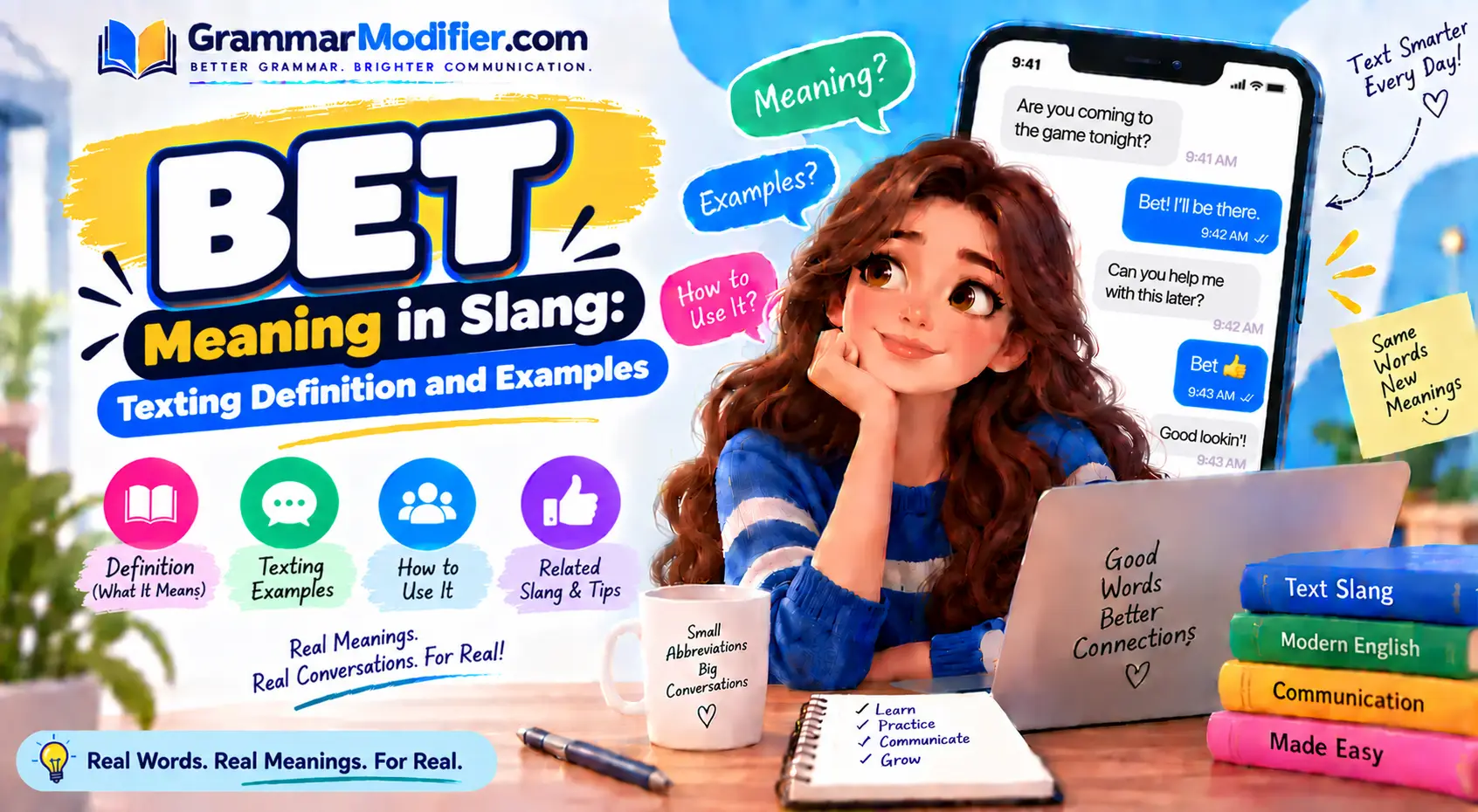
If someone texts you “bet,” they usually mean “okay,” “sure,” “deal,” or “I agree.” The word is common in casual American English, especially in messages, group chats, and everyday conversations.
However, “bet” does not have one meaning in every situation. It can confirm a plan, accept a challenge, show confidence, or sound sarcastic. This guide explains each use with natural examples and clear advice.
What Does “Bet” Mean in Slang?
In slang, bet is a short way to express agreement or acceptance. It often replaces phrases such as “sounds good,” “I’m in,” “got it,” or “you can count on me.”
The word is usually informal. Its exact meaning depends on the sentence, the relationship between speakers, and the tone of the conversation.
Common slang meanings
| Meaning | Example |
|---|---|
| Okay | “Meet at six?” — “Bet.” |
| Sure | “Can you send that?” — “Bet.” |
| Deal | “We’ll split the work.” — “Bet.” |
| I agree | “That plan makes sense.” — “Bet.” |
| Challenge accepted | “You can’t finish first.” — “Bet.” |
| I’m confident | “I can handle it.” — “Bet.” |
The slang meaning is different from the traditional meaning connected with a wager. Context helps readers understand which meaning is intended.
What Does “Bet” Mean in Texting?
In texting, “bet” is often used as a quick confirmation. It tells the other person that you understand or accept what they said.
For example:
Friend: I’ll pick you up at seven.
You: Bet.
Here, “bet” means “Okay, that works.” It does not mean that the speaker is placing a wager.
Another example:
Friend: Bring your notebook tomorrow.
You: Bet, I will.
The second reply is slightly clearer because it includes “I will.” This can be useful when the conversation involves a specific responsibility.
How “Bet” Shows Agreement
“Bet” can confirm plans, requests, instructions, or information. It is especially common between friends and people who already understand each other’s communication style.
Examples of agreement
- “Let’s meet outside the library.” — “Bet.”
- “I’ll send you the address.” — “Bet, thanks.”
- “We can finish the project tonight.” — “Bet.”
- “Please remind me tomorrow.” — “Bet, I got you.”
- “The movie starts at eight.” — “Bet.”
- “I’ll save you a seat.” — “Bet, appreciate it.”
The expression is short, but it can carry a friendly or confident tone. If the situation is serious, a longer reply may prevent confusion.
When “Bet” Means Challenge Accepted
After someone expresses doubt, “bet” can mean “challenge accepted.” It shows that the speaker feels confident or wants to prove the other person wrong.
Examples
Friend: You won’t solve that puzzle.
You: Bet.
Classmate: I don’t think you can finish before me.
You: Bet, watch me.
Friend: You’ll forget the instructions.
You: Bet I won’t.
In these examples, “bet” does not necessarily involve money. It signals confidence, determination, or playful competition.
How Tone Changes the Meaning
The word “bet” can sound friendly, excited, doubtful, or dismissive. The surrounding conversation matters more than the word alone.
Friendly tone
“I’ll bring extra snacks.”
“Bet, thank you.”
This reply sounds appreciative because “thank you” adds warmth.
Excited tone
“We got tickets for the concert!”
“BET!”
Capital letters and an exclamation mark show excitement.
Doubtful tone
“I can memorize all these answers in one minute.”
“Bet.”
This may mean “Okay, prove it.” The speaker may be accepting a challenge.
Unclear or sarcastic tone
“I’ll finish the entire assignment in five minutes.”
“Sure, bet.”
This reply may sound doubtful. If the tone is unclear, ask:
- “Do you mean yes?”
- “Are you agreeing?”
- “Are you joking?”
“Bet” on TikTok, Snapchat, and Social Media
People use “bet” in comments, captions, direct messages, gaming chats, and group conversations. It often works as a quick reaction to a plan, suggestion, or challenge.
Social media examples
- “New video goes live tonight.” — “Bet.”
- “You should try this game.” — “Bet.”
- “No way you can beat my score.” — “Bet.”
- “We’re meeting at the event.” — “Bet, see you there.”
- “I found the answer.” — “Bet!”
Social media slang changes quickly. A word may be common in one online community but less familiar in another. It is better to follow the context instead of assuming every user means the same thing.
Is “Bet” Common in American English?
“Bet” is familiar in many forms of casual American communication. It appears in spoken conversation, texting, online comments, and entertainment.
Still, slang is not used equally by everyone. Age, region, community, and personal style can influence whether a person uses or understands it.
Use “bet” when the conversation is relaxed and the other person is likely to understand it. Choose clearer language with unfamiliar people or in serious situations.
Bet vs Okay, Sure, and Deal
These expressions can all show agreement, but their tones differ.
“Okay”
“Okay” is neutral and works in many situations.
“Please arrive at nine.”
“Okay.”
“Sure”
“Sure” often sounds friendly and cooperative.
“Can you help me later?”
“Sure.”
“Deal”
“Deal” suggests agreement to an arrangement.
“I’ll handle the slides if you write the summary.”
“Deal.”
“Bet”
“Bet” is more casual and may sound confident.
“I’ll meet you after class.”
“Bet.”
For formal communication, “okay,” “confirmed,” or “I agree” may be clearer than “bet.”
Bet vs You Bet
“Bet” and “you bet” are related, but they are not always interchangeable.
Bet is often a short slang response:
“Want to come with us?”
“Bet.”
You bet is a common expression meaning “certainly,” “of course,” or “you’re welcome.”
“Can you help me?”
“You bet.”
“Thanks for your help.”
“You bet.”
The phrase “you bet” can sound friendly and natural in everyday American English. It is not limited to internet slang.
“I Bet” and Other Standard Expressions
The word “bet” also has ordinary English uses. These meanings should not be confused with the short slang reply.
“I bet”
“I bet” often introduces a belief or prediction.
“I bet the store is busy today.”
This means “I think the store is busy.” It does not necessarily mean that the speaker has made a wager.
“Best bet”
“Best bet” means the most sensible or useful choice.
“Your best bet is to arrive early.”
“Place a bet”
“Place a bet” refers to risking money or something valuable on an uncertain result.
“The traditional meaning of bet is connected with a wager.”
The surrounding words usually make the intended meaning clear.
Is “Bet” Rude or Disrespectful?
“Bet” is not automatically rude. However, a one-word reply may sound dismissive when the topic is serious or emotional.
Compare these examples:
“I’m worried about tomorrow.”
“Bet.”
This reply may sound uncaring because it does not respond to the emotion.
A warmer response would be:
“I understand. We’ll handle it together.”
In a casual planning conversation, “bet” usually sounds normal:
“I’ll meet you at the entrance.”
“Bet, see you there.”
The relationship and topic determine whether the word feels appropriate.
Can You Use “Bet” in Formal Writing?
Slang “bet” is usually not the best choice for formal emails, school assignments, reports, applications, or workplace messages.
Use a phrase that clearly communicates your meaning.
| Casual wording | More formal wording |
|---|---|
| Bet, I’ll attend. | I confirm that I will attend. |
| Bet, thanks. | Thank you. I understand. |
| Bet, that works. | That arrangement works for me. |
| Bet, I’ll send it. | I will send it as requested. |
| Bet, see you then. | I look forward to seeing you then. |
In casual messages, “bet” is natural. In formal writing, direct wording is usually safer.
Common Mistakes With “Bet”
Mistake 1: Assuming it always means agreement
“Bet” can also express a challenge or doubt.
“You can’t finish this.”
“Bet.”
Here, the meaning is closer to “challenge accepted.”
Mistake 2: Using it with every person
Not everyone uses slang in the same way. With unfamiliar people, “sounds good” may be clearer.
Mistake 3: Confusing “bet” with “I bet”
“I bet” often introduces a belief or prediction.
“I bet she is already home.”
This is different from replying “Bet” to confirm a plan.
Mistake 4: Using it in serious messages
A short slang reply may sound careless during an emotional conversation. Use a complete sentence when the subject needs attention.
Mistake 5: Treating slang as a grammar rule
“Bet” is an informal usage choice, not a universal replacement for “yes.” Context and audience matter.
How to Respond to “Bet”
Your response depends on the meaning.
If it confirms a plan
- “Great, see you then.”
- “Sounds good.”
- “Thanks.”
- “Perfect.”
- “I’ll send the details.”
If it accepts a challenge
- “We’ll see.”
- “Challenge accepted.”
- “Go for it.”
- “Good luck.”
- “Let’s find out.”
If the meaning is unclear
- “Do you mean yes?”
- “Are we confirmed?”
- “Just checking—does that work?”
- “Are you joking or agreeing?”
A short clarification can prevent confusion.
Practice: Choose the Meaning
Identify what “bet” means in each example.
Example 1
“Meet me at the front gate?”
“Bet.”
Answer: Agreement or confirmation.
Example 2
“You won’t finish the puzzle.”
“Bet.”
Answer: Challenge accepted.
Example 3
“I bet the weather will change.”
Answer: A prediction or belief.
Example 4
“Your best bet is to leave early.”
Answer: The most sensible choice.
Example 5
“Can you help me tomorrow?”
“You bet.”
Answer: Certainly or of course.
FAQs About Bet Meaning in Slang
What does “bet” mean in slang?
It usually means “okay,” “sure,” “deal,” or “I agree.” It can also mean “challenge accepted” when someone doubts the speaker.
What does “bet” mean in texting?
In texting, “bet” often confirms a plan or request. For example, “I’ll meet you at six” followed by “bet” means “Sounds good.”
Is “bet” the same as “yes”?
Not always. It can mean yes in a casual conversation, but it may also express confidence, challenge, or sarcasm.
Is “bet” rude?
The word itself is not usually rude. A short reply can sound dismissive if the conversation is serious or emotional.
Does “bet” always refer to gambling?
No. In slang, it commonly means agreement or challenge accepted. The traditional word can also refer to a wager or prediction.
Can “bet” be used in formal writing?
It is better to avoid slang “bet” in formal writing. Use “I agree,” “confirmed,” “certainly,” or “that works for me.”
Why does “bet” have different meanings?
English words often develop new meanings through informal speech and culture. Context, tone, and surrounding words help listeners understand the intended meaning.
Conclusion
Bet meaning in slang usually involves agreement, confirmation, confidence, or challenge accepted. The word is common in casual American English, especially in texts and online conversations.
Use it with people who understand the expression and choose clearer wording in formal or serious situations. When a message seems unclear, look at the context or ask a short follow-up question.
Read More: