
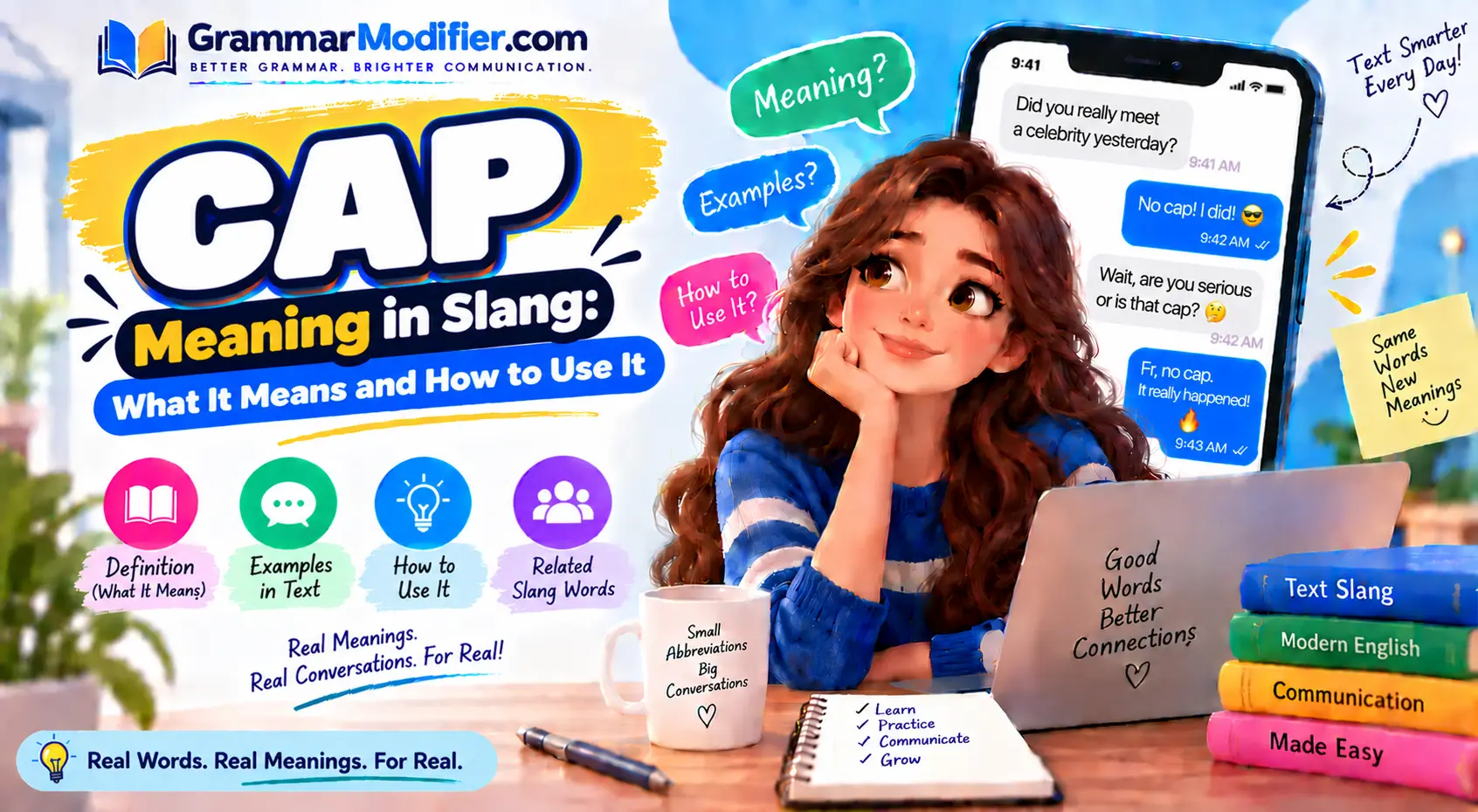
Cap is informal slang for a lie, false claim, or exaggeration. When someone says “That’s cap,” they mean they do not believe what another person said.
You may see this word in texts, comments, videos, and casual conversations. Understanding the surrounding sentence helps you recognize whether someone is joking, disagreeing, or accusing another person of lying.
Quick Answer
“Cap” in slang means a lie or something that is not true. If someone says “That’s cap,” they mean “That’s a lie.” If someone says “No cap,” they mean “I’m telling the truth” or “I’m being serious.”
TL;DR
- Cap means a lie, exaggeration, or false statement.
- That’s cap means “That’s not true.”
- Stop capping means “Stop lying or exaggerating.”
- No cap means “Honestly,” “for real,” or “I’m not lying.”
- You’re capping means “You’re lying.”
- The word is commonly used in texting, social media, gaming, and casual conversation.
What Does Cap Mean in Slang?
In American English slang, cap means something untrue. It can describe a false statement, an exaggerated story, or a claim that seems unbelievable.
Cambridge Dictionary lists cap as an informal noun meaning something someone says that is not true. It also recognizes cap as a slang verb meaning to tell a lie.
For example:
- “He said he finished the project in ten minutes. That’s cap.”
- “You got a perfect score without studying? Cap.”
- “She told everyone she met the actor, but that was cap.”
The word does not always mean the speaker deliberately lied. Sometimes it simply expresses doubt or disbelief.
How Cap Works in a Sentence
Cap can appear as a noun, a verb, or a short response. The form depends on how someone uses it.
As a noun, cap describes a false claim.
“That story is cap.”
As a verb, cap describes the act of lying or exaggerating.
“He is capping about his score.”
As a short reply, cap expresses disbelief.
“I finished the entire book in five minutes.”
“Cap.”
These forms are informal. They are most natural in casual speech, messages, and online conversations.
What Does No Cap Mean?
No cap means “no lie,” “honestly,” or “for real.” People use it to emphasize that a statement is true.
Cambridge Dictionary defines no cap as an expression used to emphasize that what someone is saying is true.
Examples:
- “No cap, that was the best concert I have attended.”
- “I am serious, no cap.”
- “No cap, you did a great job.”
- “That restaurant has amazing food, no cap.”
The phrase can appear at the beginning or end of a sentence. It often adds emphasis rather than changing the main meaning.
What Does Capping Mean?
Capping means lying or exaggerating. It is the present-participle form of the slang verb cap.
People use capping when describing something happening now or repeatedly.
Examples:
- “He is capping about his grades.”
- “Why are you capping?”
- “Stop capping about what happened.”
- “I am not capping. I really saw it.”
The word can sound playful between friends. In a serious disagreement, however, it may sound like a direct accusation.
What Does Stop Capping Mean?
Stop capping means “stop lying” or “stop exaggerating.” It challenges someone whose statement seems false.
The phrase is informal and can sound either teasing or confrontational.
Examples:
- “Stop capping. You did not finish all that food.”
- “You keep capping about your gaming score.”
- “Stop capping and tell me what happened.”
- “Are you serious, or are you capping?”
The tone matters. A laughing emoji may make the phrase sound playful, while a serious argument can make it sound harsh.
Cap vs. Lie: What Is the Difference?
Cap and lie can have similar meanings, but they are not identical in every situation.
Lie is a standard English word for an untrue statement. Cap is informal slang that can describe a lie or an exaggeration.
Compare these sentences:
- “He lied about his age.”
- “He was capping about his age.”
Both sentences suggest that the person gave false information. The second sentence sounds more casual.
Another difference is tone. Lie can sound neutral or serious, while cap often sounds conversational.
Use lie in formal writing. Use cap when the context is casual and the audience understands the slang.
Cap vs. Exaggeration
An exaggeration makes something seem larger, better, worse, or more extreme than it really is.
Cap can describe an exaggeration, even when the speaker is not making a serious attempt to deceive someone.
For example:
“I waited a million years for the bus.”
That sentence is an exaggeration. Someone might respond, “That’s cap,” because the statement is not literally true.
However, the speaker may simply be expressing frustration. The word cap does not prove that someone intended to deceive.
This distinction matters when you are trying to understand a conversation accurately.
What Does Cap Mean in Texting?
In texting, cap is often used as a short reaction to a surprising or doubtful statement.
It may appear alone or inside a longer sentence.
Examples:
- “You finished the whole assignment already?”
- “Cap.”
- “That sounds like cap.”
- “No cap, I actually enjoyed the movie.”
- “Are you capping right now?”
The word can also appear in lowercase or uppercase. The meaning usually stays the same.
What Does Cap Mean on Social Media?
On social media, cap often appears in comments, captions, and replies. People use it when they doubt a claim or think a story sounds exaggerated.
For example, someone might post that they completed a difficult challenge in an unusually short time. A commenter may write “cap” to express disbelief.
The meaning is similar across many casual online contexts. However, slang changes over time, and not every community uses the same expressions.
What Does the Cap Emoji Mean?
The baseball cap emoji, 🧢, can represent the slang word cap. It often suggests that someone is lying or exaggerating.
Examples:
- “That’s cap 🧢”
- “No cap 🧢”
- “You really did that? 🧢”
- “Stop the cap.”
The emoji is informal. Its meaning depends on the surrounding message.
Is Cap Rude?
Cap can sound rude when it directly accuses someone of lying. Among friends, it may be playful or teasing.
The same phrase can sound different depending on the relationship, situation, and tone of voice.
Compare:
- Playful: “You woke up at five? Cap.”
- Direct: “That’s cap. You are lying.”
- Neutral: “I am not sure that is accurate.”
- Polite: “Could you explain what happened?”
If you are unsure how someone will react, choose a neutral expression instead of a direct accusation.
When Should You Avoid Cap?
Cap is informal slang. It is usually unsuitable for school assignments, professional emails, formal reports, and other serious writing.
That does not mean the word is grammatically wrong. It means the tone may not fit the situation.
Avoid cap when:
- You are writing a formal email.
- You are submitting a school assignment.
- You are explaining facts in a professional report.
- You are communicating with someone who may not understand slang.
- You need to discuss a serious disagreement carefully.
Use standard English when the situation calls for a more formal tone.
Formal Alternatives to Cap
You can express the same idea without using slang. The best alternative depends on what you mean.
| Informal expression | Formal alternative |
|---|---|
| That’s cap. | That statement is inaccurate. |
| Stop capping. | Please provide accurate information. |
| No cap. | I am being honest. |
| He is capping. | He is exaggerating. |
| I do not believe you. | I am not convinced by that claim. |
These alternatives sound more neutral and are suitable for formal communication.
Where Did Cap Slang Come From?
The slang meaning of cap has roots in Black slang and predates current social media usage. Dictionary.com explains that cap was used in Black slang to mean bragging, exaggerating, or lying.
The word later became more widely recognized through hip-hop culture and online conversations. Its history is older than its current popularity on social media.
The exact development of slang can be difficult to trace. It is better to describe established historical evidence than to claim a single person or platform invented the expression.
Cap and Caping: Are They Different?
Cap and caping are not always the same word.
In the slang sense discussed in this article, capping means lying or exaggerating.
Caping can have a different meaning: defending or supporting someone, especially when others think that person does not deserve support. Dictionary.com documents this separate use.
For example:
- “He is capping about his score.”
This means he is exaggerating or lying. - “Why are you caping for that person?”
This means someone is defending or supporting that person.
The surrounding sentence tells you which meaning applies.
Common Questions About Cap
What does cap mean in slang?
Cap means a lie, false claim, or exaggeration. It is informal slang used to express doubt about something someone says.
What does no cap mean?
No cap means “no lie,” “honestly,” or “for real.” It emphasizes that the speaker believes their statement is true.
What does stop capping mean?
Stop capping means “stop lying” or “stop exaggerating.” It can sound playful or confrontational depending on the context.
Is cap the same as lie?
Cap and lie can have similar meanings, but cap is informal slang. Cap may also describe an exaggeration rather than a deliberate lie.
Is cap appropriate in formal writing?
Cap is usually unsuitable for formal writing. Use phrases such as “That statement is inaccurate” or “I do not believe that claim.”
What does the cap emoji mean?
The baseball cap emoji, 🧢, can represent cap in casual online conversations. It often expresses disbelief or suggests that someone is lying.
Conclusion
Cap is informal slang for a lie, false claim, or exaggeration. No cap emphasizes honesty, while capping describes the act of lying or exaggerating.
The most useful way to understand cap is to consider context and tone. If you are learning English, compare slang with standard expressions so you can choose the right wording for each situation.
Read More: