
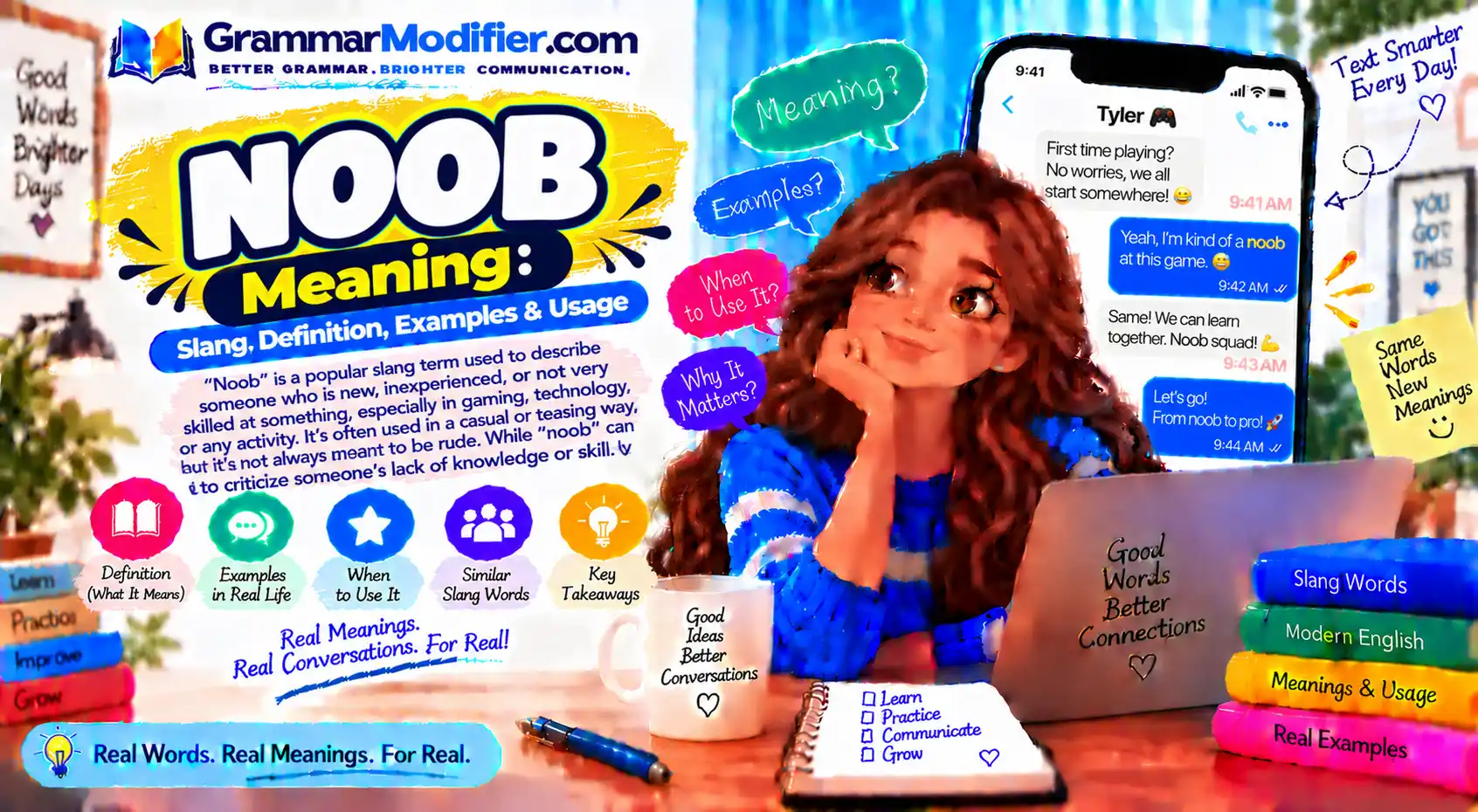
The term “noob” is a popular internet slang word used to describe someone who is new to a game, activity, or online community. It is commonly seen in gaming, social media, and online chats. While it can be used playfully among friends, it may also be used as a mild insult to point out a person’s lack of experience. Understanding the meaning of noob helps you use this widely recognized slang term correctly in different situations.
Quick Answer: What Does Noob Mean?
Noob is informal internet slang for a person who is new or inexperienced at an activity, especially gaming or using software. It is pronounced like “noob” and is commonly used in online communities.
The word can be neutral, playful, teasing, or insulting, depending on who says it and how it is used. Saying “I’m a noob” is often self-deprecating, while calling another person “a noob” can sound critical.
TL;DR: Noob Meaning at a Glance
- Noob means an inexperienced or new person.
- It is especially common in gaming and online communities.
- Noob is informal and can sound negative.
- Newbie is usually a more neutral alternative.
- N00b is an alternate internet spelling.
- Noobs is the standard plural form.
- Use beginner or novice in formal writing.
What Does Noob Mean?
Noob is a noun used for someone who has recently started an activity and does not know much about it. Dictionaries especially associate the word with computer games, software, and online communities.
The word focuses on lack of experience, not necessarily intelligence. A person can be a noob today and become highly skilled later.
Common examples include:
- “I’m a noob at this game.”
- “She’s still a noob with the software.”
- “Every player was a noob once.”
- “He helped the new player instead of making fun of him.”
Noob Meaning in Gaming
Gaming is one of the most common places to see noob. It usually describes a player who has little experience with a particular game, its controls, or its strategies. Cambridge and Oxford both specifically connect the word with gaming.
Gaming context can also change the tone. A player may call themselves a noob while learning, but calling another player a noob can be dismissive.
- Self-description: “I’m a noob, so I’m still learning.”
- Friendly teasing: “That was such a noob move.”
- Criticism: “Stop blaming the noobs for everything.”
- Neutral description: “The game needs better instructions for new players.”
Noob Meaning in Texting and Online Chat
In texting, noob usually keeps the same informal meaning. Someone may use it when talking about games, technology, hobbies, apps, or another activity where experience matters.
The surrounding message is important. Online slang often carries meaning through tone, punctuation, emojis, and the relationship between the people talking.
For example, “I’m such a noob at this” often sounds humorous. “You’re a noob” can sound much harsher.
Is Noob an Insult?
Noob is not automatically an insult, but it can be insulting. Dictionary.com labels the word as slang that is usually disparaging, while other dictionaries emphasize its meaning as an inexperienced person.
The difference often comes from how the word is directed at someone.
- “I’m a noob at chess.” — Usually harmless self-description.
- “We were all noobs when we started.” — Usually friendly.
- “You’re such a noob.” — Can sound insulting.
- “Noob question: how do I change this setting?” — Often self-deprecating.
- “That was a noob mistake.” — Can be teasing or critical.
Noob vs. Newbie
Noob and newbie are closely related. Both can describe someone who is new to an activity, but their tone can differ. Cambridge describes both as informal terms and notes that noob is more informal than newbie.
Newbie is often the safer choice when you simply want to describe a newcomer. Noob is more strongly associated with internet and gaming language and can carry a mocking tone.
| Word | Typical meaning | Tone |
|---|---|---|
| Noob | Inexperienced person, especially online | Very informal; can be negative |
| Newbie | Person new to an activity | Informal and generally neutral |
| Beginner | Person learning an activity | Neutral |
| Novice | Person with limited experience | More formal |
| Rookie | New or inexperienced person | Informal, especially in U.S. sports or jobs |
Noob vs. Newb and N00b
Newb and n00b are related forms that appear in internet language. Oxford lists newb as a form of newbie, especially in North American English, while Dictionary.com lists n00b as an alternate spelling of noob.
The forms can overlap, and online communities sometimes give them different shades of meaning. Those distinctions are not universal English rules, so context matters.
- noob — standard modern spelling
- n00b — internet-style spelling using zeros
- newb — shortened form related to newbie
- newbie — common informal term for a newcomer
Noob vs. Beginner, Rookie, and Novice
These words overlap, but they are not interchangeable in every situation. Beginner is the broadest neutral term, while rookie is especially common in American English for someone new to a job, organization, or sport.
Novice emphasizes limited experience and has a more formal tone. Noob belongs mainly to casual internet and gaming language.
- Use beginner for general learning situations.
- Use novice when a more formal word fits.
- Use rookie for a newcomer in sports or work contexts.
- Use newbie for a casual, generally neutral description.
- Use noob when informal online language fits.
What Does “Noob Question” Mean?
A noob question is a question that someone asks because they are new to a topic. The phrase can be self-deprecating, especially when someone worries that their question is very basic.
Oxford gives “noob question” as an example of real usage.
For example:
“Sorry for the noob question, but how do I change my username?”
Here, noob question means a basic question from someone who does not yet understand the subject.
What Does “Noob Mistake” Mean?
A noob mistake is a mistake associated with inexperience. It does not necessarily mean the person is incapable; it usually suggests that they have not learned the expected method yet.
For example:
“I made a noob mistake and forgot to save my settings.”
The expression can be humorous when someone uses it about themselves. When another person uses it toward someone else, it may sound mocking.
How Do You Pronounce Noob?
Noob is pronounced /nuːb/ in American English. It has one syllable and rhymes closely with words such as tube and cube.
The pronunciation is straightforward:
- Spelling: noob
- Pronunciation: /nuːb/
- Syllables: one
- Approximate sound: “noob”
Do not pronounce it like the word “nob.”
Is Noob a Noun or an Adjective?
Noob is primarily a noun. You can use it to identify a person who is inexperienced.
For example:
- “He is a noob.”
- “She is still a noob.”
- “Several noobs joined the game.”
You may also see noob used informally before another noun, especially online. Expressions such as “noob question” and “noob mistake” are common informal constructions.
The related adjective noobish is also informal.
Noob Plural and Related Word Forms
The standard plural is noobs. Dictionary.com lists noobs as the plural form.
Possessive forms follow normal English rules:
- Singular: noob
- Plural: noobs
- Singular possessive: noob’s
- Plural possessive: noobs’
Examples:
- “The noob asked for help.”
- “The noobs joined the server.”
- “The noob’s question was reasonable.”
- “The noobs’ team improved quickly.”
What Does Noobish Mean?
Noobish is an informal adjective related to noob. It can describe something that seems inexperienced, beginner-like, or characteristic of a noob.
For example:
“That strategy looks a little noobish.”
The word is strongly casual. For formal writing, inexperienced, beginner-level, or unskilled may be clearer depending on the intended meaning.
Where Did the Word Noob Come From?
Noob developed from the word “newbie” and became established in gamer slang around the early 2000s. Etymonline describes it as a variant of newbie and notes that it can carry a more derogatory sense than the related word.
Dictionary.com likewise identifies its origin as a shortening and alteration of “newbie.”
This history explains why noob and newbie still have closely related meanings today.
Noob Examples in Real Sentences
The best way to understand noob is to compare how the word works in different situations.
- “I’m a complete noob at this game.”
- “He was a noob when he first joined the community.”
- “Sorry for the noob question.”
- “That was a noob mistake, but you’ll learn from it.”
- “She called herself a noob because she had just started.”
- “Everyone starts as a beginner, so don’t mock the noobs.”
- “I’m a noob when it comes to video editing.”
- “The tutorial is designed for beginners, not experienced players.”
- “He helped several noobs learn the controls.”
- “Calling someone a noob can sound rude in a competitive chat.”
Common Mistakes When Using Noob
The most common mistake is treating noob as a formal synonym for beginner. It is slang, so beginner, novice, or newcomer may work better in formal contexts.
Another mistake is assuming that noob always means someone is unintelligent. Its core meaning is connected to inexperience, although insulting uses can add a stronger negative judgment.
- Informal: “I’m a noob at coding.”
- Formal: “I’m a beginner at coding.”
- Informal: “Sorry for the noob question.”
- Neutral: “Sorry for the basic question.”
- Potentially rude: “You’re such a noob.”
- More respectful: “You’re still learning the game.”
When Should You Use Noob?
Use noob when the setting is casual and the people involved understand internet or gaming slang. It works naturally in gaming chats, informal messages, online communities, and conversations between friends.
Avoid it when writing a formal essay, professional email, academic paper, or business document. In those settings, a neutral word communicates the idea more clearly.
Choose the word that matches your purpose:
- Noob — casual online slang
- Newbie — casual and generally neutral
- Beginner — neutral and widely useful
- Novice — more formal
- Newcomer — emphasizes someone new to a group or activity
- Rookie — common in U.S. sports and workplace contexts
FAQs About Noob Meaning
Is “noob” a bad word?
Noob is not a swear word, but it can be insulting. Its tone depends on context, relationship, and whether it is being used playfully or to criticize someone’s ability.
Is “noob” short for “newbie”?
Yes. Noob developed as a shortened or altered form of “newbie.” The two words remain closely related, although noob can have a more negative tone.
Is “noob” formal English?
No. Noob is informal slang, so it is best suited to casual speech and online communication. Use beginner, novice, or newcomer when a more formal expression is appropriate.
What is the difference between a noob and a newbie?
Both can describe someone with little experience. Newbie is generally more neutral, while noob is more strongly associated with internet culture and can sound more critical.
What does “n00b” mean?
N00b means the same basic thing as noob. It is an internet-style spelling that replaces the two “o” letters with zeros.
What is the plural of noob?
The plural is noobs. For example: “Several noobs joined the game.”
Can noob be used outside gaming?
Yes. Although gaming is a major context, noob can describe an inexperienced person in other online or technical activities. Dictionary.com examples include uses connected with workplaces, coding, and other activities.
Conclusion
Noob means a person who is new or inexperienced, especially in gaming, software, or online communities. It is informal slang, and its tone can range from self-deprecating and playful to openly critical.
For casual online conversations, noob can be perfectly natural. For formal English, choose beginner, novice, newcomer, or inexperienced person instead. When you see the word in a message, look at the surrounding context before deciding whether it is friendly or insulting.
Read More: