
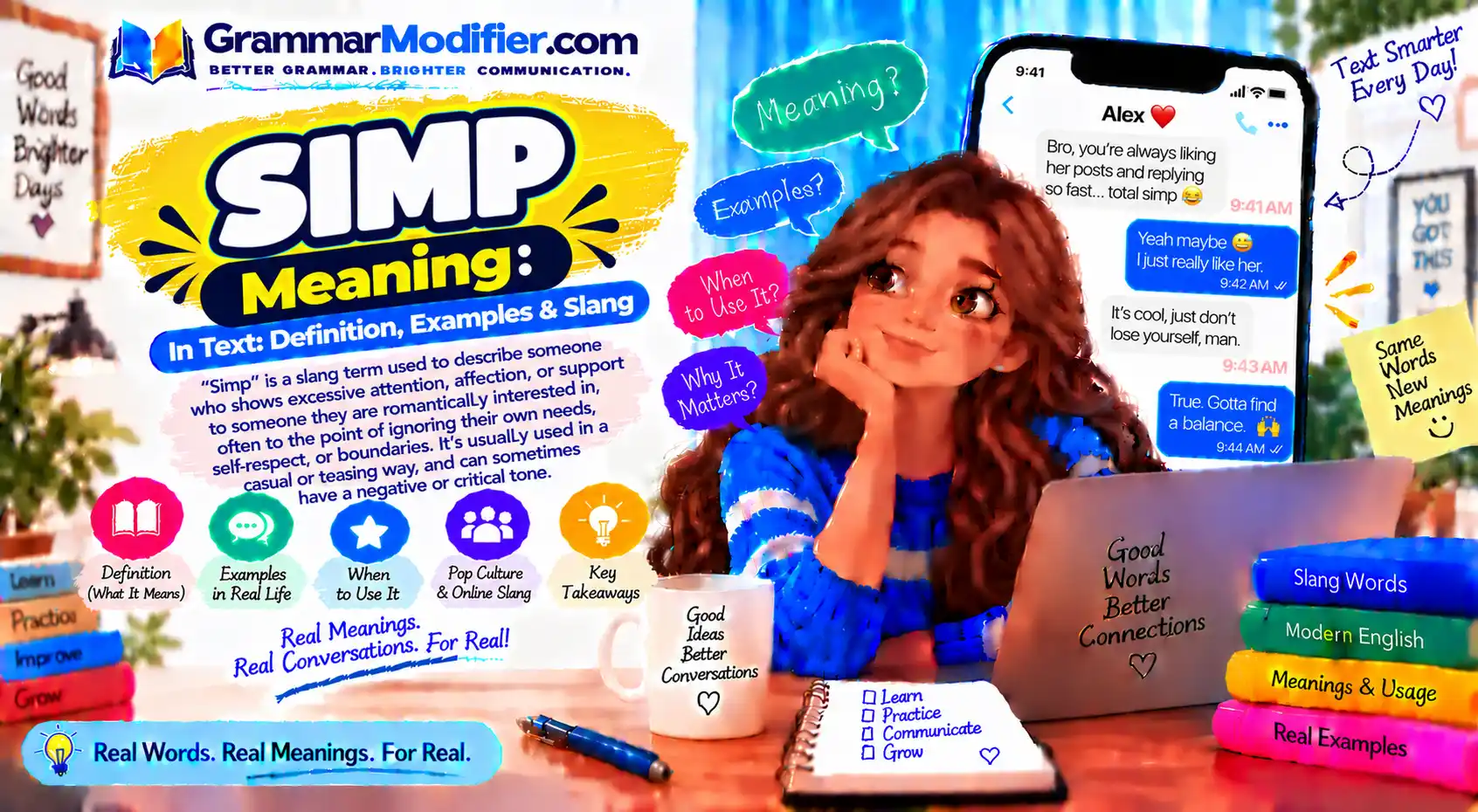
This guide explains simp meaning in text and how the slang word works in everyday American English.
You’ll learn its meanings, common phrases, tone, word forms, origin, and practical examples.
The guide also compares simp with related words such as crush, fan, and stan.
If you saw simp in a text, comment, or group chat, this guide explains exactly what the word usually means. In modern American internet slang, simp often describes someone who seems overly devoted, attentive, or admiring toward another person.
The tricky part is tone. A friend might call you a simp as a joke, while another person might use it as a criticism. Below, you’ll see how the word works in real messages, how simping and simp for differ, and when the label does not really fit.
Quick Answer
Simp meaning in text usually refers to someone who seems overly devoted, attentive, or admiring toward another person. It can be playful, humorous, or critical depending on the conversation.
TL;DR
- Simp is informal American English slang.
- It can describe excessive attention or admiration.
- Simping means acting in that way.
- Simp for someone means strongly admiring them.
- A crush does not automatically make someone a simp.
- Tone determines whether the word sounds playful or insulting.
What Does Simp Mean in Text?
In texting, simp commonly describes a person who appears to be trying unusually hard to please, impress, or support someone they like. The word often carries the idea that the attention is excessive or one-sided.
Modern dictionaries recognize related meanings. Cambridge lists both a person who tries too hard to satisfy another person and someone who strongly likes or admires someone. It also lists simp as a verb.
Examples:
- “You bought her favorite snack again? Simp.”
- “Bro, you’re such a simp.”
- “I’m not a simp. I just like her.”
- “Everyone in the comments is simping.”
The meaning is usually clear from the surrounding conversation.
What Does “You’re a Simp” Mean?
When someone texts “you’re a simp,” they usually mean that you seem extremely attentive or devoted to someone you like. The statement can be teasing rather than a serious judgment.
For example, a friend might send “You’re a simp 😂” after you talk excitedly about your crush. The same words can sound more negative if someone uses them during an argument.
| Text | Likely meaning |
|---|---|
| “You’re a simp 😂” | Playful teasing |
| “Stop simping for her.” | Criticism of excessive attention |
| “I’m such a simp for this show.” | Humorous self-description |
| “He’s a simp.” | Negative or critical judgment |
The emoji, relationship between speakers, and surrounding messages can change the tone.
Simp Meaning in Chat and Texting
In group chats and private messages, simp is usually short, casual slang. People may use it as a one-word reaction when a friend appears especially interested in someone.
The word can also be used without a romantic meaning. Someone might jokingly say they simp for a singer, actor, fictional character, sports team, or favorite creator.
- “You replied immediately. Simp behavior.”
- “I totally simp for that actor.”
- “Why are you simpping over this character?”
- “The whole chat is simpping right now.”
- “I’m a simp for good music.”
- “Okay, simp, calm down.”
These uses are informal and conversational rather than appropriate for formal writing.
What Does Simping Mean?
Simping is the -ing form of the informal verb simp. It describes the act of showing unusually strong attention, admiration, or devotion.
Cambridge lists simp as a verb meaning to try too hard to do what someone wants or to like and admire someone very much.
Examples:
- “He’s simping for his favorite actor.”
- “Why are you simping so hard?”
- “I’m not simping; I just enjoy their music.”
- “She was simping over the new character.”
- “Everyone started simping after the announcement.”
The phrase “simping hard” simply intensifies the idea. It suggests especially strong or noticeable admiration.
What Does “Simp for Someone” Mean?
Simp for someone means to show very strong admiration, attention, or devotion toward that person. In casual online speech, it often describes a crush or intense admiration.
The phrase does not always describe a real relationship. People commonly use it jokingly for celebrities, fictional characters, musicians, athletes, and creators.
Examples:
- “He really simps for his favorite singer.”
- “She simps for that actor.”
- “I simp for this fictional character.”
- “Why do you simp for him so much?”
- “I’m definitely a simp for that band.”
The phrase “simp for me” can therefore mean, “Be extremely devoted to me” or, more jokingly, “Admire me a lot.”
Is Simp an Insult?
Simp can be an insult, but it is not always intended seriously. Dictionaries label some modern senses as disapproving or disparaging.
Among friends, however, the word may simply be playful teasing. Look at the speaker’s relationship and the surrounding message before deciding how seriously to take it.
- Playful: “Bro, you’re a simp 😂”
- Critical: “Stop simping and think about what happened.”
- Self-joking: “I’m such a simp for this character.”
- Defensive: “I’m not simping. I just respect her.”
- Neutral discussion: “People use simp differently online.”
A useful distinction is that being kind or supportive does not automatically make someone a simp.
Is Simp a Bad Word?
Simp is informal slang, so it is usually better suited to casual conversation than formal English. Oxford labels the modern noun informal and offensive, while Cambridge marks it as US informal.
That does not mean every use is equally offensive. Still, calling another person a simp can feel insulting because the word may criticize their behavior.
For formal writing, alternatives depend on the intended meaning:
- Overly devoted
- Excessively attentive
- Very admiring
- Overly eager
- Strongly devoted
- A devoted fan
Simp Meaning on Social Media
On social media, simp appears in comments, posts, memes, group chats, and discussions about celebrities or creators. The word is often exaggerated for humor.
A person might call themselves a simp because they are enthusiastic about a favorite celebrity or fictional character. In that context, the speaker may not be making a serious statement about their behavior.
Common online uses include:
- “Simp alert!”
- “He’s simping again.”
- “I’m a simp for this character.”
- “The comments are full of simps.”
- “That’s some serious simp energy.”
- “Not me simpping over this scene.”
Social-media slang changes quickly, so the exact tone can vary between communities.
Can a Girl Be Called a Simp?
Yes. In current casual usage, simp can describe people of any gender.
Some older explanations focused heavily on men, especially in romantic situations. Modern internet usage is broader and can describe anyone who seems excessively admiring or devoted.
- “She’s a simp for that singer.”
- “He’s a simp for his favorite actor.”
- “They’re simpping over the new character.”
- “I’m a simp for this whole series.”
The important part is the behavior being described, not the person’s gender.
Does Having a Crush Make You a Simp?
No. Having a crush does not automatically make someone a simp.
A crush simply means you strongly like or feel attracted to someone. Simp adds a judgment about how much attention, effort, or admiration the person is showing.
| Term | Basic meaning |
|---|---|
| Crush | Someone you strongly like or feel attracted to |
| Simp | Someone described as overly devoted or attentive |
| Fan | Someone who likes or supports a person or thing |
| Stan | Informal slang for an extremely devoted fan |
For example, texting your crush does not automatically make you a simp. A friend might use the label if they think you are going unusually far to impress that person.
Simp vs. Fan vs. Stan
These words can overlap, but they are not identical.
Simp usually focuses on excessive attention or devotion toward a person. Fan is much broader and does not automatically suggest excessive behavior.
Stan generally describes a highly devoted fan or supporter. Unlike simp, it does not necessarily focus on trying to please someone personally.
Examples:
- “I’m a fan of Taylor Swift.” → ordinary admiration
- “I stan Taylor Swift.” → very strong fandom
- “I simp for Taylor Swift.” → exaggerated or intense admiration
- “He’s a simp for his crush.” → unusually devoted attention
These distinctions are informal, so real-world usage can overlap.
Is Simp a Noun or a Verb?
Simp can function as both a noun and a verb in informal American English.
As a noun, it describes a person:
“He’s a simp.”
As a verb, it describes the behavior:
“He simps for her.”
Common forms include:
- simp — noun or base verb
- simps — plural noun or third-person verb
- simped — past-tense verb
- simping — present-participle form
The spelling simping is used in standard English-style verb formation, even though simp itself is slang.
Where Did the Word Simp Come From?
The history of simp has more than one layer.
Oxford identifies the older word as an early-20th-century abbreviation of simpleton, meaning a foolish or unintelligent person. Dictionary.com also records an older simp sense as a shortening of simpleton and gives a separate later slang entry.
That history is important because the modern slang meaning should not be reduced to the popular claim that SIMP began as a fixed acronym. The dictionary evidence supports a more complicated history.
Today, the modern slang sense is widely used for excessive attention, devotion, or admiration.
Common Mistakes When Using Simp
Because simp is slang, learners sometimes apply it too broadly.
- Mistake: “Anyone with a crush is a simp.”
- Better: A crush describes feelings; simp comments on someone’s behavior.
- Mistake: “Simp always means something bad.”
- Better: It can be teasing, humorous, or critical.
- Mistake: “Simp is formal English.”
- Better: Treat it as informal slang.
- Mistake: “Being kind makes you a simp.”
- Better: Kindness alone does not establish the slang meaning.
- Mistake: “Simp always means a man.”
- Better: Current casual usage can describe any gender.
- Mistake: “Simp only applies to romantic relationships.”
- Better: People also use it for celebrities, creators, characters, and other strong admiration.
- Mistake: “Simp and fan mean exactly the same thing.”
- Better: Fan is broader and usually lacks the negative judgment.
- Mistake: “The acronym explanation is definitely the origin.”
- Better: Established dictionary sources trace an older sense to simpleton.
Simp Examples in Everyday Texts
The best way to understand simp meaning in text is to see how tone changes the interpretation.
Example: Friendly Teasing
Alex: “I bought her favorite snack again.”
Jordan: “Bro, you’re such a simp 😂”
Here, simp is probably playful teasing.
Example: Criticism
Alex: “I keep doing everything she asks.”
Jordan: “Stop simping for her.”
Here, the speaker is criticizing what they see as excessive effort.
Example: Self-Description
“I’m such a simp for this actor.”
This is likely humorous self-admission of strong admiration.
Example: Fandom
“Everyone is simpping over the new character.”
Here, the word exaggerates strong admiration.
Example: Disagreeing With the Label
“He brought her coffee once. That doesn’t make him a simp.”
This shows that the label itself can be subjective.
Example: Non-Romantic Use
“I’m a simp for really good mystery novels.”
Here, simp for is being used humorously to mean really love or admire something.
FAQs
What does simp mean in text messages?
In text messages, simp usually describes someone who seems unusually devoted, attentive, or admiring toward another person. It can be playful or critical depending on the conversation.
What does “you’re a simp” mean?
It usually means the speaker thinks you are giving someone a lot of attention or effort. Between friends, it may simply be teasing.
What does “simping” mean?
Simping means showing the behavior associated with simp. It can mean trying very hard to please someone or strongly admiring them.
Is simp an insult?
It can be. Cambridge and Oxford identify negative or disapproving uses, but people also use the word jokingly or about themselves.
Can girls be called simps?
Yes. Modern casual usage can apply simp to people of any gender.
Is simp short for simpleton?
The older noun simp is documented as a shortening of simpleton. Modern slang has developed additional meanings, so the historical and current senses should not be treated as identical.
Does having a crush make you a simp?
No. A crush describes strong romantic interest, while simp is an informal label for behavior someone considers excessively devoted or attentive.
Conclusion
Simp meaning in text usually points to someone who seems unusually devoted, attentive, or admiring toward another person. The word can be humorous, teasing, or critical, so the surrounding conversation matters.
When you see simp, simping, or simp for in a message, look at the sentence and the speaker’s tone. A good next step is to compare it with related slang such as stan, crush, fan, and admirer so you can understand the difference in real conversations.