
Quick Answer
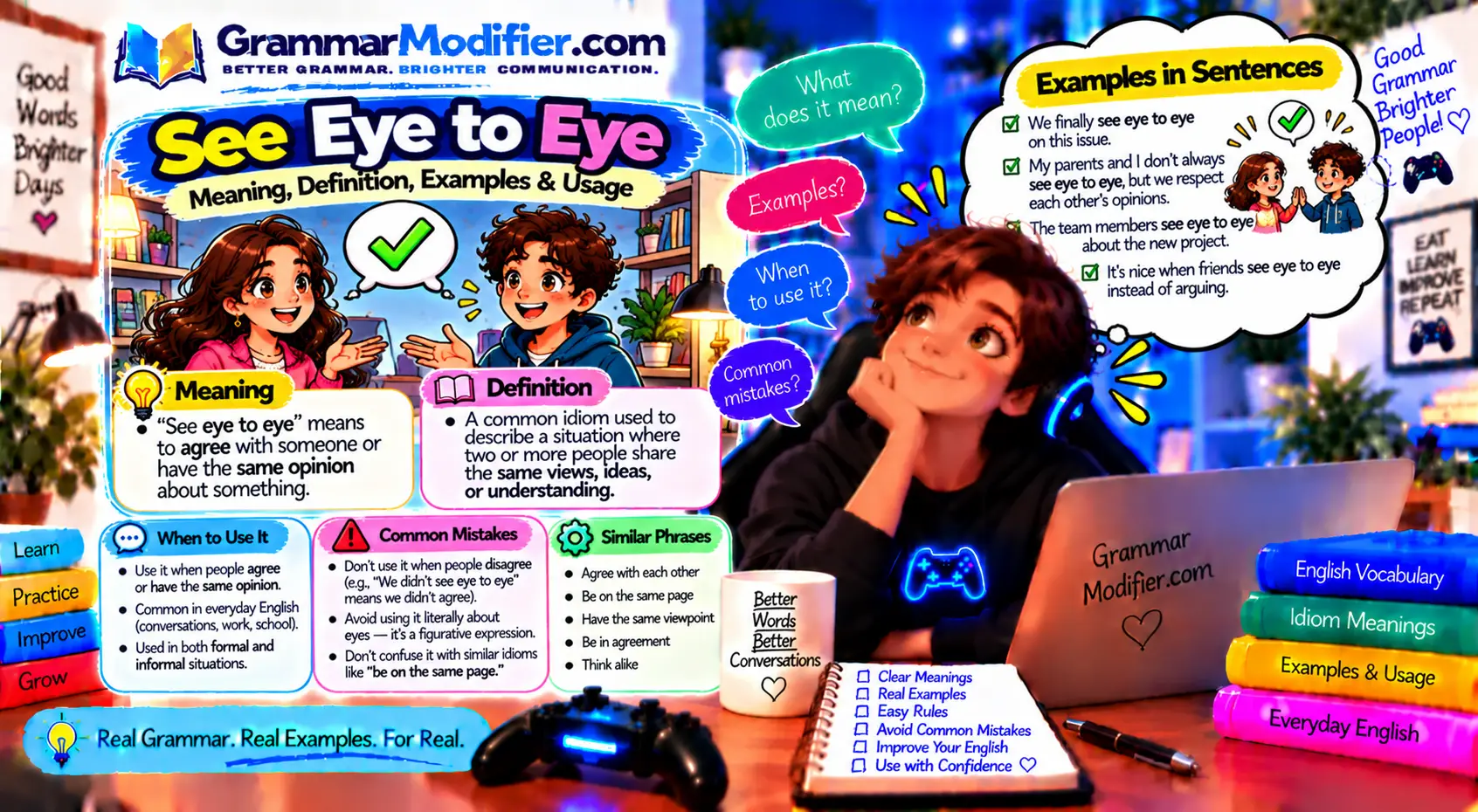
See eye to eye means to agree with someone or share the same opinion.
You usually use it for people who agree about a particular subject.
TL;DR
- See eye to eye means to agree.
- Use with before the person.
- Use on or about before the topic.
- Not see eye to eye means disagree.
- The phrase is common in everyday American English.
- Agree is a simpler alternative.
What Does See Eye to Eye Mean?
See eye to eye is an idiom meaning to agree with someone. It describes people who have the same opinion, view, or position about something.
For example, if two coworkers agree about a project, you can say, “They see eye to eye on the project.”
The phrase doesn’t usually describe physical eye contact. Its modern meaning is about agreement, not simply looking at another person.
How Do You Use See Eye to Eye?
The most useful pattern is:
see eye to eye with + person
You can add a topic with on or about.
- I see eye to eye with my sister.
- We see eye to eye on most decisions.
- They see eye to eye about the new schedule.
- She doesn’t see eye to eye with her manager.
- The students see eye to eye on the answer.
- My friends don’t see eye to eye about the trip.
- We finally saw eye to eye.
- They have never seen eye to eye on money.
See Eye to Eye With Someone
Use with when you name the person you agree with. This is the most important pattern to remember.
Don’t place the person directly after see eye to eye.
- Correct: I see eye to eye with Alex.
- Correct: She sees eye to eye with her teacher.
- Correct: We don’t see eye to eye with them.
- Incorrect: I see eye to eye Alex.
- Incorrect: She sees eye to eye her teacher.
- Correct: We don’t always see eye to eye.
See Eye to Eye on or About Something
Both on and about can introduce the subject of agreement. The best choice depends on the sentence and context.
- We see eye to eye on the plan.
- They see eye to eye about the schedule.
- I see eye to eye with her on this issue.
- We don’t see eye to eye about money.
- The managers saw eye to eye on the changes.
- They rarely see eye to eye about politics.
- My parents see eye to eye on education.
- The team sees eye to eye about the deadline.
See Eye to Eye Examples
The idiom works in many everyday situations. It can describe agreement between friends, relatives, coworkers, classmates, or groups.
- My brother and I see eye to eye on music.
- The teachers don’t see eye to eye about the schedule.
- We saw eye to eye after discussing the problem.
- My parents and I don’t always see eye to eye.
- The partners see eye to eye on the company’s direction.
- Sarah sees eye to eye with her coach.
- The students didn’t see eye to eye on the answer.
- The two teams finally saw eye to eye.
What Does Not See Eye to Eye Mean?
Not see eye to eye means to disagree with someone. It doesn’t automatically suggest an argument or personal conflict.
This form is especially useful when you want to describe different opinions in a neutral way.
- We don’t see eye to eye on everything.
- I don’t see eye to eye with my brother.
- They didn’t see eye to eye about the decision.
- She never sees eye to eye with her coworker.
- The managers don’t see eye to eye on the proposal.
- My friends and I don’t always see eye to eye.
- The two groups couldn’t see eye to eye.
- They can disagree without having a serious conflict.
See Eye to Eye Verb Forms
The idiom follows normal English verb patterns. The words eye to eye don’t change.
- Present: We see eye to eye.
- Third person: She sees eye to eye.
- Past: They saw eye to eye.
- Continuous: We are seeing eye to eye.
- Perfect: They have seen eye to eye.
- Negative: I don’t see eye to eye with him.
- Past negative: She didn’t see eye to eye with them.
- Present perfect: We haven’t always seen eye to eye.
See Eye to Eye Synonyms
The best synonym depends on the level of formality and the exact meaning.
| Expression | Typical meaning |
|---|---|
| agree | Have the same opinion |
| have the same opinion | Share an opinion |
| share the same view | Hold a similar viewpoint |
| be in agreement | Agree in a more formal style |
| think alike | Think in similar ways |
| be of the same mind | Have the same opinion |
| be on the same wavelength | Understand or think similarly |
| be on the same page | Share understanding or expectations |
See Eye to Eye vs. Be on the Same Page
These expressions are similar, but their emphasis can differ.
See eye to eye focuses on having the same opinion. Be on the same page often focuses on having the same understanding, plan, or expectations.
- We see eye to eye on the issue.
- We’re on the same page about the deadline.
- The partners see eye to eye about the decision.
- The whole team is on the same page.
Use see eye to eye when agreement is the main idea.
See Eye to Eye vs. Agree
Agree is the simpler and more direct expression. See eye to eye sounds more idiomatic and conversational.
- I agree with my manager.
- I see eye to eye with my manager.
- They agree on the plan.
- They see eye to eye on the plan.
Both can be correct. Choose based on your preferred tone and context.
See Eye to Eye vs. Compromise
See eye to eye means people agree. Compromise means people reach an arrangement despite different starting positions.
For example, two coworkers may not see eye to eye about a schedule. They might compromise by choosing a time that works for both.
So, agreement and compromise aren’t the same thing.
Is See Eye to Eye Formal or Informal?
See eye to eye is common in everyday American English. It also works in many workplace and general writing contexts.
For highly formal writing, a direct phrase can sometimes sound more precise.
- Conversational: We don’t see eye to eye.
- Neutral: We don’t agree on this issue.
- Formal: We do not share the same view.
- Formal: The two groups are not in agreement.
The expression itself isn’t incorrect or unprofessional. Context determines whether another phrase sounds more appropriate.
Common Mistakes With See Eye to Eye
The most common errors involve missing prepositions or incorrect verb forms.
- Wrong: I see eye to eye my sister.
- Correct: I see eye to eye with my sister.
- Wrong: She see eye to eye with me.
- Correct: She sees eye to eye with me.
- Wrong: They saw eyes to eyes.
- Correct: They saw eye to eye.
- Wrong: We see eye to eye each other.
- Correct: We see eye to eye with each other.
- Wrong: They don’t see eyes to eyes.
- Correct: They don’t see eye to eye.
How Do You Pronounce See Eye to Eye?
The phrase is commonly pronounced approximately as:
see eye tuh eye
The word to is often reduced in natural speech. The phrase should sound like one connected expression rather than three separate ideas.
When practicing, say it in a complete sentence:
“We don’t see eye to eye on that issue.”
What Is the Origin of See Eye to Eye?
The phrase is associated with wording found in Isaiah 52:8 in the King James Bible. Historical sources note that the original context differs from the modern meaning of agreement.
Today, see eye to eye has a well-established figurative meaning: to agree or share the same opinion. Learners generally don’t need the historical meaning to use the modern expression correctly.
How to Practice See Eye to Eye
Practice the phrase by changing the person, topic, and verb tense.
- Write a sentence using with someone.
- Write another using on something.
- Write one using about something.
- Change see to saw.
- Make a positive sentence negative.
- Replace agree with see eye to eye.
- Write an example about school.
- Write an example about work.
- Write an example about family.
- Write an example about friends.
Quick Reference: See Eye to Eye
Remember these patterns when using the idiom in conversation or writing.
- Meaning: agree or share the same opinion
- Person: see eye to eye with someone
- Topic: see eye to eye on/about something
- Negative: don’t see eye to eye
- Past: saw eye to eye
- Perfect: have seen eye to eye
- Synonym: agree
- Opposite: disagree
FAQs
What does “see eye to eye” mean?
It means to agree with someone or share the same opinion. Cambridge and Collins give the expression this agreement-based meaning.
What does “not see eye to eye” mean?
It means to disagree or have different opinions. It can describe a simple difference of opinion without suggesting a serious argument.
Can I say “see eye to eye with someone”?
Yes. This is one of the most common patterns: see eye to eye with + person.
Can I say “see eye to eye on something”?
Yes. On can introduce the topic, as in “We see eye to eye on the proposal.”
Is “see eye to eye” an idiom?
Yes. Its modern meaning is figurative because it describes agreement rather than literal eye contact.
What is the opposite of “see eye to eye”?
Common opposites include disagree, differ, see things differently, and have different views. The best choice depends on the sentence.
Conclusion
See eye to eye means to agree with someone or share the same opinion. It works naturally in conversations about family, friendships, school, work, and everyday decisions.
Remember the core patterns: see eye to eye with someone and see eye to eye on/about something. Write a few original sentences using these patterns to make the idiom easier to remember.