
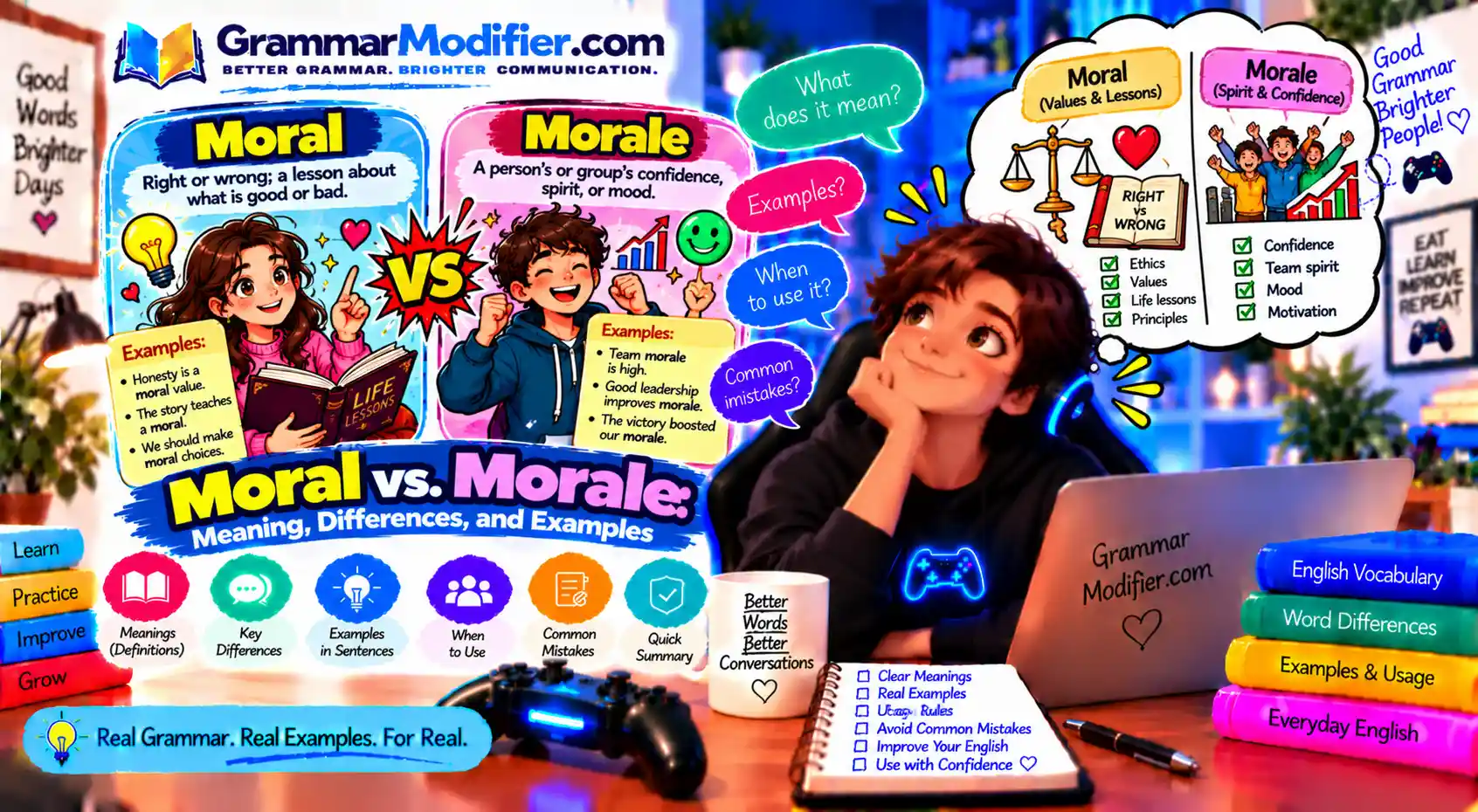
Moral vs morale may look like nearly identical words, but they describe different things. Moral usually concerns right and wrong or the lesson of a story. Morale describes someone’s confidence, enthusiasm, or determination.
Imagine a coach who refuses to cheat, even when winning seems impossible. That coach makes a moral decision. If the players feel encouraged by the coach’s honesty, their morale may improve.
The words are closely related in spelling, but choosing the right one depends on what you want to say. This guide explains moral vs. morale through clear definitions, grammar rules, pronunciation, everyday examples, and common expressions.
Quick Answer: Moral vs. Morale
Moral means connected to ethical principles, right and wrong, or a lesson learned from a story.
Morale means confidence, enthusiasm, determination, or emotional spirit.
Examples:
- ⚖️ “She faced a difficult moral choice.”
- 📖 “The moral of the story is to be honest.”
- 💪 “The victory boosted the team’s morale.”
- 🌟 “Positive feedback improved employee morale.”
Memory trick: Moral = right and wrong. Morale = confidence and spirit.
TL;DR
| Word | Meaning | Example |
|---|---|---|
| Moral | Ethical or related to right and wrong | A moral decision |
| Moral | Lesson from a story | The moral of the story |
| Morals | Principles of acceptable behavior | Strong morals |
| Morale | Confidence and enthusiasm | High team morale |
| Morality | Principles or standards of right and wrong | Questions of morality |
Bottom line: Use moral for ethics and lessons. Use morale for confidence and enthusiasm. Remember that moral support and moral victory are established expressions.
Moral vs. Morale: Quick Difference
The easiest way to choose between moral and morale is to identify the meaning of your sentence.
Use moral when talking about ethical behavior, responsibilities, principles, or lessons.
Use morale when describing how confident, motivated, or enthusiastic someone feels.
Compare:
- “The principal made a moral decision to treat every student fairly.”
- “The principal’s announcement improved student morale.”
The first sentence focuses on fairness. The second focuses on students’ feelings.
These ideas can be connected. Fair treatment may improve morale, but that does not make the two words interchangeable.
Quick test: Can you replace the word with ethical? Choose moral. Can you replace it with confidence or spirit? Choose morale.
What Does Moral Mean?
Moral is both an adjective and a noun. Its meaning depends on how it appears in a sentence.
Moral as an Adjective
As an adjective, moral describes something related to ethical principles or judgments about right and wrong.
Examples:
- “She felt a moral obligation to help.”
- “The decision raised serious moral questions.”
- “He refused to abandon his moral values.”
A moral decision is not necessarily an easy decision. It may involve competing responsibilities or difficult consequences.
Moral as a Noun
As a noun, moral often means the lesson communicated by a story or experience.
Example:
“The moral of the fable is that honesty matters.”
The word can also appear in the plural form morals, meaning a person’s principles of right and wrong.
Key point: Moral describes ethics or a lesson, while morals refers to ethical principles.
What Does Morale Mean?
Morale is a noun describing confidence, enthusiasm, determination, or emotional outlook.
People often use it when discussing workplaces, sports teams, classrooms, military units, and organizations.
Examples:
- “The successful launch improved employee morale.”
- “The coach tried to rebuild the players’ morale.”
- “The volunteers maintained high morale during the difficult week.”
Can Morale Describe One Person?
Yes. Although group morale is especially common, morale can also describe an individual’s confidence or emotional condition.
Example:
“After several disappointing results, her morale began to decline.”
High Morale vs. Low Morale
High morale means people feel encouraged, confident, or determined.
Low morale means people feel discouraged or less enthusiastic.
Morale does not necessarily tell you whether someone behaves ethically.
Remember: A person can have strong morals while experiencing low morale.
Moral vs. Morale Comparison Chart
| Feature | Moral | Morale |
|---|---|---|
| Main meaning | Ethics or a lesson | Confidence or emotional spirit |
| Part of speech | Adjective or noun | Noun |
| Typical context | Values, stories, decisions | Work, sports, school, personal outlook |
| Common phrase | Moral responsibility | Team morale |
| Related to right and wrong | Usually | Not directly |
| Related to confidence | In certain expressions | Yes |
| Example | A moral dilemma | A morale boost |
Compare These Situations
Situation 1: A workplace decision
“The manager had a moral responsibility to report the problem.”
The sentence concerns ethical duty.
Situation 2: A workplace setback
“The unexpected layoffs damaged employee morale.”
The sentence concerns confidence and emotional outlook.
Situation 3: A story
“The moral of the story is to keep your promises.”
The sentence concerns a lesson.
Situation 4: A competition
“The unexpected victory raised the team’s morale.”
The sentence concerns enthusiasm.
How to Pronounce Moral and Morale
Although their spellings are similar, moral and morale have different pronunciations in American English.
| Word | Pronunciation | Stressed syllable |
|---|---|---|
| Moral | MOR-ul | First |
| Morale | muh-RAL | Second |
Pronouncing Moral
Moral is commonly pronounced /ˈmɔrəl/, with emphasis on the first syllable.
Say: MOR-ul.
Example: “The book explores moral questions.”
Pronouncing Morale
Morale is commonly pronounced /məˈræl/, with emphasis on the second syllable.
Say: muh-RAL.
Example: “The announcement boosted team morale.”
Practice Phrases
- Moral values — MOR-ul values
- Moral support — MOR-ul support
- Employee morale — employee muh-RAL
- Low morale — low muh-RAL
Both words generally have two syllables. Their stress patterns provide the clearest pronunciation difference, although vowel sounds may vary by accent.
How to Use Moral in a Sentence
Use moral when writing about ethics, values, lessons, or established expressions.
Ethics and Responsibilities
- “The judge considered the moral implications of the case.”
- “She faced a difficult moral dilemma.”
- “Honesty is an important moral principle.”
- “He felt a moral duty to protect his neighbors.”
- “The students debated a challenging moral question.”
Personal Values
- “Her moral beliefs shaped her decision.”
- “The teacher encouraged moral development.”
- “He followed his moral compass.”
- “The policy raised moral concerns.”
- “They discussed their moral responsibilities.”
Stories and Expressions
- “The moral of the story is to be patient.”
- “The fable teaches a simple moral.”
- “Her friends offered moral support.”
- “The losing team claimed a moral victory.”
- “The film presents a complicated moral choice.”
Writing tip: Look for phrases such as moral values, moral obligation, moral dilemma, and moral of the story.
How to Use Morale in a Sentence
Use morale when describing confidence, motivation, enthusiasm, or determination.
Workplace Examples
- “The manager introduced a program to improve employee morale.”
- “Unclear expectations lowered staff morale.”
- “Recognition from leadership helped boost morale.”
- “The team maintained high morale during the transition.”
- “Regular communication helped protect workplace morale.”
Sports and Education Examples
- “The coach’s speech raised player morale.”
- “A difficult season tested the team’s morale.”
- “The school celebration improved student morale.”
- “Encouragement from classmates lifted her morale.”
- “The victory gave the players a much-needed morale boost.”
Everyday Examples
- “His morale improved after receiving good news.”
- “Repeated setbacks weakened the volunteers’ morale.”
- “The group remained cheerful despite the delays, keeping morale high.”
- “Supportive friends helped restore her morale.”
- “The unexpected success improved everyone’s morale.”
Usage tip: Common combinations include high morale, low morale, boost morale, and team morale.
Moral as an Adjective and Noun
Understanding parts of speech can prevent confusion between these words.
Moral as an Adjective
An adjective modifies a noun.
Examples:
- “It was a moral decision.”
- “She faced a moral dilemma.”
- “They discussed moral responsibility.”
Here, moral tells readers what kind of decision, dilemma, or responsibility is involved.
Moral as a Noun
As a noun, moral usually refers to a lesson.
Examples:
- “The moral is to treat others fairly.”
- “What is the moral of this story?”
- “The author explains the moral at the end.”
Morals as a Plural Noun
Morals refers to principles of acceptable conduct.
Examples:
- “She has strong morals.”
- “His morals influence his choices.”
- “They share similar morals.”
| Form | Grammar | Meaning |
|---|---|---|
| Moral | Adjective | Ethical |
| Moral | Noun | Lesson |
| Morals | Plural noun | Ethical principles |
| Morale | Noun | Confidence or spirit |
Grammar tip: The plural of moral when referring to ethical principles is morals, not morales.
Moral Support vs. Morale Boost
This is one of the most useful distinctions because both expressions concern people’s feelings.
What Is Moral Support?
Moral support means emotional encouragement, reassurance, or backing.
It often describes helping someone feel supported without necessarily providing money, supplies, or direct practical assistance.
Example:
“Her friends provided moral support before the job interview.”
The friends encouraged her.
What Is a Morale Boost?
A morale boost is something that increases confidence, enthusiasm, or determination.
Example:
“The manager’s praise gave the employees a morale boost.”
The praise improved their spirits.
Moral Support vs. Morale Boost
| Expression | Meaning | Example |
|---|---|---|
| Moral support | Emotional encouragement | Friends offered moral support. |
| Morale boost | Increase in confidence | The award provided a morale boost. |
| Boost morale | Improve emotional spirit | The celebration boosted morale. |
| Offer moral support | Encourage someone | The family offered moral support. |
Common mistake:
Incorrect: “She offered morale support.”
Correct: “She offered moral support.”
Remember: The established expression is moral support, even though it relates to feelings.
Moral Victory, Moral Compass, and Other Expressions
Some uses of moral go beyond a straightforward ethical meaning.
Moral Victory
A moral victory is an outcome that provides satisfaction or a sense of meaningful achievement even when someone does not actually win.
Example:
“The inexperienced team lost by one point, but the players considered their performance a moral victory.”
The team gained satisfaction from its performance.
Moral Compass
A moral compass is someone’s internal sense of right and wrong.
Example:
“Her moral compass helped her make the difficult decision.”
Moral Obligation
A moral obligation is a responsibility based on ethical principles.
Example:
“He felt a moral obligation to help the injured stranger.”
Moral Certainty
Moral certainty describes strong conviction or confidence about something.
Example:
“She expressed moral certainty that the decision was justified.”
Expression Guide
| Expression | Meaning |
|---|---|
| Moral victory | Satisfaction without an actual win |
| Moral compass | Sense of right and wrong |
| Moral obligation | Ethical duty |
| Moral support | Emotional encouragement |
| Moral dilemma | Difficult ethical choice |
Key point: Familiar expressions should be learned as phrases, not reconstructed from spelling rules alone.
Moral vs. Morale in the Workplace
Workplaces provide clear examples of how moral and morale describe different concerns.
Moral Issues at Work
A moral issue involves ethical conduct or a question about right and wrong.
Examples:
- “The supervisor faced a moral dilemma about reporting misconduct.”
- “Treating employees fairly is a moral responsibility.”
- “The decision raised important moral questions.”
Morale Issues at Work
A morale issue concerns employee confidence, enthusiasm, or motivation.
Examples:
- “Long working hours lowered employee morale.”
- “The new policy improved staff morale.”
- “The manager organized a celebration to boost team morale.”
Can Moral Leadership Improve Morale?
Yes. Fairness, honesty, and respectful treatment may help employees feel valued and confident.
However, ethical behavior and employee morale are not identical concepts. A decision can be ethically justified while still disappointing employees.
Professional tip: Use moral leadership for ethical conduct and employee morale for workplace confidence and enthusiasm.
Moral vs. Morale in Sports and Everyday Life
Sports offer a useful comparison because teams make ethical choices while also experiencing changes in confidence.
Moral in Sports
“The athlete made a moral decision to admit breaking the rules.”
This concerns honesty and fairness.
“The coach emphasized moral responsibility.”
This concerns ethical conduct.
Morale in Sports
“The victory improved team morale.”
This concerns confidence.
“The losing streak damaged player morale.”
This concerns discouragement.
Everyday Life
Moral: “Returning the lost wallet was the moral choice.”
Morale: “The encouraging message improved her morale.”
One Situation, Both Words
“The coach’s moral decision to treat every player fairly helped improve team morale.”
Here, moral describes ethical conduct, while morale describes the players’ emotional outlook.
Memory trick: Fair play is moral. Team spirit is morale.
Moral vs. Morale vs. Morals vs. Morality
These four forms are closely related in spelling but should not be used interchangeably.
Moral
An adjective concerning ethics or a noun meaning a lesson.
“She faced a moral dilemma.”
Morale
A noun referring to confidence or emotional spirit.
“The team’s morale improved.”
Morals
A plural noun referring to principles of right and wrong.
“He has strong morals.”
Morality
A noun referring to ethical principles, standards, or systems of right and wrong.
“The students discussed the relationship between law and morality.”
| Word | Meaning | Typical phrase |
|---|---|---|
| Moral | Ethical or a lesson | Moral decision |
| Morale | Confidence or enthusiasm | High morale |
| Morals | Ethical principles | Personal morals |
| Morality | Principles of right and wrong | Questions of morality |
Important: A person’s morals describe ethical principles. Their morale describes confidence and emotional outlook.
Moral vs. Ethical: Are They the Same?
Moral and ethical often overlap, but they can carry different emphases.
Both words concern right and wrong.
Moral is common when discussing personal principles, responsibilities, and judgments.
Ethical is especially common when discussing professional standards, codes of conduct, or systematic questions about behavior.
Examples:
- “She felt a moral obligation to help.”
- “The researcher followed ethical guidelines.”
- “The company reviewed its ethical standards.”
- “The decision raised serious moral concerns.”
These differences are tendencies, not strict rules. Both adjectives can describe personal or professional conduct.
Morale is separate from both words because it refers to confidence and emotional spirit.
Common Mistakes and Easy Memory Tricks
Here are common mistakes to avoid when choosing between moral and morale.
Incorrect vs. Correct Examples
| Incorrect | Correct | Why |
|---|---|---|
| Employee moral improved. | Employee morale improved. | Confidence |
| She faced a morale dilemma. | She faced a moral dilemma. | Ethics |
| The morale of the story is honesty. | The moral of the story is honesty. | Lesson |
| The victory boosted team moral. | The victory boosted team morale. | Team spirit |
| She has strong morales. | She has strong morals. | Ethical principles |
| Friends offered morale support. | Friends offered moral support. | Established phrase |
| They claimed a morale victory. | They claimed a moral victory. | Established phrase |
Memory Trick 1: Moral = Morality
Moral and morality share the same basic idea: right and wrong.
Memory Trick 2: Morale = Extra Energy
The extra e in morale can remind you of energy and enthusiasm.
This is a spelling aid, not the word’s origin.
Memory Trick 3: The Replacement Test
If you mean ethical, use moral.
If you mean confidence, use morale.
For fixed expressions, remember the complete phrase: moral support, moral victory, and morale boost.
Best memory rule: Moral = ethics or a lesson. Morale = confidence or enthusiasm.
Moral vs. Morale Practice Quiz
Choose the correct answer for each sentence.
Questions
1. The company’s new recognition program improved employee ______.
A. Moral
B. Morale
2. The children’s story teaches an important ______.
A. Moral
B. Morale
3. Her family provided ______ before the difficult exam.
A. Moral support
B. Morale support
4. Although the team lost, the players considered their performance a ______.
A. Moral victory
B. Morale victory
5. The coach’s encouragement gave the players a much-needed ______.
A. Moral boost
B. Morale boost
6. Which sentence is correct?
A. She has strong morals but low morale after the setback.
B. She has strong morale but low morals after the setback.
Answers With Explanations
1. B — Morale: The sentence concerns employee confidence and enthusiasm.
2. A — Moral: A story’s moral is its lesson.
3. A — Moral support: This established expression means emotional encouragement.
4. A — Moral victory: It means satisfaction or meaningful achievement without an actual win.
5. B — Morale boost: Encouragement increased the players’ confidence.
6. A — Strong morals but low morale: Morals refers to ethical principles, while morale refers to emotional outlook.
Copyable Answer Key: 1-B | 2-A | 3-A | 4-A | 5-B | 6-A
Frequently Asked Questions
What is the difference between moral and morale?
Moral concerns ethics, right and wrong, or the lesson of a story. Morale concerns confidence, enthusiasm, determination, or emotional spirit.
Is it employee moral or employee morale?
Employee morale is correct when describing workers’ confidence, enthusiasm, or emotional outlook. For example, “The new policy improved employee morale.”
Is it moral support or morale support?
Moral support is the established expression. It means encouragement, reassurance, or emotional backing.
What does low morale mean?
Low morale means reduced confidence, enthusiasm, or determination. It can affect an individual or a group.
Can one person have morale?
Yes. Although morale often describes groups, it can also refer to an individual’s confidence and emotional outlook.
Is it moral victory or morale victory?
Moral victory is correct. It refers to a sense of satisfaction or meaningful achievement despite not actually winning.
What is the difference between morals and morale?
Morals are principles about right and wrong. Morale describes confidence and emotional spirit. A person can have strong morals but low morale.
How can I remember moral vs. morale?
Remember moral = ethics and morale = enthusiasm. The extra e in morale can remind you of energy.
Conclusion
The difference between moral vs. morale is easier to remember when you focus on what each word describes.
Use moral for ethics, right and wrong, responsibilities, or lessons. Use morale for confidence, motivation, enthusiasm, and emotional spirit.
Remember the expressions moral support, moral victory, and morale boost, which are frequent sources of confusion.
Final memory rule: Moral = ethics or a lesson. Morale = confidence and enthusiasm.
With these distinctions in mind, you can use both words accurately in school assignments, workplace communication, and everyday writing.