
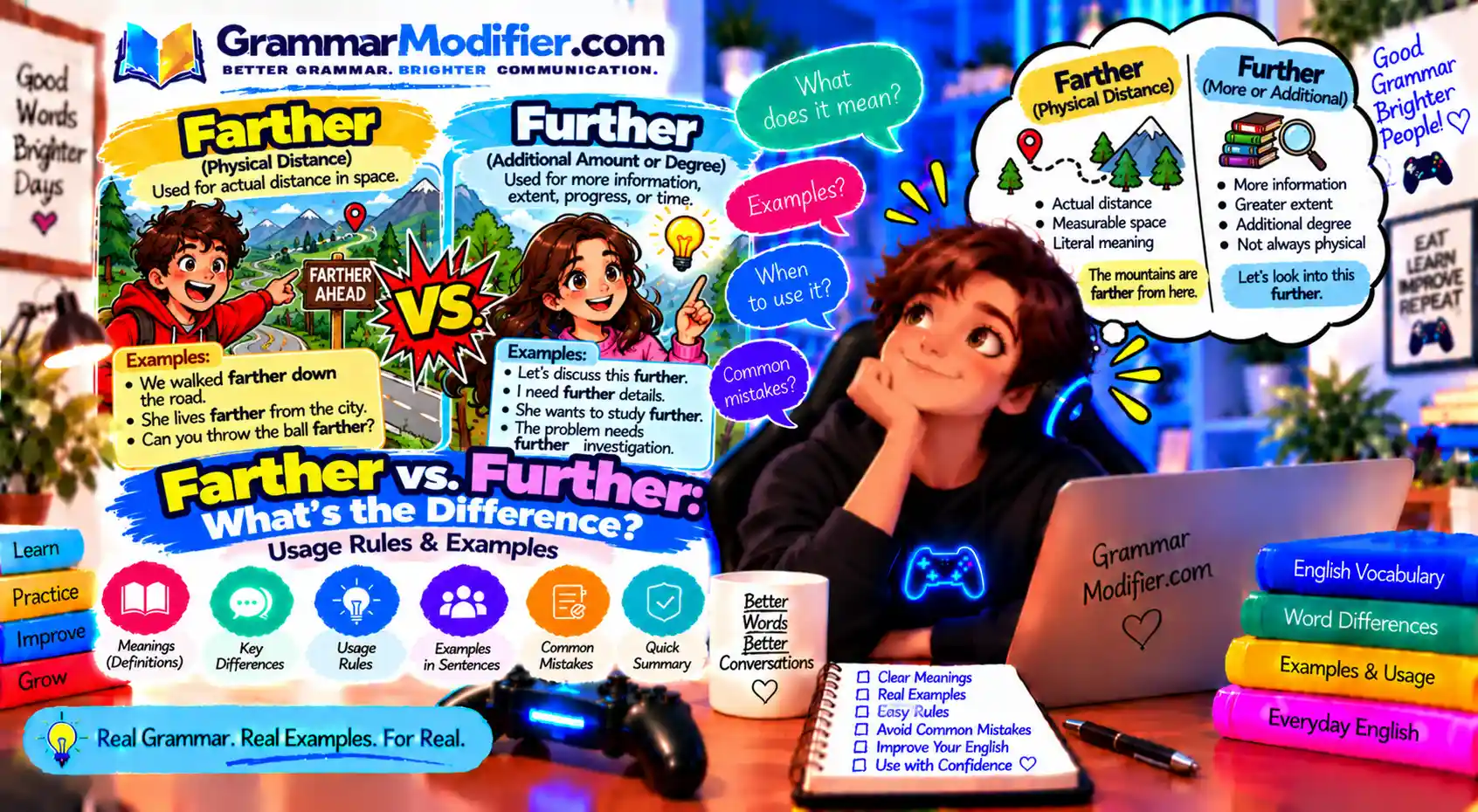
Farther and further both relate to distance, but they have different uses in everyday English. Farther usually describes a greater physical distance, while further often means additional, more, or to a greater extent.
For example, you might drive farther to reach a restaurant but ask for further information about its opening hours.
Here’s the important part: further can also describe physical distance. Both “walk farther” and “walk further” are grammatically correct.
The traditional distinction is particularly helpful in American English, where writers often prefer farther for measurable distances and further for additional information or figurative ideas.
This guide explains farther vs. further usage through simple grammar rules, pronunciation, comparisons, natural examples, common mistakes, and a practice quiz.
Quick Answer: Farther vs. Further
- 📏 Farther: Usually refers to greater physical distance.
- ➕ Further: Means additional, more, or to a greater extent. It can also describe physical distance.
- 🚀 Further as a verb: Means to advance, promote, or help something develop.
Examples:
- “The grocery store is farther from my house.”
- “Please provide further details.”
- “We should investigate the issue further.”
- “She wants to further her education.”
Easy memory trick: Farther = far away. Further = more or additional.
TL;DR
| Word | Main use | Example |
|---|---|---|
| Farther | Physical distance | We walked farther today. |
| Further | Additional information | We need further details. |
| Further | Greater extent | Let’s investigate further. |
| Further | Physical distance | They traveled further north. |
| Further | Verb meaning advance | Further your career. |
Bottom line: Use farther for physical distance when following the traditional American preference. Use further for additional information, progress, and advancement. Both words can describe physical distance.
Farther vs. Further: Quick Difference
The difference between farther and further depends on what you want to express.
Farther is most commonly used to compare physical distances between places, people, or objects.
Further has a wider range of meanings. It can describe additional information, continued action, greater progress, or physical distance.
Compare these sentences:
- “The airport is farther from downtown than the station.”
- “We need further discussion before making a decision.”
The first sentence compares locations. The second asks for more discussion.
However, “The airport is further from downtown” is also correct.
| Feature | Farther | Further |
|---|---|---|
| Physical distance | Yes | Yes |
| Additional information | No | Yes |
| Continued discussion | Not normally | Yes |
| Figurative extent | Sometimes | Commonly |
| Verb meaning advance | No | Yes |
| Comparative form of far | Yes | Yes |
Key takeaway: The physical-versus-figurative distinction is a helpful guideline, not an absolute grammar rule.
What Does Farther Mean?
Farther is a comparative form of far, commonly used to describe greater physical distance.
It functions as an adjective or adverb.
As an adjective, it describes a noun. As an adverb, it describes an action or movement.
Farther as an Adjective
- “The farther entrance is closed.”
- “We explored the farther side of the lake.”
- “The farther campsite has fewer visitors.”
Farther as an Adverb
- “She ran farther than her brother.”
- “We walked farther along the trail.”
- “The cyclist traveled farther than expected.”
These examples emphasize physical distance.
Writing tip: If you can naturally measure the distance in miles, feet, or kilometers, farther is usually an appropriate choice.
What Does Further Mean?
Further can function as an adjective, adverb, or verb.
It commonly means additional, more, or to a greater extent, but it can also refer to physical distance.
Further Meaning Additional
- “Please send further information.”
- “The report requires further explanation.”
- “No further action is necessary.”
Further Meaning Greater Extent
- “Let’s examine the problem further.”
- “The delay further complicated the situation.”
- “The team developed the idea further.”
Further Meaning Physical Distance
- “They continued further down the road.”
- “The hikers traveled further into the mountains.”
Further as a Verb
- “She wants to further her education.”
- “The organization works to further scientific research.”
Important: Further is more versatile than farther because it can express additional meaning and function as a verb.
Farther vs. Further Comparison Chart
The following examples show which word is preferred in common situations.
| Situation | Recommended word | Example |
|---|---|---|
| Running a longer distance | Farther | She ran farther today. |
| Additional details | Further | We need further details. |
| Greater driving distance | Farther | The hotel is farther away. |
| Continued investigation | Further | Investigate the matter further. |
| Additional research | Further | Further research is needed. |
| Advancing education | Further | Further your education. |
| Traveling north | Either | They traveled farther/further north. |
| Continuing a discussion | Further | Let’s discuss this further. |
Can Further Replace Farther?
Yes, when describing physical distance.
Both sentences are acceptable:
- “We walked farther down the beach.”
- “We walked further down the beach.”
However, farther is often preferred in American English when emphasizing measurable distance.
Remember: Further can replace farther in many distance-related sentences, but farther cannot normally replace further in phrases such as further information.
How to Pronounce Farther and Further
Farther and further have similar pronunciations, but their first vowel sounds differ in standard American English.
Both words have two syllables, with stress on the first syllable.
| Word | American IPA | Easy pronunciation |
|---|---|---|
| Farther | /ˈfɑrðər/ | FAR-ther |
| Further | /ˈfɝðər/ | FUR-ther |
Pronunciation Examples
- “The school is farther away.”
- “We need further clarification.”
In farther, the first syllable sounds like far.
In further, the first syllable sounds like fur.
Pronunciation tip: Unlike homophones, these words generally have distinguishable vowel sounds in American English.
When to Use Farther for Physical Distance
Farther is a natural choice when comparing measurable distances.
It commonly appears in discussions about travel, exercise, transportation, and location.
Walking and Running
- “We walked two miles farther than planned.”
- “He ran farther than his teammates.”
- “The hikers continued farther along the trail.”
Driving and Traveling
- “The next rest stop is farther down the highway.”
- “We drove farther west before stopping.”
- “The new airport is farther from the city.”
Comparing Locations
- “Her office is farther from home.”
- “The second restaurant is farther away.”
- “The playground is farther than the library.”
The Measurement Test
Ask yourself:
Can I measure this distance in miles, feet, meters, or kilometers?
If yes, farther is a useful choice.
Important: This does not mean further would automatically be incorrect. Both can describe physical distance.
When to Use Further for Additional Information
Further is the standard choice when you mean additional or more.
This usage is especially common in business emails, school assignments, instructions, and formal communication.
Common Examples
- “Please contact us for further information.”
- “The manager requested further details.”
- “The report requires further explanation.”
- “We need further evidence before reaching a conclusion.”
- “The teacher recommended further reading.”
Common Expressions
- Further information: Additional information.
- Further details: More details.
- Further assistance: Additional help.
- Further instructions: More instructions.
- Further clarification: Additional explanation.
Common Error
❌ “Please send farther information.”
✅ “Please send further information.”
Rule: When the meaning is additional, use further.
Farther vs. Further for Figurative Distance
Figurative distance refers to differences in ideas, opinions, progress, or other abstract concepts rather than physical space.
Further is often the preferred choice in these contexts.
Further From the Truth
“Nothing could be further from the truth.”
This established expression means something is completely untrue.
Further Along in a Process
“We are further along in the project than expected.”
Here, further describes progress, not physical travel.
Further Apart in Opinions
“Their opinions grew further apart.”
The sentence describes an increasing difference in viewpoints.
Is Farther Always Wrong for Figurative Distance?
No. English usage has historically allowed overlap between the words.
However, further is generally the more natural choice in expressions involving abstract progress, ideas, or extent.
Practical advice: Use further for figurative meanings unless a particular established expression or context suggests otherwise.
Farther vs. Further in American and British English
Both words appear in American and British English, although usage preferences can vary.
American English
American writing guides often teach:
- Farther: Physical distance.
- Further: Additional information or figurative extent.
Examples:
- “The station is farther away.”
- “We need further discussion.”
This distinction is useful for consistency.
British English
British English commonly uses further for both physical and figurative distance.
For example:
- “The village is further down the road.”
- “We need further information.”
Is Further for Distance Incorrect in American English?
No.
Further is accepted for physical distance in American English, too.
The difference is one of common preference and style, not a strict rule separating the two varieties.
Best practice: For American readers, use farther for measurable distance when you want a consistent distinction, while recognizing that further is also correct.
Farther, Further, Farthest, and Furthest
Farther and further are comparative forms of far.
Farthest and furthest are superlative forms.
Comparatives compare two distances or degrees. Superlatives identify the greatest distance or degree within a group.
Comparison Table
| Form | Type | Example |
|---|---|---|
| Far | Base form | The park is far away. |
| Farther | Comparative | This park is farther away. |
| Further | Comparative | We need further discussion. |
| Farthest | Superlative | She ran the farthest. |
| Furthest | Superlative | They reached the furthest point. |
Farthest vs. Furthest
Both farthest and furthest can describe the greatest physical distance.
- “He threw the ball the farthest.”
- “They reached the furthest point of the trail.”
Furthest is also common in figurative expressions.
Example: “That possibility was the furthest thing from my mind.”
What About Furthermore?
Furthermore is a linking adverb meaning moreover or in addition.
Example: “The proposal is affordable. Furthermore, it can be completed quickly.”
It is not a comparative form used for physical distance.
Memory tip: Farther/further compare. Farthest/furthest identify the greatest extent.
Further as a Verb: Meaning and Examples
Unlike farther, further can also function as a verb.
As a verb, further means to advance, promote, or help something develop.
Further Your Education
“She enrolled in graduate school to further her education.”
This means she wants to advance her education.
Further Your Career
“He completed additional training to further his career.”
This means he wants to improve his professional opportunities.
Further a Cause
“The organization works to further environmental protection.”
This means the organization supports or advances the cause.
Verb Forms
| Form | Example |
|---|---|
| Further | The program may further our goals. |
| Furthers | The initiative furthers research. |
| Furthered | The funding furthered the project. |
| Furthering | She is furthering her studies. |
Important: Do not use farther as a verb meaning advance.
Common Expressions With Farther and Further
Some expressions strongly favor one form because their meanings are established.
Further Information
“Contact our office for further information.”
Meaning: Additional information.
Until Further Notice
“The facility will remain closed until further notice.”
Meaning: Until another announcement or instruction is provided.
Without Further Ado
“Without further ado, let’s begin.”
Meaning: Without more delay or unnecessary introduction.
Further to Your Email
“Further to your email, I have attached the requested documents.”
This formal expression means following up on or with reference to an earlier message. It is more common in British business English than in everyday American writing.
Go Further
“We need to go further in our analysis.”
Meaning: Make additional progress.
For physical travel, both go farther and go further can be correct.
Farther Away
“The next town is farther away.”
Meaning: At a greater physical distance.
Writing tip: Memorize common expressions as complete phrases rather than trying to apply one rule mechanically.
Farther vs. Further in Real-Life Writing
The best way to master these words is to see how they work in practical situations.
Travel
“The hotel is farther from the airport than we expected.”
The sentence describes physical distance.
Business Email
“Please let me know if you need further assistance.”
The sentence offers additional help.
Education
“She plans to further her education next year.”
Here, further is a verb meaning advance.
Research
“The findings suggest that further investigation is necessary.”
The sentence calls for additional research.
Exercise
“He ran farther this week than last week.”
The sentence compares measurable distance.
Project Management
“The team is further along than expected.”
The sentence describes progress through a process.
Road Directions
“Continue further down the street.”
This is correct because further can describe physical distance. Farther would also work.
Key lesson: Context determines the best word, and some distance-related sentences allow either form.
Common Farther vs. Further Mistakes
The most common mistake is using farther when the intended meaning is additional.
Another mistake is treating every distance-related use of further as incorrect.
Mistake 1: Additional Information
❌ “Please provide farther information.”
✅ “Please provide further information.”
Mistake 2: Additional Discussion
❌ “We need farther discussion.”
✅ “We need further discussion.”
Mistake 3: Advancing a Career
❌ “She wants to farther her career.”
✅ “She wants to further her career.”
Mistake 4: Additional Research
❌ “Farther research is needed.”
✅ “Further research is needed.”
Mistake 5: Physical Distance
“The cabin is further down the road.”
This is correct. It does not need to be changed.
“The cabin is farther down the road.”
This is also correct and follows the traditional American preference.
Mistake 6: Fixed Expressions
❌ “Until farther notice.”
✅ “Until further notice.”
Editing checklist: Check whether the meaning is distance, additional information, progress, or advancement. Then choose the most natural form.
Easy Memory Tricks and Decision Guide
Use this simple three-question method when you are unsure which word to choose.
Question 1: Is It Physical Distance?
If yes, farther is a useful choice.
Example: “We walked farther today.”
Remember that further may also be correct.
Question 2: Does It Mean Additional or More?
If yes, choose further.
Example: “We need further details.”
Question 3: Does It Mean Advance or Promote?
If yes, choose further.
Example: “She wants to further her career.”
Easy Memory Tricks
- 📏 Farther = far away: Think about miles and distance.
- ➕ Further = more: Think about additional information.
- 🚀 Further = advance: Think about furthering education or a career.
Memory Sentence
“We traveled farther to gather further information.”
The first word describes physical travel. The second means additional information.
Best rule: Farther for physical distance; further for additional meaning—while remembering that further can also describe distance.
Farther vs. Further Practice Quiz
Choose the best answer according to common American English usage.
Questions
1. The new library is ______ from our house than the old one.
A. Farther
B. Further
C. Both are acceptable
2. Please contact the office for ______ information.
A. Farther
B. Further
3. She hopes to ______ her education.
A. Farther
B. Further
4. Which sentence is grammatically correct?
A. We walked farther down the road.
B. We walked further down the road.
C. Both A and B
5. The committee requested ______ discussion.
A. Farther
B. Further
6. Which is the standard expression?
A. Until farther notice
B. Until further notice
Answers With Explanations
1. C — Both are acceptable. Both words can describe physical distance, although farther follows the traditional American preference.
2. B — Further. The meaning is additional information.
3. B — Further. The verb further means advance or develop.
4. C — Both A and B. Both words are acceptable for physical distance.
5. B — Further. The sentence means additional discussion.
6. B — Until further notice. This is the established expression.
Copyable Answer Key: 1-C | 2-B | 3-B | 4-C | 5-B | 6-B
Frequently Asked Questions
What is the main difference between farther and further?
Farther is traditionally preferred for physical distance. Further commonly means additional, more, or to a greater extent. However, both can describe physical distance.
Is it farther or further down the road?
Both farther down the road and further down the road are correct. Farther follows the traditional American preference for physical distance.
Is it further information or farther information?
Further information is correct because the intended meaning is additional information.
Is it farther away or further away?
Both are acceptable. Farther away is often preferred when emphasizing measurable physical distance.
Can further refer to physical distance?
Yes. Further can refer to physical distance in both American and British English.
What is the difference between farthest and furthest?
Both can describe the greatest physical distance. Furthest is also common in figurative expressions such as the furthest thing from my mind.
Is it further your education or farther your education?
Further your education is correct. Here, further is a verb meaning advance or develop.
What does until further notice mean?
Until further notice means until another announcement or instruction is given. The expression always uses further.
Conclusion
The difference between farther vs. further is easier to understand when you focus on how each word is used.
Choose farther when you want to emphasize physical distance, especially in American English.
Choose further when you mean additional information, continued discussion, greater progress, or advancement.
Remember that further is also correct for physical distance, so sentences such as “We walked further down the road” are not grammatical mistakes.
The most useful rule is:
Farther = physical distance. Further = additional or greater extent. Both can describe distance.
With this distinction, you can confidently use both words in everyday communication, academic assignments, and professional writing.