
Have you ever typed stationary when you meant stationery? You’re not alone. These two English words sound exactly alike, and only one letter separates their spellings. However, their meanings are completely different.
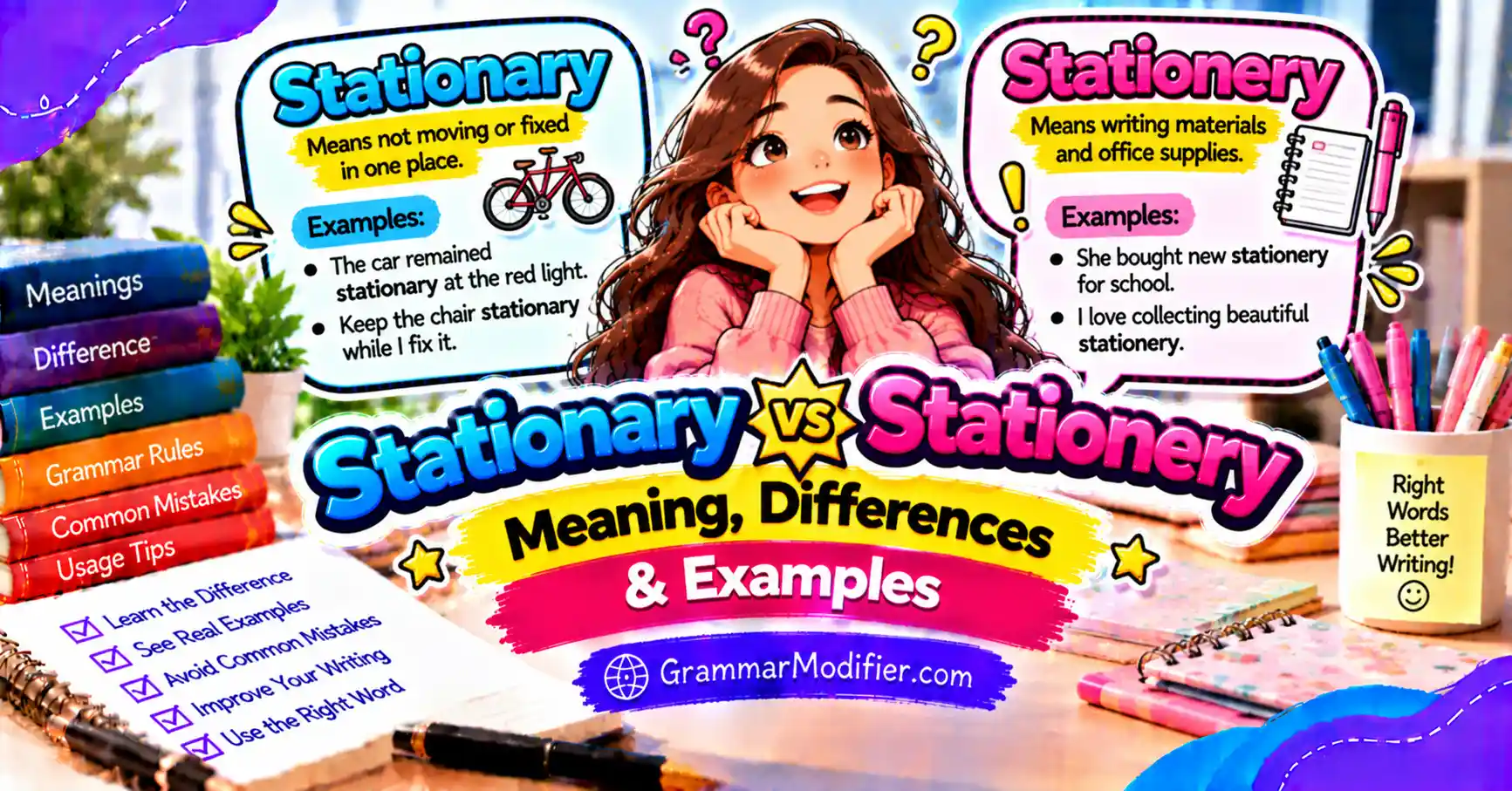
Stationary describes something that is not moving, such as a car stopped at a traffic light. Stationery refers to writing materials, including paper, envelopes, and notepads.
The easiest way to remember the difference is simple: Stationary has an A for “at rest,” while stationery has an E for “envelope.”
In this guide, you’ll learn the difference between stationary vs stationery, how to spell each word correctly, when to use them, and how to avoid common mistakes in American English.
Quick Answer: Stationary vs Stationery
Stationary means not moving, remaining in one position, or staying unchanged. It is primarily an adjective.
Stationery means writing paper, envelopes, and related writing supplies. It is a noun.
| Word | Meaning | Part of Speech | Example |
|---|---|---|---|
| Stationary | Not moving | Adjective | The car remained stationary. |
| Stationery | Writing materials | Noun | I bought new stationery. |
Remember:
- Stationary = A = At rest
- Stationery = E = Envelope
Both words are pronounced alike, making them homophones. Their meanings, not their sounds, determine which spelling you should use.
TL;DR: Stationary vs Stationery
- Stationary describes something that is not moving or remains in the same position.
- Stationery refers to writing materials such as paper, envelopes, and note cards.
- Stationary is mainly an adjective, while stationery is a noun.
- Both words sound alike but have different spellings and meanings.
- The correct expression is stationary bike, not stationery bike.
- The correct expression is stationery store, not stationary store, when referring to a shop selling writing supplies.
- Use stationary for movement and position; use stationery for writing materials.
- Remember A for at rest and E for envelope.
Table of Contents
- Stationary vs Stationery: Main Difference
- What Does Stationary Mean?
- What Does Stationery Mean?
- Stationary vs Stationery Comparison Table
- When to Use Stationary
- When to Use Stationery
- Stationary vs Stationery Pronunciation
- Stationary vs Stationery Spelling
- Stationary Bike vs Stationery Bike
- Stationary Car vs Stationery Car
- Stationery Store vs Stationary Store
- Stationary vs Stationery in American English
- Common Stationary vs Stationery Mistakes
- How to Remember Stationary vs Stationery
- Stationary vs Stationery Examples
- Stationary vs Stationery Practice Quiz
- Frequently Asked Questions
- Conclusion
- References
Stationary vs Stationery: Main Difference
The main difference between stationary and stationery is that one describes a condition, while the other names a category of materials.
Stationary describes something that stays still. It can refer to a person, vehicle, object, or piece of equipment.
Stationery refers to materials used for writing, correspondence, and related activities.
Consider these examples:
Example 1: The truck remained stationary during the inspection.
The truck was not moving.
Example 2: The company ordered new stationery for its employees.
The company purchased writing materials.
Why Are These Words Commonly Confused?
Stationary and stationery are homophones, meaning they share the same pronunciation.
When you hear either word, you cannot identify the spelling from its sound alone. You need to understand the sentence.
For example:
- The stationary camera recorded the entire meeting.
- The office ordered personalized stationery for the meeting.
In the first sentence, the word describes a camera that stays in one place. In the second, it refers to writing materials.
The One-Letter Rule
Only one letter changes:
Station-a-ry: Not moving.
Station-e-ry: Writing materials.
That single letter is the key to choosing the correct spelling.
What Does Stationary Mean?
Stationary is an adjective that means not moving, remaining in one place, or not changing position.
The word often describes vehicles, people, objects, cameras, exercise equipment, and other things that remain still.
Stationary Meaning Not Moving
The most common meaning of stationary is motionless.
Examples:
- The car remained stationary at the red light.
- The train was stationary at the platform.
- The boat appeared stationary on the calm lake.
- The security guard stood stationary near the entrance.
- The camera remained stationary during filming.
In each sentence, stationary describes a lack of movement.
Stationary Does Not Mean Permanently Fixed
A common misunderstanding is that stationary means something cannot move.
That is not necessarily true.
For example:
The bus remained stationary for thirty seconds.
The bus was not moving during those thirty seconds, but it could move afterward.
Similarly, a car waiting at a traffic light is stationary even though it will soon continue driving.
Key point: Stationary describes a state of not moving. That state can be temporary or permanent.
Stationary Meaning Unchanging
Stationary can also describe something that remains relatively unchanged.
Examples:
- The population remained nearly stationary during the period.
- The system reached a stationary state.
- Researchers studied the process under stationary conditions.
In mathematics, statistics, and other technical fields, stationary may have specialized meanings.
For example, a stationary time series is defined by particular statistical properties that remain unchanged over time. This does not mean every individual value stays the same.
Is Stationary an Adjective?
Yes. In everyday modern English, stationary is primarily an adjective.
It can appear before a noun:
- A stationary bicycle
- A stationary vehicle
- A stationary camera
- A stationary object
It can also appear after a linking verb:
- The car is stationary.
- The train remained stationary.
- The camera stayed stationary.
Rare specialized noun uses exist, but the adjective meaning is the one most learners need.
What Does Stationery Mean?
Stationery is a noun referring to writing paper, envelopes, and related writing or correspondence materials.
The word is commonly associated with schools, offices, businesses, invitations, and personal letters.
What Items Are Considered Stationery?
Common stationery items include:
- Writing paper
- Envelopes
- Letterheads
- Notepads
- Note cards
- Greeting cards
- Invitations
- Personalized writing paper
- Correspondence sets
- Certain notebooks and writing supplies
In broader everyday and retail usage, stationery may also include pens, pencils, sticky notes, and other desk supplies.
However, the traditional meaning focuses on paper-based writing and correspondence materials.
Stationery Examples in Sentences
- She purchased new stationery for her office.
- I enjoy writing letters on beautiful stationery.
- The company ordered branded stationery.
- He gave his sister a personalized stationery set.
- The store sells notebooks, envelopes, and other stationery.
- We need more stationery for the reception desk.
Is Stationery Countable or Uncountable?
Stationery is generally an uncountable noun when referring to writing materials collectively.
That means you normally do not say a stationery to refer to one item.
Compare:
| Natural English | Unnatural or Nonstandard Usage |
|---|---|
| I bought some stationery. | I bought a stationery. |
| She ordered a stationery set. | She ordered one stationery. |
| We need several stationery items. | We need several stationeries. |
| He purchased two sets of stationery. | He purchased two stationeries. |
To describe individual products, use stationery items, pieces of stationery, or sets of stationery.
Stationery vs Office Supplies
Stationery and office supplies overlap, but they are not identical.
Stationery focuses on writing materials and correspondence products.
Office supplies is a broader term that may include folders, staplers, printer paper, labels, and other workplace products.
Office equipment such as printers, monitors, and office chairs is not normally considered stationery.
Stationary vs Stationery Comparison Table
Here is a complete comparison of the two words.
| Feature | Stationary | Stationery |
|---|---|---|
| Main meaning | Not moving | Writing materials |
| Part of speech | Primarily adjective | Noun |
| Pronunciation | STAY-shuh-nair-ee | STAY-shuh-nair-ee |
| Common context | Movement and position | Writing and correspondence |
| Common phrase | Stationary bike | Stationery store |
| Common phrase | Stationary vehicle | Stationery supplies |
| Common phrase | Stationary camera | Personalized stationery |
| Example | The truck is stationary. | I bought stationery. |
| Memory clue | A = At rest | E = Envelope |
Compare the Meanings
Stationary: The machine remained stationary during maintenance.
Stationery: The company purchased new stationery for its employees.
Stationary: The cyclist trained on a stationary bicycle.
Stationery: The student organized her stationery before class.
The Quick Replacement Test
If you can replace the word with motionless or not moving, choose stationary.
If you can replace it with writing materials, choose stationery.
This simple test works in most everyday sentences.
When to Use Stationary
Use stationary when describing something that is not moving or remains in one position.
Stationary Vehicles
Examples:
- The car remained stationary at the intersection.
- The bus stayed stationary while passengers boarded.
- The truck was stationary during loading.
- The train remained stationary until the signal changed.
Stationary Objects
Examples:
- The ladder must remain stationary while someone climbs.
- The machine stayed stationary during inspection.
- The equipment was kept stationary throughout the experiment.
- The camera recorded the scene from a stationary position.
Stationary Exercise Equipment
Examples:
- I ride a stationary bike every morning.
- She purchased a stationary bicycle for home workouts.
- The gym has several stationary exercise bikes.
Stationary People
Examples:
- The guard remained stationary near the entrance.
- The actor stood stationary during the photograph.
- The participants remained stationary while the measurements were taken.
Stationary in Scientific Contexts
The word stationary may also describe a stable or unchanging condition under a technical definition.
Examples:
- The researchers examined a stationary process.
- The system reached a stationary state.
- The analysis assumed stationary conditions.
In these contexts, the precise meaning depends on the scientific field.
When to Use Stationery
Use stationery when referring to writing materials, correspondence supplies, or related paper products.
School Stationery
Examples:
- Students bought new stationery before the school year.
- She keeps her stationery in a desk organizer.
- The shop sells notebooks and other stationery supplies.
Office Stationery
Examples:
- The office manager ordered more stationery.
- The company uses branded stationery.
- We need additional stationery for the reception area.
Personalized Stationery
Personalized stationery often includes a person’s name, initials, or custom design.
Examples:
- She ordered personalized stationery with her initials.
- He received a beautiful stationery set as a birthday gift.
- The designer created custom stationery for the client.
Wedding Stationery
Wedding stationery may include invitations, RSVP cards, save-the-date cards, and matching paper goods.
Examples:
- The couple selected elegant wedding stationery.
- The invitations were part of a matching stationery suite.
- She designed personalized stationery for the wedding.
Business Stationery
Business stationery often includes branded letterheads, envelopes, and correspondence cards.
Example:
The company redesigned its business stationery after updating its logo.
Stationary vs Stationery Pronunciation
Stationary and stationery have the same pronunciation in standard American English.
They are homophones.
Pronunciation Guide
| Word | Simple Pronunciation | IPA |
|---|---|---|
| Stationary | STAY-shuh-nair-ee | /ˈsteɪʃəˌneri/ |
| Stationery | STAY-shuh-nair-ee | /ˈsteɪʃəˌneri/ |
Both words begin with the stressed STAY sound.
The pronunciation does not tell you which spelling is correct.
Why Are They Homophones?
Homophones are words that sound alike but have different meanings or spellings.
Other examples include:
- Their, there, they’re
- Peace, piece
- Flour, flower
- Principal, principle
- Compliment, complement
Stationary and stationery belong to the same category.
How to Choose the Correct Word When Listening
Pay attention to context.
If someone says:
“The vehicle remained stationary.”
The word means not moving.
If someone says:
“I ordered new stationery.”
The word refers to writing materials.
Remember: Pronunciation is identical, but meaning determines spelling.
Stationary vs Stationery Spelling
The spelling difference is only one letter.
Stationary ends in -ary.
Stationery ends in -ery.
Stationary With an A
Use stationary when describing a lack of movement.
Examples:
- Stationary car
- Stationary bike
- Stationary camera
- Stationary object
- Stationary vehicle
Stationery With an E
Use stationery when referring to writing materials.
Examples:
- Stationery store
- Stationery paper
- Stationery supplies
- Stationery set
- Wedding stationery
The Envelope Spelling Trick
Stationery contains an E, just like envelope.
Since envelopes are common stationery items, this connection is easy to remember.
The At-Rest Spelling Trick
Stationary contains an A, like at rest.
Something that is stationary is not moving.
Which Spelling Is Correct?
Both spellings are correct English words.
The important question is which meaning fits your sentence.
Stationary Bike vs Stationery Bike
The correct expression is stationary bike.
A stationary bike is an exercise bicycle that stays in one place while someone pedals.
Correct Examples
- I use a stationary bike at the gym.
- She bought a stationary bicycle for home workouts.
- He rides his stationary bike during winter.
- The fitness center has ten stationary bikes.
Why Is Stationary Correct?
The word describes the bicycle’s position.
Although the pedals and other parts move, the equipment itself generally remains in one location.
Stationery bike would incorrectly suggest a connection with writing paper or envelopes.
Stationary Bike vs Exercise Bike
Stationary bike and exercise bike are commonly used to describe the same general type of indoor cycling equipment.
The term stationary emphasizes that the bicycle does not travel along a road.
Correct: Stationary bike.
Incorrect for exercise equipment: Stationery bike.
Stationary Car vs Stationery Car
The correct expression is stationary car when describing a car that is not moving.
Correct Examples
- The police officer approached the stationary car.
- The vehicle remained stationary at the red light.
- The truck was stationary during inspection.
- The driver waited inside the stationary car.
Stationary vs Parked
A stationary car is not moving.
A parked car has been positioned or left for parking.
These meanings are related but not identical.
For example:
The car was stationary at the traffic light.
The car had stopped temporarily.
The car was parked outside the house.
The car had been left in a parking position.
A car can be stationary without being parked.
Stationary vs Stopped
Stopped often describes the action or result of ceasing movement.
Stationary describes the condition of not moving.
Compare:
- The car stopped at the intersection.
- The car remained stationary for two minutes.
The first sentence emphasizes the action. The second emphasizes the condition.
Stationery Store vs Stationary Store
The correct expression for a shop selling writing materials is stationery store.
Correct Examples
- I visited a stationery store to buy envelopes.
- The stationery shop sells greeting cards.
- She opened an online stationery store.
- The mall has a small stationery shop.
Why Is Stationery Correct?
The word stationery identifies the products sold by the business.
A stationery store may sell writing paper, envelopes, notebooks, greeting cards, and other writing supplies.
Can Stationary Store Ever Be Correct?
Yes, but it would have a different meaning.
A stationary store could describe a store that remains in one place, especially when contrasted with a mobile shop.
For example:
Unlike the traveling vendor, the stationary store operates from one permanent location.
However, if you’re describing a shop that sells writing materials, stationery store is the correct phrase.
Stationery Store vs Office Supply Store
A stationery store typically emphasizes writing materials and paper goods.
An office supply store may carry a wider selection of products, including office equipment and storage accessories.
Stationary vs Stationery in American English
The distinction between stationary and stationery is the same in American and British English.
Both varieties use stationary for a lack of movement and stationery for writing materials.
American English Examples
- The car remained stationary at the intersection.
- She purchased new stationery for her office.
- He exercises on a stationary bike.
- The company ordered personalized stationery.
British English Examples
- The vehicle remained stationary.
- The shop sells beautiful stationery.
- She bought a stationery set.
- The cyclist trained on a stationary bicycle.
Is There a US vs UK Spelling Difference?
No. Both words retain the same spellings in standard American and British English.
This differs from spelling pairs such as:
| American English | British English |
|---|---|
| Color | Colour |
| Center | Centre |
| Favorite | Favourite |
| Organize | Organise (also organize) |
Stationary and stationery do not change spelling based on region.
Regional Vocabulary Preferences
American English commonly uses office supplies as a broad category.
British English also uses stationery for many writing and office materials.
These are vocabulary preferences, not changes to the fundamental meanings.
Common Stationary vs Stationery Mistakes
The most common error is using stationary when referring to writing supplies or using stationery when describing something that is not moving.
Common Mistakes and Corrections
| Incorrect | Correct | Reason |
|---|---|---|
| Stationery bike | Stationary bike | Exercise equipment stays in place |
| Stationery car | Stationary car | Vehicle is not moving |
| Office stationary | Office stationery | Writing materials |
| Personalized stationary | Personalized stationery | Custom writing paper |
| Wedding stationary | Wedding stationery | Invitations and paper goods |
| Stationery vehicle | Stationary vehicle | Vehicle is stopped |
| Stationery camera | Stationary camera | Camera remains in position |
| Stationary paper | Stationery paper | Writing paper |
| Stationary store | Stationery store | Shop selling writing supplies |
| Stationery object | Stationary object | Object is not moving |
| Stationary supplies | Stationery supplies | Writing materials |
| Stationery position | Stationary position | Fixed or unmoving position |
These corrections assume the ordinary intended meanings. Some phrases can be grammatical in unusual contexts with a different meaning.
Mistake 1: Writing Stationary for Paper Products
Incorrect: I bought some beautiful stationary.
Correct: I bought some beautiful stationery.
The sentence refers to writing materials.
Mistake 2: Writing Stationery for Movement
Incorrect: The car remained stationery.
Correct: The car remained stationary.
The sentence describes the car’s lack of movement.
Mistake 3: Confusing Exercise Equipment
Incorrect: She rides a stationery bicycle.
Correct: She rides a stationary bicycle.
The bicycle stays in one location.
Mistake 4: Using Stationery as a Countable Noun
Awkward: I bought a stationery.
Better: I bought some stationery.
Also correct: I bought a stationery set.
Stationery is normally uncountable when referring to writing materials collectively.
Mistake 5: Relying Only on Pronunciation
Because the words sound alike, pronunciation alone cannot help you choose the correct spelling.
Always check the meaning.
How to Remember Stationary vs Stationery
You can remember these words using a few simple memory tricks.
Memory Trick 1: A for At Rest
Stationary = A = At rest
If something is at rest, it is not moving.
Example:
The stationary car remained at rest.
Memory Trick 2: E for Envelope
Stationery = E = Envelope
Envelopes are common stationery items.
Example:
The stationery set included envelopes.
Memory Trick 3: Think of a Bicycle
Picture someone riding an exercise bike indoors.
The pedals move, but the bicycle remains in one location.
That is a stationary bike.
Memory Trick 4: Think of a Writing Desk
Picture a desk covered with writing paper, envelopes, note cards, and pens.
Those items are stationery.
Memory Trick 5: Replace the Word
Ask whether the word can be replaced with not moving or writing materials.
The car remained stationary.
The car remained not moving.
She purchased stationery.
She purchased writing materials.
Memory Trick 6: Learn Two Sentences
The stationary bike stays in one place.
The stationery store sells envelopes.
These two sentences show the difference clearly.
Stationary vs Stationery Examples
Reading the words in context is one of the best ways to remember their meanings.
15 Examples Using Stationary
- The car remained stationary at the red light.
- She exercises on a stationary bike every morning.
- The train was stationary at the platform.
- The security camera stayed stationary.
- The boat appeared stationary on the lake.
- The truck remained stationary during loading.
- The guard stood stationary near the entrance.
- The machine stayed stationary during maintenance.
- The ladder remained stationary while the worker climbed.
- The vehicle was stationary when the inspection began.
- The camera recorded the scene from a stationary position.
- The equipment remained stationary throughout the test.
- The cyclist practiced on a stationary bicycle.
- The object appeared stationary from a distance.
- The bus remained stationary until everyone boarded.
15 Examples Using Stationery
- She bought new stationery for school.
- The office ordered personalized stationery.
- I enjoy collecting colorful stationery.
- The shop sells notebooks and other stationery supplies.
- He wrote a letter on expensive stationery.
- The company redesigned its business stationery.
- She purchased a matching stationery set.
- The wedding stationery included invitations and envelopes.
- I keep my stationery in a desk drawer.
- The store offers recycled-paper stationery.
- She received personalized stationery as a gift.
- We need additional stationery for the office.
- The teacher organized the classroom stationery.
- He ordered custom stationery for his business.
- The designer created elegant stationery for the event.
Side-by-Side Sentence Comparison
| Stationary | Stationery |
|---|---|
| The bike is stationary. | The stationery is on the desk. |
| The car remained stationary. | She purchased new stationery. |
| The camera stayed stationary. | The store sells stationery. |
| The machine was stationary. | The office ordered stationery. |
| The object remained stationary. | The stationery included envelopes. |
Stationary vs Stationery Practice Quiz
Choose the correct word in each sentence.
Multiple-Choice Questions
1. The car remained _____ at the traffic light.
A. stationary
B. stationery
2. She bought new _____ for her office.
A. stationary
B. stationery
3. I exercise on a _____ bike.
A. stationary
B. stationery
4. The company ordered personalized _____.
A. stationary
B. stationery
5. The security camera remained _____ during filming.
A. stationary
B. stationery
6. The shop sells greeting cards and other _____.
A. stationary
B. stationery
7. The train was _____ at the platform.
A. stationary
B. stationery
8. She wrote a thank-you note on elegant _____.
A. stationary
B. stationery
9. The worker kept the ladder _____.
A. stationary
B. stationery
10. He opened an online _____ store.
A. stationary
B. stationery
Quiz Answers and Explanations
| Question | Correct Answer | Explanation |
|---|---|---|
| 1 | A. Stationary | The car is not moving |
| 2 | B. Stationery | Refers to writing materials |
| 3 | A. Stationary | Exercise equipment remains in place |
| 4 | B. Stationery | Refers to branded writing materials |
| 5 | A. Stationary | The camera stays in one position |
| 6 | B. Stationery | Refers to writing and paper products |
| 7 | A. Stationary | The train is stopped |
| 8 | B. Stationery | Refers to writing paper |
| 9 | A. Stationary | The ladder is kept from moving |
| 10 | B. Stationery | The store sells writing materials |
Bonus Exercise: Correct the Mistakes
1. I bought some beautiful stationary.
Correct: I bought some beautiful stationery.
2. The stationery car blocked the driveway.
Correct: The stationary car blocked the driveway.
3. She rides a stationery bicycle.
Correct: She rides a stationary bicycle.
4. The company ordered branded stationary.
Correct: The company ordered branded stationery.
5. The camera remained stationery during the interview.
Correct: The camera remained stationary during the interview.
Frequently Asked Questions
What is the main difference between stationary and stationery?
Stationary means not moving or remaining in one position. Stationery refers to writing materials such as paper, envelopes, and related supplies.
Is it stationary bike or stationery bike?
The correct expression is stationary bike because the exercise bicycle stays in one location while someone pedals.
Is it stationary store or stationery store?
Use stationery store for a shop selling writing materials. A stationary store would describe a store that does not move.
How do you remember stationary vs stationery?
Remember stationary = A for at rest and stationery = E for envelope.
Are stationary and stationery homophones?
Yes. Both words have the same pronunciation but different meanings and spellings.
Is stationery a noun or an adjective?
Stationery is a noun. It can also modify another noun in expressions such as stationery store or stationery set. Stationary is primarily an adjective.
Can stationery be plural?
Stationery is generally uncountable when referring to writing materials collectively. Instead of stationeries, use stationery items, stationery products, or sets of stationery in ordinary English.
Is stationary the same as stable?
Not exactly. Stationary means not moving, while stable generally means steady, secure, or unlikely to change suddenly. Something may be stationary without being stable.
Conclusion
The difference between stationary vs stationery becomes easy once you understand their meanings.
Stationary describes something that is not moving, such as a stationary car, stationary bicycle, or stationary camera.
Stationery refers to writing materials, including paper, envelopes, notepads, and related supplies.
Although the words sound identical, they are not interchangeable.
Remember these two spelling tricks:
Stationary = A for At rest.
Stationery = E for Envelope.
If you’re describing movement or position, choose stationary. If you’re talking about writing materials, choose stationery.
With these rules, examples, and memory tricks, you can confidently use both words in everyday American English.
References and Further Reading
- Cambridge Dictionary: Stationary — Meaning, pronunciation, and examples.
- Cambridge Dictionary: Stationery — Definition and noun usage.
- Merriam-Webster: Stationary — Dictionary definition and usage.
- Merriam-Webster: Stationery — Definition of writing materials.
- Grammarly: Stationary vs. Stationery — Spelling distinctions and usage guidance.