
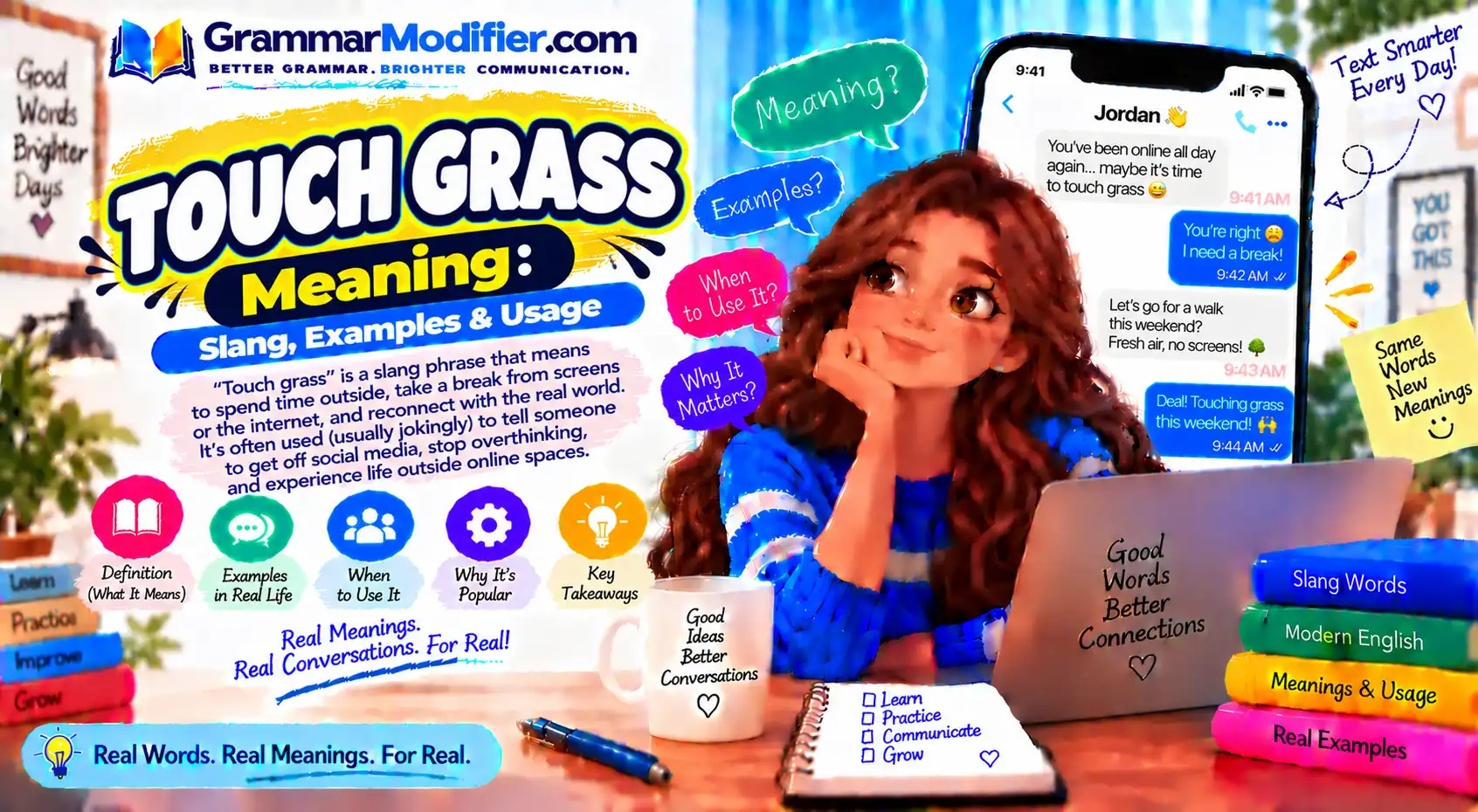
This guide explains the meaning, grammar, tone, origin, and everyday use of “touch grass.”
It shows English learners how the phrase works in texts, social media, casual conversations, and online discussions.
Quick Answer
“Touch grass” is informal internet slang meaning to step away from online activity and reconnect with everyday life. It can suggest going outside, taking a break, or gaining perspective.
Cambridge Dictionary lists it as an informal idiom, while Dictionary.com records both the outdoor meaning and the broader idea of engaging with real life.
TL;DR
- Touch grass means stepping away from excessive online activity.
- It can also mean getting a reality check.
- Go touch grass is a more direct command.
- Touched grass means someone has already gone offline or outside.
- The phrase can sound playful, teasing, or dismissive.
- It is informal slang, not formal English.
- It is common in texts, gaming, memes, and social media.
What Does Touch Grass Mean?
Touch grass usually means stop spending so much time online and reconnect with the real world. The phrase can suggest going outdoors, taking a break from a screen, or getting some perspective.
The expression is usually figurative. Someone does not normally need to literally touch a blade of grass. Instead, the phrase comments on behavior that seems overly focused on internet culture, online arguments, or digital activity.
Cambridge Dictionary gives the meaning as spending time outside or doing real-world activities instead of spending time online. Dictionary.com also includes the broader sense of engaging with reality or real life.
Examples
- “You’ve been arguing online for three hours. Touch grass.”
- “I’ve been scrolling all afternoon. I need to touch grass.”
- “After that gaming session, we should touch grass.”
- “That reaction is a little too online. Touch grass.”
Is “Touch Grass” Slang or an Idiom?
“Touch grass” is both an informal idiomatic expression and a piece of internet slang. The phrase has a meaning that goes beyond its literal words.
Cambridge specifically labels touch grass as an informal idiom. Dictionary.com labels it an American expression and records touch some grass as a variant.
In American English, it is most natural in casual speech, texting, social media, gaming communities, and online discussions.
Where it works naturally
- Text messages: “Bro, touch grass.”
- Social media: “Some people seriously need to touch grass.”
- Gaming chat: “Take a break and touch grass.”
- Friend-to-friend teasing: “We’ve been online all day. Time to touch grass.”
- Self-commentary: “I need to touch grass after that comment section.”
Where it does not fit well
- Formal business reports
- Academic essays
- Professional emails
- Formal applications
- Official announcements
For formal writing, use alternatives such as “take a break,” “step away from the screen,” or “spend some time offline.”
What Does “Go Touch Grass” Mean?
“Go touch grass” means roughly the same thing as “touch grass,” but it sounds more direct. The added word go emphasizes the action being suggested.
Grammatically, this is an imperative sentence. The subject you is understood, so the full meaning is similar to “You should go touch grass.”
Compare the tone
| Expression | Typical effect |
|---|---|
| Touch grass. | Short and direct |
| Go touch grass. | More forceful |
| Maybe touch grass. | Softer |
| You should touch grass. | More explicit advice |
| I need to touch grass. | Self-directed |
| We should touch grass. | Shared suggestion |
“Go touch grass” can be funny between friends but harsh during an argument. The relationship between the speakers matters as much as the words themselves.
What Does “Touch Some Grass” Mean?
“Touch some grass” is a common variation of “touch grass.” Adding some does not substantially change the slang meaning.
Both versions can suggest going outside, taking a break from online activity, or reconnecting with everyday life. Cambridge lists touch some grass as an alternative form.
Natural examples
- “You’ve been gaming all weekend. Go touch some grass.”
- “I think we both need to touch some grass.”
- “After reading those comments, I need to touch some grass.”
- “Maybe it’s time to touch some grass.”
The choice between “touch grass” and “touch some grass” is usually a matter of phrasing rather than meaning.
Touch Grass Grammar: How Does the Phrase Work?
“Touch grass” uses the verb “touch” followed by the noun “grass.” In its common slang form, it is an imperative verb phrase.
An imperative normally gives a command or instruction. The subject you is understood rather than written.
Common forms
| Form | Example | Meaning |
|---|---|---|
| Imperative | “Touch grass.” | Tells someone to disconnect |
| Infinitive | “I need to touch grass.” | Describes a needed action |
| Past tense | “I touched grass.” | Describes a completed action |
| Progressive | “I’m touching grass.” | Describes an action in progress |
| Third person | “He touches grass.” | Describes another person |
| Negative | “I haven’t touched grass lately.” | Says the action has not happened |
The grass in this expression is normally treated as an uncountable mass noun. That is why “touch grass” sounds natural, while “touch grasses” does not normally work for this idiom.
What Does “Touched Grass” Mean?
“Touched grass” is the past-tense version of the phrase. In slang, it usually means someone has already spent time offline or returned to ordinary life.
People also use it humorously when describing themselves after spending a long time online.
Examples
- “I finally touched grass this weekend.”
- “After six hours of gaming, I touched grass.”
- “We actually touched grass today.”
- “Have you touched grass lately?”
- “I haven’t touched grass all week.”
A related phrase is “never touched grass.” It humorously describes someone perceived as extremely online or disconnected from everyday life.
Is “Touch Grass” an Insult?
It can be an insult, but it is not automatically insulting. Tone depends heavily on the speaker, listener, and situation.
Telling a close friend “touch grass” can be playful. Saying it to a stranger during an argument can dismiss their opinion instead of addressing what they said.
Tone examples
Playful:
“You’ve been playing that game since breakfast. Touch grass!”
Self-directed:
“I spent my entire evening reading comments. I need to touch grass.”
Dismissive:
“You wrote ten paragraphs about this. Go touch grass.”
Gentler alternative:
“Maybe take a break from the app for a while.”
The key distinction is who is being told to touch grass and why.
How Is “Touch Grass” Used in Texting and Social Media?
In texts and social media, touch grass often works as a short reaction to someone who appears overly invested in an online topic.
It can appear in comments, captions, group chats, gaming conversations, and online arguments. Modern examples also appear across major social platforms and internet communities.
Common texting patterns
- “Touch grass lol.” — casual teasing
- “Bro needs to touch grass.” — joking criticism
- “I need to touch grass.” — self-aware humor
- “Time to touch grass.” — announcing a break
- “Go touch some grass.” — direct criticism
- “We need to touch grass.” — shared joke
- “I finally touched grass.” — humorous past-tense use
- “Never touched grass behavior.” — joking description
Because text does not communicate voice or facial expression, “touch grass” can sound harsher in writing than the speaker intended.
Why Do People Say “Touch Grass”?
People commonly use touch grass when they think someone’s online involvement has become excessive.
The target does not necessarily need to be literally spending all day online. The phrase can also criticize someone for taking an internet argument, fandom dispute, trend, or online opinion too seriously.
Common situations
- Someone is arguing endlessly online.
- Someone is obsessing over internet drama.
- Someone has spent hours gaming.
- Someone is reacting intensely to a minor online issue.
- Someone seems disconnected from everyday perspective.
- Someone wants to admit they have been online too long.
- Friends are joking about spending too much screen time.
- A commenter wants to dismiss another person’s behavior.
This is why “touch grass” and “chronically online” often appear in similar conversations.
Touch Grass vs. Go Outside vs. Chronically Online
These expressions overlap, but they do not mean exactly the same thing.
| Expression | Main function | Typical meaning |
|---|---|---|
| Touch grass | Command | Step away from online life |
| Go outside | Command | Spend time outdoors |
| Log off | Command | Stop using an online service |
| Take a break | Suggestion | Pause an activity |
| Chronically online | Description | Extremely influenced by or focused on internet culture |
| Get some fresh air | Suggestion | Spend time outside |
“Touch grass” has the strongest internet-slang flavor. “Go outside” and “take a break” are more neutral and can be used in many situations.
Where Did “Touch Grass” Come From?
The exact origin of “touch grass” is unknown. Dictionary.com dates its first recorded use to 2015–20, while Know Your Meme documents online examples dating to at least 2015.
Know Your Meme reports that the phrase spread significantly around 2019 and became increasingly common on Twitter during 2021. Its documentation also connects the phrase with later use on platforms including TikTok.
It is therefore safer to say the phrase emerged in online culture during the 2010s and spread widely during the following years. Claims about one specific inventor or community creating it should be treated cautiously.
How to Use “Touch Grass” in a Sentence
The phrase works best when the surrounding situation makes the intended meaning clear. It can describe another person, describe your own behavior, or work as a direct command.
Natural sentence examples
- “You’ve been online all morning. Touch grass.”
- “I need to touch grass after reading that entire thread.”
- “We should log off and touch grass.”
- “He told me to touch grass.”
- “She joked that I needed to touch grass.”
- “I finally touched grass after finishing my project.”
- “Maybe go outside instead.”
- “I need some time offline.”
A useful sentence pattern
Subject + need/should + to touch grass
“I need to touch grass.”
Imperative + touch grass
“Touch grass.”
Past tense + touched grass
“I touched grass yesterday.”
Progressive form + touching grass
“I’m touching grass right now.”
These forms help English learners understand how an internet slang phrase can still follow ordinary English grammar.
Can You Use “Touch Grass” About Yourself?
Yes. Self-directed use is often one of the friendliest ways to use the phrase.
When someone says “I need to touch grass,” they are usually joking about their own online behavior. This avoids directly criticizing another person.
Examples
- “I’ve been scrolling for three hours. I need to touch grass.”
- “After that comment section, I need to touch grass.”
- “I finally touched grass this weekend.”
- “I should probably touch some grass.”
- “We’ve been gaming all day. Let’s touch grass.”
- “I haven’t touched grass lately.”
Self-reference can turn the phrase from an insult into self-aware internet humor.
Is “Touch Grass” Formal or Informal?
“Touch grass” is informal English and internet slang. It is suitable for casual conversations, texts, social media, memes, and other relaxed settings.
For professional or academic writing, choose a more neutral expression.
Casual vs. formal alternatives
- Casual: “I need to touch grass.”
- Neutral: “I need some time offline.”
- Casual: “Go touch grass.”
- Neutral: “You should take a break.”
- Casual: “Log off and touch grass.”
- Neutral: “Step away from the screen for a while.”
- Casual: “You’re too online.”
- Neutral: “You may be spending too much time online.”
Knowing the difference between formal and informal English helps you choose the right expression for your audience.
Common Mistakes With “Touch Grass”
The phrase is grammatically simple, but learners can misunderstand its meaning, tone, or register.
Avoid these mistakes
- “Touch grasses” — usually wrong for this idiom.
- “Touch grass” in a formal essay — usually too informal.
- Assuming “touch grass” always means literal grass — usually incorrect in slang contexts.
- Assuming it is always an insult — tone depends on context.
- Treating “touched grass” as a separate slang phrase — it is usually the past-tense form.
- Using “go touch grass” with a stranger when you need a polite tone.
- Assuming “touch grass” and “go outside” always have identical tone — they do not.
- Confusing “touch grass” with “chronically online” — one commonly acts as a command, while the other describes behavior or a person.
Frequently Asked Questions
What does “touch grass” mean in simple words?
“Touch grass” means to step away from the internet and reconnect with real life. It can suggest going outside, taking a break, or gaining perspective.
Is “touch grass” rude?
It can be rude when directed at someone dismissively. Among friends, however, it can be harmless teasing or self-aware humor.
Does “touch grass” literally mean touching grass?
Sometimes the words can be understood literally, but the slang expression is usually figurative. It normally suggests spending less time online and more time engaged with everyday life.
What does “I need to touch grass” mean?
It usually means “I have spent too much time online and need a break.” Because the speaker is talking about themselves, the phrase often sounds humorous rather than insulting.
What does “never touched grass” mean?
“Never touched grass” is an informal joke about someone who seems extremely online. It does not normally mean the person has literally never been outdoors.
Is “touch grass” a real idiom?
Yes. Cambridge Dictionary lists “touch grass” as an informal idiom, and Dictionary.com also records the expression and its variant “touch some grass.”
What is another way to say “touch grass”?
Depending on the context, you can say “go outside,” “take a break,” “log off,” “step away from the screen,” or “spend some time offline.” These alternatives vary in tone and formality.
Conclusion
Touch Grass Meaning is easy to understand once you separate its literal words from its modern slang meaning. The phrase usually tells someone to step away from online life, go outside, or reconnect with everyday reality.
Its tone can range from playful to dismissive, so context matters. For casual English, learn the related forms “go touch grass,” “touch some grass,” “touched grass,” and “I need to touch grass,” then compare them with more neutral phrases such as “take a break” and “go outside.”
Read More: