
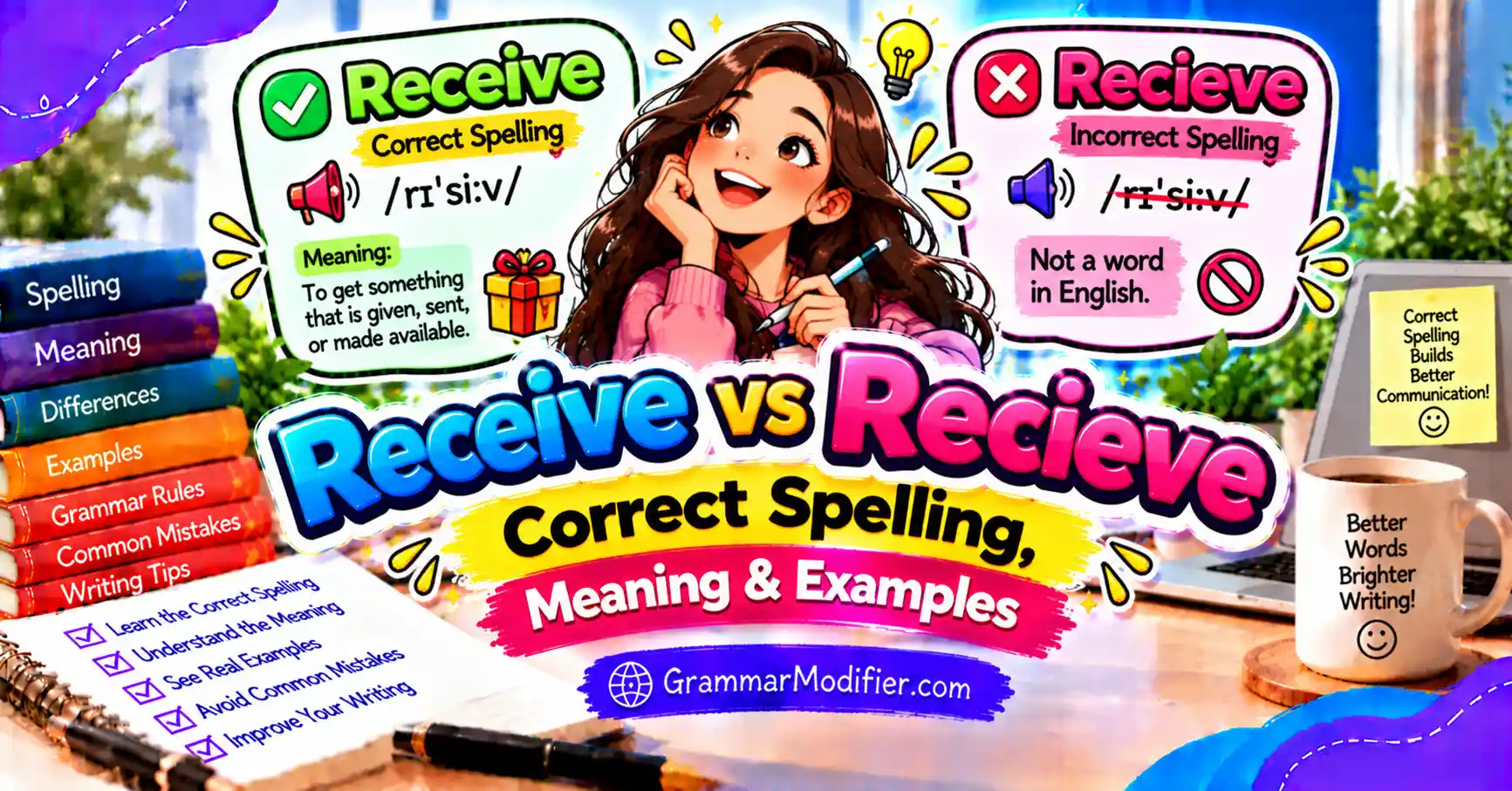
Have you ever written recieve in an email and wondered whether it was correct? You’re not alone. Many English speakers confuse the order of the letters e and i in this common word.
The correct spelling is receive, not recieve.
Receive means to get, be given, accept, or experience something. You might receive an email, a package, a gift, a payment, or important information.
The confusion comes from English spelling patterns. Although the familiar saying “i before e, except after c” can help you spell receive, it doesn’t work for every English word.
This guide explains receive vs recieve, why the correct spelling uses ei, how to spell related forms such as received and receiving, and how to avoid common mistakes. You’ll also find practical examples, easy memory tricks, and a quiz to test your understanding.
Quick Answer: Receive vs Recieve
Receive is the correct spelling. Recieve is incorrect.
The verb receive means to get something, be given something, or experience something.
| Word | Spelling Status | Meaning | Example |
|---|---|---|---|
| Receive | Correct | To get or be given something | Did you receive my email? |
| Recieve | Incorrect | Misspelling of receive | Did you recieve my email? |
The correct spelling is:
R-E-C-E-I-V-E
The most important detail is the order of the letters e and i after c.
Memory trick: In receive, E comes before I after C.
TL;DR: Receive vs Recieve
- Receive is the correct spelling in both American and British English.
- Recieve is a misspelling, not a separate standard English word.
- Receive means to get, accept, be given, or experience something.
- The correct letter sequence is cei, not cie.
- Received is the correct past tense, not recieved.
- Receiving is the correct -ing form, not recieving.
- Receiver is the correct related noun, not reciever.
- The mnemonic “i before e, except after c” works for receive but has many exceptions.
- Remember the -ceive word family: receive, deceive, perceive, and conceive.
Table of Contents
- Receive vs Recieve: Main Difference
- What Does Receive Mean?
- Is Recieve a Word?
- Why Is Receive Spelled With EI?
- I Before E Except After C Rule
- How to Spell Receive Correctly
- Receive Pronunciation and Syllables
- Receive Verb Forms
- Receive vs Received
- Receiving vs Recieving
- Common Uses of Receive
- Receive Synonyms and Related Words
- Common Receive Spelling Mistakes
- How to Remember Receive Spelling
- Receive Example Sentences
- Receive vs Recieve Practice Quiz
- Frequently Asked Questions
- Conclusion
- References and Further Reading
Receive vs Recieve: Main Difference
The difference between receive and recieve is not meaning, pronunciation, or grammar. It is simply correct versus incorrect spelling.
Receive is a standard English verb. Recieve is a common spelling error caused by reversing the letters e and i.
Correct: Receive
Examples:
- I receive messages every morning.
- Did you receive the documents?
- She will receive her package tomorrow.
- We expect to receive payment soon.
Incorrect: Recieve
These sentences contain spelling mistakes:
- I recieve messages every morning.
- Did you recieve the documents?
- She will recieve her package tomorrow.
Replace recieve with receive in each sentence.
Receive vs Recieve Comparison
| Feature | Receive | Recieve |
|---|---|---|
| Standard English spelling | Yes | No |
| Meaning | To get or be given something | Intended misspelling of receive |
| Part of speech | Verb | Not a separate standard word |
| Letter sequence | ei | ie |
| American English | Correct | Incorrect |
| British English | Correct | Incorrect |
| Formal writing | Appropriate | Spelling error |
Key takeaway: Whenever you mean to get or be given something, write receive.
What Does Receive Mean?
Receive is a verb that means to get, be given, accept, or experience something.
Its meaning changes slightly depending on the situation.
Receive Meaning to Get Something
The most common use of receive is to describe getting an object, message, or piece of information.
Examples:
- I received a package yesterday.
- She receives letters from her family.
- We received the documents this morning.
- He will receive a new phone next week.
Receive Meaning to Be Given Something
Receive can describe being given money, recognition, support, or an opportunity.
Examples:
- The student received a scholarship.
- She received an award for her work.
- The organization received a donation.
- He received financial assistance.
Receive Meaning to Experience Something
You can receive something that is not a physical object.
Examples:
- The proposal received strong support.
- The film received positive reviews.
- The employee received criticism.
- The patient received medical treatment.
In these sentences, receive describes a response, experience, or service.
Receive Meaning to Welcome Someone
In formal contexts, receive can mean to welcome visitors or guests.
Examples:
- The host received the guests warmly.
- The ambassador received the delegation.
- The hotel staff received the visitors politely.
Is Receive a Verb?
Yes. Receive is a regular verb.
It changes form according to tense and subject:
- I receive emails.
- She receives emails.
- I received an email.
- We are receiving emails.
Is Recieve a Word?
Recieve is not a standard English word. It is a misspelling of receive.
You may see it in text messages, social media posts, online comments, or informal emails, but that does not make it the accepted spelling.
Why Do People Misspell Receive?
The main reason is confusion between ie and ei.
Many common English words contain ie:
- Believe
- Piece
- Field
- Chief
- Brief
Writers sometimes apply that familiar letter order to receive.
However, receive belongs to a different spelling pattern.
Is Recieve Correct in American English?
No. American English uses receive.
Is Recieve Correct in British English?
No. British English also uses receive.
Unlike color/colour or center/centre, there is no accepted regional spelling variation here.
Can Recieve Ever Be Used?
You may write recieve when discussing the spelling mistake itself, such as in a grammar lesson or correction exercise.
For normal writing, use receive.
Why Is Receive Spelled With EI?
The correct spelling of receive contains ei immediately after the letter c.
Receive = R-E-C-E-I-V-E
The letter sequence is cei, not cie.
Breaking Down the Spelling
You can divide the word into three memorable parts:
REC + EI + VE
Put them together:
REC + EI + VE = RECEIVE
The -CEIVE Word Family
Several related English verbs share the same spelling pattern.
| Word | Meaning | Example |
|---|---|---|
| Receive | To get something | I received the message. |
| Deceive | To mislead someone | The advertisement could deceive customers. |
| Perceive | To notice or understand | She perceived a change in his attitude. |
| Conceive | To imagine or form an idea | They conceived a new plan. |
Each word contains -ceive.
Learning these words together can make their spellings easier to remember.
Where Does Receive Come From?
The word receive developed through French from Latin recipere, meaning to take or take back.
Its spelling reflects the history of the English language, which has borrowed words from several languages.
This is one reason English spelling does not always match pronunciation perfectly.
I Before E Except After C Rule
A familiar English spelling mnemonic says:
“I before E, except after C.”
It can help with certain words, including receive, but it is not a universal spelling rule.
How the Rule Applies to Receive
In receive, ei appears immediately after c.
Examples with the same pattern include:
- Receive
- Deceive
- Perceive
- Conceive
- Ceiling
- Receipt
Words With IE
Many other words contain ie:
- Believe
- Piece
- Field
- Chief
- Brief
- Relief
These words help explain the first part of the mnemonic.
Exceptions to the I-Before-E Rule
English has many exceptions.
| Word | Spelling Pattern | Explanation |
|---|---|---|
| Receive | ei after c | Fits the mnemonic |
| Deceive | ei after c | Fits the mnemonic |
| Believe | ie | Fits the basic pattern |
| Piece | ie | Fits the basic pattern |
| Weird | ei without c | Exception |
| Seize | ei without c | Exception |
| Science | ie after c | Exception |
| Efficient | ie after c | Exception |
| Ancient | ie after c | Exception |
| Neighbor | ei without c | Exception to the simple version |
Some longer versions of the mnemonic account for certain vowel sounds, but they still have exceptions.
Is the Rule Reliable?
The rule is useful as a memory aid, but it should not be treated as an absolute law.
For receive, remember the specific spelling -ceive rather than relying entirely on the mnemonic.
How to Spell Receive Correctly
The correct spelling is:
R – E – C – E – I – V – E
Follow these steps to remember it.
Step 1: Write REC
Start with:
R-E-C
Step 2: Add EI
After c, write:
E-I
This is the part most commonly reversed.
Step 3: Add VE
Finish with:
V-E
You now have:
REC + EI + VE = RECEIVE
Step 4: Check the Spelling
Ask yourself:
Did I put E before I after C?
If yes, you’ve used the correct letter order.
Step 5: Practice With a Sentence
Write:
Did you receive my email?
Repeat the sentence a few times, paying attention to the cei sequence.
Common Incorrect Spellings
| Spelling | Status |
|---|---|
| Receive | Correct |
| Recieve | Incorrect |
| Receeve | Incorrect |
| Receve | Incorrect |
| Recive | Incorrect |
| Receiv | Incorrect |
Spelling tip: Receive has seven letters.
Receive Pronunciation and Syllables
Receive is pronounced ri-SEEV in standard American English.
Its IPA pronunciation is /rɪˈsiːv/.
Syllable Breakdown
Receive has two syllables:
re-ceive
The stress falls on the second syllable.
| Part | Pronunciation |
|---|---|
| Re | ri |
| Ceive | SEEV |
Does Recieve Sound Different?
No. When people write recieve, they generally intend the same pronunciation as receive.
Because recieve is not a separate standard word, it does not have a distinct standard pronunciation.
Why Is Receive Hard to Spell?
The pronunciation does not clearly indicate whether the word contains ei or ie.
That is why recognizing the -ceive pattern is more useful than spelling the word by sound alone.
Receive Verb Forms
Receive is a regular verb, meaning its past tense and past participle follow the usual -ed pattern.
Because receive already ends in e, you add only d to form received.
Complete Verb Forms
| Form | Correct Spelling | Example |
|---|---|---|
| Base form | receive | I receive messages. |
| Third-person singular | receives | She receives messages. |
| Simple past | received | I received a message. |
| Past participle | received | I have received a message. |
| Present participle | receiving | I am receiving messages. |
Present Simple
Examples:
- I receive emails daily.
- You receive notifications.
- We receive payments online.
- They receive weekly reports.
- She receives updates every morning.
Simple Past
Examples:
- I received your email yesterday.
- He received an award.
- We received the documents.
- They received their payments.
Present Continuous
Examples:
- I am receiving messages.
- She is receiving treatment.
- We are receiving applications.
- The company is receiving orders.
Present Perfect
Examples:
- I have received your message.
- She has received the payment.
- They have received their certificates.
Future Simple
Examples:
- I will receive the package tomorrow.
- She will receive the results next week.
- We will receive an update soon.
Receive Across Common Tenses
| Tense | Example |
|---|---|
| Present simple | I receive emails. |
| Past simple | I received an email. |
| Present continuous | I am receiving emails. |
| Past continuous | I was receiving messages. |
| Present perfect | I have received the documents. |
| Past perfect | I had received the payment. |
| Future simple | I will receive the package. |
| Future perfect | I will have received the results by Friday. |
Receive vs Received
Receive is the base form of the verb.
Received is its simple past tense and past participle.
When to Use Receive
Use receive for present-tense statements with suitable subjects and after modal verbs such as will, can, and may.
Examples:
- I receive updates every day.
- We receive payments online.
- She will receive her package tomorrow.
- You may receive a confirmation email.
When to Use Received
Use received for a completed past action.
Examples:
- I received your email yesterday.
- She received the award last week.
- We received the payment this morning.
It also appears in perfect tenses.
Examples:
- I have received your message.
- She had received the documents before the meeting.
Receive vs Received Comparison
| Receive | Received |
|---|---|
| I receive daily emails. | I received an email yesterday. |
| We receive online payments. | We received payment last week. |
| They receive invitations. | They received an invitation. |
| I will receive the package. | I have received the package. |
Received vs Recieved
The correct spelling is received, not recieved.
Correct: I received your email.
Incorrect: I recieved your email.
The ei letter order remains unchanged.
Did You Receive or Did You Received?
The correct expression is:
Did you receive my email?
Not:
Did you received my email?
After did, use the base form receive.
Receiving vs Recieving
Receiving is the correct spelling.
Recieving is incorrect.
How to Form Receiving
Start with the base verb:
Receive
Remove the final e:
Receiv
Add -ing:
Receiving
The letter sequence ei remains unchanged.
Correct Examples
- I am receiving emails.
- She is receiving medical treatment.
- We are receiving applications.
- The company is receiving payments.
- They were receiving regular updates.
Receiving vs Recieving Comparison
| Incorrect | Correct |
|---|---|
| I am recieving messages. | I am receiving messages. |
| She is recieving treatment. | She is receiving treatment. |
| We are recieving payments. | We are receiving payments. |
| They were recieving updates. | They were receiving updates. |
Receiver vs Reciever
The correct related noun is receiver.
A receiver can be a person or device that receives something.
Examples:
- The receiver signed for the package.
- The radio receiver picked up the signal.
- The receiver confirmed delivery.
Reciever is a misspelling.
Common Uses of Receive
Receive appears frequently in school, business, personal communication, and everyday conversation.
Receive an Email
Examples:
- Did you receive my email?
- I received your email this morning.
- Please confirm that you received the attachment.
- We have received your request.
Receive a Package
Examples:
- I expect to receive my package tomorrow.
- She received the delivery yesterday.
- The customer did not receive the order.
- We have received the shipment.
Receive Payment
Examples:
- The company will receive payment next week.
- We received your payment.
- The seller has not received the funds.
- The organization receives donations online.
Receive a Gift
Examples:
- She received a birthday gift.
- I was happy to receive your present.
- The children received gifts during the celebration.
Receive Information
Examples:
- We received the latest information.
- She received instructions from her manager.
- The team will receive an update tomorrow.
Receive Medical Treatment
Examples:
- The patient received medical treatment.
- He is receiving physical therapy.
- She received emergency care.
Receive Feedback
Examples:
- The student received helpful feedback.
- The proposal received positive comments.
- The team received suggestions for improvement.
Receive an Award
Examples:
- She received an award for her work.
- The scientist received recognition.
- He was honored to receive the prize.
Receive in Professional Emails
The verb receive is especially common in professional communication.
Confirming a message:
Thank you for your email. I have received your message and will respond shortly.
Confirming documents:
I confirm that I have received the requested documents.
Asking about delivery:
Could you please confirm whether you received the package?
Confirming payment:
We have received your payment. Thank you.
Requesting information:
We would appreciate it if we could receive the updated report by Friday.
Receive Synonyms and Related Words
Several English verbs have meanings similar to receive, but they are not always interchangeable.
Receive vs Get
Get is common in everyday conversation.
Receive often sounds more formal.
Compare:
Casual: I got your email.
Professional: I received your email.
Both sentences can express the same basic idea.
Receive vs Accept
Receive means to get or be given something.
Accept often means to agree to take or approve something.
Example:
She received a job offer but did not accept it.
She got the offer but did not agree to it.
Receive vs Obtain
Obtain often suggests acquiring something through effort or a process.
Receive can simply describe being given something.
Compare:
- She received the certificate in the mail.
- She obtained the certificate after completing the required course.
Receive Synonyms Table
| Word | Typical Meaning | Example |
|---|---|---|
| Get | Come into possession of | I got your message. |
| Accept | Agree to take | She accepted the invitation. |
| Obtain | Acquire through a process | He obtained permission. |
| Collect | Pick up or gather | She collected the package. |
| Acquire | Come to possess | The company acquired equipment. |
| Welcome | Greet someone | They welcomed the guests. |
Related Words
| Word | Meaning |
|---|---|
| Received | Past tense and past participle of receive |
| Receiving | Present participle of receive |
| Receiver | A person or device that receives |
| Recipient | A person who receives something |
| Reception | The act or manner of receiving; also a gathering or reception area |
| Receipt | A record acknowledging payment or delivery |
Spelling note: Receipt is related to receive but has a different spelling pattern and contains a silent p.
Common Receive Spelling Mistakes
The most frequent mistakes involve reversing the letters e and i, leaving out a letter, or misspelling a related verb form.
Common Spelling Errors
| Incorrect | Correct | Explanation |
|---|---|---|
| Recieve | Receive | Correct order is EI |
| Recieved | Received | Past tense keeps EI |
| Recieving | Receiving | -ing form keeps EI |
| Recieves | Receives | Third-person form keeps EI |
| Reciever | Receiver | Related noun keeps EI |
| Receeve | Receive | Incorrect vowel sequence |
| Receve | Receive | Missing I |
| Recive | Receive | Missing E |
| Receiv | Receive | Missing final E |
| Receving | Receiving | Missing I |
Mistake 1: Reversing E and I
Incorrect: Did you recieve my message?
Correct: Did you receive my message?
Mistake 2: Misspelling the Past Tense
Incorrect: I recieved the package.
Correct: I received the package.
Mistake 3: Misspelling the -ing Form
Incorrect: We are recieving applications.
Correct: We are receiving applications.
Mistake 4: Misspelling Receiver
Incorrect: The reciever signed the form.
Correct: The receiver signed the form.
Mistake 5: Using Received After Did
Incorrect: Did you received my email?
Correct: Did you receive my email?
This is a grammar error, not a spelling error.
Mistake 6: Using Receive for a Completed Past Action
Incorrect: I receive your message yesterday.
Correct: I received your message yesterday.
Use the past tense when describing a completed action in the past.
How to Remember Receive Spelling
You can learn the correct spelling with a few practical memory techniques.
Memory Trick 1: E Before I After C
Remember:
C + E + I = CEI
In receive, the letters ei come after c.
Memory Trick 2: Learn the -CEIVE Family
Memorize these words together:
- Receive
- Deceive
- Perceive
- Conceive
They all share -ceive.
Memory Trick 3: Divide the Word
Break receive into:
REC + EI + VE
Say the parts while writing the word.
Memory Trick 4: Use a Familiar Sentence
Practice this sentence:
I received your email.
It is useful in everyday and professional writing.
Memory Trick 5: Remember the Related Forms
The spelling pattern stays consistent:
Receive → Receives → Received → Receiving → Receiver
All contain ei.
Memory Trick 6: Use the Mnemonic Carefully
The traditional saying “i before e, except after c” works for receive.
However, remember that English contains many exceptions.
The most reliable approach is to learn the specific -ceive spelling pattern.
Receive Example Sentences
The following examples show how to use receive and its related forms in natural American English.
10 Sentences With Receive
- I receive several emails every morning.
- Did you receive my message?
- We hope to receive your application soon.
- They receive weekly updates.
- I will receive my package tomorrow.
- You should receive a confirmation email.
- We receive payments through our website.
- Students receive feedback from their teachers.
- I expect to receive the documents today.
- The organization will receive additional funding.
10 Sentences With Received
- I received your email yesterday.
- She received a birthday gift.
- We received the payment last week.
- The student received an award.
- He received helpful advice.
- They received the shipment on Monday.
- I received a phone call this morning.
- The patient received medical care.
- She received positive feedback.
- The company received several applications.
10 Sentences With Receiving
- I am receiving emails from the team.
- She is receiving medical treatment.
- We are receiving new orders every day.
- The company is receiving payments online.
- They are receiving training this week.
- He is receiving support from his family.
- The students are receiving their certificates.
- I am receiving notifications on my phone.
- The organization is receiving donations.
- The customer is receiving regular updates.
5 Sentences With Receives
- She receives packages every week.
- He receives a monthly report.
- The system receives information automatically.
- The employee receives regular feedback.
- The school receives funding from several sources.
Receive vs Recieve Practice Quiz
Test your knowledge of the correct spelling and verb forms.
Multiple-Choice Questions
1. Which spelling is correct?
A. Recieve
B. Receive
C. Receeve
2. I _____ your email yesterday.
A. recieved
B. receive
C. received
3. She is _____ a package today.
A. receiving
B. recieving
C. receiveing
4. Which spelling is correct?
A. Reciever
B. Receiver
C. Receever
5. Which letter sequence appears after C in receive?
A. IE
B. EI
C. EE
6. Which sentence is correct?
A. Did you recieved my email?
B. Did you recieve my email?
C. Did you receive my email?
7. Which statement about the i-before-e rule is correct?
A. It works for every English word.
B. It helps with receive but has exceptions.
C. It never applies to receive.
8. What is the correct past tense of receive?
A. Recieved
B. Received
C. Receved
9. Which sentence uses receive correctly?
A. She receives updates every day.
B. She recieves updates every day.
C. She receeves updates every day.
10. Which is the correct -ing form?
A. Recieving
B. Receiveing
C. Receiving
Answer Key With Explanations
| Question | Answer | Explanation |
|---|---|---|
| 1 | B. Receive | Correct spelling uses EI |
| 2 | C. Received | Correct past tense |
| 3 | A. Receiving | Correct present participle |
| 4 | B. Receiver | Correct related noun |
| 5 | B. EI | Receive contains CEI |
| 6 | C | Use receive after did |
| 7 | B | The mnemonic has exceptions |
| 8 | B. Received | Past tense keeps EI |
| 9 | A | Receives is correctly spelled |
| 10 | C. Receiving | Drop the final E before adding -ing |
Bonus Exercise: Correct the Mistakes
1. I recieved your message.
Correct: I received your message.
2. She is recieving a package.
Correct: She is receiving a package.
3. Did you recieved the email?
Correct: Did you receive the email?
4. The reciever signed for the delivery.
Correct: The receiver signed for the delivery.
5. We will recieve the payment tomorrow.
Correct: We will receive the payment tomorrow.
Frequently Asked Questions
Is it receive or recieve?
Receive is the correct spelling. Recieve is a common spelling mistake and is not accepted in standard English.
Why is receive spelled with EI?
Receive uses the letter sequence ei immediately after c. The familiar “i before e, except after c” mnemonic helps with this word, although it has many exceptions.
Is recieve a real English word?
Recieve is not a separate standard English word. It is an incorrect spelling of receive.
How do you spell received correctly?
The correct spelling is received, with e before i. It is the past tense and past participle of receive.
Is it receiving or recieving?
Receiving is correct. Remove the final e from receive and add -ing, keeping the ei sequence.
What does receive mean?
Receive means to get, be given, accept, or experience something. You can receive an email, package, payment, gift, award, or medical treatment.
Does receive follow the i-before-e rule?
Yes, receive fits the familiar mnemonic. However, the rule is not universal, so it should be treated as a spelling aid rather than a guarantee.
Is receive spelled the same in American and British English?
Yes. Receive is correct in both American and British English. Recieve is incorrect in both.
Conclusion
The difference between receive vs recieve is straightforward: receive is correct, and recieve is a misspelling.
Receive is a common English verb meaning to get, be given, accept, or experience something. You can receive emails, packages, payments, gifts, awards, feedback, and information.
The correct spelling is:
R-E-C-E-I-V-E
Remember that e comes before i after c.
The same spelling pattern appears in deceive, perceive, and conceive.
Also remember these related forms:
- Receive — Base verb
- Receives — Third-person singular
- Received — Past tense and past participle
- Receiving — Present participle
- Receiver — Related noun
When you’re unsure, check the -ceive pattern and make sure you have written ei, not ie.
With practice, you’ll be able to spell receive correctly in emails, school assignments, business documents, and everyday writing.
References and Further Reading
- Merriam-Webster Dictionary: Receive — Definition, pronunciation, and verb forms.
- Cambridge Dictionary: Receive — American English meanings and examples.
- Britannica Dictionary: Receive — Definitions and usage.
- Merriam-Webster Dictionary: Receiving — Related word form and meaning.
- Cambridge Dictionary: Receiver — Meaning and examples of the related noun.