
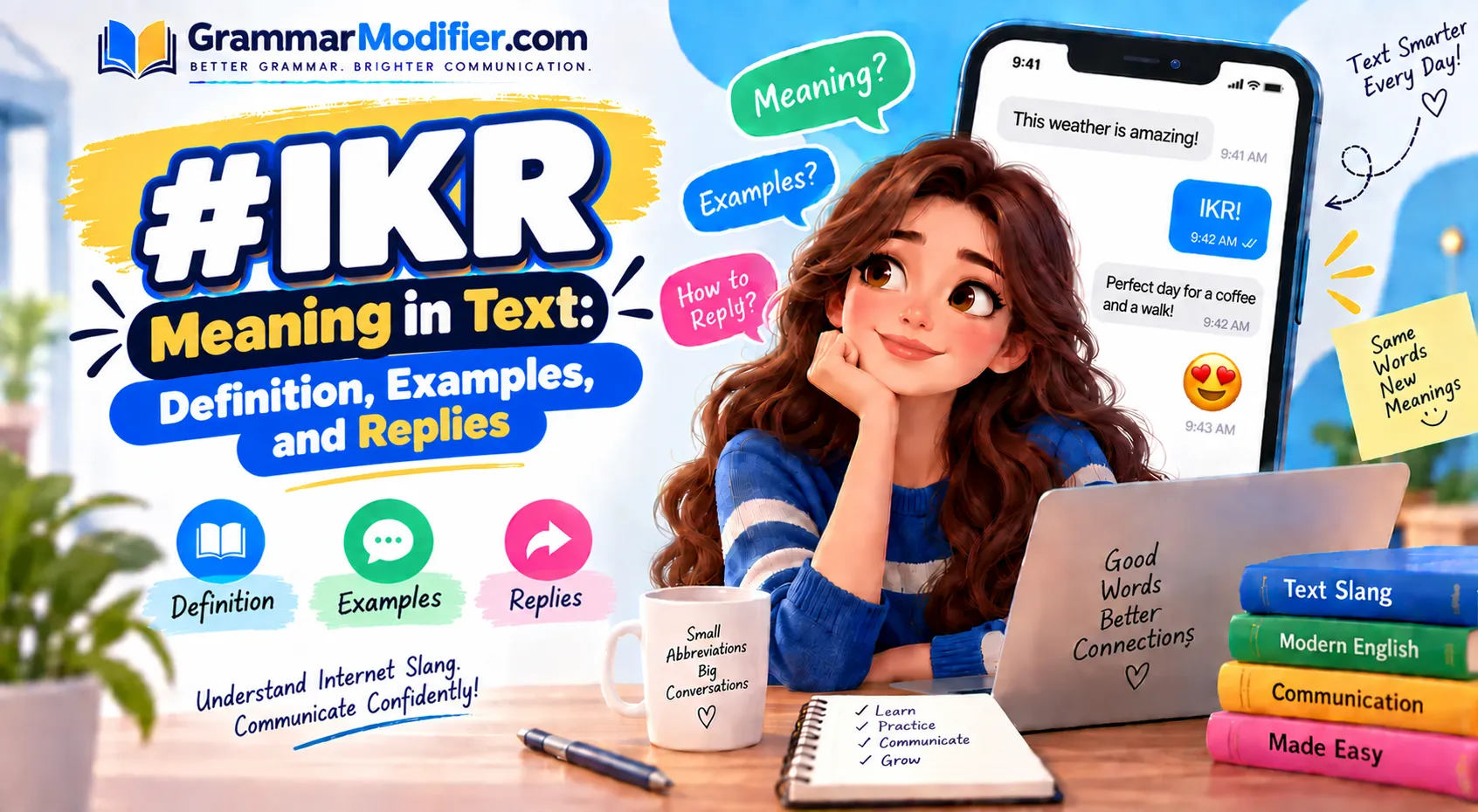
English learners often see IKR in text messages, group chats, comments, and social media replies. It usually means “I know, right?” and shows that someone strongly agrees with a previous statement.
This guide explains the meaning, sentence patterns, emotional tone, common mistakes, and useful alternatives. You’ll also learn when IKR sounds natural and when a clearer phrase works better.
Quick Answer
IKR means “I know, right?” It is an informal texting abbreviation used to show agreement with something another person has said.
TL;DR
- IKR means “I know, right?”
- It usually expresses agreement or shared feelings.
- It normally reacts to a previous message.
- Punctuation can change its emotional tone.
- Lowercase “ikr” has the same meaning.
- Use “I agree” in formal writing.
What Does IKR Mean?
IKR means “I know, right?” People use it when they strongly agree with another person’s comment, opinion, complaint, or reaction.
The expression often means “Exactly,” “I feel the same way,” or “That’s what I was thinking.” Although the full phrase contains a question, IKR usually does not ask for a real answer.
“That class felt so long.”
“IKR!”
The reply means that the second person agrees with the first person’s experience.
What Does IKR Stand For?
The letters in IKR represent I, know, and right. The complete expression is “I know, right?”
It is mainly used in informal digital communication. People may write it as IKR, ikr, or Ikr, depending on their typing habits.
“That movie was much better than I expected.”
“IKR? I thought it would be boring.”
IKR Meaning in Texting
In texting, IKR usually responds to something written immediately before it. It tells the other person that you share the same opinion, feeling, or reaction.
IKR can respond to a fact, but it is often more emotional than a simple “yes.” It may show surprise, excitement, frustration, humor, or agreement.
“The traffic was awful today.”
“IKR. I was late because of it.”
Here, IKR means “I know, right?” and agrees with the complaint.
Why Do People Use IKR?
People use IKR to agree quickly without repeating the entire previous statement. It also makes a reply feel conversational and connected.
The expression is useful when the sender wants to show, “I noticed that too,” or “I had the same reaction.” The exact emotion comes from the surrounding message.
- Agreement: “That test was difficult.” — “IKR!”
- Shared frustration: “The bus was late again.” — “IKR.”
- Excitement: “The concert was amazing.” — “IKR!”
- Surprise: “I didn’t expect that ending.” — “IKR?”
- Humor: “My alarm and I are not friends.” — “IKR.”
- Relatability: “I need coffee before doing anything.” — “IKR.”
- Shared experience: “This week went by so fast.” — “IKR!”
- Conversation support: It shows that the sender understands the other person.
IKR for Agreement and Shared Feelings
IKR can agree with a fact, but it can also respond to a feeling or personal experience. This makes it common in friendly conversations about school, work, entertainment, weather, and daily life.
The expression creates a sense of shared understanding. It often suggests that both people noticed the same thing or felt the same way.
“I’m exhausted after studying all evening.”
“IKR. I need a break.”
“That book was surprisingly good.”
“IKR! I couldn’t stop reading.”
How Context Changes IKR’s Tone
The meaning of IKR stays the same, but the tone can change. A friendly conversation may make it sound warm, while a tense conversation may make it sound dry or sarcastic.
Read the message before IKR before deciding how the sender feels. The surrounding words, punctuation, and relationship between the speakers all provide clues.
“I can’t believe we have another assignment.”
“IKR.”
This may show shared frustration.
“You forgot your homework again.”
“IKR, I’m so organized.”
This second example is likely sarcastic because the reply exaggerates the situation.
How Punctuation Changes IKR’s Tone
Punctuation can add emphasis or suggest an emotional reaction. It does not create a completely different definition, but it may influence how the message sounds.
- IKR! — strong agreement or excitement.
- IKR? — surprised or conversational agreement.
- IKR. — calm, flat, or serious agreement.
- ikr — relaxed and casual agreement.
- IKR lol — agreement mixed with humor.
- IKR, exactly. — strong agreement followed by support.
- IKR, that was frustrating. — agreement with a complaint.
- I know, right? — the complete phrase, often used in speech.
IKR Examples in Real Conversations
IKR can appear alone or before an additional sentence. The examples below show how it works in natural conversations.
- Movies: “That ending was unexpected.” — “IKR? I didn’t see it coming.”
- Weather: “It has been hot all week.” — “IKR!”
- School: “The homework took forever.” — “ikr.”
- Food: “This pizza is amazing.” — “IKR! I could eat another slice.”
- Travel: “The view was beautiful.” — “IKR? I took so many pictures.”
- Music: “That song is stuck in my head.” — “IKR!”
- Work: “Today felt unusually long.” — “IKR. I’m ready to go home.”
- Daily life: “I always lose my keys.” — “IKR. It happens to me too.”
IKR at the Beginning or End of a Message
IKR can stand alone as a reply, appear at the beginning of a sentence, or come after another comment.
When it stands alone, it usually shows immediate agreement. When it begins a longer message, it often introduces another related thought.
“IKR! I thought the meeting would never end.”
“I know, right? The ending was completely unexpected.”
“That was exhausting, IKR?”
At the end of a message, IKR can sound like a conversational tag. The meaning remains connected to the statement before it.
What Does Lowercase “ikr” Mean?
Lowercase ikr normally means the same thing as uppercase IKR. People often use lowercase letters in casual texting because they type quickly or prefer a relaxed style.
Uppercase letters may add emphasis, but they do not automatically signal anger. Context matters more than capitalization.
“That was the best part!”
“IKR!”
“This week has been exhausting.”
“ikr.”
Is IKR an Acronym or an Abbreviation?
IKR is commonly called a texting abbreviation. Some people also describe it as an initialism because each letter represents a word in the full expression.
For everyday English use, the technical label is less important than the meaning. The key point is that IKR is shortened written language for “I know, right?”
The complete phrase is more natural in spoken English, while IKR is especially common in digital messages.
Is IKR Formal or Informal?
IKR is informal English. It works well in friendly texts, casual group chats, social media comments, and conversations with people who understand texting slang.
It is usually unsuitable for formal essays, professional reports, official emails, and academic assignments. Use a complete expression when the reader may not know the abbreviation.
- Casual: “IKR! That presentation was great.”
- Formal: “I agree. That presentation was effective.”
- Casual: “The meeting was so long, ikr?”
- Formal: “I agree that the meeting lasted a long time.”
- Casual: “IKR, I had the same problem.”
- Formal: “I experienced the same problem.”
Can IKR Sound Rude or Sarcastic?
IKR is usually friendly, but it can sound dismissive or sarcastic in certain situations. A short reply may seem rude when someone expects a thoughtful answer.
For example, replying “IKR” to a serious concern may sound as if you are not listening. In a playful conversation, the same expression may feel humorous.
“I’m worried about tomorrow’s interview.”
“IKR.”
This response may not provide enough support. A better reply would be:
“I know, right? Interviews can be stressful. I hope it goes well.”
IKR Compared With FR, Same, and Exactly
These expressions can all show agreement, but their meanings and tones are slightly different.
- IKR: “I know, right?” Shows agreement with another person’s reaction.
- FR: “For real.” Confirms that something is true or serious.
- Same: Shows that you feel or experience the same thing.
- Exactly: Directly confirms that another person’s point is accurate.
- Facts: Shows strong agreement with a statement or opinion.
- Totally: Shows enthusiastic agreement.
- I agree: Gives clear agreement in standard English.
- You’re right: Directly confirms another person’s point.
“I’m exhausted today.”
“Same.”
“That rule makes no sense.”
“Exactly.”
“This is the best song ever.”
“IKR!”
How to Reply to IKR
Your reply can be short, friendly, humorous, or more detailed. Match the tone of the conversation instead of using the same response every time.
- “Exactly!”
- “Right?”
- “I know!”
- “For real.”
- “Same here.”
- “That’s what I’m saying.”
- “I felt the same way.”
- “Yes, I was thinking that too.”
- “Seriously, it was so unexpected.”
- “Totally agree.”
You do not always need to reply. If IKR naturally ends the conversation, a reaction or no response may be acceptable.
Common Mistakes With IKR
The most common mistake is treating IKR as a serious question every time. In normal texting, it usually confirms agreement with a previous message.
Another mistake is using IKR in formal writing. The abbreviation is understandable, but it may look too casual for professional or academic readers.
- Mistake: Thinking IKR always asks for an answer.
- Better: Read it as agreement unless the context suggests otherwise.
- Mistake: Using IKR in a formal essay.
- Better: Use “I agree,” “Exactly,” or “That is true.”
- Mistake: Assuming IKR always sounds excited.
- Better: Check the punctuation and surrounding message.
- Mistake: Believing lowercase “ikr” has a different definition.
- Better: Treat it as the same abbreviation.
- Mistake: Replying with only IKR to a serious concern.
- Better: Add a supportive sentence when needed.
When Should You Write “I Know, Right?” Instead?
Write “I know, right?” when you want maximum clarity or when the reader may not understand texting abbreviations.
The full phrase works better in mixed-age conversations, classroom discussions, professional messages, and formal communication. It also sounds more natural when spoken aloud.
Casual: “IKR! That was unexpected.”
Clearer: “I know, right? That was unexpected.”
In formal writing, choose “I agree,” “Exactly,” “That’s true,” or “You’re right.” These phrases communicate agreement without relying on internet slang.
FAQs
What does IKR mean from a friend?
IKR usually means your friend agrees with something you said or shares your reaction. The exact feeling depends on the message before it.
It may express excitement, frustration, surprise, humor, or simple understanding.
Is IKR a question?
The full phrase contains a question, but IKR usually works as an agreement expression. It often does not require an actual answer.
The sender is commonly saying, “I feel the same way.”
What is the difference between IKR and “I know”?
“I know” can mean that someone already has information. IKR usually means that someone agrees with another person’s statement or reaction.
“Do you know about the meeting?”
“Yes, I know.”
“That meeting was so long.”
“IKR!”
Can IKR be used in a work email?
IKR may be understood in a casual workplace chat, but it is usually not the best choice for a formal work email.
Use “I agree,” “That’s true,” or “Exactly” when writing to clients, managers, teachers, or unfamiliar readers.
Is IKR the same as “exactly”?
They are similar, but IKR sounds more conversational. Exactly is a direct agreement expression and fits more formal situations.
For example, “Exactly” can work in a business discussion, while IKR is better suited to casual texting.
Does lowercase “ikr” mean something different?
No. Lowercase ikr usually means the same thing as uppercase IKR.
Lowercase writing may feel more relaxed, while uppercase can add emphasis. The surrounding message gives the strongest clue.
Is IKR rude?
IKR is generally friendly, but it may sound sarcastic or dismissive in a tense conversation. A serious topic may require a longer and more thoughtful reply.
When someone shares a concern, add support instead of responding with only IKR.
Conclusion
IKR meaning is straightforward: it stands for “I know, right?” People use it in casual English to show agreement, shared feelings, surprise, excitement, or frustration.
Use IKR in friendly texts and online conversations. For formal writing, choose “I agree,” “Exactly,” or “That’s true.” To practice, look at the message before IKR and identify the feeling it expresses.
Read More: