
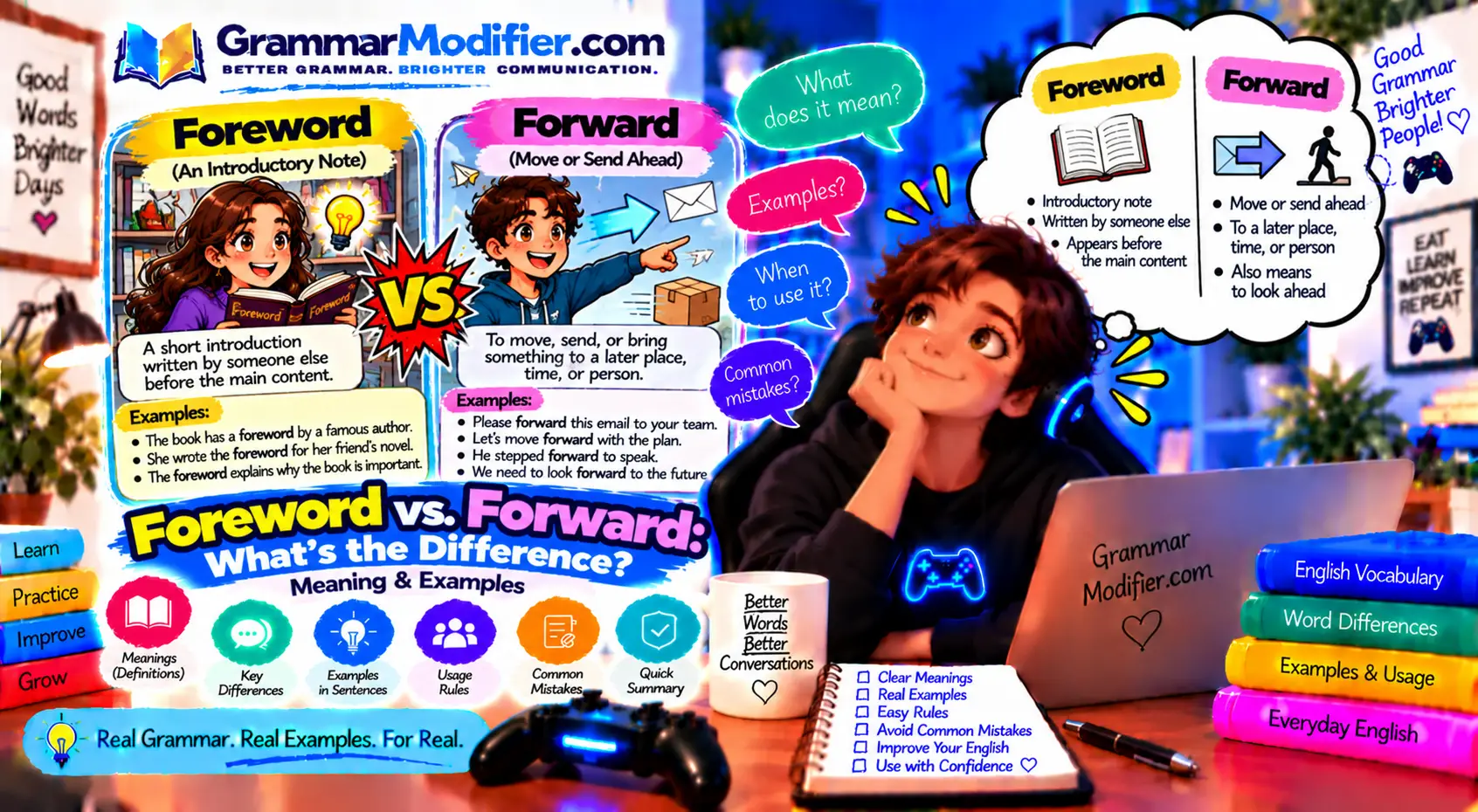
For example, a professor might write the foreword to a textbook, while a student might forward an email about that book to a friend.
The words are homophones, so their pronunciation alone cannot tell you which spelling to use.
The easiest distinction is simple: foreword refers to introductory words in a book, while forward relates to direction, progress, or sending something onward.
Quick Answer: Foreword vs. Forward
- 📖 Foreword (noun): An introductory section of a book, conventionally written by someone other than the main author.
- ➡️ Forward (adverb): Toward the front or ahead.
- 📩 Forward (verb): To send something onward or help it advance.
- 🚀 Forward (adjective): Located toward the front, future-oriented, or unusually bold.
- ⚽ Forward (noun): An attacking player in sports such as soccer.
Examples:
- “The historian wrote the foreword to the biography.”
- “Please move forward.”
- “Could you forward the document to me?”
- “The team’s forward scored the winning goal.”
Memory trick: Foreword = fore + word (words before a book). Forward = ahead or onward.
TL;DR
| Word | Meaning | Example |
|---|---|---|
| Foreword | Introductory book section | The foreword was written by a scientist. |
| Forward | Movement ahead | She stepped forward. |
| Forward | Sending information | Please forward the email. |
| Forward | Future-focused | They developed a forward-looking plan. |
| Forward | Sports position | The forward scored twice. |
Bottom line: Use foreword for a book introduction and forward for movement, progress, sending information, or a position toward the front.
Foreword vs. Forward: Quick Difference
The main difference between foreword and forward is their purpose.
A foreword is a specific type of introductory writing found in books. It commonly introduces the author, explains the book’s importance, or offers an endorsement.
Forward is a more flexible word. It can describe physical movement, progress, communication, future direction, or an attacking player.
Compare:
- “The journalist contributed the foreword to the book.”
- “The journalist decided to move forward with the investigation.”
The first sentence refers to writing. The second refers to progress.
| Feature | Foreword | Forward |
|---|---|---|
| Book introduction | Yes | No |
| Physical movement | No | Yes |
| Email communication | No | Yes |
| Future progress | No | Yes |
| Sports position | No | Yes |
| Part of speech | Noun | Adverb, adjective, verb, noun |
Quick rule: If the sentence refers to introductory writing in a book, use foreword. Otherwise, if it describes being ahead or moving onward, use forward.
What Does Foreword Mean?
A foreword is a short introductory section placed near the beginning of a book.
It is conventionally written by someone other than the book’s main author, such as an expert, colleague, or respected professional.
A foreword may establish the author’s credibility, provide background, or explain why the book deserves attention.
Foreword in a Biography
“The historian wrote the foreword to the biography.”
The historian contributed an introductory section.
Foreword in an Academic Book
“The textbook includes a foreword by a leading researcher.”
The researcher introduces the work or discusses its significance.
Foreword in a New Edition
“The publisher added a new foreword to the anniversary edition.”
The updated book contains an additional introductory contribution.
Important: A foreword is part of a book’s front matter, which appears before the main chapters.
What Does Forward Mean?
Forward has several meanings and can function as an adverb, adjective, verb, or noun.
Its central idea involves being ahead, moving onward, or directing something toward the front.
Forward as an Adverb
“She stepped forward to answer the question.”
Here, forward describes direction.
Forward as an Adjective
“The aircraft’s forward section was inspected.”
Here, forward describes a location toward the front.
Forward as a Verb
“Please forward the message to the team.”
Here, forward means to send something onward.
Forward as a Noun
“The soccer team’s forward scored twice.”
Here, forward identifies an attacking player.
Key takeaway: Foreword has one main grammatical role, while forward has several meanings and functions.
Foreword vs. Forward Comparison Chart
The following examples show when to use each word.
| Situation | Correct word | Example |
|---|---|---|
| Introductory book section | Foreword | The book includes a foreword. |
| Moving ahead | Forward | Take one step forward. |
| Sending an email | Forward | Forward the message. |
| Expert’s opening note | Foreword | The professor wrote the foreword. |
| Future planning | Forward | They adopted a forward-looking strategy. |
| Sports position | Forward | The forward scored a goal. |
| Continuing a project | Forward | Let’s move forward. |
| New book edition | Foreword | The edition includes a new foreword. |
Compare These Sentences
“The scientist wrote the foreword.”
This means the scientist contributed introductory writing.
“The scientist moved forward with the experiment.”
This means the scientist continued making progress.
Remember: The correct spelling depends on whether you mean book introduction or movement and progress.
How to Pronounce Foreword and Forward
Foreword and forward are generally pronounced alike in standard American English.
They are commonly treated as homophones, although accents and individual pronunciation patterns can vary.
Pronunciation Guide
| Word | American IPA | Easy pronunciation |
|---|---|---|
| Foreword | /ˈfɔr.wɚd/ | FOR-werd |
| Forward | /ˈfɔr.wɚd/ | FOR-werd |
Both words have two syllables, with stress on the first syllable.
Pronunciation Examples
- “The book contains a foreword.”
- “Please move forward.”
The highlighted words normally sound identical.
Why Are They Confusing?
Because pronunciation does not reliably distinguish them, writers must use context to identify the intended meaning.
Pronunciation tip: Remember the spelling connection between foreword and word rather than trying to hear a difference.
How to Use Foreword in a Sentence
Use foreword when discussing introductory writing in a book.
Publishing Examples
- “The publisher requested a foreword from a historian.”
- “The book begins with a thoughtful foreword.”
- “A respected novelist wrote the foreword.”
- “The foreword explains the book’s importance.”
- “The anniversary edition includes a new foreword.”
Academic Examples
- “The professor contributed a foreword to the textbook.”
- “The researcher wrote the foreword for the scientific collection.”
- “The foreword introduces the author’s work.”
- “The editor invited an expert to write a foreword.”
- “The foreword provides historical background.”
Everyday Examples
- “I read the foreword before Chapter One.”
- “The foreword helped me understand the book’s purpose.”
Writing tip: Common expressions include write a foreword, foreword by, and foreword to a book.
How to Use Forward in a Sentence
Use forward when describing movement, progress, direction, or sending something onward.
Movement and Direction
- “Please step forward.”
- “The crowd moved forward.”
- “She leaned forward to hear better.”
- “The car rolled forward.”
- “He looked forward instead of backward.”
Communication
- “Please forward the email.”
- “She forwarded the document to her manager.”
- “I’ll forward your request.”
- “The assistant forwarded the message.”
- “Could you forward the invitation?”
Progress and Planning
- “The project is moving forward.”
- “The company adopted a forward-looking strategy.”
Key point: Forward appears frequently in professional communication and everyday descriptions of progress.
Foreword vs. Preface vs. Introduction
A foreword, preface, and introduction all appear near the beginning of a book, but they serve different purposes.
Foreword
A foreword is conventionally written by someone other than the main author.
It may introduce the author, establish credibility, or explain why the book matters.
Preface
A preface is usually written by the author.
It often explains why the book was written, how it developed, or what the author hopes to accomplish.
Introduction
An introduction prepares readers for the book’s subject.
It may define important concepts, provide context, or explain the structure of the chapters.
Quick Comparison
| Section | Usually written by | Main purpose |
|---|---|---|
| Foreword | Another person | Introduce or endorse the book |
| Preface | Author | Explain the book’s background |
| Introduction | Author | Prepare readers for the subject |
These are established publishing conventions, although individual books may organize their opening material differently.
Memory tip: Foreword = outside introduction. Preface = author’s explanation. Introduction = subject overview.
Who Writes a Foreword and Where Does It Appear?
A foreword is normally written by someone with expertise, professional experience, or a meaningful connection to the book.
Who Can Write a Foreword?
Common contributors include:
- A historian introducing a biography.
- A scientist introducing a research book.
- A fellow author introducing a novel.
- An industry expert introducing a business book.
Where Does a Foreword Appear?
A foreword usually appears in the book’s front matter, before the main chapters.
Depending on the publisher’s design, it may appear alongside a preface, acknowledgments, or introduction.
Can a Book Have More Than One Foreword?
Yes. Some books include multiple forewords, especially when new editions contain additional introductory contributions.
Should the Author Write Their Own Foreword?
An author’s personal explanation is generally better labeled a preface.
Publishing tip: Use foreword for an outside contributor’s introductory remarks and preface for the author’s own preliminary explanation.
Forward as a Verb: Forwarded and Forwarding
Forward is commonly used as a verb meaning to send something onward.
It can also mean helping an activity, plan, or goal advance.
Forward an Email
“Please forward the email to the department.”
This means to send the received email to another recipient.
Forward a Document
“She forwarded the report to her supervisor.”
This means she passed the report along.
Forward a Request
“The receptionist forwarded the request to the correct office.”
This means the request was directed onward.
Forward a Goal
“The new partnership helped forward the organization’s mission.”
Here, forward means to advance or promote a goal.
Verb Forms
| Form | Example |
|---|---|
| Forward | Please forward the email. |
| Forwards | She forwards requests daily. |
| Forwarded | He forwarded the document. |
| Forwarding | I am forwarding the message. |
Important: Foreword is not a verb meaning send onward.
Forward vs. Forwards in American English
Both forward and forwards can function as directional adverbs.
However, forward is generally the more common choice in edited American English.
Forward
“She stepped forward.”
This is natural in American English.
Forwards
“She stepped forwards.”
This is also grammatical, although forward is generally preferred in American usage.
Forward as a Verb
When giving an instruction, use forward:
- Correct: “Please forward the message.”
- Incorrect: “Please forwards the message.”
However, forwards is correct for the third-person singular present tense:
“She forwards emails every morning.”
Quick Rule
| Situation | Recommended form |
|---|---|
| American English direction | Forward |
| Alternative directional adverb | Forwards |
| Verb after please | Forward |
| Verb after she/he/it | Forwards |
Writing tip: For consistent American English, use forward as your default directional adverb.
Forward as an Adverb, Adjective, and Noun
Forward has several grammatical functions beyond its use as a verb.
Forward as an Adverb
“She stepped forward.”
The word describes movement toward the front.
Forward as an Adjective
“The forward section of the aircraft was damaged.”
The word describes a position toward the front.
Forward Meaning Overly Bold
“It was rather forward of him to ask such a personal question.”
Here, forward means unusually bold, direct, or presumptuous.
Forward as a Noun
“The team’s forward scored the winning goal.”
Here, forward refers to a player in an attacking position.
Forward-Looking
“The company adopted a forward-looking strategy.”
This describes a strategy focused on future developments.
Grammar tip: The different uses of forward are connected by ideas of position, direction, advancement, or being ahead.
Common Expressions With Forward
Forward appears in many useful expressions.
Move Forward
“Let’s move forward with the plan.”
Meaning: Continue making progress.
Look Forward To
“I look forward to hearing from you.”
Meaning: Anticipate something with interest or pleasure.
Grammar rule: When a verb follows look forward to, use its -ing form.
- Correct: “I look forward to meeting you.”
- Incorrect: “I look forward to meet you.”
Put Forward
“She put forward a new proposal.”
Meaning: Suggest or present an idea.
Bring Forward
“The meeting was brought forward to Monday.”
In British English, this commonly means moving an event to an earlier date. In American English, move up is often clearer.
Straightforward
“The instructions are straightforward.”
Meaning: Clear and easy to understand.
Writing tip: Learn these expressions as complete phrases because their meanings can extend beyond physical movement.
Common Foreword vs. Forward Mistakes
Because these words sound alike, spelling mistakes are common.
Mistake 1: Book Introduction
❌ “The book includes a forward.”
✅ “The book includes a foreword.”
Why: Foreword refers to introductory writing.
Mistake 2: Sending an Email
❌ “Please foreword the email.”
✅ “Please forward the email.”
Why: Forward means send onward.
Mistake 3: Movement
❌ “Take one step foreword.”
✅ “Take one step forward.”
Why: Forward describes direction.
Mistake 4: Expert’s Opening Note
❌ “The historian wrote the forward.”
✅ “The historian wrote the foreword.”
Why: The sentence refers to a book introduction.
Mistake 5: Progress
❌ “We need to move foreword.”
✅ “We need to move forward.”
Why: Forward describes progress.
Mistake 6: Professional Emails
❌ “I look forward to meet you.”
✅ “I look forward to meeting you.”
Why: The expression look forward to takes a noun or an -ing verb form.
Editing tip: Ask whether the sentence describes introductory book words or movement, progress, or sending.
Easy Memory Tricks and Decision Guide
These homophones are easy to distinguish with a few spelling associations.
Foreword = Fore + Word
Foreword contains the word word.
Think of introductory words appearing before the main chapters of a book.
Foreword → Before + Words → Book introduction
Forward = Ahead
Forward refers to movement, progress, or sending something onward.
Imagine an arrow pointing ahead.
Forward → Ahead → Movement or progress
Quick Decision Guide
Question 1: Are you referring to introductory writing in a book?
- Yes → Foreword
- No → Continue.
Question 2: Are you referring to movement, direction, progress, or sending something?
- Yes → Forward
Question 3: Are you describing a sports player or a position toward the front?
- Yes → Forward
Memory Sentence
“I read the foreword before moving forward to Chapter One.”
The first word describes introductory writing. The second describes progress.
Best memory trick: Foreword = book words. Forward = move ahead.
Foreword vs. Forward Practice Quiz
Choose the correct answer for each sentence.
Questions
1. The historian contributed the ______ to the biography.
A. Foreword
B. Forward
2. Please ______ the email to your supervisor.
A. Foreword
B. Forward
3. The crowd moved ______ toward the stage.
A. Foreword
B. Forward
4. Which section is usually written by the author to explain why a book was created?
A. Foreword
B. Preface
5. Which sentence is grammatically correct?
A. I look forward to meet you.
B. I look forward to meeting you.
6. Which sentence uses forwards correctly as a verb?
A. Please forwards the message.
B. She forwards messages every morning.
Answers With Explanations
1. A — Foreword: Refers to introductory writing in a book.
2. B — Forward: Means to send a message onward.
3. B — Forward: Describes movement toward the front.
4. B — Preface: The author typically writes the preface to explain the book’s background.
5. B — I look forward to meeting you: A verb after look forward to takes the -ing form.
6. B — She forwards messages every morning: Forwards is the correct third-person singular verb form.
Copyable Answer Key: 1-A | 2-B | 3-B | 4-B | 5-B | 6-B
Frequently Asked Questions
What is the main difference between foreword and forward?
Foreword is an introductory section in a book. Forward means ahead, toward the front, or onward. It can also mean sending something to another person.
Is it foreword or forward in a book?
Use foreword when referring to an introductory contribution in a book, usually written by someone other than the main author.
Who usually writes a foreword?
A foreword is conventionally written by someone other than the author, such as an expert, colleague, or respected professional.
Are foreword and forward pronounced the same?
Yes. They are generally pronounced FOR-werd in standard American English and are commonly treated as homophones.
Is it forward an email or foreword an email?
Forward an email is correct because forward means to send a message onward.
What is the difference between a foreword and a preface?
A foreword is normally written by another person to introduce the book, while a preface is usually written by the author to explain its background.
Is it forward or forwards in American English?
Both are acceptable directional adverbs, but forward is generally preferred in edited American English. Forwards is also the third-person singular form of the verb forward.
Is it looking forward to meeting or looking forward to meet?
Looking forward to meeting is correct. When a verb follows look forward to, it normally takes the -ing form.
Conclusion
The difference between foreword vs. forward becomes clear when you focus on meaning.
Use foreword for an introductory section of a book, conventionally written by someone other than the author.
Use forward for movement, direction, progress, sending something onward, or a position toward the front.
Although these words sound alike, they are not interchangeable.
Final memory rule: Foreword = introductory book words. Forward = movement or progress.
Remember this distinction to use both words correctly in book publishing, academic writing, professional emails, and everyday communication.