
Have you ever read the word entrepreneur in a business article and wondered how to say it? You’re not alone. Its French spelling makes it look more complicated than it sounds, especially when you reach the ending.
You might be tempted to pronounce it like enter-pren-new-er. However, the standard English pronunciation is shorter and follows a different rhythm.
The secret is knowing which syllable receives the strongest stress. Once you master that part, the remaining sounds become much easier to connect.
Whether you’re discussing a startup, preparing for a presentation, or improving your English vocabulary, this guide will help you pronounce entrepreneur confidently and use it correctly.
Quick Answer
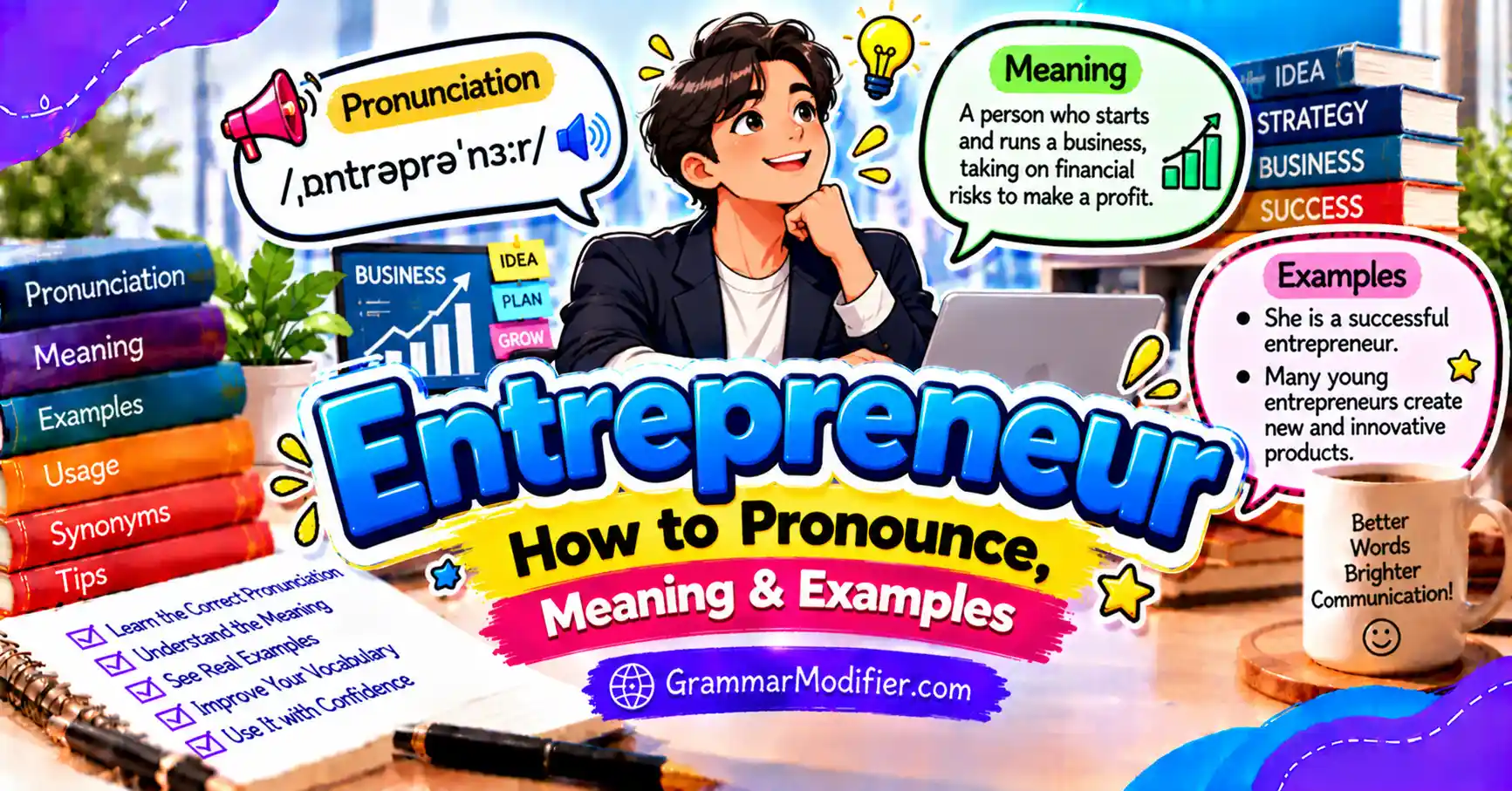
Entrepreneur is commonly pronounced ahn-truh-pruh-NUR in American English. Its IPA transcription is /ˌɑːn.trə.prəˈnɝː/. The word has four syllables, with primary stress on the fourth and secondary stress on the first. An entrepreneur is someone who starts or organizes a business venture, often accepting financial risk.
TL;DR
- American IPA: /ˌɑːn.trə.prəˈnɝː/
- British IPA: /ˌɒn.trə.prəˈnɜː(r)/
- Easy pronunciation: ahn-truh-pruh-NUR
- Syllables: Four
- Primary stress: Fourth syllable
- Secondary stress: First syllable
- Meaning: A person who organizes or develops a business venture
- Part of speech: Countable noun
- Plural: Entrepreneurs
- Origin: French
Table of Contents
- What Is the Correct Pronunciation of Entrepreneur?
- How to Pronounce Entrepreneur Step by Step
- Entrepreneur Pronunciation in American English
- Entrepreneur Pronunciation in British English
- How Many Syllables Are in Entrepreneur?
- Which Syllable Is Stressed in Entrepreneur?
- How to Pronounce the Ending of Entrepreneur
- Why Is Entrepreneur Difficult to Pronounce?
- What Does Entrepreneur Mean?
- Entrepreneur Definition and Part of Speech
- How to Use Entrepreneur in a Sentence
- Common Entrepreneur Pronunciation and Spelling Mistakes
- Entrepreneur vs Business Owner, Founder, and Investor
- Entrepreneurial and Entrepreneurship Pronunciation
- How to Practice Pronouncing Entrepreneur Naturally
- Entrepreneur Pronunciation Quiz and Exercises
What Is the Correct Pronunciation of Entrepreneur?
The standard American English pronunciation of entrepreneur is /ˌɑːn.trə.prəˈnɝː/.
A simple way to remember it is ahn-truh-pruh-NUR.
The final syllable receives the strongest stress. The first syllable is also noticeable, but it is less prominent.
| Feature | Correct Information |
|---|---|
| Word | Entrepreneur |
| American IPA | /ˌɑːn.trə.prəˈnɝː/ |
| British IPA | /ˌɒn.trə.prəˈnɜː(r)/ |
| Easy pronunciation | ahn-truh-pruh-NUR |
| Syllables | Four |
| Primary stress | Fourth syllable |
| Secondary stress | First syllable |
| Part of speech | Noun |
For accurate audio, listen to the Cambridge Dictionary pronunciation of entrepreneur.
Example: The entrepreneur opened a small bakery near the university.
How to Pronounce Entrepreneur Step by Step
Learning entrepreneur is easier when you practice its four syllables separately.
First Syllable: Ahn
The first syllable is /ɑːn/ in the American transcription used here.
It contains an open vowel similar to the one in father in many American accents.
This syllable receives secondary stress.
Second Syllable: Truh
The second syllable is /trə/.
Its vowel is a schwa, represented by /ə/.
Schwa is a short, relaxed vowel heard in unstressed syllables.
Third Syllable: Pruh
The third syllable is /prə/.
Keep the P and R sounds together.
Avoid inserting an extra vowel between them.
Fourth Syllable: NUR
The final syllable is /nɝː/ in the common American pronunciation.
It contains an R-colored vowel and receives primary stress.
Sound Breakdown
| Syllable | IPA | Stress |
|---|---|---|
| ahn | /ɑːn/ | Secondary |
| truh | /trə/ | Unstressed |
| pruh | /prə/ | Unstressed |
| NUR | /nɝː/ | Primary |
Practice sentence: My brother hopes to become an entrepreneur.
Entrepreneur Pronunciation in American English
In American English, entrepreneur commonly follows the pronunciation /ˌɑːn.trə.prəˈnɝː/.
The two middle syllables are light, while the final syllable receives strong emphasis.
American Pronunciation Tips
- Use an open vowel at the beginning.
- Keep the middle syllables relaxed.
- Make the final syllable strongest.
- Pronounce the R-colored vowel at the end.
Some American dictionaries recognize other vowel variants near the end, including pronunciations with a vowel closer to /ʊr/.
These are accepted variations, not necessarily errors.
Example: The entrepreneur created a mobile app for local businesses.
Entrepreneur Pronunciation in British English
In British English, entrepreneur is commonly pronounced /ˌɒn.trə.prəˈnɜː(r)/.
The first vowel differs from the standard American form.
Many British speakers also use a non-rhotic pronunciation, meaning the final R is not pronounced before a pause.
American vs. British English
| Feature | American English | British English |
|---|---|---|
| Common IPA | /ˌɑːn.trə.prəˈnɝː/ | /ˌɒn.trə.prəˈnɜː(r)/ |
| First vowel | /ɑː/ | /ɒ/ |
| Final vowel | R-colored /ɝː/ | /ɜː/ |
| Syllables | Four | Four |
| Main stress | Fourth | Fourth |
Both pronunciations are correct within their respective accents.
Example: The British entrepreneur expanded her company into new markets.
How Many Syllables Are in Entrepreneur?
Entrepreneur has four syllables in its standard careful pronunciation.
A syllable is a unit of speech built around a vowel sound.
You can practice by tapping once for each syllable.
Four-Syllable Table
| Number | Sound | Stress |
|---|---|---|
| 1 | ahn | Secondary |
| 2 | truh | Weak |
| 3 | pruh | Weak |
| 4 | NUR | Primary |
The final beat should stand out.
Don’t add a separate syllable after the final R sound.
Example: The entrepreneur presented a new business idea to investors.
Which Syllable Is Stressed in Entrepreneur?
The fourth syllable receives primary stress.
The first syllable receives secondary stress.
This means the final syllable is the strongest part of the word.
IPA Stress Symbols
| Symbol | Meaning |
|---|---|
| ˈ | Primary stress |
| ˌ | Secondary stress |
| /ə/ | Reduced schwa vowel |
In the transcription /ˌɑːn.trə.prəˈnɝː/, the primary stress mark appears before the final syllable.
Why Stress Matters
Incorrect stress can make a word harder for listeners to recognize.
English pronunciation depends on rhythm as well as individual sounds.
Example: The entrepreneur developed a successful online business.
How to Pronounce the Ending of Entrepreneur
The ending -preneur can confuse English learners because the spelling doesn’t match familiar English patterns.
In the standard American pronunciation, the final two syllables are /prə/ and /nɝː/.
The first is weak. The second is strongly stressed.
Ending Pronunciation
| Sound | IPA | Explanation |
|---|---|---|
| pruh | /prə/ | P and R followed by schwa |
| NUR | /nɝː/ | Strong R-colored vowel |
Avoid pronouncing the ending as new-er.
The final sound is closer to the stressed vowel in American English nurse.
Example: She became an entrepreneur after working in finance.
Why Is Entrepreneur Difficult to Pronounce?
Entrepreneur is challenging because English borrowed it from French.
The spelling reflects its history, but the pronunciation follows English sound patterns that may feel unfamiliar.
French Origin
Entrepreneur comes from French and is related to the verb entreprendre, meaning to undertake.
The word eventually became closely connected with people who organize and develop business ventures.
Common Difficulties
Unfamiliar spelling: The letters don’t clearly reveal the pronunciation.
Reduced vowels: The middle syllables contain weak schwa sounds.
Final stress: The strongest syllable appears at the end.
Accent differences: American and British speakers use different vowel sounds.
Memory tip: An entrepreneur is someone who undertakes a business venture.
Example: The entrepreneur turned a simple idea into a profitable company.
What Does Entrepreneur Mean?
An entrepreneur is a person who starts, organizes, or develops a business venture, often taking financial risks.
Entrepreneurs may create products, provide services, or build companies that solve problems.
Simple Meaning
Entrepreneur = someone who starts or develops a business venture.
Common Entrepreneurial Activities
| Activity | Example |
|---|---|
| Starting a business | Opening a coffee shop |
| Developing a product | Creating a mobile application |
| Offering a service | Launching a cleaning company |
| Managing risk | Investing savings in a startup |
| Solving problems | Building a new delivery system |
An entrepreneur doesn’t have to invent something completely new.
A person who opens a neighborhood restaurant may also be an entrepreneur.
Example: The entrepreneur started a landscaping company with two employees.
Entrepreneur Definition and Part of Speech
Entrepreneur is a countable noun.
It refers to a person and can be singular or plural.
Singular and Plural Forms
| Form | Example |
|---|---|
| Singular | An entrepreneur started the company. |
| Plural | Several entrepreneurs attended the conference. |
| Singular possessive | The entrepreneur’s idea attracted investors. |
| Plural possessive | The entrepreneurs’ projects received funding. |
The plural is entrepreneurs.
Use an entrepreneur, not a entrepreneur, because the word begins with a vowel sound.
Example: An entrepreneur must understand customer needs.
How to Use Entrepreneur in a Sentence
Here are 30 original examples showing how entrepreneur is used naturally.
Starting a Business
- The entrepreneur opened a bakery downtown.
- She became an entrepreneur after leaving her office job.
- A young entrepreneur launched an online clothing store.
- The entrepreneur hired five employees during the first year.
- My uncle is an entrepreneur who owns a repair shop.
- The entrepreneur created a delivery service for local restaurants.
Technology and Innovation
- The entrepreneur developed an app for small businesses.
- A technology entrepreneur introduced a new payment system.
- The entrepreneur designed a tool that saves farmers time.
- She met an entrepreneur working on renewable energy.
- The entrepreneur tested his product with potential customers.
- An ambitious entrepreneur created a language-learning platform.
Finance and Business Risk
- The entrepreneur invested her savings in the company.
- Every entrepreneur needs a realistic financial plan.
- The entrepreneur applied for a small-business loan.
- An experienced entrepreneur understands cash flow.
- The entrepreneur negotiated funding with several investors.
- She advised the entrepreneur to prepare for unexpected expenses.
Education and Careers
- The college invited an entrepreneur to speak with students.
- He studied marketing before becoming an entrepreneur.
- The entrepreneur shared lessons from her first failed business.
- A local entrepreneur volunteered as a student mentor.
- The teacher encouraged students to interview an entrepreneur.
- She attended a workshop for aspiring entrepreneurs.
Everyday Conversation
- My neighbor is an entrepreneur who runs a landscaping business.
- The entrepreneur works from a small office downtown.
- Her cousin wants to become an entrepreneur someday.
- The newspaper interviewed a successful local entrepreneur.
- An entrepreneur often balances several responsibilities.
- The entrepreneur celebrated the company’s fifth anniversary.
Common Entrepreneur Pronunciation and Spelling Mistakes
Entrepreneur is often misspelled because its French-derived spelling is unfamiliar.
Pronunciation mistakes usually involve incorrect stress or extra vowel sounds.
Pronunciation Mistakes
| Mistake | Correct Approach |
|---|---|
| Stressing the first syllable most | Stress the fourth syllable |
| Adding a fifth syllable | Use four syllables |
| Dropping the R from /prə/ | Keep the PR sound |
| Saying the ending as new-er | Use the dictionary pronunciation |
| Stressing the middle syllables | Keep them relaxed |
Common Spelling Mistakes
| Incorrect | Correct |
|---|---|
| enterpreneur | entrepreneur |
| entreprenuer | entrepreneur |
| entreprenur | entrepreneur |
| entrepraneur | entrepreneur |
| entreprenour | entrepreneur |
Spelling Memory Trick
Divide the written word into:
entre + pren + eur
This is a spelling aid, not an exact pronunciation breakdown.
Example: The entrepreneur received an award for her business achievements.
Entrepreneur vs Business Owner, Founder, and Investor
These terms describe different business roles, although one person may hold several of them.
Comparison Table
| Term | Meaning |
|---|---|
| Entrepreneur | Starts or develops a business venture, often taking risks |
| Business owner | Owns all or part of a business |
| Founder | Establishes a company or organization |
| Investor | Provides capital in expectation of a return |
Key Differences
An entrepreneur focuses on developing a venture.
A business owner owns a business, whether they started it or purchased it.
A founder is the person who established the organization.
An investor contributes money or other capital but may not manage the company.
Example: The founder was also an entrepreneur and the company’s largest investor.
Entrepreneurial and Entrepreneurship Pronunciation
Two important related words are entrepreneurial and entrepreneurship.
They share the same word family but have different endings.
Entrepreneurship
Entrepreneurship is a noun referring to the process or activity of creating and developing business ventures.
Its common American IPA transcription is /ˌɑːn.trə.prəˈnɝː.ʃɪp/.
It has five syllables in this careful transcription.
Example: The university offers a course in entrepreneurship.
Entrepreneurial
Entrepreneurial is an adjective describing qualities associated with entrepreneurs.
One common American IPA transcription is /ˌɑːn.trə.prəˈnʊr.i.əl/.
It has six syllables in this transcription. Pronunciation variants occur.
Example: She demonstrated an entrepreneurial mindset by solving a local problem.
Related Word Comparison
| Word | Part of Speech | American IPA |
|---|---|---|
| Entrepreneur | Noun | /ˌɑːn.trə.prəˈnɝː/ |
| Entrepreneurship | Noun | /ˌɑːn.trə.prəˈnɝː.ʃɪp/ |
| Entrepreneurial | Adjective | /ˌɑːn.trə.prəˈnʊr.i.əl/ |
How to Practice Pronouncing Entrepreneur Naturally
A short daily routine can improve your pronunciation.
Five-Minute Practice Routine
Minute 1: Listen
Play the pronunciation from Cambridge Dictionary.
Focus on the final stressed syllable.
Minute 2: Repeat Slowly
Say the four syllables separately, then connect them.
Minute 3: Practice Stress
Make the fourth syllable stronger than the others.
Minute 4: Practice Phrases
Repeat:
- Successful entrepreneur
- Young entrepreneur
- Local entrepreneur
- Technology entrepreneur
- Aspiring entrepreneur
Minute 5: Read Sentences
Practice these sentences:
- She is a successful entrepreneur.
- The entrepreneur launched a new company.
- My friend wants to become an entrepreneur.
- The entrepreneur presented her business idea.
- Several entrepreneurs attended the event.
Record yourself and compare your pronunciation with a dictionary recording.
Entrepreneur Pronunciation Quiz and Exercises
Test your understanding with these questions and correction exercises.
Ten Multiple-Choice Questions
1. Which American IPA transcription is correct?
A. /ˌɑːn.trə.prəˈnɝː/
B. /ˈɛn.tər.prə.nɔːr/
C. /ˈɑːn.trə.prə.nɝː/
2. How many syllables does entrepreneur have?
A. Three
B. Four
C. Five
3. Which syllable receives primary stress?
A. First
B. Second
C. Fourth
4. Which syllable receives secondary stress?
A. First
B. Third
C. Fourth
5. Which language did English borrow entrepreneur from?
A. German
B. French
C. Spanish
6. What does entrepreneur mean?
A. Someone who starts or organizes a business venture
B. Someone who never takes financial risks
C. Someone who only buys products
7. What part of speech is entrepreneur?
A. Adjective
B. Noun
C. Preposition
8. Which spelling is correct?
A. Enterpreneur
B. Entreprenuer
C. Entrepreneur
9. What is the plural of entrepreneur?
A. Entrepreneures
B. Entrepreneurs
C. Entrepreneuries
10. What does entrepreneurship refer to?
A. The process of developing business ventures
B. A type of business tax
C. A person who only invests in stocks
MCQ Answer Key With Explanations
| Question | Answer | Explanation |
|---|---|---|
| 1 | A | This is the standard American transcription used in this guide. |
| 2 | B | Entrepreneur has four syllables. |
| 3 | C | Primary stress falls on the fourth syllable. |
| 4 | A | Secondary stress falls on the first syllable. |
| 5 | B | English borrowed entrepreneur from French. |
| 6 | A | An entrepreneur organizes or develops a venture. |
| 7 | B | Entrepreneur is a countable noun. |
| 8 | C | Entrepreneur is the correct spelling. |
| 9 | B | Add S to form entrepreneurs. |
| 10 | A | Entrepreneurship concerns creating and developing ventures. |
Five Correction Exercises
Correct each incorrect statement.
Exercise 1: Entrepreneur has five syllables.
Exercise 2: The first syllable receives the strongest stress.
Exercise 3: The correct spelling is enterpreneur.
Exercise 4: Entrepreneur is an adjective.
Exercise 5: An entrepreneur and an investor always have exactly the same role.
Correction Exercise Answers
- Entrepreneur has four syllables.
- The fourth syllable receives primary stress.
- The correct spelling is entrepreneur.
- Entrepreneur is a countable noun.
- An entrepreneur develops or organizes a venture, while an investor provides capital. Their roles may overlap, but they are not identical.
Frequently Asked Questions
How do Americans pronounce entrepreneur?
Americans commonly pronounce entrepreneur ahn-truh-pruh-NUR, with the IPA transcription /ˌɑːn.trə.prəˈnɝː/.
How many syllables are in entrepreneur?
Entrepreneur has four syllables in its standard careful pronunciation.
Which syllable is stressed in entrepreneur?
The fourth syllable receives primary stress, while the first syllable receives secondary stress.
Is entrepreneur a French word?
Yes. English borrowed entrepreneur from French, where it is related to entreprendre, meaning to undertake.
How do you spell entrepreneur correctly?
The correct spelling is entrepreneur. Common misspellings include enterpreneur and entreprenuer.
What does entrepreneur mean in simple English?
An entrepreneur is someone who starts, organizes, or develops a business venture, often taking financial risks.
Is entrepreneur pronounced differently in British English?
Yes. British English commonly uses /ˌɒn.trə.prəˈnɜː(r)/, while American English commonly uses /ˌɑːn.trə.prəˈnɝː/.
What is the difference between an entrepreneur and a business owner?
An entrepreneur emphasizes starting or developing a venture, while a business owner owns a business. One person can be both.
Conclusion
Learning how to pronounce entrepreneur becomes easier when you focus on its four syllables and final stress.
The common American pronunciation is /ˌɑːn.trə.prəˈnɝː/, with primary stress on the fourth syllable and secondary stress on the first.
An entrepreneur is someone who organizes or develops a business venture, often accepting financial risk.
Practice the word slowly, listen to dictionary audio, and use it in everyday sentences. With repetition, you’ll become more confident pronouncing entrepreneur naturally.
Authoritative References
- Cambridge Dictionary — Entrepreneur Pronunciation
- Oxford Learner’s Dictionaries — Entrepreneur
- Merriam-Webster — Entrepreneur
- Cambridge Dictionary — Entrepreneurship Pronunciation
- Cambridge Dictionary — Entrepreneurial Pronunciation
- Online Etymology Dictionary — Entrepreneur
- Collins Dictionary — Entrepreneur