
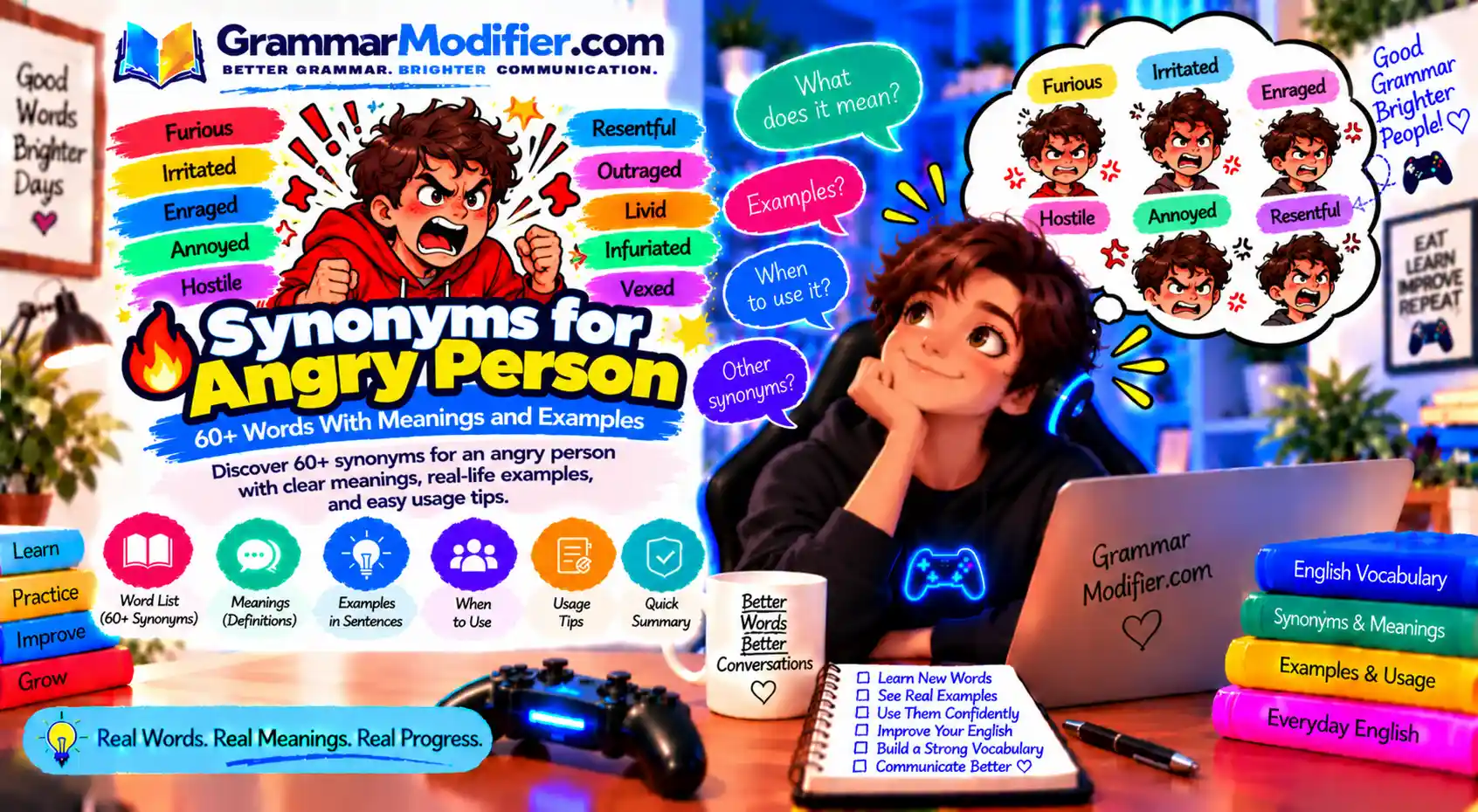
Looking for the best synonyms for angry person? English offers many ways to describe someone who feels angry, loses their temper easily, or frequently acts grumpy. Words like furious, irritable, hotheaded, grouchy, and cantankerous can express different types of anger.
However, these words don’t all mean the same thing. A furious person feels intense anger, while a short-tempered person becomes angry easily. This guide explains useful synonyms, their meanings, natural sentence examples, and how to choose the right expression in American English.
Quick Answer
The best synonyms for angry person include hothead, grouch, grump, crank, curmudgeon, irritable person, short-tempered person, furious person, irate person, and cantankerous person. Use hothead for someone who gets angry quickly, grouch for someone often grumpy, and furious for someone extremely angry.
TL;DR
- Hothead: Someone who loses their temper quickly.
- Grouch: A person who is often grumpy.
- Irascible: Easily angered or irritated.
- Furious: Extremely angry.
- Irate: Very angry about something.
- Cantankerous: Bad-tempered and argumentative.
Best Synonyms for Angry Person
The best synonym depends on the person’s feelings and behavior. Some words describe temporary anger, while others describe a person’s usual temperament.
For example, angry describes an emotion, but hothead describes someone who frequently reacts with anger. Understanding this difference helps you choose more accurate vocabulary.
| Synonym | Simple Meaning | Best Use |
|---|---|---|
| Hothead | Someone who gets angry quickly | Quick temper |
| Grouch | A habitually grumpy person | Bad mood |
| Grump | Someone who is often irritable | Informal speech |
| Crank | A bad-tempered person | Personality |
| Curmudgeon | A complaining, bad-tempered person | Character descriptions |
| Furious | Extremely angry | Intense emotion |
| Irate | Very angry | Complaints |
| Irritable | Easily annoyed | Mood or temperament |
| Short-tempered | Quick to lose patience | Personality |
| Irascible | Easily provoked into anger | Formal writing |
| Cantankerous | Argumentative and bad-tempered | Difficult personality |
| Livid | Extremely angry | Strong reactions |
Example: “The usually calm manager became irate after discovering the repeated mistakes.”
Common Words for an Angry Person
Everyday English includes several familiar words for anger. These expressions are useful in conversations, school assignments, emails, and stories.
Some describe mild irritation, while others suggest stronger feelings. Choosing the right word helps readers understand the situation without exaggeration.
- Angry: Feeling strong displeasure.
- Mad: Angry, especially in American English.
- Annoyed: Slightly angry or bothered.
- Irritated: Upset by something unpleasant.
- Frustrated: Annoyed because something isn’t working.
- Upset: Emotionally troubled or unhappy.
- Grumpy: In a bad mood.
- Cranky: Easily irritated or complaining.
- Grouchy: Often grumpy or unpleasant.
- Aggravated: Increasingly irritated.
- Displeased: Unhappy with something.
- Cross: Angry, especially in British English.
Examples in Sentences
- “The annoyed customer asked for a refund.”
- “My brother gets grumpy when he’s tired.”
- “The frustrated student couldn’t solve the problem.”
- “She was mad about the unexpected delay.”
Usage tip: In American English, mad is a common informal synonym for angry. However, upset and frustrated can describe feelings that don’t necessarily involve anger.
Synonyms for Someone Who Gets Angry Easily
A person who gets angry easily may react strongly to small problems. English has several adjectives for this personality trait.
These words describe how quickly someone becomes angry, rather than how angry they feel at one particular moment.
- Short-tempered: Quickly loses patience.
- Hot-tempered: Becomes angry easily.
- Quick-tempered: Reacts angrily without much delay.
- Irascible: Easily provoked into anger.
- Touchy: Easily offended or upset.
- Testy: Irritable and impatient.
- Snappish: Likely to respond sharply.
- Prickly: Sensitive and easily annoyed.
- Petulant: Childishly irritable.
- Choleric: Easily angered or bad-tempered.
- Ill-tempered: Frequently unpleasant or angry.
- Thin-skinned: Easily hurt by criticism.
Examples
- “Our short-tempered coach dislikes repeated mistakes.”
- “He’s touchy about his appearance.”
- “The irascible professor demanded silence.”
- “Her snappish response surprised everyone.”
Grammar tip: Say “He is a hothead” or “He is hotheaded.” The first uses a noun, while the second uses an adjective.
Strong Words for a Very Angry Person
When someone experiences extreme anger, ordinary words may sound too mild. Stronger alternatives communicate the intensity more clearly.
Words such as furious, enraged, and livid are useful in dramatic stories, emotional descriptions, and serious disagreements.
- Furious: Extremely angry.
- Enraged: Filled with intense anger.
- Livid: Very angry.
- Infuriated: Made extremely angry.
- Incensed: Deeply angered or offended.
- Outraged: Angry about something considered wrong.
- Wrathful: Full of powerful anger.
- Fuming: Strongly angry.
- Seething: Experiencing intense, often restrained anger.
- Apoplectic: Extremely angry, often visibly so.
- Beside oneself with rage: Overwhelmed by anger.
- Boiling with anger: Feeling intense anger.
Examples
- “The coach was furious after the team ignored his instructions.”
- “She was livid when someone stole her work.”
- “The residents were outraged by the unfair decision.”
Important difference: Outraged often suggests anger about injustice, while furious can describe intense anger for many reasons.
Polite Words for an Angry Person
Calling someone angry may sometimes sound confrontational. In professional situations, a more neutral expression can be helpful.
Words like frustrated, displeased, and upset may describe someone’s reaction respectfully. However, they aren’t exact synonyms for anger.
- Frustrated: Upset by difficulties or obstacles.
- Displeased: Unhappy with something.
- Dissatisfied: Not satisfied with a result.
- Upset: Emotionally troubled.
- Agitated: Emotionally unsettled.
- Bothered: Annoyed or troubled.
- Unhappy: Not pleased with a situation.
- Disappointed: Unhappy about an outcome.
- Concerned: Worried rather than necessarily angry.
- Distressed: Experiencing emotional discomfort.
Professional Examples
Instead of writing “The angry customer complained,” you could write:
“The frustrated customer requested assistance.”
Instead of “The manager was furious,” you could write:
“The manager was displeased with the results.”
Use these alternatives only when they accurately describe the person’s feelings. Polite wording shouldn’t change the facts.
Formal Synonyms for Angry Person
Formal English includes precise words for anger and difficult personalities. These expressions often appear in literature, essays, and advanced vocabulary lessons.
Some describe intense feelings, while others describe someone’s temperament. Learning their meanings improves both writing and reading comprehension.
- Irascible: Easily angered.
- Cantankerous: Bad-tempered and argumentative.
- Choleric: Easily angered or irritable.
- Indignant: Angry about perceived unfairness.
- Incensed: Extremely angry.
- Belligerent: Hostile and ready to argue or fight.
- Pugnacious: Eager to fight or argue.
- Splenetic: Bad-tempered or spiteful.
- Querulous: Habitually complaining.
- Petulant: Childishly irritable.
- Wrathful: Filled with intense anger.
- Acrimonious: Bitter or angry, usually describing speech or relationships.
Examples
- “The cantankerous landlord argued with every tenant.”
- “The students felt indignant about the unfair punishment.”
- “His belligerent behavior disrupted the meeting.”
Vocabulary note: Acrimonious usually describes arguments, exchanges, or relationships rather than directly describing a person’s mood.
Informal and Slang Words for Angry People
Informal American English includes colorful expressions for anger. These words often appear in conversations, movies, and social media.
Some expressions sound playful, while others can be insulting. Their suitability depends on the situation and your relationship with the person.
- Hothead: Someone who becomes angry quickly.
- Grouch: A habitually grumpy person.
- Grump: Someone who is often irritable.
- Crank: A bad-tempered person.
- Sourpuss: A gloomy or unpleasant person.
- Crabby: Irritable or unpleasant.
- Ticked off: Angry or annoyed.
- Steamed: Very angry.
- Fed up: Tired of an unpleasant situation.
- Worked up: Emotionally upset or excited.
- Salty: Bitter, annoyed, or resentful.
- Hot under the collar: Angry or irritated.
Examples
- “He’s still ticked off about yesterday’s argument.”
- “Don’t be such a grouch!”
- “She got worked up over a small mistake.”
American English tip: Ticked off is informal. In professional writing, annoyed, upset, or frustrated may be more suitable.
One-Word Names for an Angry Person
Sometimes, a single noun describes a person’s temperament more effectively than a long phrase. These words are useful in conversations and character descriptions.
Unlike adjectives such as furious or irritable, nouns such as hothead and grouch can directly refer to people.
| Noun | Meaning | Example |
|---|---|---|
| Hothead | Quick-tempered person | “He’s a hothead.” |
| Grouch | Habitually grumpy person | “Don’t be a grouch.” |
| Grump | Irritable person | “He’s a grump today.” |
| Crank | Bad-tempered person | “The crank complained again.” |
| Curmudgeon | Habitually complaining person | “He’s a lovable curmudgeon.” |
| Grumbler | Frequent complainer | “She’s a constant grumbler.” |
| Sourpuss | Gloomy or unpleasant person | “Don’t be a sourpuss.” |
| Crosspatch | Bad-tempered person | “The crosspatch refused to join.” |
Key difference: A hothead loses their temper quickly, while a grouch is often grumpy or complaining.
Words for a Constantly Angry Person
Some words describe someone who frequently appears irritated or bad-tempered. These expressions suggest a repeated pattern rather than a single angry reaction.
However, one bad day doesn’t define someone’s personality. Use these descriptions only when they reflect consistent behavior.
- Irascible: Easily angered.
- Cantankerous: Habitually argumentative.
- Ill-tempered: Frequently unpleasant.
- Bad-tempered: Often angry or irritable.
- Grouchy: Regularly grumpy.
- Surly: Unfriendly and bad-tempered.
- Crotchety: Easily annoyed and complaining.
- Peevish: Irritated by small things.
- Ornery: Stubborn and bad-tempered.
- Testy: Easily irritated.
- Cranky: Frequently irritable.
- Disagreeable: Unpleasant or difficult to get along with.
Examples
- “The crotchety neighbor complained about the noise.”
- “His surly attitude made conversations difficult.”
- “The cantankerous shopkeeper argued with customers.”
American English note: Ornery is a familiar American word for someone stubborn, difficult, or bad-tempered.
Words for an Aggressive or Hostile Person
Anger and aggression are related, but they aren’t identical. Anger is an emotion, while aggression describes behavior.
A person can feel furious without acting aggressively. Similarly, someone may behave aggressively without showing obvious anger.
- Aggressive: Forceful or confrontational.
- Hostile: Openly unfriendly.
- Belligerent: Ready to argue or fight.
- Combative: Eager to confront others.
- Confrontational: Likely to challenge people directly.
- Argumentative: Frequently inclined to argue.
- Quarrelsome: Often starting disagreements.
- Antagonistic: Showing opposition or hostility.
- Pugnacious: Eager to fight.
- Threatening: Suggesting possible harm.
Examples
- “The hostile visitor refused to cooperate.”
- “His confrontational attitude made the discussion difficult.”
- “The belligerent passenger argued with the staff.”
Remember: Furious describes emotional intensity, while aggressive describes behavior. They shouldn’t automatically replace each other.
Synonyms for a Quietly Angry Person
Not everyone expresses anger through shouting or arguments. Some people become silent, distant, or emotionally restrained when upset.
These words help writers describe hidden resentment, unresolved conflict, or strong emotions beneath a calm appearance.
- Seething: Feeling intense anger internally.
- Resentful: Bitter about perceived unfairness.
- Sullen: Quietly bad-tempered.
- Brooding: Thinking deeply about troubling feelings.
- Bitter: Holding lasting resentment.
- Disgruntled: Unhappy and dissatisfied.
- Aggrieved: Feeling unfairly treated.
- Smoldering: Suggesting strong hidden emotion.
- Sulky: Quietly showing annoyance.
- Glowering: Looking angrily or threateningly.
Examples
- “He sat silently, seething with anger.”
- “The resentful employee avoided further discussion.”
- “She gave him a glowering look.”
Writing tip: A clenched jaw, tense silence, or sharp glance can reveal anger without directly naming the emotion.
Angry Person Synonyms for Creative Writing
Creative writers often need more descriptive vocabulary than the word angry. A precise synonym can reveal a character’s mood, personality, or motivation.
For example, someone may feel furious about betrayal, irritable from exhaustion, or resentful about unfair treatment. Each word creates a different impression.
| Situation | Best Word | Example |
|---|---|---|
| Reacts angrily to small problems | Hotheaded | “The hotheaded captain shouted.” |
| Hides intense anger | Seething | “She was seething beneath her calm expression.” |
| Feels unfairly treated | Indignant | “He gave an indignant reply.” |
| Frequently complains | Grouchy | “The grouchy shopkeeper frowned.” |
| Is extremely angry | Livid | “She was livid after the betrayal.” |
| Is argumentative | Cantankerous | “The cantankerous neighbor slammed the gate.” |
| Holds lasting resentment | Bitter | “He remained bitter about the decision.” |
| Reacts with hostility | Belligerent | “The belligerent stranger stepped forward.” |
Weak vs. Strong Description
Basic: “The angry man looked at his friend.”
More descriptive: “The furious man clenched his fists and stared at his friend.”
The second sentence communicates both the emotion and the physical reaction.
Angry Person Synonyms in Sentences
Sentence examples help English learners understand how different anger words work. They also show which expressions sound natural in American English.
Notice whether each word describes a temporary emotion, repeated behavior, or a person’s reaction to conflict.
- Angry: “The angry customer demanded an explanation.”
- Furious: “My father was furious about the broken window.”
- Irate: “The irate passenger requested a refund.”
- Irritable: “She became irritable after working all night.”
- Grumpy: “My grandfather feels grumpy in the morning.”
- Cranky: “The tired child became cranky.”
- Grouchy: “Our grouchy neighbor dislikes loud music.”
- Short-tempered: “The short-tempered manager snapped at his assistant.”
- Hot-tempered: “His hot-tempered reactions surprised everyone.”
- Irascible: “The irascible professor disliked interruptions.”
- Cantankerous: “The cantankerous customer argued about the price.”
- Livid: “She was livid after discovering the mistake.”
- Seething: “He was seething after the unfair decision.”
- Resentful: “The resentful worker refused to discuss the promotion.”
- Belligerent: “The belligerent visitor shouted at security.”
- Indignant: “The student was indignant about the accusation.”
Practice tip: Replace angry in your own sentences with a more precise word. Check whether the replacement changes the meaning.
Angry vs. Irritable vs. Furious
These three words describe related emotions, but they have different meanings. Understanding their differences makes descriptions more accurate.
Angry expresses general displeasure, irritable describes someone easily annoyed, and furious means extremely angry.
| Word | Meaning | Intensity |
|---|---|---|
| Annoyed | Slightly bothered | Mild |
| Irritable | Easily annoyed | Variable |
| Angry | Feeling strong displeasure | Moderate to strong |
| Irate | Very angry | Strong |
| Furious | Extremely angry | Very strong |
| Enraged | Filled with intense anger | Extreme |
Examples
- “She was angry about the mistake.”
- “She felt irritable after a sleepless night.”
- “She was furious when she discovered the deception.”
Important distinction: Irritable describes how easily someone becomes annoyed. It doesn’t necessarily mean their anger is intense.
Common Mistakes When Choosing Anger Words
Many English learners treat anger-related words as exact replacements. However, each word carries a different meaning, grammatical role, or emotional intensity.
Another common mistake involves using adjectives as nouns. Learning the difference helps you form natural, grammatically correct sentences.
Common Mistakes and Corrections
- ❌ “He is a furious.” → ✅ “He is furious.”
- ❌ “She is an irritable.” → ✅ “She is irritable.”
- ❌ “He is hothead.” → ✅ “He is a hothead.”
- ❌ “She is a short-tempered.” → ✅ “She is short-tempered.”
- ❌ “Grumpy means extremely angry.” → ✅ “Grumpy usually describes mild irritability.”
- ❌ “Aggressive and angry mean exactly the same thing.” → ✅ “Aggression describes behavior; anger describes emotion.”
- ❌ “Concerned always means angry.” → ✅ “Concerned usually means worried.”
- ❌ “Every hostile person is furious.” → ✅ “Hostility doesn’t always involve intense anger.”
Memory trick: Use a hothead for a noun, hotheaded for an adjective, and furious for an intense emotion.
How to Choose the Right Angry Person Synonym
The right word depends on the situation, emotional intensity, and writing style. A professional email requires different language from a dramatic story.
Before choosing a synonym, decide whether you’re describing someone’s current feelings, repeated behavior, or personality.
Quick Word-Selection Guide
- Slightly bothered? Use annoyed.
- Frustrated by repeated problems? Use frustrated.
- Angry in general? Use angry.
- Extremely angry? Use furious.
- Angry about unfairness? Use indignant.
- Easily angered? Use short-tempered.
- Frequently grumpy? Use grouchy.
- Quick to lose their temper? Use hothead.
- Bad-tempered and argumentative? Use cantankerous.
- Quietly holding intense anger? Use seething.
Quick Vocabulary Practice
Choose the best word for each sentence.
- Someone who loses their temper quickly is a ______.
- A person who is extremely angry is ______.
- Someone who is frequently grumpy may be called a ______.
- A person angry about unfair treatment may feel ______.
- Someone experiencing intense but restrained anger may be ______.
Answer Key:
- Hothead
- Furious
- Grouch
- Indignant
- Seething
FAQs About Synonyms for Angry Person
What is another word for an angry person?
Common alternatives include hothead, grouch, grump, crank, and irritable person. For someone experiencing strong anger, furious person or irate person may be more appropriate.
What do you call someone who gets angry easily?
Someone who gets angry easily is short-tempered, hot-tempered, quick-tempered, or irascible. The informal noun hothead describes someone quick to anger.
What is the strongest word for an angry person?
Enraged, furious, livid, and incensed describe intense anger. The best choice depends on the situation and the reason behind the emotion.
What is a polite way to describe an angry person?
Frustrated, displeased, upset, and dissatisfied may sound more respectful. However, these words describe different feelings and shouldn’t replace angry when doing so would misrepresent the situation.
What is the difference between irate and irascible?
Irate means very angry, often about a particular incident. Irascible describes someone who becomes angry easily, making it more suitable for describing temperament.
Is hothead a negative word?
Yes, hothead usually has a negative meaning because it suggests someone reacts angrily or impulsively. It can sound critical or insulting depending on the context.
Is grumpy the same as angry?
Not exactly. Grumpy describes a bad mood or frequent irritability, while angry describes stronger displeasure. Someone can be grumpy without feeling intense anger.
Conclusion
Learning the right synonyms for angry person helps you describe emotions and personalities with greater accuracy. Words such as hothead, grouch, irritable, furious, irascible, and cantankerous express different meanings and shouldn’t always replace one another.
For clearer communication, consider the person’s mood, behavior, and emotional intensity. Practice using these words in your own sentences to build a stronger English vocabulary.