
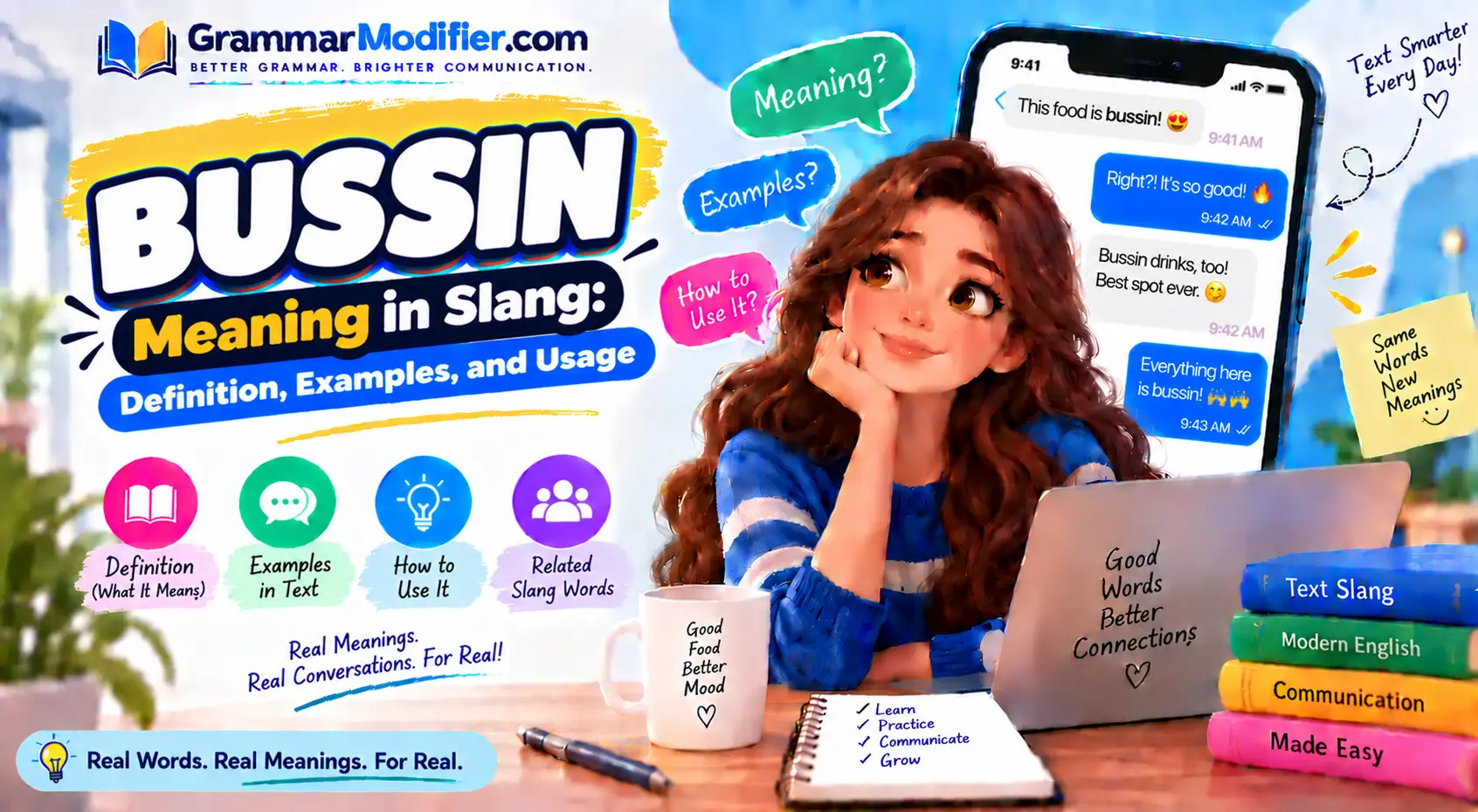
English learners often see bussin in food videos, group chats, TikTok comments, and casual American conversations. The word usually expresses strong approval, especially when someone thinks food tastes exceptionally good.
This guide explains the meaning of bussin, how to use it in sentences, and how it differs from similar slang words. You’ll also learn its pronunciation, spelling variations, cultural background, common mistakes, and formal alternatives.
Quick Answer
Bussin is informal slang meaning extremely good, delicious, or satisfying. It is most often used for food, but people may also use it for music, clothing, experiences, and other things they enjoy.
TL;DR
- Bussin usually means extremely good.
- Food is its most common context.
- It is informal American English slang.
- Bussin’ is an alternative spelling.
- Bussin bussin adds stronger emphasis.
- Use standard words in formal writing.
- Context and tone affect the meaning.
What Does Bussin Mean in Slang?
Bussin is an enthusiastic slang word for something that is excellent, enjoyable, or satisfying. It is especially common when someone wants to praise food.
For example, if someone says, “This chicken sandwich is bussin,” they mean the sandwich tastes really good. The expression is stronger and more playful than simply saying “This sandwich is good.”
Common examples include:
- “This ramen is bussin.”
- “That burger was bussin.”
- “Your cookies are bussin.”
- “This playlist is bussin.”
- “That concert was bussin.”
- “Bussin!” can work as a short reaction.
Is Bussin a Compliment?
Yes, bussin is usually a compliment. It shows that the speaker strongly likes something or feels impressed by it.
The word can also be used sarcastically. For example, someone might say “Bussin?” after tasting disappointing food. The question mark and the speaker’s tone can signal doubt instead of praise.
Compare these examples:
- Sincere: “This pizza is bussin!”
- Sarcastic: “You paid that much for this? Bussin?”
- Playful: “That cafeteria meal is bussin today.”
The surrounding situation helps determine whether the word is sincere, exaggerated, or ironic.
What Does Bussin Mean When Talking About Food?
Food is the clearest and most common use of bussin. It describes a meal, snack, dessert, or drink that tastes especially delicious.
People often use it after trying something flavorful, well-prepared, or better than expected. The word is common in food reviews, reaction videos, and conversations between friends.
Examples:
- “These tacos are bussin.”
- “That homemade pasta was bussin.”
- “This chocolate cake is bussin bussin.”
- “The fries are bussin today.”
- “Your soup is seriously bussin.”
- “That barbecue sandwich was bussin.”
In standard English, you could replace the word with delicious, excellent, flavorful, or satisfying.
What Does Bussin Mean in Texting?
In texting, bussin is a quick way to show approval. Friends may use it as a complete reaction or place it inside a longer sentence.
The word often appears with other informal expressions, including fr, which means “for real.”
Examples:
- “That restaurant was bussin.”
- “This food is bussin fr.”
- “Bro, these wings are bussin.”
- “Is that dessert bussin?”
- “Bussin 😂”
- “That meal was bussin, no lie.”
The spelling may appear as bussin, bussin’, or BUSSIN. Capital letters usually add excitement rather than changing the meaning.
What Does Bussin Mean on TikTok and Social Media?
On TikTok, Instagram, Snapchat, and other social platforms, bussin often appears in food videos and comment sections. Users may write it when reacting to a meal, recipe, restaurant, or cooking clip.
The word also appears in posts about music, outfits, trips, games, and other enjoyable experiences. Social media helped make the expression familiar to a wider audience.
Typical social-media examples include:
- “This recipe is bussin.”
- “The comments are bussin today.”
- “That outfit is bussin.”
- “This sound is bussin.”
- “The food looked bussin.”
- “Bussin fr” means the speaker strongly agrees.
Although many people recognize the term, not everyone uses it naturally. It may sound playful or exaggerated depending on the speaker.
What Does Bussin Bussin Mean?
Bussin bussin is an intensified form of bussin. Repeating the word adds emphasis and suggests that something is especially excellent.
The repeated form is most common in casual speech, texting, and social-media comments.
Examples:
- “This dessert is bussin bussin.”
- “Those tacos were bussin bussin.”
- “That restaurant is bussin bussin.”
- “This meal is bussin bussin fr.”
- “The new playlist is bussin bussin.”
The phrase does not describe a different quality. It simply makes the praise stronger.
How Do You Pronounce Bussin?
Bussin is commonly pronounced BUH-sin. The stress falls on the first syllable.
A simple pronunciation guide is:
BUH-sin
It sounds similar to the beginning of bus, followed by a short in sound. The slang form is commonly written as bussin’, with an apostrophe showing the dropped ending in informal speech.
Bussin or Bussin’: Which Spelling Is Correct?
Both bussin and bussin’ appear in informal writing.
Bussin’ includes an apostrophe and reflects the traditional slang spelling. Bussin removes the apostrophe, which is common in texting, captions, comments, and search queries.
Examples:
- “This burger is bussin’.”
- “This burger is bussin.”
- “That meal was BUSSIN.”
The spelling does not change the meaning. For casual online writing, either form may be understood.
Is Bussin an Adjective?
In its slang use, bussin commonly works like an adjective because it describes the quality of something.
It often appears after a linking verb such as is, was, or looks.
Common sentence patterns include:
- Subject + is + bussin: “This pizza is bussin.”
- Subject + was + bussin: “That meal was bussin.”
- Subject + looks + bussin: “That cake looks bussin.”
- Standalone reaction: “Bussin!”
- Question form: “Is this place bussin?”
Slang does not always follow the same patterns as formal vocabulary. In everyday use, however, these structures sound natural in casual American English.
How Do You Use Bussin in a Sentence?
Use bussin when speaking casually about something you strongly enjoy. It works best with friends, family members, informal messages, and social-media comments.
Useful sentence patterns include:
- “This food is bussin.”
- “That was bussin.”
- “Your cooking is bussin.”
- “This song is bussin.”
- “That place was bussin.”
- “Bussin!” as a quick reaction.
- “Is this dessert bussin?”
- “That meal was bussin fr.”
Avoid forcing the word into serious or formal situations. A natural sentence is more important than using slang in every conversation.
Bussin vs. Fire, Gas, Lit, and Slaps
Several slang words express approval, but they do not always fit the same situations.
| Slang word | Common meaning | Typical use |
|---|---|---|
| Bussin | Extremely good or delicious | Food, experiences, casual praise |
| Fire | Excellent or exciting | Music, food, clothes, ideas |
| Gas | Very good or impressive | Food, music, performances |
| Lit | Exciting, lively, or fun | Parties, events, social situations |
| Slaps | Very enjoyable or powerful | Music, food, entertainment |
Examples:
- “This chicken is bussin.”
- “That new song is fire.”
- “The concert was lit.”
- “This beat slaps.”
- “That restaurant is gas.”
These words overlap, but bussin has the strongest connection with delicious food.
Can Bussin Be Used Outside Food?
Yes. Although food is its main context, bussin can describe anything that someone considers excellent.
People may use it for music, clothing, videos, games, trips, or memorable experiences. The meaning remains close to really good or impressive.
Examples:
- “This playlist is bussin.”
- “That jacket is bussin.”
- “The new game is bussin.”
- “This view is bussin.”
- “That weekend trip was bussin.”
This broader use is informal and often playful. It may sound less natural than food-related use for some speakers.
Where Did Bussin Come From?
The exact origin of bussin is not completely settled. The term is associated with African American English and existed before its major rise on social media.
TikTok, food videos, memes, and online conversations helped spread the word widely around 2020 and 2021. It is inaccurate to say that TikTok created the expression; the platform mainly increased its visibility.
The term is now recognized by many English speakers, but usage differs across age groups, communities, and regions.
Is Bussin AAVE or Gen Z Slang?
Bussin is commonly connected with African American English, while its later internet popularity is strongly associated with Gen Z culture.
These descriptions are not interchangeable. Gen Z did not necessarily create the word, but social media helped introduce it to people outside its earlier speech communities.
For respectful language use, avoid treating every slang term as an invention of TikTok. Slang often develops within communities before becoming widely visible online.
Common Mistakes With Bussin
English learners may confuse bussin with similar-looking words or use it in unsuitable contexts.
Remember these points:
- Bussin means extremely good in slang.
- Bussin’ is an alternative spelling.
- Busting has a different meaning.
- Bussing can relate to buses or clearing dishes.
- Busing commonly relates to transporting people by bus.
- Bussin is informal, not academic vocabulary.
- It usually expresses positive approval.
- Tone can make it sarcastic.
- Food is its most natural subject.
- Do not use it in every sentence.
For example:
- Slang: “This burger is bussin.”
- Formal: “This burger is delicious.”
- Incorrect meaning: “The school is bussin students to another building.”
- Better: “The school is busing students to another building.”
Is Bussin Appropriate in Formal English?
Usually, bussin is not appropriate for formal English. Avoid it in school essays, business emails, job applications, official reports, and professional recommendations.
Use a standard word that communicates the meaning clearly.
| Informal slang | Formal alternative |
|---|---|
| Bussin | Excellent |
| Bussin food | Delicious |
| That song is bussin | That song is impressive |
| This place is bussin | This place is enjoyable |
| That meal was bussin | That meal was satisfying |
You can use bussin in a quotation, language lesson, casual review, or discussion about slang. In those cases, the word itself is the topic.
FAQs
What does bussin mean in simple English?
Bussin means something is extremely good, especially food. It can also describe music, clothing, experiences, and other enjoyable things.
Is bussin a bad word?
No. Bussin is generally positive slang. It may sound sarcastic if the speaker uses a doubtful tone or places it in an ironic situation.
What does bussin mean on TikTok?
On TikTok, bussin commonly praises food that looks or tastes delicious. It may also describe a song, outfit, video, or experience that viewers enjoy.
What does bussin fr mean?
Bussin fr means something is really good, “for real.” The abbreviation fr adds emphasis and shows that the speaker genuinely agrees.
Can adults use the word bussin?
Yes, adults can use it, but it may sound playful or deliberately informal. The expression is most natural in casual conversations and online settings.
What is the difference between bussin and delicious?
Delicious is standard English and works in formal writing. Bussin is casual slang with a stronger, more playful feeling.
Is bussin still used?
Bussin remains recognizable in casual online English, especially in food-related content. However, slang usage varies by community, age, platform, and personal style.
Conclusion
Bussin meaning is simple: it describes something extremely good, especially delicious food. The word can also praise music, clothing, experiences, and online content in casual American English.
Use bussin naturally with suitable audiences, and choose words such as delicious, excellent, or impressive in formal situations. To practice, write one casual sentence with bussin and then rewrite it using a standard English alternative.
Read More: