
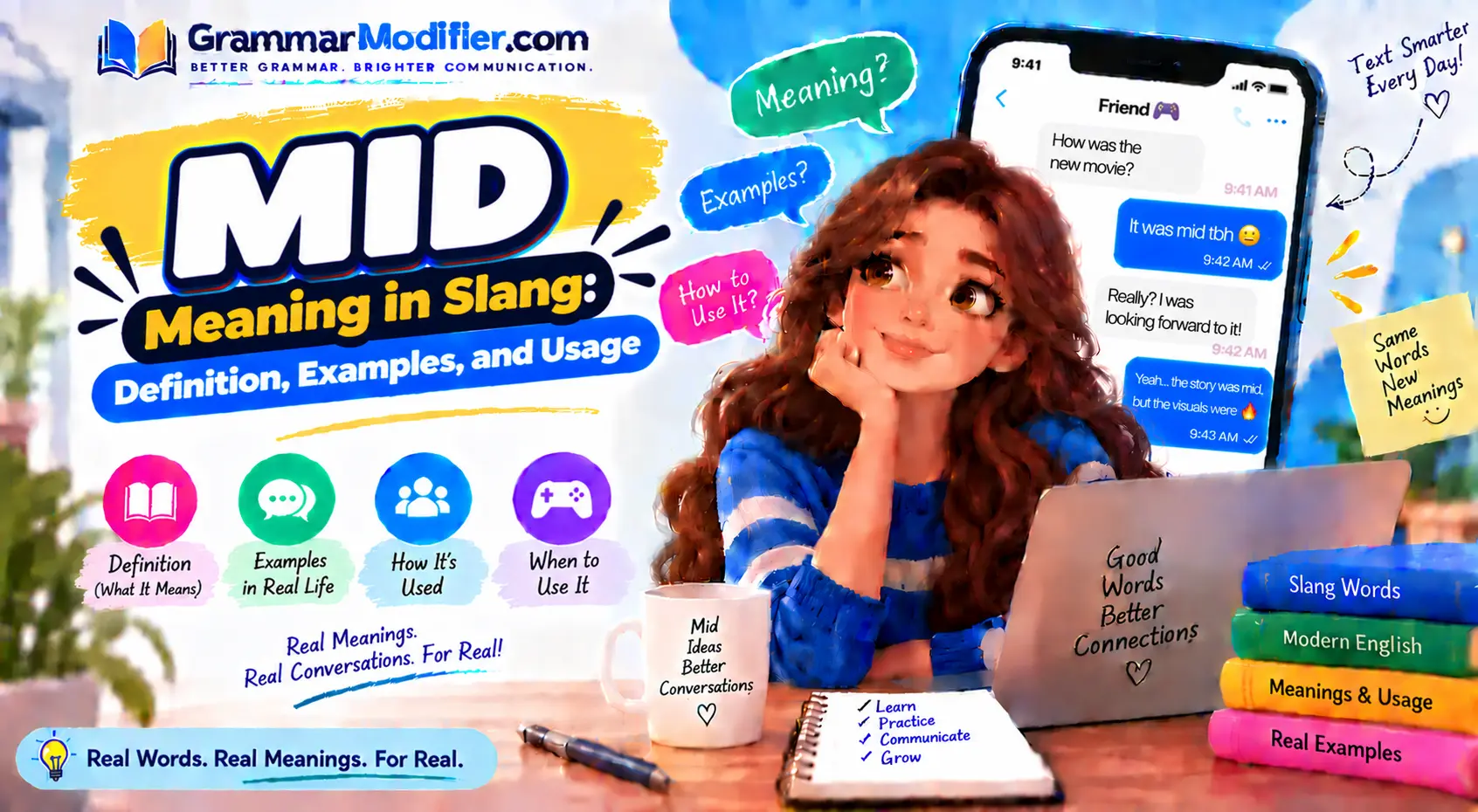
This guide helps English learners understand mid meaning in slang and use the word naturally. You may see it in texts, social media comments, gaming chats, music reviews, and casual conversations.
The article explains the meaning, tone, origin, related phrases, and common mistakes. You’ll also learn how to respond to “mid” and choose clearer words in school or professional writing.
Quick Answer
Mid means average, ordinary, or underwhelming. In slang, people often use it when something does not match the hype or fails to impress them.
TL;DR
- Mid usually means average or unimpressive.
- It often suggests disappointment after high expectations.
- The slang use is casual and common online.
- “Mid fr” means “mid, for real.”
- “Mid-tier” means average or middle-level.
- Calling a person mid may sound rude.
- Formal alternatives include average and underwhelming.
What Does Mid Mean in Slang?
In modern slang, mid describes something that is not especially good, exciting, or memorable. It usually falls somewhere between good and bad.
The word often carries a negative feeling because the speaker expected more. A movie can be watchable but still be called mid if it feels forgettable.
- “That movie was mid.”
- “The new song is mid.”
- “The food looked better than it tasted.”
- “This game is fun, but the story is mid.”
- “The restaurant was mid for the price.”
- “That trend is already mid.”
- “The sequel was mid compared with the original.”
- “The concert was okay, but the opening act was mid.”
Mid does not always mean terrible. It usually means average, disappointing, or less impressive than expected.
Mid Meaning in Standard English
The word mid also has a standard English meaning connected to the middle of something. This use appears in words such as midday, midweek, midseason, and midyear.
The slang meaning focuses on quality rather than time or location. Context tells readers which meaning is intended.
- Midday means the middle of the day.
- Midweek means the middle of the week.
- Midseason means the middle part of a season.
- Midyear means the middle of a year.
- “The meeting starts at midday” uses the standard meaning.
- “The movie was mid” uses the slang meaning.
- “The store is in midtown” describes location.
- “That review was mid” describes quality.
In formal writing, the slang meaning may seem too casual. Use words such as average, ordinary, or underwhelming when greater clarity is needed.
Why Does Mid Often Mean Disappointing?
People often use mid when something receives more praise than they think it deserves. The word can criticize the gap between the hype and the actual experience.
For example, a highly promoted movie may have good actors and impressive visuals. If the story feels predictable, a viewer might call the movie mid.
- Average: The quality is ordinary.
- Underwhelming: The result is weaker than expected.
- Overrated: The subject receives more praise than it deserves.
- Forgettable: The subject does not leave a strong impression.
- Mediocre: The quality is only moderate.
- Not worth the hype: Expectations were higher than the experience.
A person may say “That was mid” even when they enjoyed parts of it. The word often summarizes a mixed opinion rather than total rejection.
What Does Mid Mean in Texting?
In texting, mid is a short reaction to something someone recommends, shares, or describes. It can replace a longer sentence such as “It was okay, but nothing special.”
The meaning depends on the relationship between the speakers. Friends may use it as a joke, while strangers may interpret it as dismissive.
- “How was the movie?” — “Mid.”
- “Did you like the new album?” — “Not really. Mid.”
- “This update is mid.”
- “Your recommendation was mid.”
- “That restaurant was mid.”
- “The ending was mid, honestly.”
- “It was mid, but I still had fun.”
- “That was mid fr.”
Adding a reason makes the message more useful. Instead of saying only “mid,” someone could write, “The acting was good, but the story was predictable.”
What Does Mid Mean on TikTok and Social Media?
On TikTok, Instagram, YouTube, and other social platforms, people use mid in comments, captions, reaction videos, and debates. It often dismisses a trend, song, outfit, opinion, or performance.
The word may be serious, playful, sarcastic, or deliberately provocative. Some users write “mid” simply to challenge a popular opinion.
- “This trend is mid.”
- “The new sound is mid.”
- “That edit is mid.”
- “Mid take.”
- “This outfit is mid.”
- “Everyone loves it, but I think it’s mid.”
- “The comments calling this mid are hilarious.”
- “That creator’s latest video was kind of mid.”
Online slang changes quickly. The same word may sound friendly in one group and insulting in another.
What Does Mid Fr Mean?
Mid fr means “mid, for real.” The abbreviation fr stands for “for real” and emphasizes that the speaker genuinely holds the opinion.
The phrase is common in casual texting and online comments. It usually strengthens the criticism rather than changing the basic meaning.
- “That movie was mid fr.”
- “This game is mid fr.”
- “The new song is mid fr.”
- “That was a mid fr performance.”
- “Everyone hyped it up, but it’s mid fr.”
- “The food was mid fr, especially for that price.”
- “That’s a mid take fr.”
- “This update is mid fr.”
Because fr adds emphasis, the phrase can sound more direct than simply saying “mid.”
What Does Mid-Tier Mean?
Mid-tier means average, middle-level, or neither excellent nor terrible. It can describe products, players, skills, services, games, or performance.
Unlike mid, which often sounds dismissive, mid-tier can be more descriptive. It may describe something that is acceptable but not among the best options.
- “That phone is mid-tier.”
- “The player is mid-tier.”
- “This restaurant offers mid-tier service.”
- “The game has mid-tier graphics.”
- “That brand sells mid-tier products.”
- “The team is mid-tier this season.”
- “The character is mid-tier in competitive play.”
- “This laptop is mid-tier for its price.”
Mid-tier is often more neutral than mid, but the speaker’s tone still matters.
What Does “Mid Take” Mean?
A mid take is an opinion that someone considers ordinary, weak, predictable, or unimpressive. It is commonly used during online debates.
The phrase does not necessarily mean the opinion is factually wrong. It usually shows that the speaker does not find the opinion interesting or convincing.
- “That is a mid take.”
- “Your review is a mid take.”
- “That’s the most mid take I’ve seen today.”
- “I disagree, but calling it a mid take is fair.”
- “That opinion is not terrible; it’s just mid.”
- “The post had a few good points, but the conclusion was a mid take.”
- “That is a mid take at best.”
- “The comments turned into a debate over one mid take.”
The phrase can be playful among friends, but it may sound dismissive in a serious discussion.
Is Mid Positive, Negative, or Neutral?
Mid is usually negative or mildly critical. It suggests that something is not impressive enough to deserve strong praise.
However, it is not always harsh. A speaker may use it casually when they mean “fine, but nothing special.”
- “The movie was mid” sounds mildly negative.
- “The movie was mid, but I enjoyed it” sounds softer.
- “That product is mid at best” sounds more critical.
- “It’s a little mid” sounds less severe.
- “You are mid” may sound personally insulting.
- “That joke was mid” usually criticizes the joke.
- “The meal was mid for the price” adds a value judgment.
- “Mid” can be humorous when the speaker exaggerates.
The target matters. Criticizing a movie is usually less personal than criticizing someone’s appearance, talent, or intelligence.
Mid vs. Meh, Mediocre, and Trash
These words overlap, but they do not always have the same strength or tone.
| Word | Meaning | Typical Tone |
|---|---|---|
| Mid | Average or underwhelming | Casual and mildly negative |
| Meh | Unexciting or not worth strong emotion | Often softer |
| Mediocre | Moderate or below-average quality | More formal |
| Average | Ordinary or typical | Usually neutral |
| Underwhelming | Less impressive than expected | Polite criticism |
| Trash | Extremely poor or worthless | Much harsher |
| Overrated | Praised more than deserved | Focuses on public opinion |
For example, “The movie was meh” may sound indifferent. “The movie was mid” may sound more dismissive. “The movie was trash” expresses a much stronger negative opinion.
Mid Meaning in Music, Movies, and Gaming
People frequently use mid when discussing entertainment. They may describe a song, album, film, show, character, or video game as average.
The word often reflects disappointment with the final result. A project can have strong visuals, famous creators, or a large budget and still be called mid.
- “The chorus was catchy, but the song was mid.”
- “The movie had great effects but a weak story.”
- “The album felt mid from beginning to end.”
- “The game looks good but plays mid.”
- “The final episode was mid.”
- “That character is mid-tier.”
- “The graphics are strong, but the gameplay is mid.”
- “The sequel was mid compared with the first movie.”
A more detailed review should explain the reason behind the opinion.
Mid Meaning in Food, Fashion, and Products
Mid can describe almost anything people judge casually. Common examples include food, clothing, restaurants, phones, laptops, events, and online trends.
The word is useful for a quick reaction, but it does not explain what went wrong. A helpful review should add details about quality, price, service, or performance.
- “The burger was mid.”
- “The fries were good, but the burger was mid.”
- “That jacket is mid.”
- “The service was mid.”
- “The hotel was mid for the price.”
- “The headphones look great but sound mid.”
- “The event was mid, but my friends made it fun.”
- “The snack was mid compared with the other flavor.”
Can You Call a Person Mid?
Yes, but calling a person mid can sound more insulting than using it for a movie or product. It may criticize someone’s appearance, talent, personality, or social presence.
The phrase is often used as a joke between friends. Still, the listener may not understand the intended humor.
- “That actor’s latest performance was mid” criticizes a performance.
- “That person is mid” may sound personal.
- “His argument was mid” focuses on an argument.
- “Her presentation was mid” focuses on a presentation.
- “Your idea is mid” criticizes an idea.
- “You are mid” may sound rude.
- “That outfit is mid” criticizes clothing.
- “The character is mid-tier” sounds more specific than criticizing a real person.
When speaking politely, describe the specific behavior or work instead of labeling the person.
How to Reply When Someone Says Mid
A reply depends on whether the comment is serious, playful, or rude. You do not need to argue every time someone uses the word.
If the person gives no explanation, asking a calm question can turn a short insult into a useful discussion.
- “What part did you dislike?”
- “Fair, it wasn’t for everyone.”
- “I thought it was better than that.”
- “That’s your opinion.”
- “What would have made it better?”
- “I liked the ending, even if the beginning was weak.”
- “You’re allowed to feel that way.”
- “I enjoyed it, so that’s what matters to me.”
If someone calls you or your work mid repeatedly, you can respond directly:
“You can disagree, but please explain what you mean.”
Where Did Mid Slang Come From?
The slang meaning of mid is connected to the idea of something being in the middle or of average quality. Earlier informal use also connected the word with mid-grade products.
The modern meaning became more visible through online communities, gaming discussions, music commentary, sports conversations, and short-form video platforms. No single person can be confirmed as the creator of the slang.
- The word is related to “middle.”
- Earlier informal use described average quality.
- Online communities expanded its meaning.
- Music and gaming discussions helped spread it.
- Social media made the term more widely recognized.
- “Mid-grade” helped support the quality-based meaning.
- The exact first use is difficult to confirm.
- The meaning may continue changing by community.
Because slang develops gradually, it is safer to describe the origin as an evolving usage rather than one fixed invention.
Common Mistakes With Mid
Learners sometimes misunderstand mid because it can sound neutral in standard English. In slang, it usually carries some criticism.
Another common mistake is using the word in formal writing without considering the audience.
- Mistake: “Mid means terrible.”
Correction: Mid usually means average or underwhelming. - Mistake: “Mid is always neutral.”
Correction: It often carries mild criticism. - Mistake: “Mid is formal English.”
Correction: The slang use is casual. - Mistake: “Mid is an acronym.”
Correction: It is a slang word connected with middle and average quality. - Mistake: “Mid is always harmless.”
Correction: Calling a person mid may sound rude. - Mistake: “Mid explains the entire problem.”
Correction: Add a reason when a detailed opinion matters. - Mistake: “Mid means the same as awful.”
Correction: Awful is much stronger. - Mistake: “Use mid in every review.”
Correction: Choose more precise language when necessary.
Formal Alternatives to Mid
In formal English, choose a word that explains your meaning more precisely. The best alternative depends on whether you mean average quality, weak performance, or disappointment.
These words work better in school assignments, workplace messages, professional reviews, and serious discussions.
- Average — ordinary or typical.
- Mediocre — only moderate in quality.
- Ordinary — not unusual or special.
- Unimpressive — fails to create interest.
- Underwhelming — less satisfying than expected.
- Disappointing — does not meet expectations.
- Adequate — acceptable but not excellent.
- Unremarkable — not memorable or distinctive.
- Limited — lacking strength or quality in a specific area.
- Moderate — neither high nor low.
For example:
Informal: “The presentation was mid.”
Formal: “The presentation was adequate but lacked strong examples.”
Practice: Choose the Meaning
Read each sentence and identify the meaning of mid.
- “The movie was mid, but the ending was great.”
- “This phone is mid-tier.”
- “Mid fr, I expected more.”
- “The restaurant was mid for its price.”
- “The word mid appears in midweek.”
- “That is a mid take.”
- “The song was mid compared with the artist’s earlier work.”
- “You are mid” may sound more personal than “Your presentation was mid.”
Answers:
- The movie was average or underwhelming.
- The phone is middle-level.
- The speaker strongly believes it was average.
- The restaurant was disappointing for its cost.
- The word refers to the middle of the week.
- The speaker considers the opinion weak or ordinary.
- The song was less impressive than earlier work.
- The comment may criticize the person rather than a specific action.
FAQs
Does mid mean bad?
Mid usually means average, ordinary, or underwhelming. It does not normally mean completely terrible.
Is mid a Gen Z word?
The word became especially common through online youth culture, gaming, music discussions, and short-form video platforms. Other age groups may understand it now.
What does mid mean in a text?
In a text, mid usually means “It was average” or “It was not as good as expected.” It can be used as a complete reply.
What does mid fr mean?
Mid fr means “mid, for real.” The phrase emphasizes that the speaker genuinely thinks something is average or disappointing.
What does mid take mean?
A mid take is an opinion that someone considers weak, ordinary, predictable, or unimpressive. It is common in online debates.
Can mid describe a person?
Yes, but calling a person mid may sound rude or personal. It is safer to use the word for a movie, product, idea, or performance.
Is mid appropriate in school writing?
The slang meaning is usually too informal for school assignments. Use average, mediocre, ordinary, or underwhelming instead.
Conclusion
The mid meaning in slang is usually average, ordinary, or underwhelming. People use it in texts, comments, reviews, and casual conversations when something does not impress them or fails to match the hype.
Remember that mid is informal and often mildly negative. Practice noticing the context, then choose a more precise word such as average, mediocre, or disappointing when formal English is needed.
Read More: