
Quick Answer
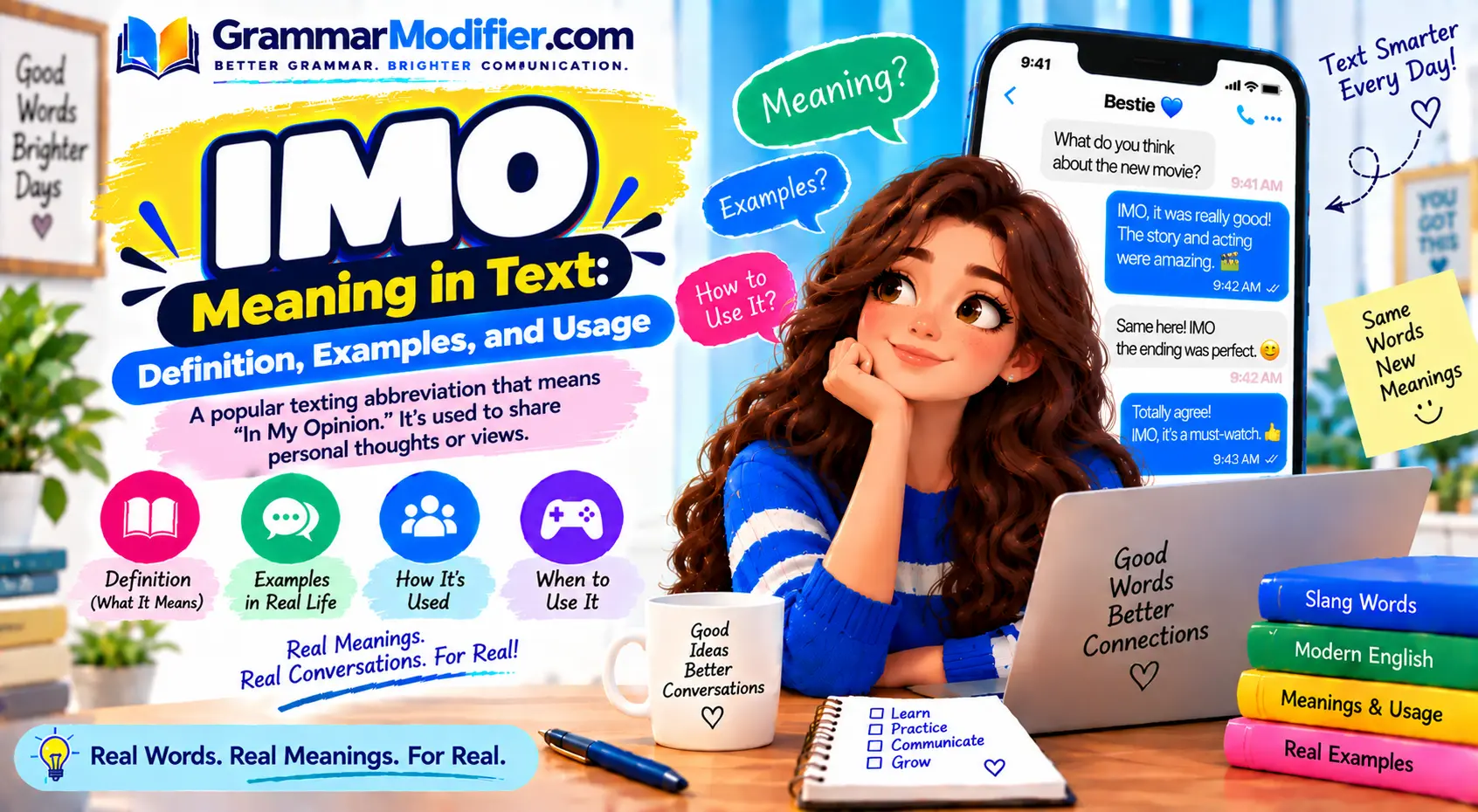
IMO meaning in text is “in my opinion.” People use it in chats, comments, and messages before sharing a personal view. It shows that the statement reflects the writer’s thoughts rather than a proven fact.
TL;DR
- IMO means “in my opinion.”
- It introduces a personal belief or judgment.
- IMO is common in texting and social media.
- It is usually casual and conversational.
- IMHO means “in my humble opinion.”
- Use “in my opinion” in formal writing.
What Does IMO Mean in Text?
IMO means “in my opinion.” It is a common abbreviation used when someone wants to share a personal thought, judgment, or preference.
For example:
- IMO, this movie was excellent.
- That restaurant is overrated, IMO.
- IMO, we should leave earlier.
The abbreviation tells readers that the statement is personal. It does not automatically mean the writer is uncertain or wrong.
What Does IMO Stand For?
The letters in IMO represent:
- I = In
- M = My
- O = Opinion
An opinion is a belief or judgment about something. It may be based on experience, preference, or personal reasoning.
For example, “Blue is the best color” is an opinion. Different people may reasonably prefer different colors.
IMO Meaning in Chat
In chat, IMO helps people share views quickly. It is often used before a suggestion, review, criticism, or personal preference.
Examples include:
- IMO, the second option looks better.
- You should watch it, IMO.
- IMO, that was the funniest part.
- This game is too difficult, IMO.
The abbreviation is usually friendly and informal. Its tone depends on the words around it.
IMO Meaning on Social Media
People use IMO in social media comments, replies, captions, and discussion threads. It can introduce a positive opinion, disagreement, or personal recommendation.
Examples:
- IMO, this is the best song on the album.
- The design looks cleaner, IMO.
- IMO, everyone should try this recipe.
- That ending was disappointing, IMO.
IMO is not limited to one platform. It can appear anywhere people share short written opinions.
How Context Changes IMO
The meaning of IMO stays the same, but the tone can change with the sentence. Friendly wording makes the opinion sound respectful, while blunt wording may sound critical.
Compare these examples:
- IMO, your idea could work with a few changes.
- IMO, your idea makes no sense.
Both sentences express a personal view. The first sounds helpful, while the second may sound harsh.
IMO vs. IMHO
IMHO means “in my humble opinion.” It is similar to IMO, but it can sound more modest or playful.
Examples:
- IMO, this is the best choice.
- IMHO, this is the best choice.
IMO is more direct. IMHO may suggest that the writer is presenting a personal view without claiming authority.
Some people also use IMHO to mean “in my honest opinion.” The intended meaning usually depends on context.
Is IMO an Opinion or a Fact?
IMO introduces an opinion, not proof. It signals that the writer is sharing a personal judgment.
Compare these sentences:
- IMO, winter is the best season.
- Winter begins in December in the Northern Hemisphere.
The first sentence expresses a preference. The second makes a factual claim that can be checked.
Using IMO does not make a factual statement automatically correct. It only shows that the writer is presenting it as a personal view.
How to Use IMO in a Sentence
IMO can appear at the beginning, middle, or end of a sentence.
Common patterns include:
- IMO, + opinion
- Opinion + IMO
- IMO, + suggestion
- Opinion, IMO
Examples:
- IMO, this book is worth reading.
- This book is worth reading, IMO.
- IMO, you should try the new version.
- The first design looks better, IMO.
A comma often follows IMO when it appears at the beginning of a sentence.
Is IMO Formal or Informal?
IMO is mainly used in informal communication. It works well in text messages, online discussions, gaming chats, and social media comments.
Use a more formal phrase in school assignments, professional reports, business emails, and official documents.
Instead of:
- IMO, this plan needs more work.
Use:
- In my opinion, this plan needs more work.
- I believe this plan needs further review.
- From my perspective, this plan needs more work.
The full phrase sounds clearer and more professional.
Is IMO Rude?
IMO is not rude by itself. The surrounding sentence determines whether the message sounds polite, neutral, or insulting.
Compare:
- IMO, you could explain that point more clearly.
- IMO, you clearly do not understand anything.
The first offers feedback. The second attacks the person.
To keep an opinion respectful, focus on the idea rather than the individual. Words such as “I think,” “I feel,” and “from my perspective” can also soften disagreement.
Common Mistakes With IMO
Several mistakes appear often in casual writing.
- Incorrect: IMO, I think this is useful.
Better: IMO, this is useful.
The phrase “in my opinion” already shows personal belief. - Incorrect: IMO means in my option.
Better: IMO means “in my opinion.”
“Opinion” refers to a personal view. - Incorrect: IMO is always used to show uncertainty.
Better: IMO introduces a personal judgment.
A writer may still sound very confident. - Incorrect: IMO must appear at the beginning.
Better: IMO can appear at the beginning, middle, or end. - Incorrect: IMO is suitable for every type of writing.
Better: Use the full phrase in formal situations.
How to Respond to IMO
Your response depends on whether you agree, disagree, or want more information.
If you agree, you can say:
- I agree.
- Same here.
- That’s how I see it too.
If you disagree, try:
- I see your point, but I think differently.
- That’s fair, although I prefer the other option.
- I understand, but my experience was different.
If you want more detail, ask:
- What makes you think that?
- Why do you prefer it?
- Can you explain your view?
Respectful replies keep conversations productive.
Other Meanings of IMO
In texting, IMO usually means “in my opinion.” However, the abbreviation can have other meanings in professional or organizational contexts.
One important alternate meaning is International Maritime Organization, a United Nations agency connected with shipping and maritime safety.
Context helps identify the intended meaning:
- IMO, this phone is too expensive.
Here, IMO means “in my opinion.” - The IMO adopted new maritime safety rules.
Here, IMO refers to the International Maritime Organization.
The surrounding words usually make the meaning clear.
IMO vs. IME and IMHO
These abbreviations look similar, but they express different ideas.
- IMO = In my opinion
- IMHO = In my humble opinion
- IME = In my experience
Use IMO for a personal judgment:
- IMO, this is the easiest method.
Use IMHO for a modest or slightly playful opinion:
- IMHO, the older version was better.
Use IME when referring to personal experience:
- IME, this type of software takes time to learn.
An opinion describes what you think. An experience describes what you have personally observed or lived through.
IMO Examples in Real Conversations
Friend: Which movie should we watch?
Reply: IMO, the comedy looks more fun.
Classmate: Do you like the new school schedule?
Reply: IMO, it gives us more time between classes.
Group chat: Should we order pizza or sandwiches?
Reply: IMO, pizza would be easier for everyone.
Social media comment:
IMO, the original design looked better.
Online discussion:
I understand your point, but IMO, the second option is more practical.
These examples show how IMO introduces a personal view without needing a long explanation.
FAQs
What does IMO mean in a text message?
IMO means “in my opinion.” It tells the reader that the message expresses the writer’s personal view.
What does IMO mean on social media?
On social media, IMO means “in my opinion.” People use it before sharing thoughts about videos, products, news, entertainment, or everyday topics.
Is IMO the same as IMHO?
They are very similar. IMO means “in my opinion,” while IMHO usually means “in my humble opinion.”
Can I use IMO in formal writing?
It is better to write “in my opinion” in formal writing. The full phrase is clearer and more suitable for school, work, and official communication.
Does IMO mean the writer is unsure?
Not necessarily. IMO shows that a statement is personal, but the writer may still feel strongly about it.
What is the difference between IMO and IME?
IMO means “in my opinion.” IME means “in my experience,” so it refers to something the writer has personally experienced.
Conclusion
IMO meaning in text is “in my opinion.” It is a short, common way to introduce a personal belief, preference, suggestion, or judgment in casual communication.
Use IMO in chats, comments, and social media when you want to share your view. For formal writing, use the complete phrase “in my opinion” to make your meaning clear.
Read More: