
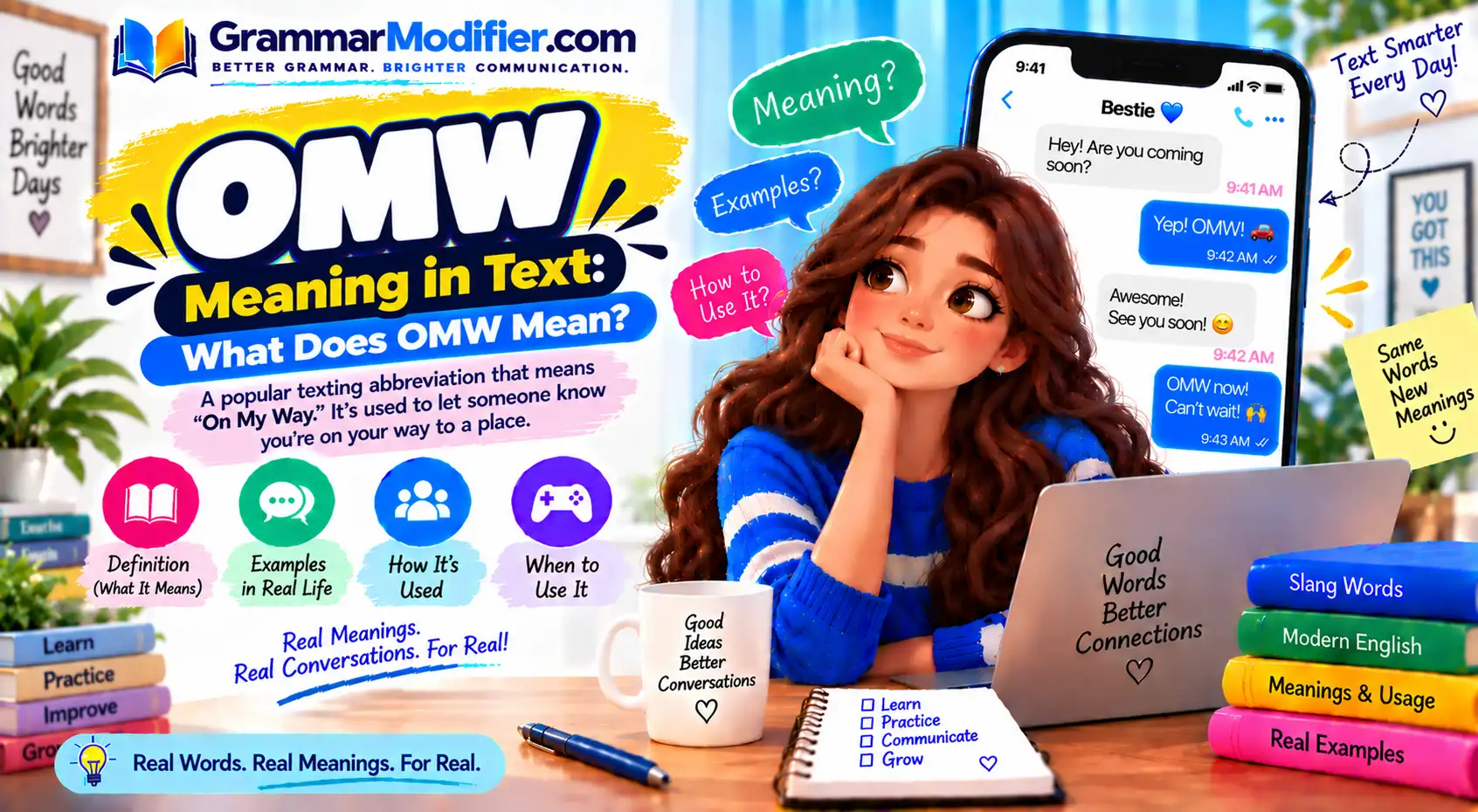
OMW is a common texting abbreviation that usually means “On My Way.” People use it to tell someone they are heading toward a place, person, event, or activity.
If you received a message saying “OMW,” you may be wondering whether the person has already left, is leaving soon, or simply means they are coming. The answer depends on context, so this guide explains the different ways people use OMW in everyday English.
Quick Answer
OMW means “On My Way.” In texts, chats, and social media, it usually tells someone that the sender is coming, heading somewhere, or preparing to leave.
For example:
“Are you coming?”
“OMW!”
This means “I’m on my way” or “I’m coming.”
TL;DR
- OMW usually means “On My Way.”
- It is an informal initialism used in digital communication.
- OMW can mean already traveling or leaving soon.
- It does not give an exact arrival time.
- ETA is better when you need to know when someone will arrive.
- omw and OMW normally have the same meaning.
- In rare contexts, OMW can mean “Oh My Word.”
What Does OMW Stand For?
OMW stands for “On My Way.” It is commonly used in text messages, instant messages, group chats, and other informal digital conversations. Wiktionary classifies OMW as an initialism, meaning the letters represent the words in the phrase.
The full expression “on my way” indicates that someone is en route or heading toward a destination. It can refer to a person traveling to meet someone, going to an event, or moving toward another location.
OMW means:
- OMW = On My Way
- omw = on my way
- OMW now = I’m heading there now
- OMW to work = I’m heading to work
- OMW home = I’m heading home
- OMW! = I’m coming!
The abbreviation saves time while keeping the message clear.
OMW Meaning in Text Messages
In a text message, OMW usually means that someone is coming or heading somewhere. The destination may already be understood from the conversation.
For example:
Friend: “Where are you?”
You: “OMW.”
The natural interpretation is “I’m on my way.”
You can also add information after OMW:
- “OMW to the restaurant.”
- “OMW home.”
- “OMW now.”
- “OMW, be there soon.”
- “OMW to the party.”
- “Sorry, OMW now.”
The surrounding conversation gives the abbreviation its practical meaning.
Does OMW Mean They Have Already Left?
Not necessarily. This is one of the most useful details to understand about OMW.
Some people use OMW after they have actually started traveling. Others use it when they are about to leave and expect to start traveling shortly. Current usage references describe both possibilities.
Consider these examples:
“Are you still coming?”
“Yep, OMW.”
This could mean the person has started traveling or is getting ready to leave.
Compare that with:
“Where are you?”
“OMW now.”
The word “now” gives a stronger indication that the person is currently heading there.
If exact timing matters, ask:
“Have you left already?”
or:
“What’s your ETA?”
That avoids assuming more than the message actually says.
How OMW Is Used in Conversation
The meaning of OMW stays fairly consistent, but the situation can change how the message should be understood.
Someone might use it to confirm plans, reassure a person who is waiting, or say they are coming to help.
Common situations include:
- Meeting someone: “OMW to the café.”
- Going home: “Dinner’s ready. OMW home.”
- Attending an event: “OMW to the concert.”
- Helping someone: “Need help? OMW.”
- Running late: “Sorry, OMW.”
- Joining friends: “Where are you guys? OMW.”
- Confirming plans: “Are you coming? OMW!”
- Giving a quick update: “OMW now.”
In each example, OMW communicates movement or an intention to head toward the relevant destination.
What Does OMW Mean From Someone?
If someone sends you “OMW,” they are generally telling you that they are coming or heading toward the place being discussed.
The abbreviation does not have a special meaning based on whether the sender is a guy, girl, friend, coworker, or someone you are dating. The surrounding conversation matters more than the sender’s identity.
For example:
“Are you still coming to the movie?”
“OMW.”
The sender is confirming that they are coming.
In another conversation:
“My car broke down.”
“OMW.”
Here, the sender may mean “I’m coming to help.”
So the best interpretation comes from the situation, not from assumptions about the person sending the message.
What Tone Does OMW Have?
OMW is usually casual and neutral, but punctuation, capitalization, and surrounding words can change its tone.
Compare these messages:
| Message | Possible tone |
|---|---|
| OMW | Neutral and direct |
| omw | Relaxed and casual |
| OMW! | Energetic or enthusiastic |
| OMW now | More immediate |
| Sorry, OMW | Apologetic or reassuring |
| OMW 😂 | Playful |
| OMW ❤️ | Friendly or affectionate depending on context |
The abbreviation itself does not automatically make a message romantic, rude, excited, or annoyed.
For example, “OMW ❤️” may sound affectionate because of the heart emoji, but OMW itself still means “On My Way.”
OMW on WhatsApp, Instagram, Snapchat, and TikTok
On WhatsApp, Instagram, Snapchat, TikTok, and other messaging platforms, OMW normally keeps the same meaning: “On My Way.” Recent usage guides show the abbreviation being used across texts, chats, social media, and casual online conversations.
Examples include:
WhatsApp: “OMW, see you soon.”
Instagram DM: “OMW to the party.”
Snapchat: “omw 😂”
TikTok: “OMW to spend money I shouldn’t.”
The TikTok example can be playful or figurative rather than a literal travel update.
The platform does not normally change the meaning. Context does.
How to Respond to OMW
The best response depends on what you need to know.
If you simply want to acknowledge the message, you can say:
- “Okay, see you soon!”
- “Sounds good.”
- “Great, see you there.”
- “Okay!”
- “See you soon.”
If timing matters, ask for more information:
- “What’s your ETA?”
- “How long until you get here?”
- “Have you left already?”
- “About how far away are you?”
Remember that OMW does not provide a precise arrival time. Someone could be a few minutes away or still preparing to leave.
OMW vs. ETA
OMW and ETA are related, but they answer different questions.
| Term | Meaning | Main purpose |
|---|---|---|
| OMW | On My Way | Says someone is coming or heading there |
| ETA | Estimated Time of Arrival | Gives an expected arrival time |
For example:
“Are you coming?”
“OMW.”
The person is saying they are coming.
If you ask:
“What’s your ETA?”
you are asking when they expect to arrive.
So if someone says “OMW,” you know they are coming, but you may not know exactly when they will arrive.
OMW vs. OTW
OMW means “On My Way.”
OTW commonly means “On the Way.”
Both can describe someone traveling toward a destination, so they may sound interchangeable in casual messages.
Examples:
“OMW to school.”
“OTW to school.”
The practical meaning is very similar. However, OMW directly expresses the speaker’s own movement, while OTW is a broader “on the way” expression.
OMW vs. BRB
OMW and BRB have completely different meanings.
OMW = On My Way
BRB = Be Right Back
Use OMW when you are heading somewhere.
“OMW to the store.”
Use BRB when you are temporarily leaving a conversation.
“BRB, getting some water.”
The two abbreviations should not be treated as synonyms.
Is OMW Formal or Informal?
OMW is informal. It is most natural in texts, chats, social media, and relaxed conversations. Current usage references also describe it as an informal abbreviation.
It can work in a casual workplace message:
“OMW to the office.”
However, a formal email would usually be clearer with the complete phrase:
“I’m on my way to the office.”
For school assignments, formal letters, professional reports, and other formal writing, avoid relying on texting abbreviations unless the context specifically calls for them.
OMW in American English and Everyday Writing
In American English, “on my way” is an ordinary expression for describing movement toward a destination.
The shortened form OMW belongs mainly to informal digital communication rather than formal written English.
For English learners, the useful distinction is simple:
- Formal: “I am on my way.”
- Casual: “I’m on my way.”
- Texting: “OMW.”
All three communicate the same basic idea, but they suit different situations.
Can OMW Have Another Meaning?
Yes. “On My Way” is the main meaning in ordinary texting, but OMW can have other meanings in different contexts.
Wiktionary lists “Oh My Word” as another internet-slang expansion of OMW. This meaning is much less likely when someone is discussing travel or meeting plans.
For example:
“OMW to your house.”
Almost certainly means:
“On My Way to your house.”
But an expression of surprise could potentially use OMW differently if the surrounding conversation supports that interpretation.
There can also be specialized abbreviations in particular fields. A technical document should always be read in context rather than assuming every occurrence has the texting meaning.
Common Mistakes With OMW
The most common mistake is assuming that OMW always proves the sender has already left. It does not. People may use it while preparing to leave or when confirming that they intend to come.
Another mistake is treating OMW as a precise arrival update. It does not tell you the distance, travel method, traffic conditions, or exact arrival time.
Avoid these misunderstandings:
- OMW does not automatically mean “I’ll arrive in five minutes.”
- OMW does not always prove the person has already left.
- OMW is not normally appropriate for formal academic writing.
- OMW and ETA do not mean the same thing.
- OMW and BRB describe different situations.
- The sender’s gender does not change the basic meaning.
- Capital OMW and lowercase omw normally mean the same thing.
- Context should determine whether OMW has an alternative meaning.
OMW Examples in Real Conversations
Seeing OMW in complete conversations makes its meaning easier to understand.
Example: Meeting a Friend
Friend: “We’re already at the coffee shop.”
You: “OMW!”
Meaning: You are heading to the coffee shop.
Example: Going Home
Parent: “Dinner is ready.”
You: “OMW home.”
Meaning: You are heading home.
Example: Running Late
Friend: “We’ve been waiting outside.”
You: “Sorry, OMW now.”
Meaning: You are coming and want to reassure them.
Example: Asking for Help
Friend: “I need help carrying these boxes.”
You: “OMW.”
Meaning: You are coming to help.
Example: Exact Timing
Friend: “Are you coming?”
You: “OMW. What’s the address?”
Friend: “I’ll send it now.”
Here, OMW confirms the person’s intention to come, but it does not provide an arrival time.
Example: Figurative Use
“OMW to becoming a better writer.”
Here, OMW can be used playfully to describe progress toward a goal, rather than literal travel.
FAQs
What does OMW mean in text?
OMW usually means “On My Way.” It tells the recipient that someone is heading toward a destination, person, event, or activity.
Does OMW mean “I’m coming”?
Usually, yes. In a conversation about plans, OMW commonly means “I’m coming” or “I’m heading there.”
Does OMW mean someone has already left?
Not always. A person may use OMW after leaving or when they are preparing to leave soon, so context matters.
Is OMW slang?
OMW is best described as an informal texting initialism or abbreviation. It is common in digital communication rather than formal writing.
What is the difference between OMW and ETA?
OMW means “On My Way,” while ETA means “Estimated Time of Arrival.” OMW tells you someone is coming; ETA tells you when they expect to arrive.
What should I reply when someone says OMW?
You can reply “Okay, see you soon” if no further information is needed. If timing matters, ask “What’s your ETA?” or “How long until you arrive?”
Can OMW mean “Oh My Word”?
Yes, but this is much less common than “On My Way” in ordinary texting. Context should determine which meaning applies.
Conclusion
The most common OMW meaning is “On My Way.” It is an informal initialism used in texts, chats, social media, and other casual digital conversations to say that someone is coming or heading toward a destination.
The key point is that OMW does not always mean the person has already left, and it does not provide an exact arrival time. When you need precise timing, ask for an ETA. Once you understand that small distinction, OMW becomes one of the easiest texting abbreviations to recognize and use naturally.