
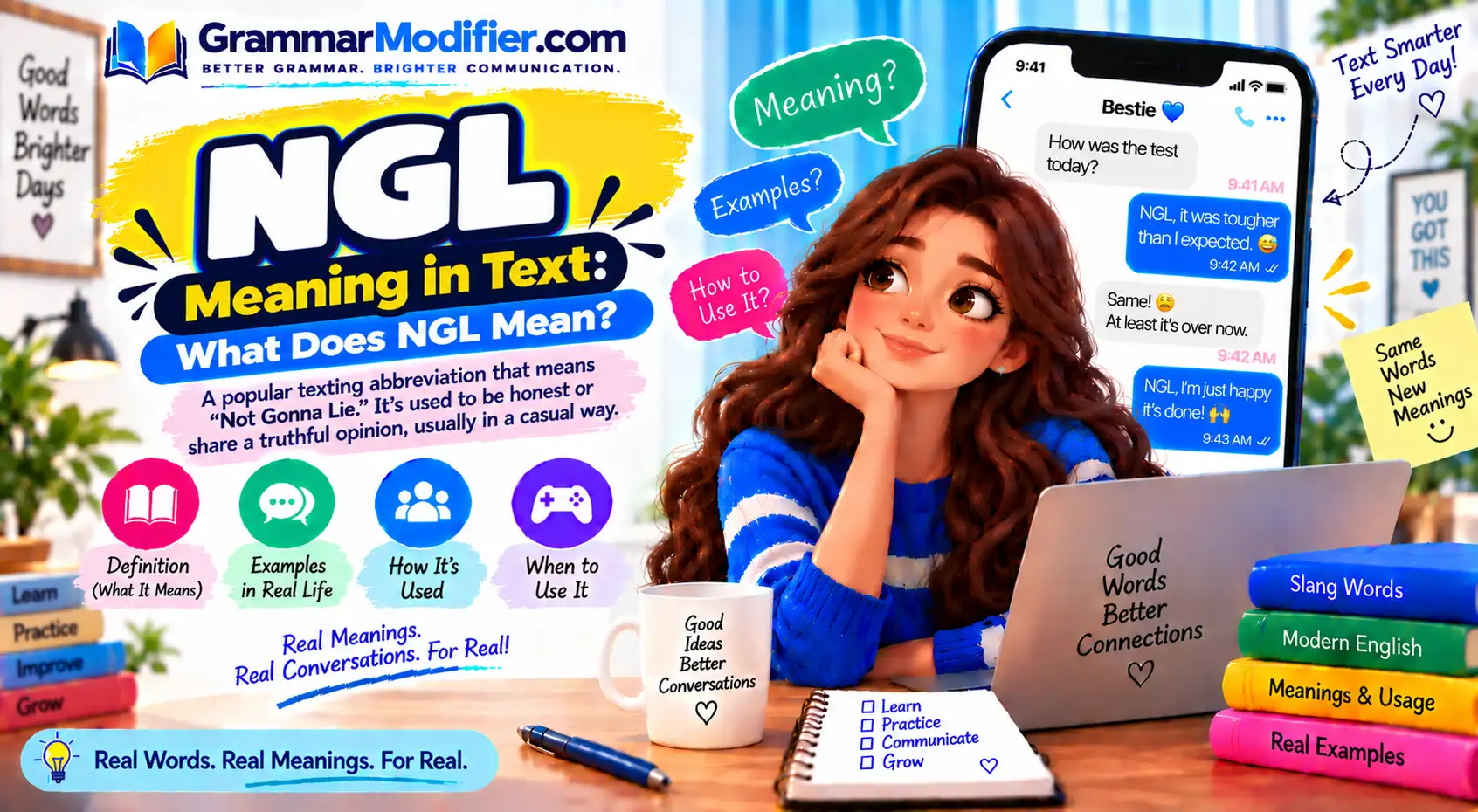
If you’ve seen NGL meaning in text and wondered what the abbreviation means, the answer is straightforward: NGL means “not gonna lie.” It is informal internet language used in texts, chats, comments, and social media.
People use NGL before an honest opinion, feeling, admission, compliment, criticism, or reaction. This guide explains its meaning, tone, sentence placement, examples, social-media use, common mistakes, and suitable alternatives.
Quick Answer
NGL means “not gonna lie.” It is an informal abbreviation used to introduce an honest thought, opinion, feeling, admission, or reaction in casual communication. Cambridge Dictionary classifies NGL as an informal abbreviation used in texts and social media.
TL;DR
- NGL = “not gonna lie.”
- It is mainly used in casual digital communication.
- It can introduce praise, criticism, feelings, or opinions.
- NGL can appear at the beginning or end of a sentence.
- TBH has a very similar meaning.
- Use “honestly” in formal writing instead.
What Does NGL Stand For?
NGL stands for “not gonna lie.” The abbreviation takes the first letter from each word: Not, Gonna, Lie.
“Gonna” is a casual form of “going to,” so the full phrase itself is conversational. NGL therefore fits naturally in texting and other informal online communication.
You can usually replace NGL with phrases such as:
- Honestly
- To be honest
- I have to admit
- Truthfully
- In all honesty
For example, “NGL, I liked the movie” means roughly “Honestly, I liked the movie.”
What Does NGL Mean in Simple English?
In simple English, NGL means “I’m being honest about what I’m about to say.” It often signals that the writer is giving a genuine reaction rather than trying to sound polite or neutral.
However, NGL does not automatically mean the statement is a fact. It usually introduces the speaker’s own opinion, feeling, or reaction.
- “NGL, I’m tired.” = “Honestly, I’m tired.”
- “NGL, that was great.” = “Honestly, that was great.”
- “NGL, I expected more.” = “To be honest, I expected more.”
- “That was funny, NGL.” = “That was funny, honestly.”
How Is NGL Used in Texting?
People commonly put NGL before something they want to say openly. It can introduce an ordinary opinion, so it does not always signal a major confession.
NGL can also appear after the main statement. In that position, it often sounds like a casual afterthought.
- “NGL, I really enjoyed it.”
- “NGL, your idea makes sense.”
- “NGL, I forgot about the meeting.”
- “That was harder than I expected, NGL.”
- “I actually liked it, ngl.”
- “NGL, I was nervous.”
- “NGL, that made me laugh.”
- “You were right, NGL.”
What Tone Does NGL Have?
The meaning of NGL stays the same, but the tone comes from the rest of the sentence. It can sound friendly, funny, serious, positive, negative, surprised, or personal.
Cambridge notes that NGL can introduce an admission or make a criticism or complaint less likely to sound offensive.
- Positive: “NGL, you did an amazing job.”
- Negative: “NGL, I didn’t enjoy the movie.”
- Neutral: “NGL, I wasn’t expecting that.”
- Funny: “NGL, I could eat pizza every day.”
- Personal: “NGL, I was nervous.”
- Agreeing: “NGL, you had a good point.”
Is NGL Positive or Negative?
NGL is neither positive nor negative by itself. The statement around it determines the overall tone.
This matters because some learners assume NGL always introduces criticism. That is not true. It can introduce a compliment just as easily as a complaint.
Compare these examples:
- “NGL, that was fantastic.” — positive
- “NGL, that was disappointing.” — negative
- “NGL, I’m surprised.” — neutral
- “NGL, I agree with you.” — agreement
- “NGL, I forgot.” — admission
Does NGL Mean Someone Was Lying?
Not necessarily. NGL means “not gonna lie,” but using it does not prove that the person lied earlier.
In many messages, NGL simply works as a conversational signal before an honest reaction. Someone might write “NGL, I’m hungry” without suggesting they previously lied about being hungry.
The surrounding conversation matters more than the abbreviation itself.
NGL at the Beginning or End of a Sentence
NGL commonly appears at the beginning of a sentence, but it can also appear at the end.
At the beginning, it introduces the statement:
NGL, I really liked the concert.
At the end, it can sound more like an afterthought:
The concert was really good, NGL.
Both communicate the same basic idea. In casual texting, capitalization and punctuation are flexible.
NGL Examples in Everyday Conversations
Realistic examples make the expression easier to understand. Notice that the meaning changes according to the words around NGL.
- Friend: “Did you like the movie?”
- Reply: “NGL, I loved it.”
- Friend: “Was the test hard?”
- Reply: “NGL, it was harder than I expected.”
- Friend: “Do you like this design?”
- Reply: “NGL, I prefer the first one.”
- Friend: “Was that funny?”
- Reply: “That was hilarious, ngl.”
- Friend: “Are you nervous?”
- Reply: “NGL, a little.”
NGL on Instagram, TikTok, Snapchat, and WhatsApp
On Instagram, TikTok, Snapchat, WhatsApp, and similar platforms, NGL generally keeps the same meaning: “not gonna lie.” The platform does not normally change the definition.
You might see it in comments, captions, direct messages, group chats, or replies.
- Instagram: “NGL, this photo looks great.”
- TikTok: “NGL, I watched this three times.”
- Snapchat: “NGL, that was fun.”
- WhatsApp: “NGL, I forgot to reply.”
- Gaming chat: “NGL, that level was difficult.”
How Do You Respond to NGL?
You do not need a special reply to the abbreviation itself. Respond to the statement that follows NGL.
For example, if someone writes “NGL, that was my favorite part,” you could say:
- “Same! I loved that part too.”
- “Really? That was my favorite too.”
- “I agree.”
- “I actually preferred the ending.”
- “Yeah, that part was great.”
If NGL introduces a compliment, a simple “Thank you!” may be enough.
NGL vs. TBH
NGL and TBH are very similar texting abbreviations. NGL means “not gonna lie,” while TBH means “to be honest.”
Both can introduce an honest opinion or reaction, so they can often be exchanged without changing the basic message.
| Abbreviation | Full form | Common use |
|---|---|---|
| NGL | Not gonna lie | Honest reaction or admission |
| TBH | To be honest | Honest opinion or statement |
| IMO | In my opinion | Personal viewpoint |
| FR | For real | Agreement or emphasis |
For example, “NGL, that was good” and “TBH, that was good” are very close in meaning.
NGL vs. IMO, FR, and “No Cap”
NGL overlaps with other internet abbreviations, but each expression has its own usual purpose.
IMO directly identifies something as a personal opinion. FR often emphasizes sincerity, agreement, or truth. “No cap” is another informal expression used to emphasize that someone is being truthful or not exaggerating.
- NGL: “NGL, I liked it.”
- IMO: “IMO, the first version is better.”
- FR: “FR, that was difficult.”
- No cap: “No cap, that was the best part.”
These expressions can overlap in casual conversations, but they are not interchangeable in every sentence.
Is NGL Formal or Informal?
NGL is informal slang. It is suitable for casual texting, social media, gaming chats, and conversations with people who understand internet language.
It is usually better to avoid NGL in formal school, business, academic, or official writing.
Use these alternatives instead:
- NGL, I agree. → Honestly, I agree.
- NGL, this needs work. → I believe this needs some work.
- NGL, I expected more. → To be honest, I expected more.
- NGL, this is helpful. → I find this helpful.
Common Mistakes With NGL
NGL is easy to understand, but several usage mistakes are common among English learners.
- Treating NGL as formal English
- Assuming NGL always introduces criticism
- Assuming NGL proves someone was previously lying
- Using NGL repeatedly in every message
- Confusing NGL with TBH or IMO
- Ignoring the surrounding sentence
- Assuming the sender’s gender changes its meaning
- Treating an opinion after NGL as an established fact
The key point is simple: NGL signals an informal, candid statement, while the rest of the sentence provides the actual message.
Can You Use NGL in Professional Writing?
You generally should not use NGL in formal emails, academic assignments, reports, applications, or official documents.
The issue is not that the abbreviation is grammatically wrong. It is that internet slang does not match the expected style of formal writing.
For professional communication, choose a standard expression such as “honestly,” “to be honest,” “in my view,” or “from my perspective.”
Other Meanings of NGL
Context can give NGL a completely different meaning outside casual texting. Dictionary.com lists NGL as an abbreviation for natural gas liquid, a term used in the energy industry.
So, the surrounding words matter:
- Text message: usually “not gonna lie”
- Social media: usually “not gonna lie”
- Casual chat: usually “not gonna lie”
- Energy industry: potentially “natural gas liquid”
- Technical writing: check the surrounding terminology
For everyday texting, “not gonna lie” is the meaning most readers expect.
Better Alternatives to NGL
If you want the same basic idea without internet slang, several expressions work well.
Casual alternatives include “honestly,” “to be honest,” and “I have to admit.”
More formal alternatives include “in my view,” “from my perspective,” “truthfully,” and “in all honesty.”
Choose the expression based on your audience and purpose rather than simply replacing every NGL with the same word.
FAQs
What does NGL mean in text?
NGL means “not gonna lie.” It is an informal abbreviation used before an honest opinion, feeling, admission, compliment, criticism, or reaction.
What does NGL mean on Instagram or TikTok?
NGL usually means “not gonna lie” on Instagram, TikTok, and other social platforms. The surrounding message determines whether the tone is positive, negative, funny, serious, or personal.
Is NGL slang?
Yes. NGL is informal internet slang, so it is most appropriate for casual digital conversations rather than formal writing.
Is NGL the same as TBH?
They have very similar meanings. NGL means “not gonna lie,” while TBH means “to be honest.” Both commonly introduce an honest statement.
What should I reply when someone says NGL?
Respond to the message after NGL rather than the abbreviation itself. You can agree, disagree, thank the person, ask a question, or share your own opinion.
Can I use NGL in an email?
You can use it in a very casual personal message, but it is usually unsuitable for a professional or formal email. “Honestly” or “to be honest” is a safer choice.
Does NGL always mean “not gonna lie”?
In texting and social media, “not gonna lie” is the usual meaning. In technical contexts, NGL can have other meanings, including natural gas liquid.
Conclusion
The most common NGL meaning in text is “not gonna lie.” People use it in casual messages to introduce an honest opinion, feeling, admission, compliment, criticism, or reaction.
Remember that NGL itself does not determine the tone. Read the entire sentence, consider the relationship between the speakers, and choose formal alternatives such as “honestly” when the situation calls for standard English.
Read More: