
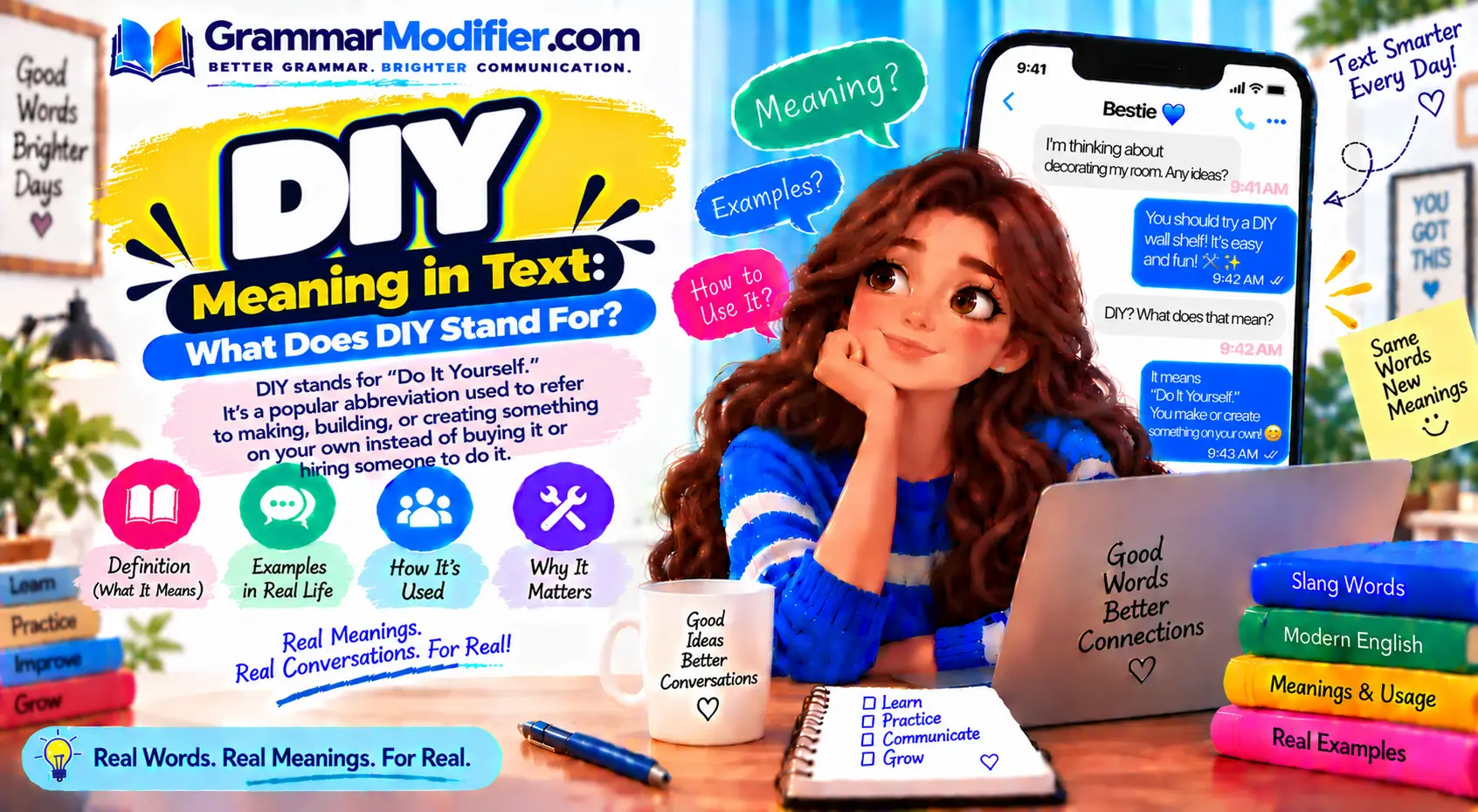
If you’re wondering what DIY means, it stands for “do it yourself.” The abbreviation describes making, repairing, decorating, or completing something on your own instead of hiring someone to do it.
You’ll often see DIY in home improvement, crafts, furniture, decorations, tutorials, social media posts, and everyday conversations. It can also appear in texting when someone talks about handling a task independently.
Quick Answer: What Does DIY Mean?
DIY means “do it yourself.” It refers to creating, fixing, building, decorating, or completing something without having another person do the work for you.
For example, “I made this table as a DIY project” means the speaker made the table themselves.
TL;DR
• DIY stands for “do it yourself.”
• It describes doing a task independently.
• DIY is common in crafts and home improvement.
• DIY project means a project completed yourself.
• DIYer means someone who enjoys DIY activities.
• In texting, DIY usually keeps the same meaning.
What Does DIY Stand For?
DIY stands for “do it yourself.” Each letter comes from the first letter of the three words.
The phrase tells someone to complete a task personally rather than relying on a professional or another person. The abbreviation makes the phrase shorter and easier to use.
For example:
• DIY = Do It Yourself
• DIY project = Do-it-yourself project
• DIY furniture = Furniture made or modified yourself
• DIY tutorial = Instructions for completing something yourself
What Is the Meaning of DIY?
The basic DIY meaning is the practice of doing something yourself.
The activity can involve making, repairing, decorating, modifying, or building something. DIY does not describe one specific type of project.
Common examples include:
• Painting a bedroom yourself
• Building a small bookshelf
• Making handmade decorations
• Repairing a simple household item
• Customizing an old piece of furniture
• Creating a handmade gift
• Following a craft tutorial
• Making decorations for an event
The key idea is personal involvement rather than simply purchasing a finished service or product.
How Do You Pronounce DIY?
In American English, DIY is pronounced “dee-eye-why.”
Each letter is pronounced separately. It is not normally pronounced as one spoken word.
For example:
“I found a DIY project online.”
The abbreviation is pronounced dee-eye-why project.
Is DIY an Abbreviation or Acronym?
DIY is commonly treated as an abbreviation for “do it yourself.” Major English dictionaries list DIY as a shortened form of the phrase.
You may occasionally see D.I.Y. with periods, especially in older writing. The form DIY without periods is widely used in modern English.
The longer phrase can also appear as do-it-yourself, especially when it works as a modifier.
For example:
DIY project
do-it-yourself project
Both communicate the same basic idea.
DIY as a Noun
DIY can be used as a noun when it refers to the activity of doing things yourself.
For example:
“I enjoy DIY on weekends.”
Here, DIY refers to activities such as repairing, decorating, or making things.
Another example is:
“She spends her free time doing DIY.”
In this use, DIY describes the general activity rather than one specific object.
DIY as a Modifier
DIY can also appear before another noun to describe something connected with doing a project yourself.
Common examples include:
• DIY project
• DIY furniture
• DIY decorations
• DIY crafts
• DIY tutorial
• DIY home improvement
• DIY gift
• DIY ideas
For example:
“We found a useful DIY furniture tutorial.”
Here, DIY tells the reader that the furniture project can be completed independently.
What Does DIY Mean in Texting?
In texting and online chat, DIY normally still means “do it yourself.”
The meaning depends on the surrounding sentence. Someone may use DIY to describe a project, tutorial, repair, craft, or another activity they plan to complete independently.
For example:
“I’m going to try a DIY solution for my desk.”
This means the person plans to handle the project themselves.
In a playful conversation, someone could also say:
“DIY!”
In that context, the speaker may mean “do it yourself.” The tone can be serious, humorous, or teasing depending on the conversation.
What Does DIY Mean on Social Media?
On social media, DIY is frequently used when people share projects, tutorials, crafts, decorations, and creative ideas.
You might see phrases such as:
• DIY room decor
• DIY birthday decorations
• DIY craft ideas
• DIY home projects
• DIY gift ideas
• DIY furniture makeover
• DIY tutorial
For example, a creator might post a video showing how to turn an old item into a decorative piece. The caption could describe it as a DIY project.
In this setting, DIY usually emphasizes that the creator made or changed the item themselves.
What Is a DIY Project?
A DIY project is an activity that someone plans and completes themselves.
The project could be practical, creative, decorative, or educational. It might take a few minutes or several days.
Examples include:
• Building a simple shelf
• Painting a room
• Making a photo frame
• Creating handmade decorations
• Restoring furniture
• Making a personalized gift
• Installing simple decorative items
• Creating a craft project
The phrase DIY project does not automatically mean the project is difficult. A small craft can be DIY just as much as a larger home project.
What Does DIYer Mean?
A DIYer is a person who regularly does DIY projects.
The word combines DIY with the suffix -er, which identifies a person who performs an activity.
For example:
“My brother is an experienced DIYer.”
This means he regularly makes, repairs, builds, or modifies things himself.
You may also see do-it-yourselfer, which has the same general meaning.
DIY Examples in Everyday English
Understanding the word becomes easier when you see it in natural sentences.
• “I found a DIY tutorial for making a bookshelf.”
The tutorial explains how to make the bookshelf yourself.
• “She loves DIY crafts.”
She enjoys making craft items herself.
• “This is a beginner-friendly DIY project.”
The project is designed for someone doing it themselves.
• “We chose a DIY approach to decorate the room.”
They decided to handle the decorating themselves.
• “He watches DIY home-improvement videos.”
He watches videos about completing home projects independently.
DIY vs. Homemade: Are They the Same?
DIY and homemade can overlap, but they are not always interchangeable.
DIY focuses on the act of doing something yourself. Homemade usually describes something made at home rather than commercially produced.
For example:
“I made a DIY bookshelf.”
The focus is on completing the project yourself.
“We had homemade cookies.”
The focus is on the cookies being made at home.
Something can be both DIY and homemade, but the terms emphasize different ideas.
DIY vs. Handmade
Handmade means something was made by hand rather than mass-produced.
DIY emphasizes that the person completed the project themselves.
For example, a person could make a handmade card as a DIY project. The two descriptions can overlap, but they highlight different aspects of the item.
Common Mistakes With DIY
The most common spelling mistake is writing DYI instead of DIY.
The correct order is:
D → I → Y
These letters represent:
Do → It → Yourself
Another mistake is assuming DIY only refers to home repairs. The term also applies to crafts, decorations, furniture, gifts, tutorials, and many creative projects.
It is also unnecessary to write DIY project project because the word “project” should appear only once.
DIY Capitalization and Writing Style
The abbreviation is normally written in uppercase as DIY.
Common forms include:
DIY project
DIY ideas
DIY tutorial
DIY crafts
When using the complete phrase as a compound modifier, do-it-yourself is commonly hyphenated.
For example:
“She followed a do-it-yourself guide.”
The exact style can vary by publication, but DIY is the standard short form in everyday writing.
DIY in American and British English
The meaning of DIY is broadly the same in American and British English.
In both varieties, it can describe doing repairs, decorating, building, crafting, or other projects yourself.
American English commonly uses phrases such as DIY project, DIY crafts, and DIY home improvement. British English also uses DIY extensively, particularly when discussing household repairs and decorating.
The meaning does not normally change simply because the speaker is American or British.
Related DIY Words and Phrases
Learning related expressions can help you understand DIY meaning in different contexts.
Useful terms include:
• Do it yourself — the complete phrase behind DIY
• DIYer — a person who does DIY projects
• DIY project — a project completed yourself
• DIY tutorial — instructions for completing a project yourself
• DIY crafts — handmade craft activities
• DIY furniture — furniture made or modified yourself
• DIY home improvement — household improvement work completed yourself
• Handmade — something made by hand
• Homemade — something made at home
• Self-made — created independently, often with a broader meaning
FAQs About DIY Meaning
What is the full meaning of DIY?
DIY stands for “do it yourself.” It describes completing a task, project, repair, or creative activity yourself.
What does DIY mean in a text message?
In a text message, DIY usually means “do it yourself.” It can describe a project or, depending on tone, tell someone to handle something independently.
What does DIY stand for in social media?
On social media, DIY means “do it yourself.” It commonly appears in posts about crafts, decorations, home projects, tutorials, and creative ideas.
What is an example of DIY?
Painting your room yourself is a DIY project. Making decorations, customizing furniture, or creating a handmade gift can also be DIY activities.
What does DIYer mean?
A DIYer is someone who enjoys or regularly completes do-it-yourself projects. The person may work on crafts, repairs, decorating, furniture, or other projects.
How do you pronounce DIY?
DIY is pronounced “dee-eye-why.” Each letter is spoken separately.
Is DIY the same as homemade?
Not exactly. DIY focuses on doing something yourself, while homemade usually emphasizes that something was made at home.
Conclusion
The DIY meaning is simple: DIY stands for “do it yourself.” It describes making, repairing, decorating, building, or completing something without having someone else do the work for you.
You can now recognize DIY in texts, social media posts, tutorials, home-improvement guides, and everyday conversations. When you encounter the abbreviation, check the surrounding words to understand exactly what the person is doing themselves.
Read More: