
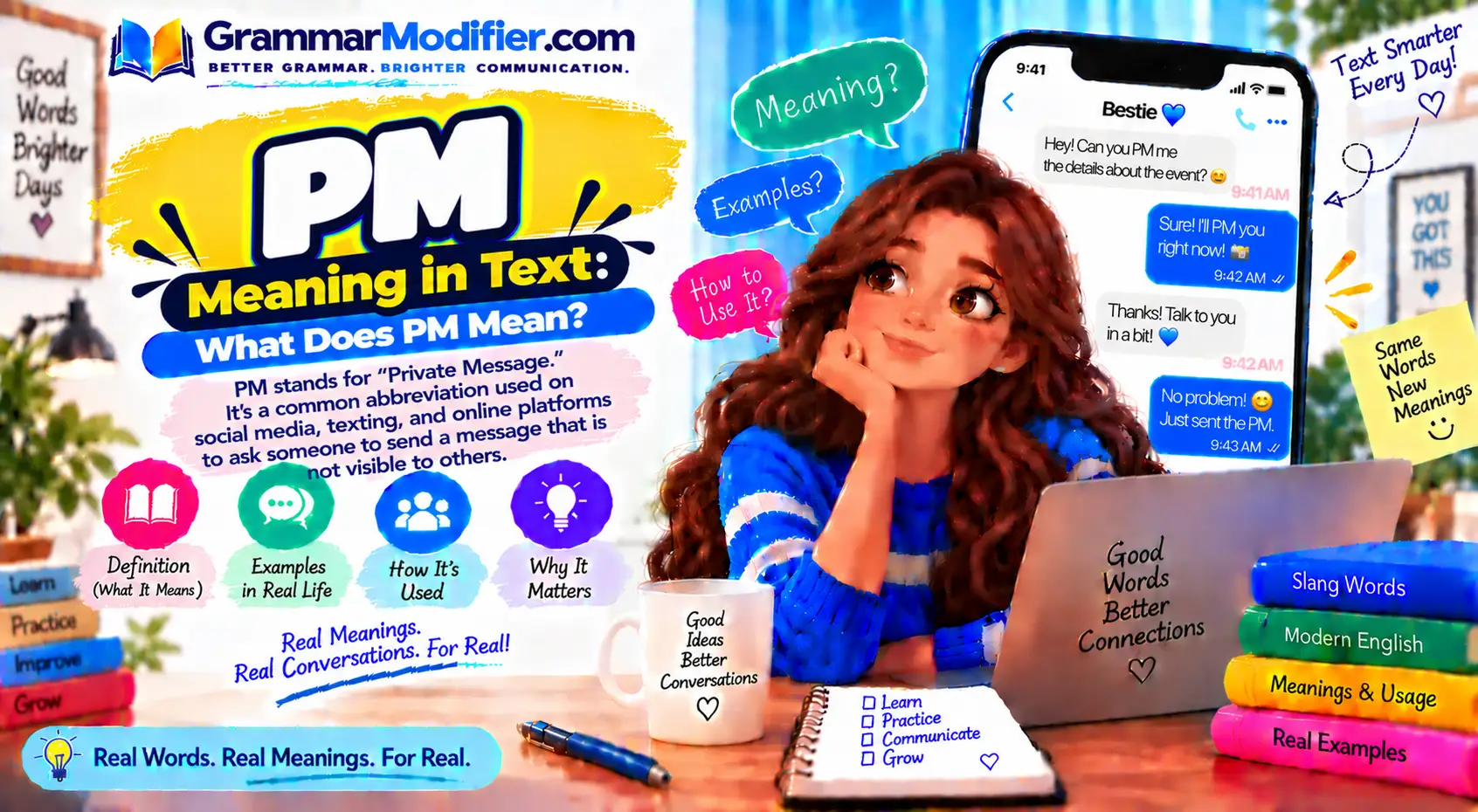
This guide helps English learners and everyday texters understand PM meaning in text without confusion. The abbreviation usually refers to a private message, but its meaning can change with context.
You’ll learn how PM works in messages, social media, group chats, forums, and workplaces. You’ll also see common examples, mistakes, related meanings, and natural ways to reply.
Quick Answer
PM in text usually means “Private Message.” When someone says “PM me,” they are asking you to contact them privately rather than publicly.
TL;DR
• PM usually means Private Message in online conversations.
• PM me means “send me a private message.”
• PM and DM often describe the same action.
• PM can also mean post meridiem when discussing time.
• Context tells you which meaning of PM is intended.
What Does PM Mean in Text?
In texting and online communication, PM usually means “Private Message.” It refers to a message sent privately instead of posted publicly.
For example, “PM me the details” means “send me the details privately.” The term is common in online communities, forums, marketplaces, and casual conversations.
What Does PM Stand For?
The most common expansion is Private Message. Some communities also use Personal Message, which has nearly the same practical meaning.
In both cases, the idea is private communication. The exact wording can depend on the platform or community.
PM Meaning in Chat
In online chat, PM usually tells someone to continue a conversation privately. It can move a discussion away from a public comment or group conversation.
For example, “Can you PM me?” means “Can you message me privately?” The abbreviation works naturally in casual digital communication.
What Does PM Me Mean?
“PM me” means “send me a private message.” It is usually an invitation or request to continue talking privately.
You might see “PM me for details,” “PM me if interested,” or “PM me the address.” In each case, the speaker wants the information exchanged privately.
How PM Is Used in Messages
PM can work as both a noun and a verb in informal digital English. This flexibility makes it common in short online conversations.
As a noun, you can say, “I sent you a PM.” As a verb, you can say, “I’ll PM you later.”
PM vs DM
PM means Private Message, while DM means Direct Message. In everyday online communication, both usually refer to sending someone a private message.
The preferred term depends on the platform and community. DM is especially common on modern social platforms, while PM remains familiar in forums, groups, and online communities.
PM on Social Media
People may use PM on social platforms when they want someone to contact them privately. The exact terminology varies by platform.
For example, someone might write “PM me for the price” in a social post. On platforms that commonly use the term DM, the same request may appear as “DM me.”
PM in Group Chats
In a group chat, PM can mean moving a conversation into a private one-to-one chat. This is useful when the topic only concerns two people.
For example, someone might say, “I have the information. PM me.” They are asking you to continue the conversation privately instead of filling the group chat.
PM in Online Forums and Gaming
PM has long been familiar in online forums and gaming communities. Users often need a private way to exchange information without posting it publicly.
Examples include “PM me your username” and “I’ll PM you the server details.” In these settings, PM usually means a private message.
PM in Work Conversations
In workplace communication, PM can have meanings unrelated to private messaging. One common example is Project Manager.
For example, “Ask the PM about the deadline” may refer to a Project Manager. The surrounding words, workplace setting, and subject usually make the intended meaning clear.
PM as a Time Abbreviation
When written after a number, PM usually means post meridiem, a Latin phrase meaning “after midday.” It identifies times from noon through the evening in the 12-hour clock.
For example, “The meeting starts at 4 PM” refers to a time. This meaning is completely different from “PM me,” where PM refers to private messaging.
How to Tell Which PM Meaning Is Intended
Context is the easiest way to understand PM. Look at the words around it and the subject of the conversation.
If PM appears with me, send, message, inbox, or chat, it probably means Private Message. If it follows a number, such as 7 PM, it normally refers to time.
Common PM Text Examples
Here are natural examples of PM in text:
• “PM me the details.” — Send the details privately.
• “I’ll PM you later.” — I’ll message you privately later.
• “Check your PMs.” — Check your private messages.
• “PM me if you’re interested.” — Contact me privately.
• “The call starts at 6 PM.” — PM refers to time.
• “Ask the PM about the schedule.” — PM may mean Project Manager.
• “I sent you a PM.” — I sent a private message.
• “Can you PM me the link?” — Send the link privately.
Is PM Formal or Informal?
PM as Private Message is generally informal digital language. It works well in chats, forums, social media, and casual online communities.
For formal writing, it is often clearer to write “private message” or “direct message.” This avoids confusion when your audience may not know the abbreviation.
Common Mistakes With PM
One common mistake is assuming PM always means Private Message. It can also refer to time, Project Manager, Prime Minister, and other context-specific terms.
Another mistake is treating PM and DM as completely different actions. They usually describe private communication, although platform terminology can differ.
How to Reply to “PM Me”
When someone says “PM me,” a short response is usually enough. Your reply can match the tone and situation.
You can say “Sure, I’ll message you,” “Just sent you a PM,” or “I’ll check my messages.” If you do not want to move the conversation privately, you can simply continue with the public discussion.
FAQs
What does PM mean in text slang?
PM usually means “Private Message” in texting and online communication. It asks someone to continue a conversation privately.
Is PM the same as DM?
Usually, yes. PM means Private Message, while DM means Direct Message, and both normally describe private online communication.
What does “PM me” mean?
“PM me” means “send me a private message.” It is commonly used when someone wants to move a conversation away from public comments or group chats.
Can PM mean a time?
Yes. PM can mean post meridiem when it appears with a time, such as 5 PM or 8 PM.
What does PM mean on social media?
On social media, PM usually means Private Message. However, some platforms use DM more often for the same type of private communication.
Is PM formal or informal?
As a private-message abbreviation, PM is mainly informal. In formal writing, spelling out “private message” can make your meaning clearer.
What does PM mean at work?
In workplace communication, PM may mean Project Manager or Project Management, depending on the sentence. Context is necessary because PM has several meanings.
Conclusion
PM meaning in text usually refers to “Private Message,” especially when someone says “PM me.” It tells another person to continue the conversation privately.
Remember to check the surrounding words because PM can also refer to time or workplace roles. When you see PM, use the sentence and context to identify the intended meaning, then choose the clearest response.
Read More: