
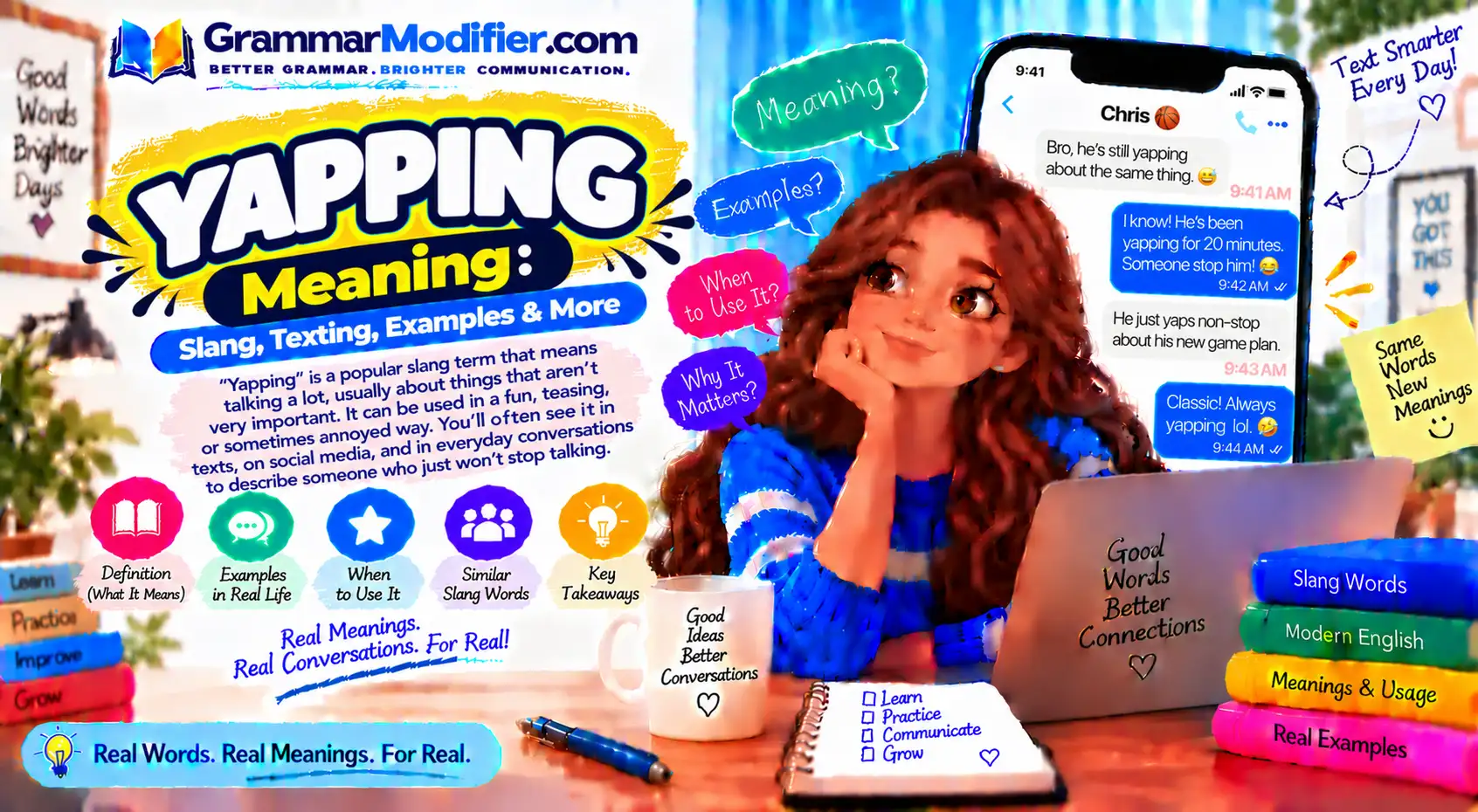
Yapping is a popular informal English word that means talking a lot, talking for a long time, or continuing to talk when the listener wants you to get to the point. In modern internet slang, however, yapping can be playful, affectionate, enthusiastic, self-aware, or mildly critical.
If someone says, “You’re yapping,” they may be teasing you about talking too much. If someone says, “Sorry, I’m yapping again,” they are often joking about themselves. The meaning depends heavily on context, tone, and the relationship between the speakers.
Quick Answer: What Does Yapping Mean?
Yapping means talking continuously or at length. In casual slang, it can describe nonstop conversation, enthusiastic storytelling, or unnecessary talking.
The word comes from yap, an established English verb that can also describe the repeated sharp barking of a small dog. Cambridge Dictionary lists the human-speech sense as informal and the animal sense as well.
TL;DR
- Yapping means talking a lot or for an extended time.
- It can be playful, positive, teasing, or negative.
- “Stop yapping” means stop talking so much.
- A yapper is someone who talks a lot.
- A yap session is a long, casual conversation.
- “I’m yapping” is often a self-aware joke.
- “Let her yap” can mean letting someone continue talking.
- In formal English, talking or speaking is usually better.
Yapping Meaning in Slang
In modern slang, yapping usually describes someone who keeps talking, often with lots of details, stories, opinions, or side comments. It does not always mean the speaker is saying something useless.
That distinction matters. A friend might call another friend a yapper because they enjoy hearing that person talk. Someone else might say “stop yapping” because they are genuinely tired of the conversation.
| Context | Likely meaning | Tone |
|---|---|---|
| “You’re yapping again.” | You are talking a lot. | Teasing or critical |
| “Sorry, I’m yapping.” | I realize I am talking a lot. | Self-aware |
| “I love our yap sessions.” | I enjoy our long conversations. | Positive |
| “Stop yapping and answer me.” | Get to the point. | Impatient |
| “Let her yap.” | Let her continue talking. | Playful or supportive |
| “He’s a certified yapper.” | He talks a lot. | Humorous |
The modern slang meaning has become broader than simple criticism. Recent linguistic research on TikTok usage describes humorous, enthusiastic, affectionate, identity-based, and socially connective uses of “yapping,” showing why context matters.
Is Yapping Positive or Negative?
Yapping can be either positive or negative. The word itself does not determine the speaker’s attitude.
When someone describes another person as a yapper, it may be affectionate between friends. When the same person says “stop yapping” during an argument, it can sound dismissive.
A useful rule is to look at who says it, who hears it, and what happens around the phrase.
Positive or playful yapping
- “I could listen to you yap all night.”
- “We had the best yap session yesterday.”
- “Let her yap; she’s excited.”
- “I’m a professional yapper.”
- “Sorry for yapping, but this story is hilarious.”
Negative or dismissive yapping
- “Please stop yapping and listen.”
- “He keeps yapping instead of answering.”
- “They were yapping through the entire movie.”
- “You’re yapping without making a point.”
So, calling someone a yapper is not automatically an insult.
What Does “I’m Yapping” Mean?
“I’m yapping” usually means “I realize I’m talking a lot.” It is often used as a self-aware comment during a long explanation, story, voice message, or conversation.
This phrase is especially useful in casual texting and social media because it lets the speaker acknowledge their own long message without sounding overly serious.
For example:
“Sorry, I’m yapping again. Anyway, here’s what happened.”
Here, yapping is not necessarily negative. The speaker is simply admitting that they have been talking for a while.
Other natural examples include:
- “I’m yapping, but this part is actually important.”
- “Sorry for yapping about my new hobby.”
- “Okay, I’ll stop yapping now.”
- “I started yapping and forgot the original question.”
- “Let me stop yapping and get to the point.”
What Does “Stop Yapping” Mean?
“Stop yapping” means “stop talking so much” or “get to the point.” It can be funny between close friends, but it may sound rude when directed at someone you do not know well.
The phrase is therefore more about tone and relationship than grammar.
For example, a friend might say:
“Stop yapping and tell me what happened!”
That could be playful. In a workplace or classroom, however, “Could you get to the main point?” would usually be more appropriate.
Similar expressions
- Stop talking so much.
- Get to the point.
- Give me the short version.
- Can you summarize that?
- What’s the main idea?
What Is a Yap Session?
A yap session is a long, relaxed conversation. It can involve stories, opinions, personal updates, gossip, hobbies, entertainment, or almost anything else.
Unlike “stop yapping,” the phrase “yap session” is often positive. Friends may describe a long phone call or late-night conversation as a yap session because they enjoyed talking.
Examples:
- “We had a two-hour yap session last night.”
- “That coffee turned into a full yap session.”
- “I need a yap session with my best friend.”
- “Our group chat became a three-hour yap session.”
- “We started talking about movies and ended up having a yap session.”
The phrase is closely related to “yap sesh,” an even more casual version used in online conversations.
What Does Yapper Mean?
A yapper is someone who talks a lot. It comes from the verb yap and is normally informal.
People often use yapper as a humorous self-description. Phrases such as “professional yapper” and “certified yapper” exaggerate the idea for comic effect.
Examples:
- “I’m definitely a yapper.”
- “She’s such a yapper when she gets excited.”
- “He became a professional yapper during that podcast.”
- “My friend is a certified yapper.”
- “Every friend group has a yapper.”
Calling someone a yapper can sound affectionate among friends, but it may sound insulting in a serious setting.
What Does “Let Her Yap” Mean?
“Let her yap” means to let a woman or girl continue talking without interrupting her. Online, the phrase is often humorous and can even be supportive.
The expression does not necessarily mean that the person is boring. It can simply acknowledge that she has a lot to say.
For example:
“She’s excited about her new project. Let her yap.”
Here, the speaker is encouraging her to continue.
Related expressions include:
- Let him yap.
- Let them yap.
- Let me yap.
- Let her cook and yap.
- I could listen to her yap all day.
These expressions are highly informal and belong mainly to casual online or conversational language.
What Does “Born to Yap” Mean?
“Born to yap” is a humorous expression for someone who loves talking. It suggests that talking is a natural part of the person’s personality.
It is usually exaggerated rather than literal.
For example:
“I was born to yap, so don’t expect a short story.”
Similar playful phrases include:
- Born to yap
- Certified yapper
- Professional yapper
- Full-time yapper
- I was made to yap
These phrases are usually self-descriptions rather than serious labels.
Yapping on TikTok and Social Media
The popularity of yapping increased significantly through online communities, especially short-form video and social platforms. TikTok discussions often use the word for long explanations, storytelling, commentary, or enthusiastic talking.
Online, yapping can describe both the speaker and the content.
Someone might call a long video a yap session, describe themselves as a professional yapper, or comment “let her yap” when they enjoy someone’s explanation.
The important point is that internet slang changes quickly. Not every young English speaker uses these expressions in exactly the same way.
Yapping vs. Talking vs. Rambling
These words overlap, but they are not identical.
| Word | Main idea | Tone |
|---|---|---|
| Talking | Speaking or communicating | Neutral |
| Yapping | Talking a lot or continuously | Informal |
| Rambling | Talking without staying focused | Often critical |
| Chatting | Talking casually | Usually friendly |
| Ranting | Speaking strongly about a complaint or opinion | Emotional |
Consider these examples:
Neutral:
“We were talking about our weekend.”
Informal:
“We were yapping about our weekend.”
Unfocused:
“He was rambling about several unrelated topics.”
This is why yapping is not simply a replacement for talking. The slang word adds an attitude or playful feeling.
Yapping vs. Babbling
Yapping and babbling can both describe a lot of speech, but they carry different suggestions.
Yapping focuses on continued or excessive talking. Babbling can suggest speech that is confused, hurried, childish, or difficult to follow.
For example:
“She kept yapping about her favorite show.”
This simply means she talked about it for a long time.
“He was babbling because he was nervous.”
This suggests that his speech was less organized.
Because of this difference, calling someone’s speech babbling can sound more critical than calling it yapping.
How to Use Yapping in a Sentence
Yapping is an informal word, so it works best in casual conversation, texting, social media, and humorous writing.
Common sentence patterns include:
Subject + be + yapping
“She is yapping about her new favorite show.”
Subject + keep + yapping
“They keep yapping about the same topic.”
Subject + start + yapping
“He started yapping as soon as we arrived.”
Subject + stop + yapping
“I should stop yapping and finish my work.”
Subject + enjoy + yapping
“We enjoy yapping about movies.”
The word is grammatically normal, but its register is informal.
Grammar Forms of “Yap”
The word yap functions as a verb, and yapping is its present participle or gerund form depending on how it works in a sentence.
| Form | Example |
|---|---|
| yap | “They yap about everything.” |
| yaps | “He yaps about sports.” |
| yapped | “She yapped for an hour.” |
| yapping | “They are yapping again.” |
The literal animal meaning also follows the same grammar:
“The little dog is yapping outside.”
The human slang meaning and the animal meaning share the same verb.
Common Mistakes With Yapping
The biggest mistake is assuming yapping always means annoying or meaningless talking. Modern usage can be playful, enthusiastic, affectionate, or self-directed.
Another mistake is using the word in situations where neutral language would be more appropriate.
Avoid these mistakes
- Don’t treat yapping as formal vocabulary.
- Don’t assume every yapper is being criticized.
- Don’t use “stop yapping” with strangers casually.
- Don’t confuse yapping with rambling in every situation.
- Don’t assume yapping always means nonsense.
- Don’t use internet slang in formal school writing without a reason.
- Don’t replace every instance of “talking” with “yapping.”
- Don’t ignore tone when interpreting the phrase.
When Should You Avoid the Word Yapping?
Use yapping mainly in informal situations. In professional, academic, or formal communication, neutral words usually communicate your meaning more clearly.
Instead of:
“He kept yapping during the meeting.”
A professional version would be:
“He continued talking during the meeting.”
Or:
“He continued discussing the issue after the scheduled discussion ended.”
Better formal alternatives
- talking
- speaking
- discussing
- explaining
- describing
- communicating
- presenting
- elaborating
The right replacement depends on what the person was actually doing.
Where Did “Yap” and “Yapping” Come From?
Yap is not a newly invented internet word. English has long used the verb for the sharp, repeated sound made by a small dog.
The human-speech sense developed around the idea of noisy, continuous, or annoying talk. Modern online culture has given the word a broader range of meanings, including playful and positive uses.
That history explains why yapping can carry different feelings depending on context. The older sense emphasizes irritating noise, while newer slang can simply describe someone who talks enthusiastically.
Yapping Examples in Everyday English
Here are examples showing how the meaning changes with context:
Friendly:
“We were yapping about our favorite movies.”
Self-aware:
“Sorry, I’m yapping again.”
Positive:
“I love a good yap session.”
Playful criticism:
“Girl, you’ve been yapping for twenty minutes.”
Dismissive:
“He’s yapping instead of answering the question.”
Supportive:
“Let her yap. She’s excited.”
Formal alternative:
“She discussed the project for twenty minutes.”
These examples show why tone is essential when interpreting slang.
FAQs About Yapping Meaning
Is yapping a bad word?
No. Yapping is an established English word, but its slang use is informal. Depending on context, it can sound funny, affectionate, teasing, or dismissive.
Is yapping an insult?
Not necessarily. Calling someone a yapper can be playful between friends, while “stop yapping” can sound rude when used seriously.
Is yapping Gen Z slang?
The word itself is older than Gen Z slang. However, younger online communities have popularized and expanded its use across social media.
What does “sorry for yapping” mean?
It means “sorry for talking so much.” The phrase is usually self-aware and casual rather than a serious apology.
What does “certified yapper” mean?
A certified yapper is a humorous way to describe someone who talks a lot. “Certified” is exaggeration, not an actual qualification.
Can I use yapping in formal writing?
Usually, no. In formal writing, choose a neutral word such as talking, speaking, discussing, or explaining, depending on the meaning.
What is the difference between yapping and rambling?
Yapping emphasizes talking a lot, while rambling suggests that the speaker is wandering away from the main point. A person can yap without rambling.
Conclusion
Yapping means talking a lot or for an extended time, but modern slang gives the word more flexibility. It can describe playful conversation, enthusiastic storytelling, self-aware talking, or speech that someone finds excessive.
The easiest way to understand yapping meaning is to look at the context and tone. Use it freely in casual conversations and online spaces, but choose neutral words such as talking or speaking when the situation is formal.
Read More: