
Quick Answer
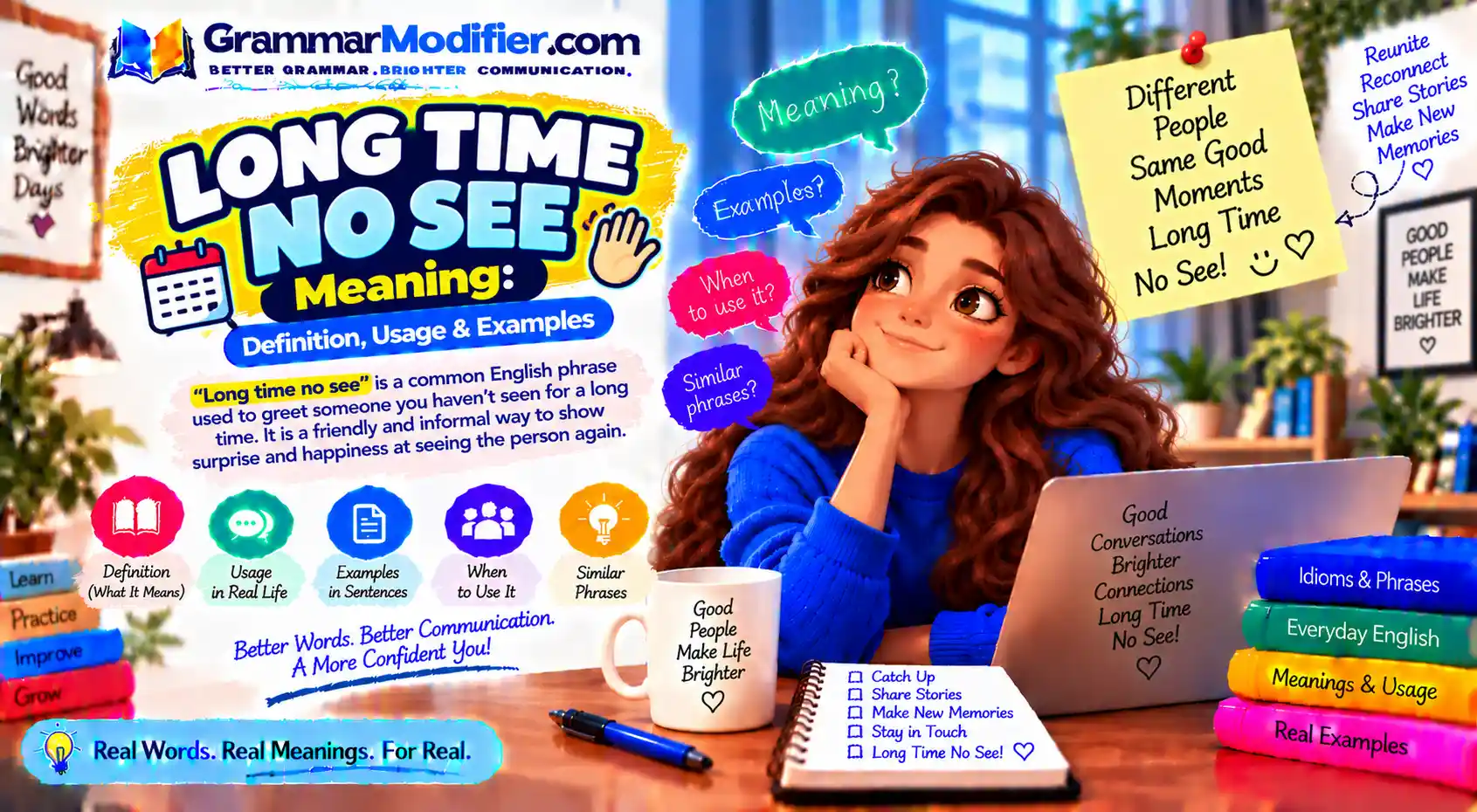
“Long time no see” is an informal English greeting used when you meet someone after not seeing them for a long time.
It is a fixed idiom, so its unusual grammar is not a pattern you should copy elsewhere.
TL;DR
- Meaning: You haven’t seen someone for a long time.
- Grammar: It is a fixed idiomatic expression.
- Tone: Friendly, casual, and conversational.
- Best use: Friends, familiar coworkers, and acquaintances.
- Formal alternative: “It’s been a while since we last spoke.”
- Natural reply: “Yes, it’s been a while! How have you been?”
What Does Long Time No See Mean?
“Long time no see” means that you have not seen someone for a long period.
It is normally used as a friendly greeting when people meet again after an absence. Cambridge and Oxford both identify it as an informal expression with this meaning.
For example:
“Hey, Sam! Long time no see!”
The speaker is not asking a literal question. They are simply recognizing that a lot of time has passed.
Is Long Time No See Grammatically Correct?
Yes, it is acceptable as a fixed English expression. However, it does not follow the normal structure of a complete English sentence.
That difference can confuse learners. The safest approach is to memorize “long time no see” as one established idiom rather than treating its word order as a general grammar rule.
Compare:
Natural: “Long time no see!”
Natural: “I haven’t seen you in a long time.”
Unnatural: “It is long time no see.”
The first expression is idiomatic. The second is a normal sentence.
When Should You Use Long Time No See?
Use the phrase when you reconnect with someone after a noticeable gap.
It works especially well when the relationship is already familiar. The phrase can express friendly surprise, recognition, or pleasure at seeing someone again.
Common situations include:
- Meeting an old friend.
- Seeing a former classmate.
- Running into a familiar coworker.
- Reconnecting with an acquaintance.
- Sending a casual message after a long gap.
Long Time No See Examples
Here are some natural examples:
- “Hey, Maria! Long time no see!”
- “Long time no see! How have you been?”
- “Wow, long time no see. What have you been up to?”
- “Tom! Long time no see!”
- “Long time no see! We should catch up sometime.”
Notice that the expression often appears with another question or greeting.
Is Long Time No See Formal or Informal?
“Long time no see” is informal. It is natural in casual conversation, but it may sound too relaxed in highly formal communication.
For a friend, it sounds completely natural:
“Long time no see! How’s everything going?”
For a client or formal professional contact, choose a more neutral expression:
“It’s great to reconnect. I hope you’ve been well.”
Oxford also labels the expression informal in its American English dictionary.
Can You Use Long Time No See in an Email?
Yes, but the relationship matters.
A friendly email can easily begin:
“Hi Alex, long time no see! I hope you’ve been doing well.”
A business email to a client, manager, or unfamiliar professional contact usually benefits from a more polished alternative.
Try:
“It’s been a while since we last connected.”
Or:
“It’s great to reconnect with you.”
Long Time No See in American English
“Long time no see” is established in American English and remains recognizable today.
Modern American English dictionaries continue to list the expression as an informal greeting.
It is not necessary to avoid the phrase simply because its grammar looks unusual. The key issue is context. Use it when a friendly, conversational tone is appropriate.
Long Time No See vs. It’s Been a While
These expressions have similar meanings, but their tones differ.
| Expression | Typical Tone | Example |
|---|---|---|
| Long time no see | Casual | “Hey! Long time no see!” |
| It’s been a while | Neutral | “It’s been a while. How are you?” |
| It’s been ages | Casual | “It’s been ages since we talked!” |
| It’s great to reconnect | Professional-friendly | “It’s great to reconnect with you.” |
| It’s been some time since we last spoke | Formal | “It’s been some time since we last spoke.” |
If you are unsure about formality, “It’s been a while” is a flexible choice.
Other Ways to Say Long Time No See
There is no single replacement that works in every situation.
For casual conversations, try:
“It’s been ages!”
For a neutral conversation:
“It’s been a while!”
For professional communication:
“It’s great to reconnect.”
For an email:
“It’s been some time since we last spoke.”
The best choice depends on who you are talking to and where the conversation happens.
Common Mistakes With Long Time No See
One common mistake is treating the expression as ordinary sentence grammar.
Avoid creating forms such as:
“It is long time no see.”
Use:
“Long time no see!”
Another mistake is using the phrase in every situation. The expression is informal, so a formal business letter may need a different greeting.
Also remember that “long time no see” describes a reunion or renewed contact. It would sound strange if you saw the person only a few minutes ago.
Long Time No See in Texting and Social Messages
The phrase works naturally in casual texting because it is short and friendly.
For example:
“Hey! Long time no see! How have you been?”
You can also make the message more conversational:
“Long time no see! What have you been up to lately?”
For professional messages, consider:
“It’s been a while. I hope you’ve been well.”
How Do You Respond to Long Time No See?
A natural response acknowledges the time gap and keeps the conversation moving.
You can say:
“I know! It’s been a while. How have you been?”
Or:
“Yes, it has! What have you been up to?”
You do not need to repeat “long time no see.” A short response followed by a question sounds natural.
Where Did Long Time No See Come From?
The exact origin of “long time no see” remains uncertain.
Historical sources have connected the expression with different forms of contact-language English, including possible Chinese and Native American influences.
Early printed examples appear in American sources around the late nineteenth and early twentieth centuries. Because the historical evidence has competing explanations, it is better to describe the origin as uncertain.
Long Time No See: Tone and Context
The phrase usually communicates friendly recognition rather than criticism.
For example, saying “Long time no see!” to an old friend normally means you are pleased to see them again.
The same words can feel too casual in a formal setting. Always consider your relationship with the person and the communication setting.
Long Time No See for English Learners
English learners should memorize “long time no see” as a complete expression.
Do not try to use its unusual structure to create new sentences. Instead, learn the phrase alongside normal alternatives such as “I haven’t seen you in a long time” and “It’s been a while.”
This makes it easier to understand both casual conversation and formal writing.
Quick Reference: Long Time No See
Remember these four points:
- Meaning: You have not seen someone for a long time.
- Grammar: It is a fixed idiom.
- Tone: Informal and friendly.
- Formal alternative: “It’s been a while since we last spoke.”
If you remember those points, you can use the expression naturally without overthinking its unusual grammar.
FAQs
What does “long time no see” mean?
It means you have not seen someone for a long time. It is normally used as a friendly, informal greeting.
Is “long time no see” grammatically correct?
It is an established fixed expression, although it does not follow ordinary sentence structure. English speakers recognize and use it as an idiom.
Is “long time no see” formal?
No. It is generally informal. For formal communication, use phrases such as “It’s great to reconnect” or “It’s been some time since we last spoke.”
Can I use “long time no see” in a professional email?
You can use it with a familiar coworker in a relaxed workplace. With clients, executives, or formal contacts, a more neutral phrase is usually more appropriate.
What is another way to say “long time no see”?
Common alternatives include “It’s been a while,” “It’s been ages,” “It’s great to see you again,” and “Nice to reconnect.”
Is “long time no see” still used today?
Yes. Current English dictionaries continue to list it as an informal greeting.
Conclusion
“Long time no see” is a familiar English idiom meaning that you have not seen someone for a long time. It is friendly, conversational, and especially common in informal situations.
Use it with people you know when the setting is relaxed. For formal communication, choose a phrase such as “It’s been a while since we last spoke.” The next time you reconnect with an old friend, “Long time no see!” is a natural greeting.
Read More: