
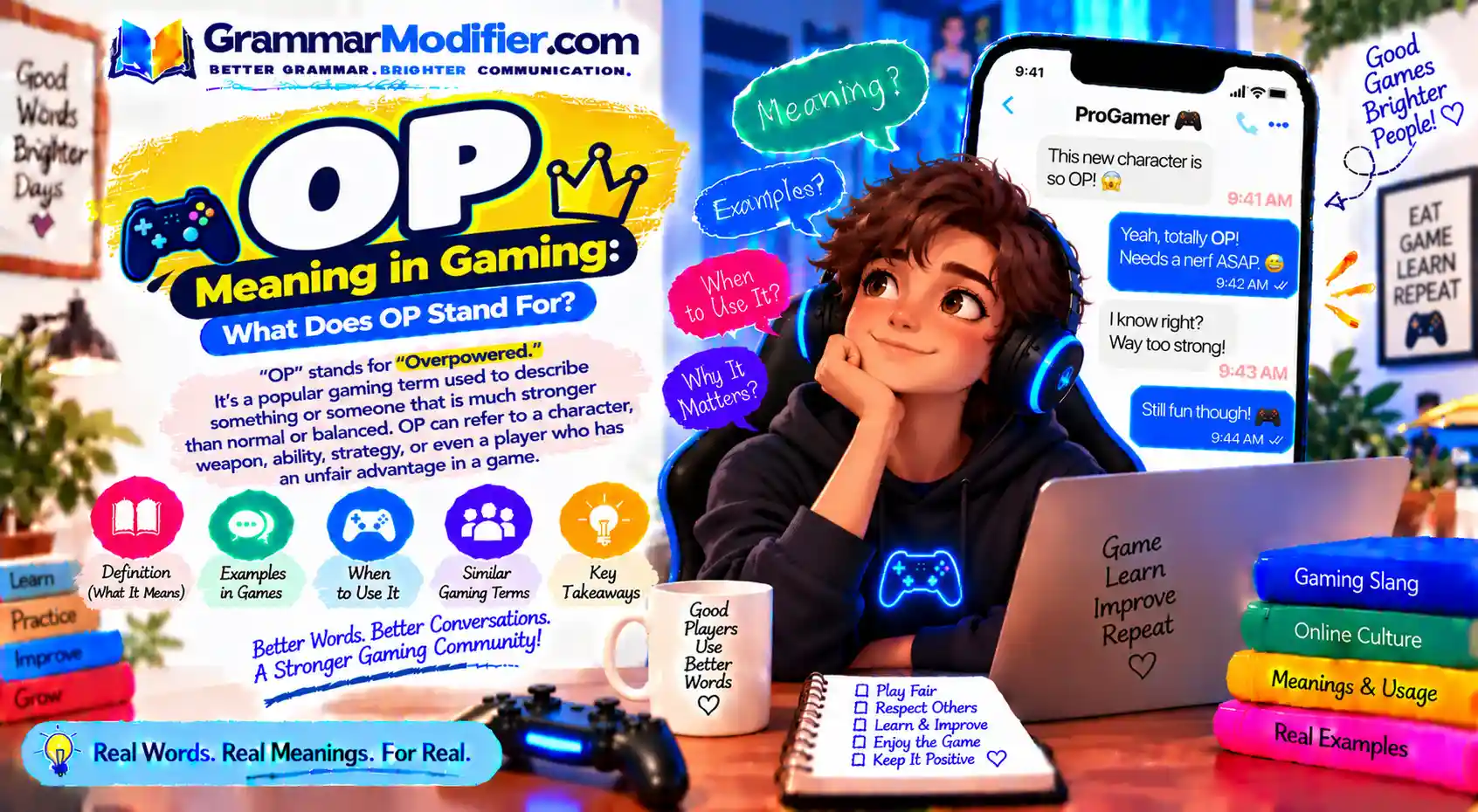
If you play online games, watch gaming streams, or read game chat, you’ve probably seen OP used to describe something powerful. In gaming, OP usually means “overpowered,” referring to something that seems much stronger than comparable options.
The term can describe a character, weapon, ability, item, build, strategy, or game mechanic. You’ll also learn how OP differs from related terms and how to tell when OP means something else online.
Quick Answer
OP in gaming means “overpowered.” Gamers use it when a game element seems disproportionately strong, difficult to counter, or unusually effective compared with other available choices. Epic Games uses OP in this same sense for an in-game element that is stronger than it should be.
TL;DR
- OP usually means “overpowered” in gaming.
- It can describe characters, weapons, abilities, items, or strategies.
- OP does not simply mean “good” or “strong.”
- Nerf means reducing something’s power.
- Buff means increasing something’s power.
- Meta and OP describe different ideas.
- On forums, OP can mean “original poster.”
What Does OP Mean in Gaming?
In gaming, OP is short for “overpowered.” Players use it when something appears far more effective than similar choices.
Epic Games defines OP as something that is stronger than it should be, including a character, weapon, or other in-game element. Gaming terminology sources similarly connect OP with balance problems in both PvP and PvE games.
For example:
- “That character is OP.” — The character seems excessively powerful.
- “This build is OP.” — The combination performs unusually well.
- “That ability is OP.” — The ability provides an unusually large advantage.
- “This update made the weapon OP.” — A recent change appears to have increased its power too much.
What Does Overpowered Mean in Gaming?
Overpowered means something has more power or effectiveness than players think it should have. The comparison usually involves other choices available in the same game.
Being powerful does not automatically make something OP. A strong character may still have clear weaknesses, counters, or trade-offs.
Something is more likely to be called OP when it:
- Performs much better than similar choices.
- Dominates many situations.
- Has very few effective counters.
- Produces unusually strong results with little effort.
- Makes alternative choices feel less useful.
- Creates balance concerns in competitive play.
The exact meaning is subjective because players may disagree about whether something is truly overpowered.
How Gamers Use OP in Chat
OP is informal gaming slang, so it appears frequently in game chat, Discord conversations, streams, forums, and discussions about patches or balance.
The word normally describes the thing being discussed rather than the player using it.
Common examples include:
- “That sword is OP.”
- “The new hero looks OP.”
- “This build is completely OP.”
- “That boss is OP for this level.”
- “They need to nerf this ability.”
The surrounding words usually make the meaning obvious. If OP follows a character, weapon, skill, or build, it almost certainly means overpowered.
What Can Be OP in a Game?
Almost any game element can be described as OP if players believe it has an excessive advantage.
Common examples include:
- Characters or heroes
- Weapons and equipment
- Abilities and skills
- Items and upgrades
- Classes or character builds
- Strategies and tactics
- Combos
- Game mechanics
- Bosses or enemies
Hitmarker notes that characters, weapons, and skills are common examples of things players may label OP.
OP Characters and Classes
An OP character is a character that seems substantially stronger than other available choices.
The problem might come from unusually high damage, strong defenses, powerful abilities, mobility, or a combination of several advantages.
For example:
“This character is OP because it wins too many matchups with very little counterplay.”
That explanation is more precise than simply saying the character is “really good.”
A character can also become OP after a patch or balance update changes its abilities.
OP Weapons, Items, and Abilities
Weapons and abilities are frequently called OP when their performance seems out of line with comparable options.
A weapon might be considered OP because of its damage, accuracy, range, speed, or versatility. An ability might feel OP because it combines high impact with a short cooldown or limited counterplay.
For example:
“That ability is OP because it deals huge damage and comes back too quickly.”
The important point is that OP describes perceived balance, not simply high power.
OP Builds and Strategies
An OP build is a combination of equipment, abilities, attributes, or other choices that produces unusually strong results.
A strategy can also become OP when it consistently succeeds against many opponents or situations.
For example:
“This build is OP after the latest patch.”
That sentence suggests the current version of the game has made the combination unusually effective.
Because games change through patches, an OP build can stop being OP after developers adjust its strongest components.
OP vs. Strong: What’s the Difference?
Strong and OP are related, but they aren’t identical.
A strong character can perform very well while still having weaknesses and reasonable counters. OP usually suggests that the strength has gone beyond what players consider balanced.
| Term | Meaning |
|---|---|
| Strong | Performs well but can remain balanced |
| OP | Seems disproportionately powerful |
| Broken | Often suggests an extreme balance or gameplay problem |
| Meta | Currently effective or commonly used in the game’s environment |
For example, saying “This character is strong” is generally milder than saying “This character is OP.”
OP vs. Broken: What’s the Difference?
Gamers sometimes use OP and broken interchangeably, but the words can carry different shades of meaning.
OP usually focuses on excessive power. Broken can suggest that something is so unbalanced that it seriously damages normal gameplay.
The distinction isn’t universal. Gaming communities use these terms differently.
For example:
“The weapon is OP.”
It is considered too powerful.
“The weapon is broken.”
The speaker suggests its behavior or balance is severely problematic.
Both statements are informal judgments, not official technical classifications.
OP vs. Meta: What’s the Difference?
OP and meta are not synonyms.
The meta refers to strategies, characters, builds, or choices that are currently effective or widely used within a game’s competitive environment.
Something can be meta without being OP.
For example:
“This character is meta because competitive players use it frequently.”
That doesn’t automatically mean:
“This character is OP.”
The second statement makes a stronger claim about excessive power.
OP vs. Buff and Nerf
A buff makes a game element stronger, while a nerf makes it weaker.
These terms often appear alongside OP because balance changes can affect whether something feels overpowered.
For example:
“The developer buffed the character, and now players think it’s OP.”
Or:
“The weapon was OP, so the latest patch nerfed it.”
The relationship is simple:
- Buff = increase in power
- Nerf = decrease in power
- OP = considered excessively powerful
OP and Game Balance
Game balance is the broader idea behind many OP discussions.
When different characters, weapons, abilities, or strategies have meaningful strengths and weaknesses, players have more reasons to make different choices.
An OP element can attract attention when it becomes so effective that many players prefer it over alternatives.
That doesn’t mean every complaint about OP balance is objectively correct. Players can disagree because skill levels, game modes, patches, and personal playstyles affect how powerful something feels.
Is OP the Same as Cheating?
No. Calling something OP does not mean it is cheating.
A character, weapon, or ability can be completely legitimate and still be considered overpowered.
For example, if a developer releases a weapon that is available to every player but gives an unusually large advantage, players might call it OP. That describes its perceived strength, not whether it violates the rules.
This distinction is especially useful when reading competitive gaming discussions.
How Do You Know Which Meaning of OP Is Intended?
Context tells you which meaning is most likely.
In gaming, OP usually means “overpowered.” In online forums, OP commonly means “original poster,” the person who created the discussion.
Compare these examples:
“That character is OP.”
Gaming context → overpowered
“OP replied to the comments.”
Forum context → original poster
Reddit’s official help documentation uses OP to refer to the original poster in a discussion.
So, don’t assume that OP always has one meaning. Look at what the sentence is talking about.
Common OP Examples in Gaming
Seeing OP in realistic sentences makes the slang easier to recognize.
OP for a Character
“That hero is OP after the latest update.”
The player thinks the hero has become too powerful.
OP for a Weapon
“This weapon is OP at close range.”
The weapon seems unusually effective in that situation.
OP for an Ability
“That ability is OP because it has almost no counter.”
The player is criticizing its balance.
OP for a Build
“Everyone is using this OP build.”
The combination is currently considered extremely effective.
OP as Excited Praise
“This sword is OP! I love it.”
Here, OP can sound positive because the speaker enjoys how powerful the item feels.
Is OP Positive or Negative?
OP can be positive, negative, or mixed depending on context.
A player may use OP as a complaint:
“That character is OP and needs a nerf.”
Another player may use the same term as praise:
“This build is OP. It’s so much fun.”
The word itself mainly communicates excessive or unusually high power. The speaker’s attitude comes from the rest of the sentence.
How to Use OP Correctly
Use OP mainly in informal gaming conversations. It works naturally when talking about game balance, characters, weapons, abilities, builds, and strategies.
For clearer communication:
- Use OP in casual gaming chat.
- Use overpowered in formal or educational writing.
- Check the context before interpreting OP.
- Don’t treat every strong game element as OP.
- Remember that OP can mean original poster outside gaming.
- Use specific explanations when discussing balance.
Instead of writing:
“That character is OP.”
A more informative statement is:
“That character is OP because its damage is high, its defensive tools are strong, and it has few reliable counters.”
That gives readers a reason behind the claim.
FAQs
What does OP mean in gaming?
OP means “overpowered” in gaming. It describes a character, weapon, ability, item, build, strategy, or other game element that seems disproportionately powerful.
Does OP mean good in gaming?
Not exactly. OP means overpowered, while “good” can simply mean effective, useful, or enjoyable.
A player might praise an OP item, while another player might complain that the same item damages game balance.
Is OP the same as meta?
No. Meta refers to choices that are currently effective or common within a game’s competitive environment. OP suggests that something is excessively powerful.
A character can be meta without everyone agreeing that it is OP.
What is an OP character?
An OP character is one that players consider unusually powerful compared with other characters.
Its advantage might come from damage, defense, mobility, abilities, or strong matchups.
What is the difference between OP and nerf?
OP describes excessive power, while a nerf reduces power.
If players consider a character OP, developers might later nerf its damage, abilities, cooldowns, or other mechanics.
Can a weapon be OP without being cheating?
Yes. A weapon can be an official part of a game and still be considered OP.
OP describes perceived strength or balance. Cheating refers to breaking game rules or using unauthorized advantages.
Can OP mean something besides overpowered?
Yes. OP can mean “original poster” in forums and online discussions. Reddit officially uses the abbreviation in this sense.
Conclusion
OP meaning in gaming is straightforward: OP usually stands for “overpowered.” Gamers use it when a character, weapon, ability, build, strategy, or other game element seems unusually strong compared with available alternatives.
Remember the key distinction: strong doesn’t always mean OP, and OP doesn’t automatically mean cheating. When you see the term, look at the game context and the speaker’s explanation. For related gaming slang, learning terms such as buff, nerf, meta, broken, AFK, GG, and GLHF can make game chats much easier to understand.