
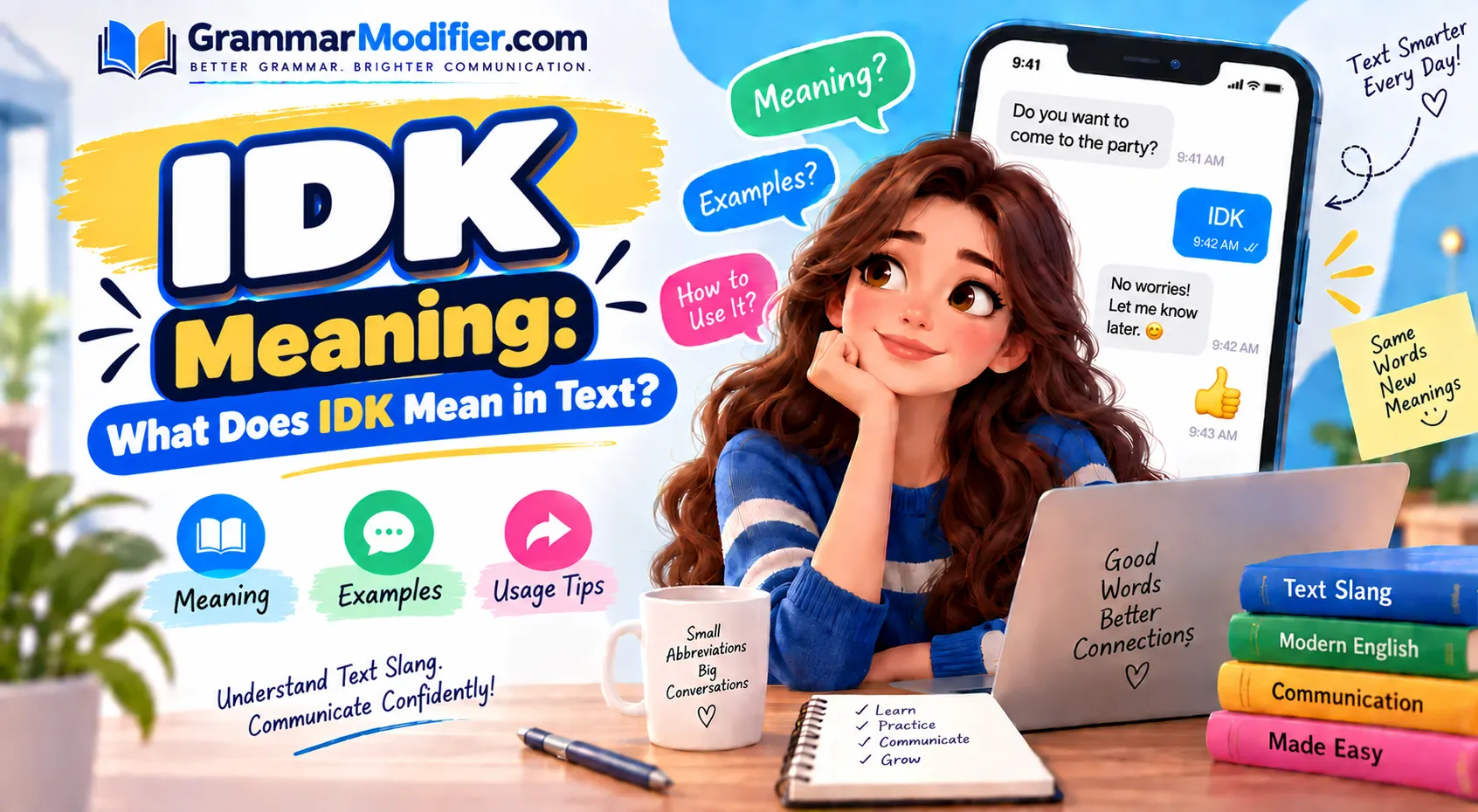
If you have seen IDK in a text message, comment, or group chat, it means “I don’t know.” People use this informal abbreviation when they lack information, feel uncertain, or have not made a decision.
This guide explains how IDK works in real conversations. You’ll learn how to use it naturally, understand different tones, reply politely, and choose the full phrase when writing for school or work.
Quick Answer
IDK means “I don’t know.” It is an informal abbreviation commonly used in text messages, social media, and casual online conversations.
TL;DR
- IDK means “I don’t know.”
- It is mainly used in casual writing.
- Lowercase “idk” has the same meaning.
- Tone depends on the surrounding words.
- “IDK yet” means the answer is not known now.
- Use “I don’t know” in formal writing.
What Does IDK Stand For?
IDK stands for “I don’t know.” The abbreviation uses the first letters of the three words: I, D, and K.
The phrase can express several related ideas. A person may not have the information, may feel unsure, or may not want to make a decision yet.
For example:
- “IDK where she went.” — The sender does not know her location.
- “IDK what to choose.” — The sender is undecided.
- “IDK, maybe tomorrow.” — The sender is uncertain about the timing.
IDK Meaning in Texting
In texting, IDK is a quick way to answer a question or show uncertainty. It can appear by itself or inside a longer sentence.
The abbreviation does not always mean the sender is unwilling to help. Sometimes the person simply has not checked the answer.
- “IDK what time it starts.”
- “IDK. Let me ask.”
- “IDK if I can come.”
- “IDK where my phone is.”
- “IDK what happened.”
- “IDK, you decide.”
- “IDK the answer yet.”
- “IDK, but I can find out.”
Why Do People Use IDK?
People use IDK for more than one reason. The most common purpose is to show that they do not have enough information.
It can also make a message sound less forceful. Saying “IDK, maybe we should wait” sounds more tentative than “We should wait.”
Common uses include:
- Showing a lack of knowledge
- Expressing uncertainty
- Showing indecision
- Avoiding a definite answer
- Giving a quick response
- Softening an opinion
- Asking someone else to decide
- Admitting that more information is needed
Can IDK Mean “I’m Not Sure”?
Yes. In many conversations, IDK means “I’m not sure” rather than a complete lack of knowledge.
For example, “IDK if that will work” shows doubt about a possible result. The sender may have some information but still cannot give a confident answer.
Compare these examples:
- “IDK where the store is.” — The sender lacks the information.
- “IDK if the store is open.” — The sender is uncertain.
- “IDK what to order.” — The sender cannot decide.
- “IDK, that sounds strange.” — The sender is expressing a cautious opinion.
How Punctuation Changes IDK’s Tone
Punctuation can influence how a short message feels. It does not change the basic meaning, but it may suggest hesitation, impatience, or friendliness.
Read the whole message before deciding what the sender intends.
- “IDK.” — Brief and possibly abrupt
- “idk lol.” — Relaxed or playful
- “IDK yet.” — The answer may come later
- “IDK…” — Hesitation or uncertainty
- “IDK, I’ll check.” — Helpful and cooperative
- “IDK, you decide.” — Uncertainty or lack of preference
- “IDK, whatever.” — May sound impatient
- “IDK, sorry.” — A softer and more polite reply
IDK Examples in Everyday Conversations
IDK is common in casual conversations with friends, classmates, and online contacts. The surrounding words often reveal whether the sender is confused, undecided, or simply answering quickly.
Here are realistic examples:
- Alex: “Are you coming tonight?”
Sam: “IDK yet. I’ll let you know.” - Alex: “Who took my notebook?”
Sam: “IDK. It was already missing.” - Alex: “Which movie should we watch?”
Sam: “IDK, you choose.” - Alex: “Can you finish this today?”
Sam: “IDK if I’ll have enough time.” - Alex: “Why is the website down?”
Sam: “IDK, but I can check.” - Alex: “Do you like this design?”
Sam: “IDK. It looks okay to me.”
What Does Lowercase “idk” Mean?
Lowercase idk means the same thing as uppercase IDK. Texting often uses lowercase letters because messages are informal and quick.
There is no fixed difference between these forms:
- IDK
- idk
- Idk
Capital letters may make a message look more direct, while lowercase letters may feel more relaxed. However, this is a style impression, not a strict grammar rule.
Is IDK an Abbreviation or Initialism?
IDK is generally described as an abbreviation for “I don’t know.” More specifically, it is formed from the initial letters of the words.
Some people use the word acronym for any shortened expression. In careful language discussions, an acronym is usually pronounced as a word, while an initialism is pronounced letter by letter.
IDK is normally read as the separate letters I-D-K, so “initialism” is the more precise term. For everyday texting, though, calling it an abbreviation is completely understandable.
Is IDK Formal or Informal?
IDK is informal. It works well in text messages, casual chats, comments, and friendly emails.
Use the full phrase “I don’t know” in essays, reports, job applications, business emails, and other formal writing. The complete wording is clearer and more appropriate for professional readers.
- Casual: “IDK when the meeting starts.”
- Formal: “I don’t know when the meeting starts.”
- Casual: “IDK if I can attend.”
- Formal: “I’m not sure whether I can attend.”
- Casual: “IDK what caused the problem.”
- Formal: “I do not know what caused the problem.”
Can IDK Sound Rude or Dismissive?
IDK is not automatically rude. However, a one-word response may sound dismissive if the other person expects a thoughtful answer.
Adding a few words can make the message more helpful. Compare the difference:
- “IDK.” — Very brief
- “IDK, but I’ll check.” — Helpful
- “IDK yet.” — Honest and open-ended
- “IDK, sorry.” — Polite
- “IDK, whatever.” — Possibly annoyed
- “I’m not sure. Can we check?” — Cooperative
IDK Compared With IDC, NGL, and TBH
IDK is often confused with other texting abbreviations. These expressions have different meanings and should not be used interchangeably.
- IDK: “I don’t know”
“IDK where he went.” - IDC: “I don’t care”
“IDC which restaurant we choose.” - NGL: “Not gonna lie”
“NGL, that was surprising.” - TBH: “To be honest”
“TBH, I need more time.” - I’m not sure: A fuller and more formal way to express uncertainty
- I have no idea: A stronger expression of not knowing
- Dunno: Another informal form of “don’t know”
The key difference is simple: IDK concerns knowledge, while IDC concerns interest or concern.
How to Reply to IDK
The best reply depends on what the person does not know. You can offer help, ask a follow-up question, or give them time to find the answer.
Useful responses include:
- “No worries.”
- “Let’s find out.”
- “I’ll check.”
- “Who might know?”
- “Can you ask someone?”
- “Same here.”
- “Take your time.”
- “Let me know when you find out.”
If the sender says “IDK what to choose,” you might reply, “Which option do you prefer?” If they say “IDK where it is,” you can offer to help search.
Common Mistakes With IDK
Most mistakes involve using IDK in a setting that requires formal language or adding unnecessary spaces between the letters.
Keep the abbreviation connected and make the surrounding sentence clear.
- Too casual: “IDK the answer.”
Better for formal writing: “I don’t know the answer.” - Incorrect spacing: “I D K what happened.”
Better: “IDK what happened.” - Unclear reply: “IDK maybe.”
Better: “I’m not sure. Maybe tomorrow.” - Abrupt response: “IDK.”
Friendlier: “IDK, but I can check.” - Too informal for a report: “IDK why sales changed.”
Better: “The reason for the change is unknown.” - Overuse: “IDK, IDK, IDK.”
Better: “I’m not sure what to say.”
Does IDK Have Other Meanings?
In ordinary texting, IDK almost always means “I don’t know.” This is the meaning most readers will expect in messages and social media posts.
A different meaning may appear in a company name, organization, username, or specialized context. If the surrounding message does not make sense, check the full conversation before assuming the abbreviation has another meaning.
When Should You Write “I Don’t Know” Instead?
Write “I don’t know” when the audience may not understand texting abbreviations or when the message needs a professional tone.
The full phrase is suitable for school assignments, workplace communication, customer service, applications, and formal documents.
Use these alternatives when appropriate:
- “I don’t know.”
- “I’m not sure.”
- “I’m uncertain.”
- “I don’t have that information.”
- “I’ll need to check.”
- “I’m not certain yet.”
- “That information is unavailable to me.”
- “Let me confirm the details.”
FAQs
What does IDK mean from a friend?
IDK usually means “I don’t know.” Your friend may lack information, feel uncertain, or need more time to decide.
The tone depends on the message. “IDK, I’ll check” sounds more helpful than a reply containing only “IDK.”
Is IDK a bad word?
No. IDK is not a swear word or an offensive expression. It is an informal abbreviation.
It may sound dismissive in some situations, but the abbreviation itself is not rude.
What does “IDK yet” mean?
“IDK yet” means “I don’t know yet.” The person does not have an answer now but may know later.
A natural reply is, “No problem. Let me know when you find out.”
Is IDK proper English?
IDK is accepted as informal digital language. It is common in texting and casual online communication.
For formal writing, use “I don’t know” or “I’m not sure” instead.
What is the difference between IDK and IDC?
IDK means “I don’t know.” IDC means “I don’t care.”
Use IDK when you lack information. Use IDC when the answer does not matter to you.
How should I reply when someone says IDK?
You can say “No worries,” “Let’s find out,” or “I’ll check.” The best response depends on the question.
If the person seems unsure, offer help. If they need time, give them space to respond later.
Conclusion
IDK meaning is straightforward: it is an informal abbreviation for “I don’t know.” People use it in texts, comments, group chats, and casual online conversations.
Use IDK with people who understand informal messaging. For school, work, and professional communication, write the complete phrase instead. To practice, compare short replies such as “IDK,” “IDK yet,” and “IDK, I’ll check” to see how context changes tone.
Read More: