
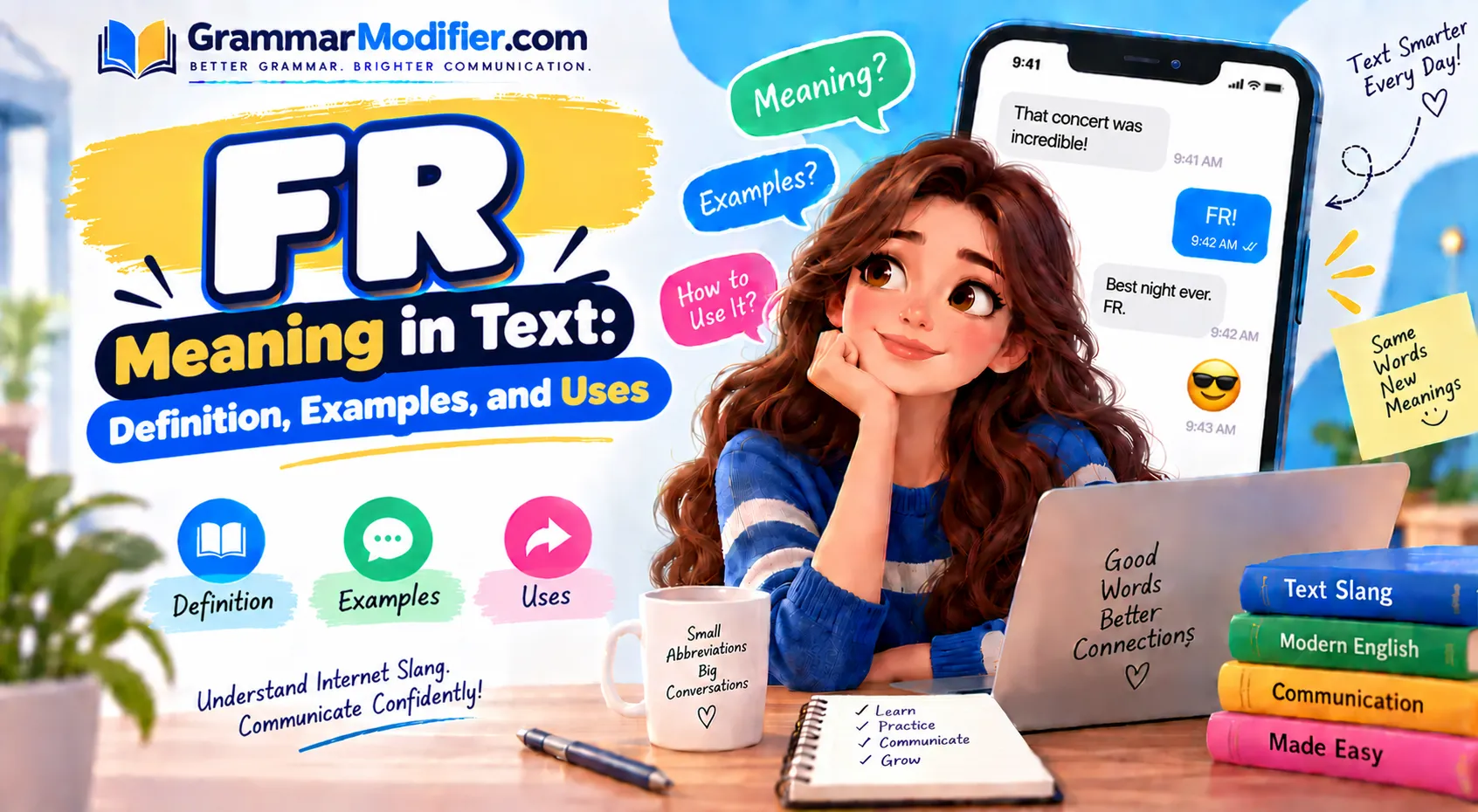
If you have searched for FR Meaning in Text, you may have seen the abbreviation in a message, comment, or group chat. In most casual online conversations, FR means “for real.” It can show agreement, sincerity, emphasis, surprise, or disbelief.
This guide explains how FR works in everyday texting and social media conversations. You will learn the difference between FR, FR?, FR!, and FRFR, along with practical examples and formal alternatives. The goal is to help you understand the message without guessing at the wrong tone.
Quick Answer
FR usually means “for real” in text messages and online conversations. It can mean “I agree,” “seriously,” “honestly,” or “is that true?” depending on the context and punctuation.
TL;DR
- FR usually stands for “for real.”
- A standalone FR often means “I agree.”
- FR at the end adds emphasis.
- FR? can mean “Really?”
- FRFR means “for real, for real.”
- FR is informal texting language.
What Does FR Mean?
In texting slang, FR means “for real.” It is a shortened form of the phrase people use to show that something is true, serious, or genuinely felt.
For example, if someone writes, “That exam was exhausting,” a reply of “FR” usually means “I agree” or “Seriously.” The abbreviation confirms the other person’s experience.
The meaning is usually clear from the message around it. A standalone FR often reacts to another person, while FR placed after a sentence emphasizes the writer’s own statement.
What Does FR Stand For?
FR stands for “for real.” The letters come from the first letters of for and real.
The full phrase is an informal expression connected with truth, seriousness, or genuine feelings. In digital communication, FR makes the phrase shorter and faster to type.
Examples include:
- “FR, I agree with you.”
- “That was difficult fr.”
- “Are you fr?”
- “I’m tired fr.”
Although FR is commonly used online, it is not limited to one app or one age group. It appears in casual texts, comments, direct messages, and online chats.
FR Meaning in Texting
In text messages, FR usually works as a quick reaction or emphasis marker. It can replace expressions such as “seriously,” “exactly,” “honestly,” or “I agree.”
Consider these examples:
- “This week has been so stressful.”
- “FR.”
Here, FR means “I know, right?” or “I agree.”
Now compare it with this sentence:
“This week has been so stressful fr.”
In this example, FR emphasizes the writer’s own feeling. It means the person is genuinely stressed, not simply exaggerating.
Why Do People Use FR?
People use FR because it communicates agreement or seriousness in only two letters. It is especially useful in fast, informal conversations where a complete sentence is not necessary.
Common uses include:
- Agreeing with someone’s opinion.
- Confirming that a statement is true.
- Emphasizing a personal feeling.
- Showing that a person is serious.
- Reacting to surprising information.
- Supporting someone’s experience.
- Expressing strong approval.
- Making a short comment feel more sincere.
FR can also make a message sound more conversational. However, its tone depends on the surrounding words, punctuation, and relationship between the speakers.
FR for Agreement and Sincerity
A standalone FR commonly expresses agreement. It tells the other person that the writer shares the same opinion or experience.
For example:
A: “That movie was way too long.”
B: “FR.”
B is agreeing with A.
FR can also show sincerity when it follows a statement:
- “I really need a break fr.”
- “That was the best part fr.”
- “I’m not ready for Monday fr.”
- “You explained it perfectly fr.”
In these examples, FR adds the meaning “I genuinely mean this.” It does not always mean that the writer is making a serious announcement. Sometimes it simply adds emphasis to a casual opinion.
How Context Changes FR’s Tone
FR can sound supportive, excited, doubtful, or impatient. The meaning is usually connected to what came before it.
Compare these uses:
- “FR.” — agreement.
- “FR?” — surprise or doubt.
- “FR!” — excited agreement.
- “You did that fr?” — disbelief.
- “Okay, fr.” — seriousness or impatience.
- “That was funny fr.” — sincere emphasis.
The relationship between the people also matters. A close friend may use FR playfully, while the same message from someone unfamiliar may sound blunt.
FR Versus FR?
The difference between FR and FR? is mainly the punctuation.
FR usually confirms or agrees with something:
“This homework is confusing.”
“FR.”
FR? usually asks for confirmation:
“I got tickets to the concert.”
“FR?”
The second person may be asking, “Really?”, “Are you serious?”, or “Did that actually happen?”
A question mark can therefore change FR from an agreement into a question. The surrounding message determines whether the question sounds excited, doubtful, or surprised.
FR at the Beginning, Middle, or End
FR can appear in different positions within a sentence.
At the beginning:
“FR, I was thinking the same thing.”
This usually introduces agreement.
In the middle:
“That was, fr, the funniest part.”
This adds emphasis to the sentence.
At the end:
“I need a vacation fr.”
This emphasizes the writer’s feeling.
As a complete reply:
“FR.”
This normally reacts to the previous message and means something like “Exactly” or “I agree.”
FR Examples in Real Conversations
Example 1: Agreement
A: “The traffic was terrible today.”
B: “FR.”
Meaning: B agrees.
Example 2: Strong emphasis
A: “I’m so tired.”
B: “Same, I barely slept fr.”
Meaning: B is emphasizing that the tiredness is genuine.
Example 3: Surprise
A: “I finished the whole project in one night.”
B: “FR?”
Meaning: B is surprised and wants confirmation.
Example 4: Sincere opinion
A: “Do you like this song?”
B: “FR, it’s one of my favorites.”
Meaning: B is giving an honest, enthusiastic opinion.
Example 5: Group chat agreement
A: “We should leave before the rain starts.”
B: “FR.”
C: “I’m grabbing my jacket now.”
Meaning: B agrees, and C is acting on the suggestion.
What Does Lowercase “fr” Mean?
Lowercase fr usually means the same thing as uppercase FR. Both normally stand for “for real.”
Lowercase writing often feels relaxed:
- “that was wild fr”
- “you’re right fr”
- “fr i forgot”
- “same fr”
Uppercase writing may add visual emphasis:
- “FR!”
- “FR??”
- “FR, EXACTLY.”
Capitalization does not create a completely different meaning. It mainly changes how strong or noticeable the message appears.
Is FR Formal or Informal?
FR is informal texting slang. It works best in casual conversations with friends, family members, classmates, and online communities.
It is usually not suitable for:
- Academic essays.
- Formal school assignments.
- Job applications.
- Business reports.
- Official emails.
- Customer-service messages.
- Professional documents.
Use a clearer expression in formal writing:
- “I agree.”
- “That is true.”
- “Seriously.”
- “In fact.”
- “I genuinely mean this.”
- “That was difficult.”
For example:
Casual: “That meeting was long fr.”
Professional: “That meeting was longer than expected.”
FR Compared With TBH, NGL, and Honestly
FR, TBH, NGL, and honestly can all express sincerity, but they are used differently.
| Expression | Usual meaning | Common function |
|---|---|---|
| FR | For real | Agreement or emphasis |
| TBH | To be honest | Introduces an honest opinion |
| NGL | Not gonna lie | Introduces a candid statement |
| Honestly | Honestly | Gives an opinion or emphasizes truth |
| No cap | No lie | Emphasizes that something is true |
Compare these sentences:
- “FR, that was difficult.”
- “TBH, that was difficult.”
- “NGL, that was difficult.”
- “Honestly, that was difficult.”
FR sounds more like agreement or emphasis. TBH and NGL more often introduce the speaker’s own opinion or admission.
What Does FRFR Mean?
FRFR means “for real, for real.” It repeats the idea of FR to add stronger emphasis.
Examples:
- “I’m serious frfr.”
- “That was the best game frfr.”
- “You need to rest frfr.”
- “I’m leaving early frfr.”
FRFR can sound sincere, dramatic, funny, or forceful. It is still informal and usually appears in texts, comments, group chats, and casual online conversations.
The difference is simple:
- FR: for real.
- FRFR: for real, for real.
- FRFR usually adds extra intensity.
What Does “Fr.” Mean Before a Name?
The form “Fr.” can have a different meaning when it appears before a person’s name. In religious contexts, it can be an abbreviation for “Father,” as in:
“Fr. Michael led the service.”
This meaning is different from the texting slang FR. Context and punctuation help distinguish them. A message such as “That was funny fr” uses slang, while “Fr. Michael” uses the title abbreviation.
FR can also represent other terms in specialized settings. If the message is about school, business, technology, or another field, do not automatically assume it means “for real.”
How to Reply to FR
Your reply depends on whether the person is agreeing, emphasizing a statement, or asking a question.
If someone sends FR as agreement, you can reply:
- “Exactly.”
- “Right?”
- “I know!”
- “That’s what I’m saying.”
- “Seriously.”
- “Same.”
- “No doubt.”
- “For real.”
If someone writes FR?, answer the question directly:
- “Yes, seriously.”
- “I’m not joking.”
- “Yeah, it really happened.”
- “No, I was exaggerating.”
- “I mean it.”
If the message is unclear, ask:
“Do you mean for real?”
That is often better than guessing.
When Should You Write “For Real” Instead?
Use the full phrase “for real” when the audience may not understand texting slang or when the message needs a more polished tone.
The full phrase is better in formal or unfamiliar situations:
“I’m being serious.”
“Do you really mean that?”
“I genuinely agree.”
“That was difficult, for real.”
FR is natural in casual messages, but “for real” is clearer when speaking to a teacher, employer, customer, or professional contact.
FAQs
What does FR mean from a friend?
FR usually means “for real.” Your friend may be agreeing with you, confirming a statement, or emphasizing that they feel the same way.
What does FR mean on TikTok or Snapchat?
On social media, FR normally means “for real.” It may appear in comments, captions, direct messages, and short reactions.
Is FR rude?
FR is not automatically rude. However, “FR?” or “bro, FR?” may sound skeptical or impatient depending on the conversation.
Is FR the same as FRFR?
FR means “for real,” while FRFR means “for real, for real.” FRFR adds stronger emphasis and may sound more intense.
Can I use FR in a work email?
FR is usually too casual for a formal work email. Use “I agree,” “That is true,” or “I understand” instead.
Does lowercase fr mean something different?
No. Lowercase fr and uppercase FR usually have the same meaning. Capitalization mainly changes the visual tone.
What does Fr. mean before a person’s name?
“Fr.” can mean “Father” when used before the name of a Christian priest. This is different from the slang use of FR in texting.
Conclusion
FR Meaning in Text is usually “for real.” People use it to agree with someone, emphasize a statement, show sincerity, or ask whether something is true.
The easiest way to understand FR is to check the surrounding message and punctuation. Use FR in relaxed conversations, and choose the full phrase “for real” when the audience may not understand slang or when the message needs a more formal tone.
Read More: