
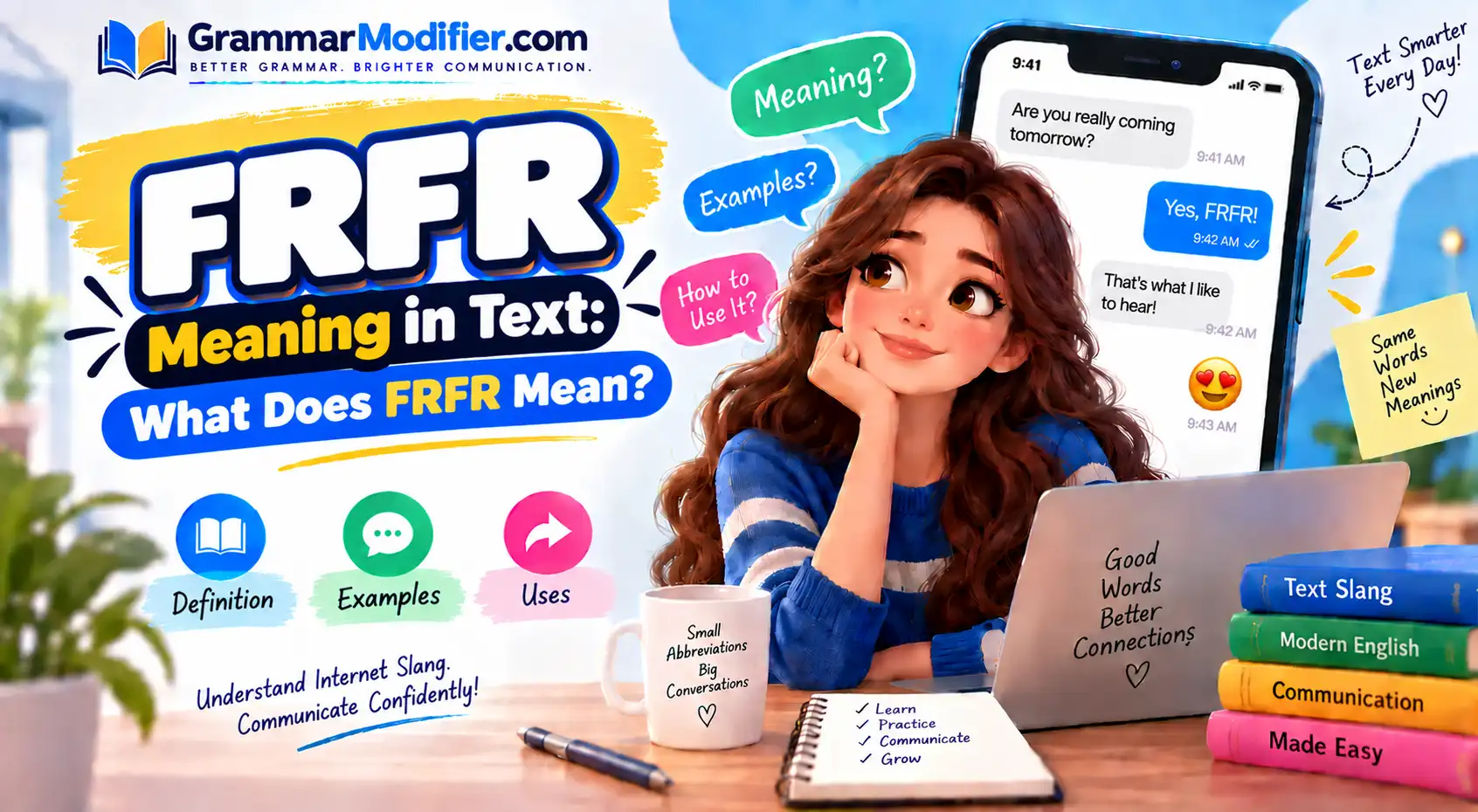
If someone sends you “FRFR,” they usually mean “for real, for real.” This informal abbreviation shows that the person is serious, sincere, or strongly agrees with something.
You may see FRFR in text messages, group chats, comments, gaming conversations, and social media posts. Its meaning is simple, but punctuation and surrounding words can change the tone.
Quick Answer
FRFR means “for real, for real.” It is casual texting slang used to add strong emphasis, express genuine feelings, confirm honesty, or show agreement. It is similar to saying “seriously,” “honestly,” or “I really mean it.”
TL;DR
- FRFR means “for real, for real.”
- It emphasizes honesty or strong agreement.
- FRFR is more emphatic than FR.
- FRFR? can express doubt or surprise.
- Lowercase “frfr” has the same meaning.
- Use formal alternatives in school or work writing.
What Does FRFR Stand For?
FRFR stands for “for real, for real.” The phrase repeats “for real” to make the message sound stronger.
The shorter form FR means “for real.” When someone repeats it as FRFR, they are adding extra emphasis. It is similar to repeating a word in speech:
“I’m really, really serious.”
People may pronounce FRFR as “for real, for real.” Some people read the letters aloud as “eff-ar-eff-ar,” but the full phrase explains the meaning more clearly.
FRFR Meaning in Texting
In texting, FRFR usually tells the reader that the sender genuinely means what they wrote. It can support an opinion, confirm a feeling, or show that someone is not joking.
For example:
“That was the best part of the trip frfr.”
The writer is not simply saying the trip was good. They are strongly emphasizing that the experience was their favorite part.
FRFR can also appear as a short reply:
Person A: “This week has been exhausting.”
Person B: “FRFR.”
Here, Person B means “I completely agree” or “Seriously, same.”
Why Do People Use FRFR?
People use FRFR to make a message feel more definite, emotional, or sincere. It does not usually introduce a new idea. Instead, it strengthens the idea already expressed.
Common purposes include:
- Showing strong agreement
- Emphasizing a personal opinion
- Confirming that a statement is serious
- Showing genuine appreciation
- Supporting a compliment
- Expressing frustration
- Making a dramatic statement sound playful
- Confirming that someone is not joking
Compare these two messages:
“You did a good job.”
“You did a great job frfr.”
The second message sounds more personal and emphatic.
FRFR for Agreement and Sincerity
FRFR often means “exactly,” “seriously,” or “I agree.” It can appear alone or after a complete sentence.
For agreement:
Friend A: “Getting out of bed on Monday is difficult.”
Friend B: “Frfr.”
For sincerity:
“I really appreciate your help frfr.”
The first example confirms agreement. The second emphasizes that the appreciation is genuine.
FRFR can also strengthen a promise or serious statement:
“I’m going to finish this project tonight frfr.”
This suggests that the speaker wants others to believe they are serious about their plan.
FRFR Versus FR
FR means “for real,” while FRFR means “for real, for real.” Both can express agreement, honesty, or emphasis.
The repeated form often sounds stronger:
| Expression | Usual meaning | Example |
|---|---|---|
| FR | For real; agreement or emphasis | “That movie was good fr.” |
| FRFR | For real, for real; stronger emphasis | “That movie was amazing frfr.” |
| FR? | Really? Are you serious? | “You finished already, fr?” |
| FRFR? | Seriously? Is that true? | “You won the contest frfr?” |
The difference is not always dramatic. Some people use FR and FRFR interchangeably in casual messages.
FRFR Versus FRFR?
Punctuation can change the purpose of the abbreviation. FRFR usually emphasizes a statement, while FRFR? often asks for confirmation.
Examples:
“You’re right frfr.”
This means the speaker strongly agrees.
“You’re right frfr?”
This may mean the speaker is surprised or asking whether the other person is serious.
The question mark can also show disbelief:
“They canceled the entire event frfr?”
The writer may be asking, “Did that really happen?”
How Punctuation Changes FRFR’s Meaning
Punctuation helps readers understand the emotion behind FRFR.
- “Frfr.” — Strong agreement or confirmation
- “Frfr!” — Excitement or extra emphasis
- “Frfr?” — Surprise, doubt, or a request for confirmation
- “I mean it frfr.” — Seriousness and sincerity
- “You did that frfr.” — Praise or approval
- “That was wild frfr.” — Strong reaction
- “Great, another test frfr.” — Possible sarcasm
The surrounding sentence still matters. Punctuation can suggest a tone, but it does not always determine it.
FRFR at the Beginning, Middle, or End
FRFR can appear in different positions within a casual sentence.
At the beginning:
“Frfr, you made the right decision.”
In the middle:
“I frfr thought you were joking.”
At the end:
“That was the funniest thing ever frfr.”
At the beginning, FRFR often introduces agreement or emphasis. In the middle, it strengthens the speaker’s claim. At the end, it adds force to the entire statement.
FRFR Examples in Real Text Conversations
Here are natural examples of how people may use FRFR:
- “That new song is stuck in my head frfr.”
- “Frfr, you handled that situation really well.”
- “I need a vacation frfr.”
- “You’re one of the kindest people I know frfr.”
- “Wait, they canceled the event frfr?”
- “This weather is exhausting frfr.”
- “I thought you were joking, but you were frfr serious.”
- “That was the best birthday surprise ever frfr.”
- “Frfr though, you should be proud of yourself.”
- “I’m never staying up that late again frfr.”
- “You remembered that? Thank you frfr.”
- “More homework? Exactly what I wanted today, frfr.”
These examples show that FRFR can express agreement, appreciation, seriousness, surprise, humor, or frustration.
What Does Lowercase “frfr” Mean?
Lowercase “frfr” has the same meaning as uppercase “FRFR.” The lowercase version often feels more relaxed because people commonly use lowercase text in casual conversations.
Compare:
“That was amazing FRFR.”
“that was amazing frfr”
Both messages mean that the writer strongly believes the experience was amazing. Capitalization may affect visual emphasis, but it does not normally change the definition.
You may also see the phrase written with spaces:
fr fr
This usually means the same thing as FRFR.
Is FRFR Formal or Informal?
FRFR is informal texting slang. It works well in casual conversations with friends, classmates, family members, and online communities.
It may sound out of place in:
- School essays
- Academic assignments
- Job applications
- Professional reports
- Formal emails
- Official requests
Instead of writing:
“I agree with the proposal frfr.”
Use:
“I completely agree with the proposal.”
Other formal alternatives include:
- “I genuinely agree.”
- “I am being serious.”
- “I truly mean this.”
- “I strongly agree.”
- “This is my honest opinion.”
FRFR on TikTok, Snapchat, and Social Media
FRFR may appear in comments, captions, direct messages, gaming chats, and group conversations. People often use it to react quickly to an opinion or show that a post reflects their own feelings.
For example:
“This semester has been so stressful frfr.”
A reply could be:
“Frfr, I’m ready for a break.”
The meaning remains connected to “for real, for real.” The platform does not usually change the definition, although the tone may be more playful in a meme or comment.
Is FRFR Rude, Sarcastic, or Flirty?
FRFR is not automatically rude, sarcastic, or flirty. The surrounding message determines how it sounds.
A sincere example:
“You’re a great friend frfr.”
A sarcastic example:
“Another surprise test? Perfect, frfr.”
A playful example:
“You really think you can beat me frfr?”
An affectionate example:
“I’m glad you’re in my life frfr.”
The abbreviation itself does not create a romantic or sarcastic meaning. It simply adds emphasis to the message.
Can FRFR Prove That Something Is True?
FRFR shows that someone believes or claims something strongly. It does not prove that the statement is factually correct.
For example:
“This is the best pizza in town frfr.”
The writer is strongly expressing a personal opinion. They are not providing evidence that every person would agree.
This distinction is useful when reading online comments. FRFR communicates confidence or sincerity, not objective proof.
How to Reply to FRFR
Your response should match the meaning and tone of the original message.
If you agree
“Exactly.”
“Frfr, you get it.”
If you feel the same way
“I feel the same.”
“Seriously, same.”
If you are surprised
“Wait, seriously?”
“You’re being serious?”
If the message is funny
“Finally, someone understands me.”
“That’s exactly how I feel.”
If you need clarification
“Do you mean that seriously?”
“Are you being for real?”
You do not need to use FRFR in your reply. A normal sentence is often the clearest response.
When Should You Write “For Real, For Real” Instead?
Use the full phrase when the reader may not understand texting slang. It is also better when clarity matters more than speed.
The full phrase can work in a serious conversation:
“I’m being honest with you, for real.”
For school, work, or formal writing, choose a clearer alternative:
- “Seriously”
- “Genuinely”
- “Honestly”
- “I truly mean it”
- “I completely agree”
FRFR is best for relaxed communication. The full phrase is more accessible to readers who are unfamiliar with online abbreviations.
FAQs
Does FRFR mean the same thing as FR?
FR means “for real.” FRFR means “for real, for real,” so it often adds stronger emphasis.
Both expressions can show agreement, honesty, or seriousness.
What does FRFR mean by itself?
When used alone, FRFR usually means “I completely agree” or “That is very true.”
The previous message helps determine the exact meaning.
What does FRFR mean with a question mark?
“FRFR?” usually means “Really?” or “Are you serious?”
It may express surprise, doubt, or a request for confirmation.
Is FRFR a bad word?
No. FRFR is not a swear word. It is informal slang used to express sincerity, agreement, or emphasis.
The rest of the sentence can still sound rude or sarcastic, depending on the context.
Can FRFR be used in formal writing?
FRFR is usually too casual for formal writing.
Use “seriously,” “genuinely,” “I agree,” or “I truly mean it” instead.
Is FRFR stronger than FR?
Usually, yes. Repeating “for real” adds emphasis, although some people use FR and FRFR in the same way.
Does FRFR mean “I love you”?
Not by itself. FRFR can appear in an affectionate message, but the surrounding words determine whether the message is romantic, friendly, or serious.
Conclusion
FRFR means “for real, for real.” People use it in casual messages to emphasize honesty, agreement, seriousness, or genuine emotion. It is a stronger and more expressive version of FR, which means “for real.”
When you see FRFR, read the entire message before deciding on the tone. It may express sincere agreement, excitement, humor, doubt, or sarcasm. Use it naturally in casual conversations, and choose clearer alternatives in formal writing.
Read More: