
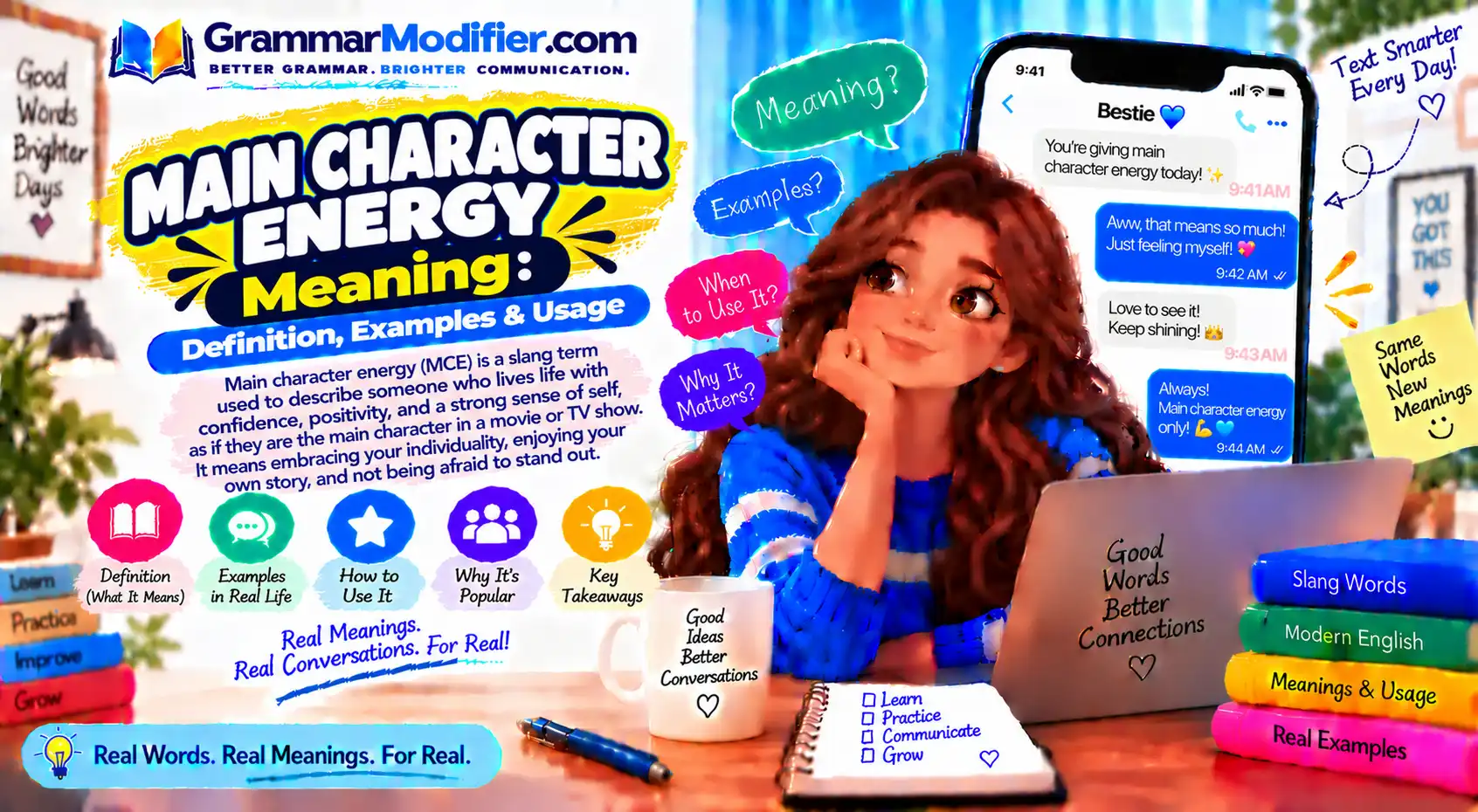
“Main Character Energy” describes a confident attitude where someone carries themselves as if they are the central character in their own life. It often suggests self-confidence, independence, and embracing memorable moments.
In this guide, you’ll learn the Main Character Energy meaning, see real-life examples, and discover how to use the phrase naturally in texts, conversations, and social media.
Quick Answer
Main character energy is an informal expression for behaving or carrying yourself like the central character in your own life story. It usually suggests confidence, self-assurance, individuality, and intentional living, but it can also criticize someone who seems overly self-centered.
In everyday American English, the phrase is common in texting, social media, captions, and casual conversation. The meaning depends heavily on tone and context.
TL;DR
• Main character energy means confident, noticeable self-expression.
• It comes from the idea of being life’s protagonist.
• The phrase is informal internet slang.
• It is often positive or playful.
• It can also describe excessive self-focus.
• Context determines whether it sounds flattering or critical.
What Does Main Character Energy Mean?
Main character energy describes an attitude that makes someone seem like the protagonist of their own story. Think of the person who walks through an ordinary day with confidence, purpose, and a strong sense of individuality.
The phrase is usually figurative. Someone does not literally believe they are inside a movie. Instead, they may treat ordinary experiences as meaningful, cinematic, or worth enjoying. Dictionary.com describes the expression as prioritizing yourself and your happiness, while Cambridge Dictionary connects the related social-media term main character with feeling confident, interesting, and important.
For example:
• “She booked a solo trip and came back with serious main character energy.”
• “Walking through the city with headphones on gave him main character energy.”
• “Her confidence during the presentation was pure main character energy.”
The phrase can also be critical:
“He has so much main character energy that he forgets other people are in the room.”
Here, the speaker is suggesting self-centered behavior, not healthy confidence.
Is Main Character Energy a Compliment?
Usually, yes, when someone uses it to describe confidence, independence, self-expression, or enjoying life. Dictionary.com notes that the phrase is generally positive when people use it about themselves or someone they admire.
However, main character energy is not automatically positive. A speaker can use it jokingly or negatively when someone behaves as though everyone else is merely part of their story.
| Context | Likely Meaning |
|---|---|
| Solo trip | Independence and confidence |
| New outfit | Confidence and personal style |
| Personal achievement | Pride and self-belief |
| Dramatic photo | Playful or cinematic mood |
| Constantly seeking attention | Possible criticism |
| Ignoring other people | Excessive self-focus |
A useful rule is simple: if the phrase celebrates someone’s confidence, it is positive; if it criticizes their treatment of others, it is negative.
What Does Main Character Energy Mean in Texting?
In texting, main character energy is usually a short way to comment on someone’s confidence, appearance, decision, or mood. It can work as a compliment, joke, reaction, or playful tease.
The phrase is flexible because texting often leaves tone to context. Emojis, punctuation, previous messages, and the relationship between the speakers can all affect how the phrase sounds.
Natural examples include:
• “You actually booked the trip? Main character energy.”
• “That outfit is giving main character energy.”
• “Okayyy, main character!”
• “I got coffee, put on headphones, and walked home like I was in a movie.”
• “That was such a main character moment.”
• “You really walked into the meeting like the main character.”
If someone texts “main character energy fr”, “fr” means “for real.” The whole message usually means the person genuinely thinks the situation looks confident, dramatic, or impressive.
Main Character Energy on TikTok and Social Media
The expression became closely associated with TikTok and social-media culture around 2020. People began presenting ordinary activities as cinematic moments, often using music, carefully framed videos, and captions about being the protagonist of their own lives. Dictionary.com dates the social-media emergence of the main-character concept to 2020, while reporting from the period documents the growth of related TikTok trends.
That culture helped give the phrase a broader meaning. A coffee run, train ride, walk through a city, solo trip, outfit, workout, or personal achievement could become a main character moment.
Common social-media contexts include:
• Solo travel videos
• Outfit photos and videos
• “Get ready with me” content
• Personal achievement posts
• Cinematic walks or sunsets
• New beginnings and life changes
• Confidence-focused captions
• Humorous everyday situations
The phrase is not limited to TikTok. It also appears in Instagram posts, captions, comments, memes, and casual online conversations.
Where Did Main Character Energy Come From?
The expression is built around the familiar storytelling idea of a main character, or protagonist. In fiction, the main character occupies the central role in a story. Online, that idea became a metaphor for treating your own life as the story in which you have the leading role.
The specific social-media trend grew strongly around 2020, particularly through TikTok culture. Dictionary.com records examples of the phrase from July 2020 and describes its development from the social-media use of main character.
The trend was closely connected with ideas such as romanticizing your life, noticing small experiences, and taking a more intentional approach to everyday activities. That does not mean every use is serious. The phrase is often deliberately exaggerated for humor.
Main Character Energy Examples in Real Life
The easiest way to understand this slang is to compare situations where the same phrase has different meanings.
Positive examples
“She started a new job and walked into her first day with main character energy.”
Here, the phrase praises confidence and a willingness to embrace a new experience.
“He took himself out for dinner and looked completely comfortable alone.”
This can suggest independence and self-confidence.
Playful examples
“I bought an expensive coffee and walked around downtown like I was in a movie.”
Here, the phrase is humorous. The speaker is exaggerating an ordinary experience.
Critical examples
“He interrupted everyone because he thought the conversation was about him.”
Calling this main character energy would suggest excessive self-focus.
This difference is important: the phrase describes an impression, not a fixed personality type.
Main Character Energy vs. Main Character
The two expressions are related, but they are not identical.
Main character can literally mean the central person in a book, movie, television show, or story. In informal social-media language, it can describe someone who seems especially confident, interesting, or important. Cambridge Dictionary recognizes this informal social-media meaning.
Main character energy focuses on the quality or attitude someone appears to project.
Compare:
• “She is the main character in the movie.”
• “She has main character energy at the party.”
• “He thinks he’s the main character.”
• “He gives off main character energy.”
The first expression can identify a person. The second describes a vibe, attitude, or impression.
Main Character Energy vs. Main Character Syndrome
These phrases overlap, but their usual connotations differ.
Main character energy can be positive. It may describe confidence, self-expression, motivation, independence, or taking ownership of your choices.
Main character syndrome usually has a more critical meaning. It can describe a pattern in which someone becomes excessively self-focused or treats other people as less important.
Most importantly, main character syndrome is not a clinical diagnosis. Healthline describes both expressions as informal internet terms rather than recognized diagnoses. Cleveland Clinic likewise explains that “main character syndrome” is not a medical diagnosis.
This distinction matters:
• Confidence: “I want to make choices that fit my goals.”
• Healthy self-focus: “My needs matter too.”
• Excessive self-focus: “Everyone should revolve around me.”
The first two can fit the positive idea of main character energy. The last is closer to the critical use of main character syndrome.
Main Character Energy vs. Main Character Moment
A main character moment is usually one specific experience that feels unusually memorable, dramatic, or cinematic.
Main character energy is broader. It can describe someone’s general attitude or the feeling they project across different situations.
For example:
“Winning the competition was a main character moment.”
That describes one event.
“She has main character energy whenever she takes on a challenge.”
That describes a recurring impression.
Both expressions are informal, and both can be sincere or humorous.
Main Character Energy vs. Main Character Era
A main character era describes a period of someone’s life when they feel especially confident, independent, intentional, or focused on themselves.
The difference is mainly about scope:
• Main character energy = an attitude or vibe
• Main character moment = one memorable experience
• Main character era = a period of life
• Main character = the person or role itself
For example:
“I’m entering my main character era.”
This suggests a new personal chapter.
“That outfit gives me main character energy.”
This describes the feeling or attitude associated with one situation.
Main Character Energy vs. Side Character Energy
Side character energy is a related internet expression that plays with the same storytelling metaphor.
Someone using the phrase may be joking about staying out of the spotlight, supporting friends, or enjoying a quieter role. It does not literally mean that the person is less important.
Compare:
• Main character energy: “I’m going after what I want.”
• Side character energy: “I’m happy supporting my friends today.”
• Main character moment: “This one experience feels cinematic.”
• Main character era: “I’m going through a confident new phase.”
These expressions are flexible slang, so their exact meaning depends on the speaker.
How to Use Main Character Energy in a Sentence
The most natural grammatical pattern is to treat main character energy as a noun phrase.
Common structures include:
• have + main character energy — “She has main character energy.”
• give off + main character energy — “He gives off main character energy.”
• give + something + main character energy — “That outfit gives main character energy.”
• show + main character energy — “She showed main character energy during the interview.”
• feel + main character energy — “I felt main character energy during that trip.”
• bring + main character energy — “She brought main character energy to the event.”
You normally do not need an article before “energy.”
Natural:
“She has main character energy.”
Less natural:
“She has a main character energy.”
The first version treats energy as an uncountable idea, similar to “confidence” or “enthusiasm.”
Is Main Character Energy Formal English?
No. It is informal internet slang and works best in casual settings.
It fits naturally in:
• Text messages
• Social-media captions
• Comments
• Casual conversations
• Memes
• Informal blogs
• Personal posts
For formal writing, choose a more precise description.
Instead of:
“The speaker had main character energy.”
You could write:
“The speaker appeared confident and self-assured.”
Instead of:
“Her post has main character energy.”
A formal description might be:
“Her post presents a strong sense of personal confidence and individuality.”
Using the slang in an academic paper, business report, or formal application may sound too casual unless you are specifically discussing internet language.
Common Mistakes With Main Character Energy
The phrase is easy to understand once you recognize its figurative meaning, but a few mistakes are common.
• Incorrect: “She has a main character energy.”
Better: “She has main character energy.”
• Awkward: “He has main character energies.”
Better: “He has main character energy.”
• Misleading: “Main character energy is always positive.”
Better: “Main character energy is often positive, but context can make it critical.”
• Incorrect assumption: “Main character syndrome is a medical diagnosis.”
Better: It is an informal internet expression, not a clinical diagnosis.
• Too formal: Using the phrase in a serious academic argument without explaining it.
• Too literal: Assuming someone believes they are literally the protagonist of a fictional story.
• Missing context: Calling someone “main character energy” without considering whether it sounds complimentary or sarcastic.
What Does Main Character Energy Say About a Person?
The phrase alone does not establish someone’s personality or mental health. It is an informal description of how someone appears in a particular situation.
A person might show main character energy by confidently traveling alone, starting a new project, dressing in a way they enjoy, celebrating an achievement, or simply making an ordinary day feel special.
The critical version is different. It may describe someone who dominates conversations, expects attention, or treats other people as though their needs do not matter. Healthline notes that excessive versions can involve arrogance, self-centeredness, superiority, or entitlement.
So, main character energy is better understood as a context-dependent description than as a permanent personality label.
Main Character Energy: Frequently Asked Questions
Is main character energy a compliment?
Usually, yes. It often praises confidence, independence, individuality, or the ability to enjoy your own life.
However, someone can use it sarcastically when criticizing attention-seeking or self-centered behavior.
Can I say “main character energy” about myself?
Yes. People often use it playfully when describing their own confidence, appearance, choices, or experiences.
For example: “I booked the solo trip. Main character energy.”
Is main character energy the same as narcissism?
No. Main character energy is informal slang, while narcissism can refer to a range of personality traits and, in a clinical context, a diagnosable condition.
Using the phrase about someone’s confidence does not mean that person has narcissistic personality disorder.
What does main character energy mean on TikTok?
On TikTok, it commonly describes content or behavior that presents someone as the protagonist of their own life. It can involve cinematic videos, solo activities, personal achievements, confidence, or deliberately dramatic everyday moments.
What is a main character moment?
A main character moment is a particular experience that feels memorable, dramatic, exciting, or cinematic.
For example, winning an award, traveling somewhere alone, or experiencing an unexpected breakthrough might be described this way.
What is a main character era?
A main character era describes a period when someone feels especially confident, independent, intentional, or focused on their own goals.
It is similar to main character energy but emphasizes a phase of life rather than a single attitude or moment.
Conclusion
Main character energy means carrying yourself like the protagonist of your own story, usually with confidence, individuality, and intentionality. It became strongly associated with social-media culture around 2020 and remains common in casual American English, especially online.
The phrase is usually positive, but it can become critical when it describes excessive self-focus or disregard for others. When you see it in a text or caption, look at the surrounding context and tone to understand what the speaker really means.
Read More: