
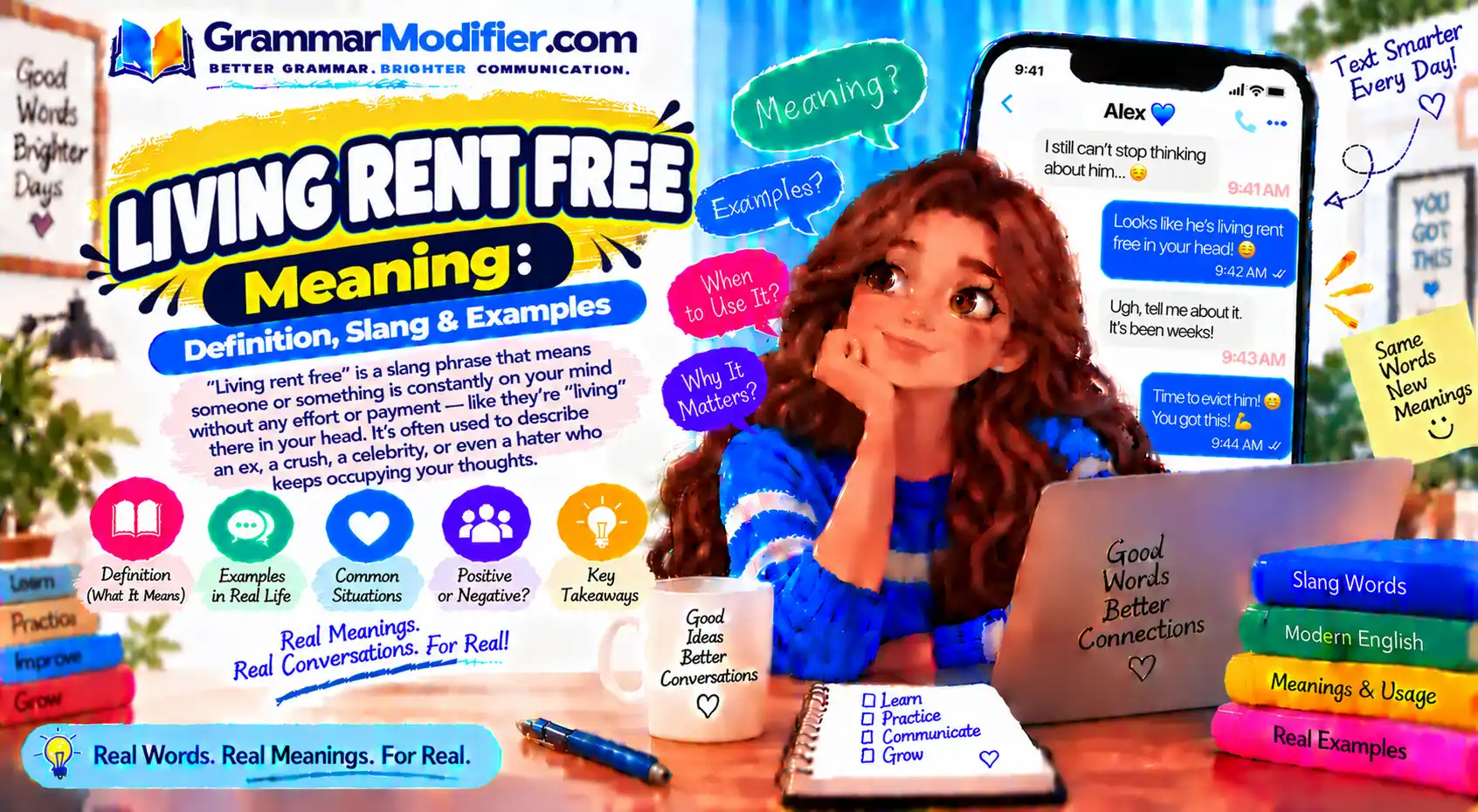
Living rent free is an informal English expression for something or someone that keeps occupying your thoughts. It uses a playful housing metaphor: the thought has taken up space in your mind without “paying rent.”
The phrase is common in casual American English, texting, comments, and social media. It can describe a funny memory, catchy song, annoying situation, person, joke, or idea that you keep thinking about.
Quick Answer
Living rent free means staying in someone’s thoughts without being easily forgotten. In the common phrase “living rent free in my head,” the speaker means they keep thinking about something or someone.
TL;DR
• Living rent free means something keeps occupying your thoughts.
• It is informal and often humorous.
• “In my head” is the most common complete form.
• It can describe positive, negative, or annoying thoughts.
• The phrase is common in texting and online conversation.
• “Obsessed” can sound stronger than “living rent free.”
• Use more neutral wording in formal or academic writing.
What Does Living Rent Free Mean?
When something is living rent free, it keeps taking up mental space. The expression compares your mind to a home and the thought to a tenant.
The “rent” is imaginary. The joke is that the person, memory, song, or idea gets valuable space without giving anything back. Current slang references describe the expression in this figurative sense.
For example:
• That song is living rent free in my head.
• That embarrassing moment still lives rent free in my mind.
• Your joke has been living rent free in my head all day.
The phrase can be shortened to “rent free” when the context is already clear.
What Does “Living Rent Free in My Head” Mean?
“Living rent free in my head” means I keep thinking about it or cannot easily get it out of my mind.
The subject can be almost anything:
• A person: “My old friend is living rent free in my head.”
• A song: “That chorus is living rent free in my head.”
• A memory: “That awkward moment still lives rent free in my head.”
• A joke: “That joke has been living rent free in my head.”
• An idea: “Your suggestion has been living rent free in my head.”
The expression does not automatically mean serious obsession. It often makes the idea sound playful, exaggerated, or self-aware.
What Does “Rent Free” Mean in Slang?
In slang, rent free is a shortened version of the idea that someone or something is living rent free in your head.
For example, someone might comment:
“That scene lives rent free.”
The missing phrase is understood from context. The speaker means that the scene remains memorable or keeps returning to their thoughts.
The shortened version is especially natural in casual online communication. It can also be used teasingly when someone repeatedly talks about a person they claim not to care about.
Rent-Free vs. “Living Rent Free”
There are two related uses that learners should keep separate.
Rent-free has a literal meaning when it describes housing or another place that costs no rent. Dictionaries such as Cambridge, Oxford, Collins, and Dictionary.com document this standard meaning.
Living rent free, however, is usually figurative when it refers to someone’s thoughts.
| Expression | Meaning | Example |
|---|---|---|
| rent-free apartment | No rent is paid | “They received a rent-free apartment.” |
| live rent-free | Live somewhere without paying rent | “She lives rent-free with her family.” |
| live rent free in my head | Stay in my thoughts | “That song lives rent free in my head.” |
This distinction is useful because the same words can have literal or figurative meanings.
Is Living Rent Free an Idiom or Slang?
Living rent free is best treated as an informal idiomatic expression and a common piece of internet slang.
Its meaning cannot be understood literally when the “home” is someone’s head. Wiktionary labels the expression chiefly U.S., informal, and idiomatic, while Collins documents the related expression in its dictionary material.
In everyday English, you might hear:
• “That movie lives rent free in my head.”
• “He lives rent free in her head.”
• “This meme is living rent free in my brain.”
• “That comment has been living rent free in my mind.”
These sound natural in casual conversation, but they are not the best choices for formal reports or academic essays.
How Is Living Rent Free Used in Texting?
In texting, the phrase usually communicates a strong but often playful reaction. Someone may use it after remembering something funny, strange, embarrassing, catchy, or impressive.
The phrase can also be teasing. If a friend keeps mentioning someone, you might jokingly suggest that the person is “living rent free” in their head.
Natural Texting Examples
• “That video is living rent free in my head 😂”
• “Why is that quote still living rent free in my mind?”
• “Your story has been living rent free in my head all morning.”
• “That outfit lives rent free in my brain.”
The wording is deliberately casual, so it works better in a text than in a formal email.
What Does Living Rent Free Mean on Social Media?
On social media, living rent free often appears in comments, captions, memes, and replies. It is useful because it describes a strong reaction in only a few words.
The tone depends on the subject.
• Positive: “That scene is living rent free in my head.”
• Funny: “This meme has been living rent free in my brain.”
• Annoyed: “That rude comment is still living rent free in my head.”
• Teasing: “You keep talking about him. He lives rent free in your head.”
Current slang references continue to describe the expression as a common informal online phrase.
Can Living Rent Free Be Positive or Negative?
Yes. Context determines the tone.
A person can use the phrase for something they genuinely enjoy. A favorite song may live rent free in someone’s head because it is catchy. A favorite movie scene can have the same effect.
The expression can also describe something unwanted. An embarrassing mistake, annoying comment, or frustrating conversation may continue returning to someone’s thoughts.
Positive Examples
• “That song has been living rent free in my head all weekend.”
• “That movie scene lives rent free in my head.”
• “Her hilarious reaction is living rent free in my mind.”
Negative Examples
• “That rude comment is still living rent free in my head.”
• “Why is that argument still living rent free in my mind?”
• “That awkward mistake has been living rent free in my brain.”
Living Rent Free Sentence Examples
Here are natural examples showing different situations and sentence patterns:
• That song lives rent free in my head.
• That movie scene is living rent free in my mind.
• Your comment has been living rent free in my head all morning.
• That embarrassing moment still lives rent free in my memory.
• He seems to live rent free in her head.
• Why is that joke living rent free in my brain?
• That little detail has been living rent free in my thoughts.
• This meme is going to live rent free in my head forever.
• Her reaction lives rent free in my mind.
• That conversation has been living rent free in my head all week.
Notice that the expression can describe a person, object, event, memory, statement, or idea.
How Do You Use “Living Rent Free” Correctly?
The verb changes according to the subject and tense. You do not need to keep living in every sentence.
Common Patterns
• Present simple: “That song lives rent free in my head.”
• Present progressive: “That song is living rent free in my head.”
• Past: “That song lived rent free in my head for months.”
• Present perfect progressive: “That song has been living rent free in my head.”
• Future: “That scene will live rent free in my head forever.”
The most common structure is:
Subject + live/lives/living + rent free + in + possessive + head/mind
For example:
That joke + lives + rent free + in + my head.
The expression is flexible, so speakers may use head, mind, or brain depending on their preferred style.
Living Rent Free vs. Obsessed
These expressions overlap, but they are not identical.
Obsessed usually sounds stronger. It can describe intense interest, enthusiasm, or fixation.
Living rent free is often lighter and more humorous. It emphasizes the fact that something keeps returning to your thoughts.
| Phrase | Typical feeling | Example |
|---|---|---|
| living rent free | Playful, memorable, mildly annoying | “That scene lives rent free in my head.” |
| obsessed with | Strong interest or fixation | “I’m obsessed with that show.” |
| can’t stop thinking about | Neutral and direct | “I can’t stop thinking about that conversation.” |
| stuck in my head | Persistent thought or memory | “That song is stuck in my head.” |
So, saying “I’m obsessed with this song” can sound stronger than “This song lives rent free in my head.”
Living Rent Free vs. “Can’t Stop Thinking”
“I can’t stop thinking about it” is straightforward English. It does not have the humorous metaphor found in “living rent free.”
Compare these examples:
Casual:
“That conversation is living rent free in my head.”
Neutral:
“I can’t stop thinking about that conversation.”
Both communicate a similar idea, but the first sounds more playful and conversational.
For formal writing, the second option is usually clearer.
Is Living Rent Free Formal or Informal?
Living rent free is informal English. It is suitable for casual conversations, texts, comments, captions, and other relaxed communication.
Avoid relying on it in academic essays, formal reports, professional documents, or serious business communication.
More Formal Alternatives
• remains on my mind
• continues to occupy my thoughts
• is difficult to forget
• continues to preoccupy me
• remains memorable
For example:
Informal: “That conversation is living rent free in my head.”
More formal: “That conversation remains on my mind.”
Common Mistakes With Living Rent Free
The most common problems involve literal meaning, verb agreement, and register.
• Incorrect: “She living rent free in my head.”
• Correct: “She is living rent free in my head.”
• Incorrect: “That song live rent free in my head.”
• Correct: “That song lives rent free in my head.”
• Confusing: “They live rent free” can describe free housing.
• Figurative: “They live rent free in my head” describes persistent thoughts.
• Avoid: Using the phrase in a formal academic essay.
• Better: Use “remains on my mind” when a formal tone is needed.
• Remember: The phrase does not always describe a negative thought.
• Use: It can describe something funny, enjoyable, memorable, or annoying.
Where Did the Phrase Living Rent Free Come From?
The literal expression “rent-free” is much older than the modern slang usage. Dictionary.com dates the literal term to the seventeenth century, while modern dictionaries continue to define it as living or staying somewhere without paying rent.
The figurative idea of someone living rent-free in another person’s head is documented in U.S. print sources by the late twentieth century. A frequently cited example appears in Rabbi Abraham J. Twerski’s 1988 book Living Each Day. A similar formulation appeared in an Ann Landers advice column in 1990. The exact single origin is not universally established.
The modern internet shortened and popularized the expression. Today, “rent free” can work as a compact way to describe something that keeps occupying someone’s thoughts.
Is Living Rent Free Still Used in 2026?
Yes. The expression remains recognizable in informal American English and online communication. Current 2026 slang references continue to describe its use for people, memories, songs, comments, jokes, and other things that stay on someone’s mind.
Its basic meaning has remained stable even as the situations change. Someone can say a song, meme, conversation, person, or embarrassing moment is living rent free whenever it keeps returning to their thoughts.
What Are the Best Synonyms for Living Rent Free?
There is no single perfect synonym because the phrase can carry different tones.
Casual Alternatives
• stuck in my head
• can’t get it out of my head
• can’t stop thinking about it
• always on my mind
• stuck in my mind
More Formal Alternatives
• remains on my mind
• continues to occupy my thoughts
• remains memorable
• continues to preoccupy me
Choose the alternative based on tone and context, not simply on whether the meanings are similar.
FAQs
What does living rent free mean in simple words?
Living rent free means something keeps occupying your thoughts. You may keep remembering it even though you are not deliberately trying to think about it.
Is living rent free an insult?
Not necessarily. It can be playful, complimentary, teasing, or critical depending on the situation and what is being described.
Can living rent free describe something positive?
Yes. A favorite song, movie scene, funny joke, or happy memory can live rent free in your head because it is enjoyable or memorable.
Is living rent free proper English?
It is natural informal English, especially in conversation and online communication. It is less suitable for academic, legal, or highly formal writing.
What does “rent free” mean on TikTok and social media?
It usually means a person, idea, video, song, or memory keeps occupying someone’s thoughts. The phrase is often used humorously in comments and captions.
Is living rent free the same as being obsessed?
Not exactly. Obsessed can suggest stronger or more intense interest, while living rent free often sounds lighter and more humorous.
What can live rent free in your head?
Almost anything can, including a person, song, joke, memory, movie scene, conversation, comment, image, or idea that keeps returning to your thoughts.
Conclusion
The living rent free meaning is simple: someone or something continues to occupy your thoughts without being easy to forget. The expression uses a playful housing metaphor and is especially common in casual American English.
Use living rent free when you want a humorous, conversational way to describe a persistent thought. For formal writing, choose a clearer alternative such as “remains on my mind” or “continues to occupy my thoughts.”
Read More: