
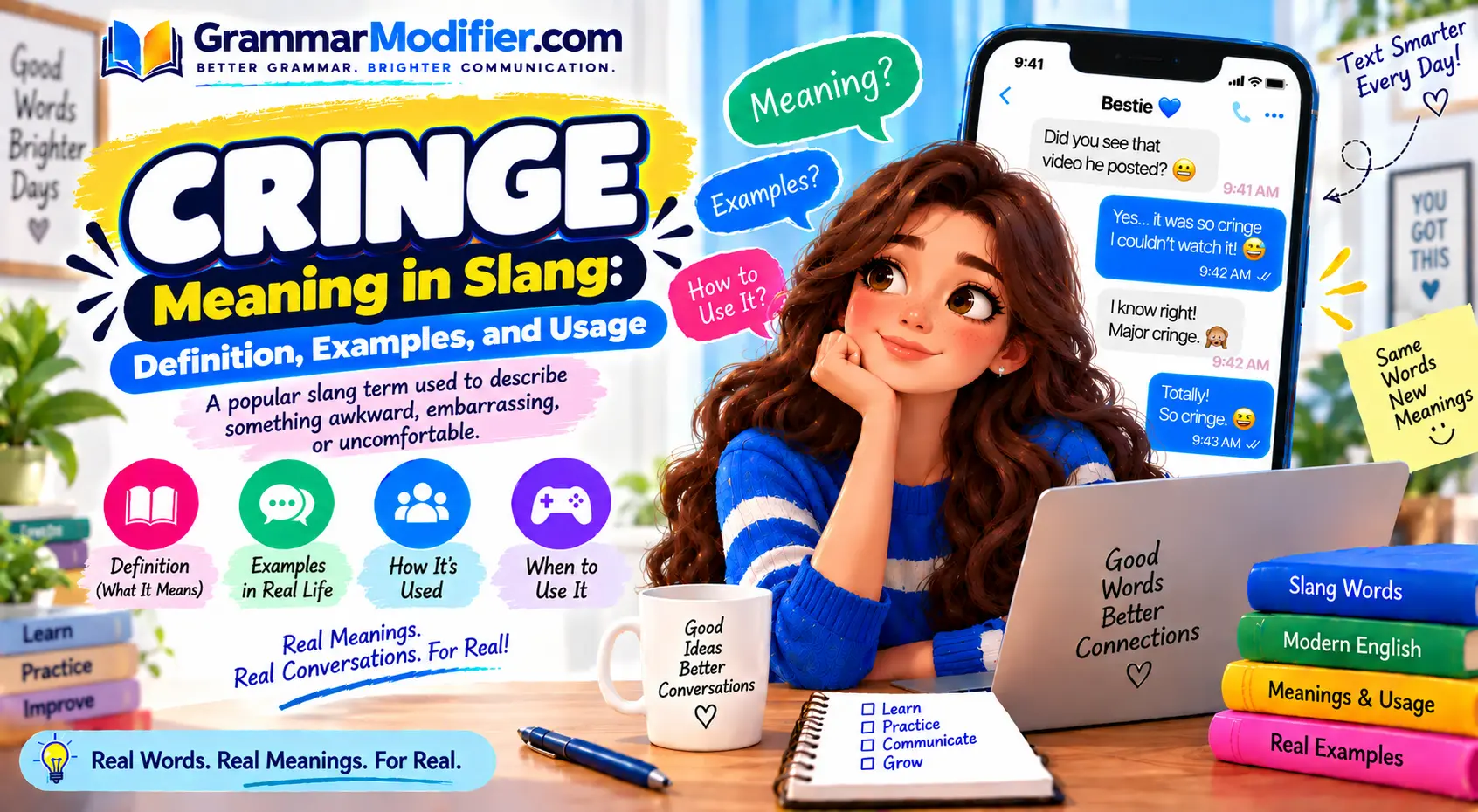
This guide explains cringe meaning in slang for students, English learners, and anyone who sees the word in online conversations. The term usually describes something awkward, embarrassing, or uncomfortable to watch.
You will learn how cringe works as a verb, adjective, noun, and quick reaction. The guide also covers texting examples, social media usage, related words, common mistakes, and practical ways to respond.
Quick Answer
Cringe in slang means something feels awkward, embarrassing, or uncomfortable to watch or experience. People often use it for secondhand embarrassment, forced behavior, awkward jokes, or uncomfortable online content.
TL;DR
- Cringe describes awkward or embarrassing behavior.
- It can work as a verb, noun, or adjective.
- “That’s cringe” means “That feels embarrassing.”
- “I cringe” describes a personal reaction.
- Cringey and cringeworthy have similar meanings.
- The word can sound playful, rude, or judgmental.
What Does Cringe Mean in Slang?
In slang, cringe describes something that makes people feel awkward, embarrassed, or uncomfortable. It often involves secondhand embarrassment, which means feeling embarrassed for someone else.
For example, a person might call an overly dramatic speech “cringe.” They may also use the word for an awkward message, forced joke, or uncomfortable video.
Common examples include:
- “That video was so cringe.”
- “His fake laugh is cringe.”
- “I felt secondhand embarrassment. So cringe.”
- “That pickup line was extremely cringe.”
- “The whole performance made me cringe.”
The word does not always mean something is terrible. Sometimes it describes behavior that feels forced, overly dramatic, outdated, or socially uncomfortable.
Cringe as a Verb
As a verb, cringe means to react with embarrassment, discomfort, fear, or awkwardness. In modern casual English, it often describes an emotional reaction rather than a physical movement.
The verb usually appears with a subject, such as I, she, he, or they.
Examples:
- “I cringe whenever I hear that old recording.”
- “She cringed at the awkward joke.”
- “They cringed when the speaker forgot the name.”
- “He cringed after reading his old post.”
- “I always cringe at that scene.”
The verb can also describe a physical reaction to fear or danger. However, slang conversations usually focus on embarrassment or social discomfort.
Cringe as an Adjective
In online slang, cringe often works as an adjective. It describes something that causes embarrassment or feels awkward.
This use is common in phrases such as:
- “That was cringe.”
- “This caption is cringe.”
- “The speech sounded cringe.”
- “That trend is getting cringe.”
- “His attempt to sound cool was cringe.”
Traditional grammar often expects an adjective such as embarrassing or awkward. However, informal English frequently uses cringe in the same position.
For example:
- Informal: “That joke was cringe.”
- More traditional: “That joke was embarrassing.”
- More formal: “That joke created an uncomfortable reaction.”
The slang version is natural in texts, comments, and casual speech.
Cringe as a Noun
Cringe can also function as a noun. In this form, it refers to an embarrassing moment, an uncomfortable feeling, or content that causes secondhand embarrassment.
Examples include:
- “That was pure cringe.”
- “The cringe was impossible to ignore.”
- “I couldn’t handle the cringe.”
- “This video contains so much cringe.”
- “The ending created serious cringe.”
The noun form is especially common in phrases such as the cringe, pure cringe, and maximum cringe.
In formal writing, words such as embarrassment, discomfort, or awkwardness may be clearer.
Cringe Meaning in Texting
In texting, cringe is usually a quick reaction to something embarrassing or awkward. A person may send only the word “cringe” instead of writing a full sentence.
For example:
- “Cringe 😬”
- “That message was cringe.”
- “Bro, why would you send that?”
- “I’m cringing so hard right now.”
- “That was the most cringe thing ever.”
The tone depends on the relationship between the people. Friends may use it playfully, while strangers may use it as criticism.
A short reply such as “cringe” can sound harsh without context. Adding a softer phrase can make the meaning friendlier:
- “That was a little awkward.”
- “I’m laughing, but that was kind of cringe.”
- “That joke didn’t land.”
- “That was uncomfortable to watch.”
What Does Cringe Mean on TikTok?
On TikTok, cringe often describes videos that viewers find awkward, forced, overly dramatic, or embarrassing. It can refer to acting, dancing, jokes, captions, trends, or attempts to appear relatable.
Examples include:
- A person forcing an emotional reaction for views.
- A scripted joke that feels unnatural.
- A trend copied without understanding its meaning.
- An exaggerated performance that feels uncomfortable.
- A caption that sounds overly dramatic.
However, cringe is subjective. One viewer may find a video funny, while another may find it embarrassing.
The term can also be used jokingly. A creator may call their own video cringe because they recognize that it is silly or exaggerated.
Cringe in Social Media Comments
People use cringe in comments to express quick disapproval or discomfort. It may appear under videos, photos, advertisements, memes, or public posts.
Common comment examples include:
- “This is so cringe.”
- “The secondhand embarrassment is real.”
- “Why did I watch the whole thing?”
- “That ending was cringe.”
- “The forced reaction made me cringe.”
The word can describe content rather than the person who created it. This distinction matters because calling a video awkward is usually less personal than attacking the creator.
A respectful comment focuses on the content:
- “The delivery felt forced.”
- “The joke was awkward.”
- “The acting seemed unnatural.”
- “That trend does not work for me.”
What Does Cringey Mean?
Cringey means embarrassing, awkward, or uncomfortable. It is closely related to cringe and cringeworthy.
Both cringey and cringy appear in informal English. The spelling with -ey is common, while cringy is also widely understood.
Examples:
- “That commercial was cringey.”
- “The dialogue felt cringy.”
- “His speech was a little cringey.”
- “The video became cringy after the first minute.”
Cringeworthy means something deserves or causes a cringe reaction. It is often used when the embarrassment feels especially strong.
Examples:
- “That was a cringeworthy performance.”
- “The interview had several cringeworthy moments.”
- “The advertisement was unintentionally cringeworthy.”
Cringe vs. Awkward and Embarrassing
These words overlap, but they are not always identical.
Awkward describes an uncomfortable or difficult social situation. Embarrassing describes something that causes shame or self-consciousness. Cringe often adds a reaction of discomfort, especially when watching someone else.
Examples:
- “The silence was awkward.”
- “Forgetting her name was embarrassing.”
- “Watching him pretend to know the answer was cringe.”
The difference is not strict. A situation can be awkward, embarrassing, and cringe at the same time.
Use awkward for a social situation, embarrassing for personal shame, and cringe for a strong uncomfortable reaction.
Cringe vs. Cheesy and Cringeworthy
Cheesy usually means overly sentimental, predictable, or lacking sophistication. It is not always negative.
For example:
- “That movie had a cheesy ending.”
- “The romantic message was cheesy.”
- “The joke was cheesy but funny.”
Cringeworthy means something causes embarrassment or discomfort. It is usually stronger than cheesy.
Compare these examples:
- “The speech was cheesy but sweet.”
- “The speech was cringe because it felt forced.”
- “The speech was cringeworthy because everyone became uncomfortable.”
Something can be cheesy without being cringe. A person may enjoy a cheesy song while still finding an awkward performance cringeworthy.
Is Cringe an Insult?
Cringe can be an insult, but it is not always intended to be cruel. The meaning depends on tone, context, and the relationship between speakers.
Friends may use the word as playful teasing. Strangers may use it to dismiss someone’s behavior or expression.
The word can become hurtful when it targets a person rather than a specific action. This is especially true when someone is learning, expressing themselves, or trying something new.
A more respectful approach is to describe the exact issue:
- “That joke felt forced.”
- “The message was too dramatic.”
- “The timing was awkward.”
- “That style is not really my taste.”
Calling something cringe is a personal judgment, not an objective fact. Different people may react differently to the same content.
Where Did Cringe Come From?
The word cringe has been used in English for centuries. Its older meaning involved shrinking back, bending, or recoiling because of fear, discomfort, or submission.
Over time, the word developed an emotional meaning connected with embarrassment. Modern internet culture expanded this meaning further.
Today, people use cringe to describe awkward posts, uncomfortable videos, forced jokes, and secondhand embarrassment. Social media helped make the adjective and noun forms common in casual communication.
The related words cringey and cringeworthy describe things that produce this reaction.
Common Mistakes With Cringe
Several mistakes appear when learners use cringe in sentences.
- Incorrect: “I am cringe at that video.”
- Better: “I cringe at that video.”
- Incorrect: “That video is very cringed.”
- Better: “That video is very cringe.”
- Incorrect: “He was cringe when he watched it.”
- Better: “He cringed when he watched it.”
- Incorrect: “That was a cringe-worthy moment” when no embarrassment exists.
- Better: Use cringe-worthy only when something creates discomfort.
- Incorrect: “Cringe means frightened in every situation.”
- Better: In slang, it usually refers to embarrassment or awkwardness.
- Incorrect: “Cringe always means something is bad.”
- Better: It can be playful, subjective, or mildly critical.
- Incorrect: “Cringey” and “cringe” always have identical grammar.
- Better: Use cringe as a slang adjective and cringey as a descriptive adjective.
- Incorrect: “Everyone thinks this is cringe.”
- Better: “Some people may find this cringe.”
How to Use Cringe in a Sentence
You can use cringe naturally in casual speech, texts, comments, and informal writing. Choose the form based on whether you are describing an action, a thing, or a reaction.
Useful sentence patterns include:
- “I cringe when ___.”
- “That was so cringe.”
- “The ___ was cringey.”
- “I felt secondhand embarrassment when ___.”
- “That moment was pure cringe.”
- “The scene made me cringe.”
- “That joke was awkward, not funny.”
- “The video became cringeworthy near the end.”
Examples:
- “I cringe whenever I remember that presentation.”
- “That caption is so cringe.”
- “The conversation became awkward.”
- “Her attempt to sound confident felt cringey.”
- “The commercial had one cringeworthy moment.”
- “I laughed because the scene was intentionally cringe.”
Avoid using the word in formal essays unless the assignment allows informal language. In academic writing, awkward, embarrassing, uncomfortable, or socially inappropriate may be more suitable.
How to Respond When Someone Says Cringe
Your response depends on whether the person is joking, criticizing, or giving feedback.
If the comment is playful, you can respond casually:
- “Fair enough.”
- “I knew it was a little cringe.”
- “That was the point.”
- “You’re not wrong.”
- “I was trying something different.”
If the comment feels rude, you can stay calm:
- “What part felt awkward to you?”
- “I see it differently.”
- “You can dislike it without being rude.”
- “Thanks for the feedback.”
- “I was just having fun.”
If you are unsure about the tone, ask for clarification. A simple question can prevent an unnecessary argument.
Practice: Choose the Correct Meaning
Choose the best answer for each sentence.
- “I cringe whenever I hear that old recording.”
- A. I feel embarrassed.
- B. I feel hungry.
- C. I feel excited.
- “That video is so cringe.”
- A. The video is very expensive.
- B. The video feels awkward or embarrassing.
- C. The video is educational.
- “The conversation was awkward.”
- A. The conversation felt uncomfortable.
- B. The conversation was very loud.
- C. The conversation was very short.
- “That commercial was cringeworthy.”
- A. It was difficult to understand.
- B. It caused embarrassment or discomfort.
- C. It was completely silent.
- “That joke was cheesy but harmless.”
- A. The joke was overly sentimental or predictable.
- B. The joke was dangerous.
- C. The joke was grammatically incorrect.
Answers: A, B, A, B, and A.
FAQs
What does cringe mean in slang?
Cringe means something feels awkward, embarrassing, or uncomfortable. It often describes secondhand embarrassment caused by watching another person’s behavior.
Is cringe a bad word?
No, cringe is not a swear word. However, it can sound rude or insulting when used to criticize someone directly.
What does cringe mean in texting?
In texting, cringe is a quick reaction to an awkward message, joke, video, or situation. It can be serious, playful, or sarcastic.
What does cringey mean?
Cringey means embarrassing, awkward, or uncomfortable. It is closely related to cringe and cringeworthy.
Is cringe the same as embarrassing?
The meanings overlap, but they are not always identical. Embarrassing often describes shame, while cringe emphasizes discomfort or secondhand embarrassment.
Can I use cringe in formal writing?
You can use it when discussing informal language or internet culture. In formal writing, words such as awkward, embarrassing, or uncomfortable are usually clearer.
How do I respond when someone calls something cringe?
You can respond with “Fair enough,” explain your intention, or ask what felt awkward. A calm response works better than arguing about personal taste.
Conclusion
The cringe meaning in slang usually refers to something awkward, embarrassing, forced, or uncomfortable to watch. It can describe a reaction, a moment, a message, a video, or a person’s behavior.
Use the word naturally in casual conversations, but remember that its meaning is subjective. When you want to be respectful, describe the specific action instead of labeling the entire person. Try using the examples above in your own sentences to build confidence.
Read More: