
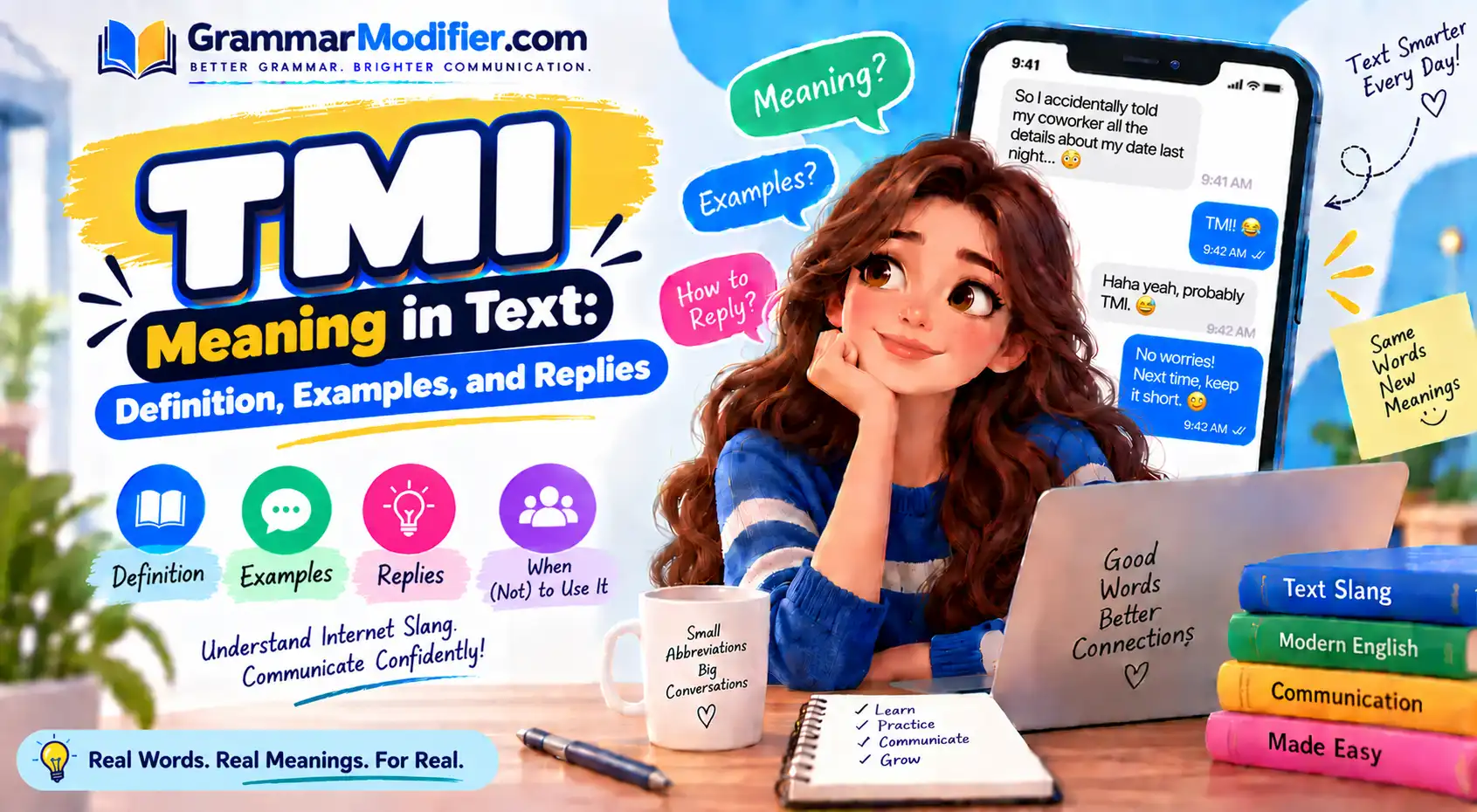
TMI means “too much information.” In texting and online conversations, people use it when someone shares more personal, embarrassing, unnecessary, or detailed information than the listener expected.
The expression can be funny, playful, uncomfortable, or serious depending on the conversation. For example, “TMI 😂” often sounds like friendly teasing, while “TMI.” may sound like a direct request to stop sharing details.
Quick Answer: What Does TMI Mean?
TMI stands for “too much information.” It is an informal expression used when someone gives details that feel overly personal, unnecessary, or uncomfortable.
Examples:
- “I don’t need to know what happened in the bathroom. TMI!”
- “Sorry, TMI, but I haven’t slept well all week.”
- “TMI 😂”
- “Was that TMI?”
TMI is usually used in texts, group chats, social media comments, and casual conversations. It is not normally appropriate for formal writing.
TL;DR
- TMI means “too much information.”
- It usually reacts to personal, embarrassing, or unnecessary details.
- “TMI!” may sound surprised or playful.
- “TMI.” can sound more serious or critical.
- “TMI 😂” usually shows friendly teasing.
- “Sorry, TMI” means the speaker realizes they may have overshared.
- “TMI?” asks whether the information was too personal or detailed.
- In serious conversations, use empathy instead of dismissing someone with TMI.
What Does TMI Stand For?
TMI is an abbreviation for “too much information.” It is commonly used in informal English, especially in digital communication.
The phrase does not always mean that the information is bad or incorrect. It usually means that the speaker has shared more detail than the listener wanted or expected.
For example:
“My doctor explained every detail of the procedure, and now I feel uncomfortable.”
A friend might reply:
“TMI.”
The friend is not necessarily saying the information is false. They are saying that the level of detail was more than they wanted to hear.
How Is TMI Used in Texting?
In text messages, TMI works as a short reaction. Instead of writing a complete sentence such as “That is more personal information than I needed,” someone can simply type “TMI.”
It may appear:
- At the beginning of a reply
- At the end of a message
- As a one-word response
- With an emoji
- With an exclamation mark or question mark
Examples:
Friend: “I just explained my entire medical history to the new student.”
You: “TMI 😂”
Friend: “I won’t attend school today because of a private health issue.”
You: “You don’t have to share every detail.”
The second response may be more appropriate because the person is discussing a serious or personal matter.
Why Do People Say TMI?
People say TMI for several reasons. The meaning depends on the subject, relationship, and tone of the conversation.
To React to Personal Details
Someone may share information about their body, health, relationships, family, or private experiences. TMI signals that the details feel too personal for the audience.
To Tease a Friend
Close friends may use TMI as a joke. In this situation, it does not necessarily mean the speaker is upset.
“I told my crush exactly how nervous I was.”
“TMI 😂”
To Set a Boundary
TMI can also politely or directly communicate that someone should stop sharing details.
“I understand, but I don’t need to know every part of the argument.”
To React to Too Much Explanation
TMI is not limited to private information. It can also describe a long explanation containing unnecessary details.
“The teacher explained the entire history of the broken printer.”
“That was TMI.”
TMI as a Reaction to Personal Details
The most familiar use of TMI is reacting to information that feels private, embarrassing, or uncomfortable.
Common subjects include:
- Bathroom or bodily details
- Private medical information
- Relationship problems
- Intimate experiences
- Family arguments
- Personal financial details
- Embarrassing mistakes
- Details shared in the wrong group chat
However, personal does not automatically mean inappropriate. Someone may need to discuss a health problem, emotional difficulty, or family issue to receive help.
For that reason, TMI should be used carefully. A joke that works between close friends may sound dismissive when someone is asking for support.
TMI as a Warning About Oversharing
People also use TMI before sharing something personal. This is common in phrases such as:
- “Sorry, TMI.”
- “TMI, but…”
- “This might be TMI.”
- “I hope this isn’t TMI.”
These expressions warn the listener that the next detail may be more personal than usual.
Example:
“Sorry, TMI, but I’ve been feeling sick all morning.”
The speaker understands that the information may be unnecessary or uncomfortable, so they give the listener a warning.
TMI Versus Oversharing
Oversharing is the act of giving too much personal information. TMI is often the reaction to that behavior.
| Expression | Meaning |
|---|---|
| Oversharing | Sharing more personal information than is appropriate |
| TMI | A reaction meaning “that is too much information” |
| Sorry, TMI | A warning that you may be oversharing |
| TMI? | Asking whether you have shared too much |
| Information overload | Receiving more information or detail than you can easily process |
For example:
“I told everyone in the group chat about my private argument.”
That may be oversharing.
“TMI. We can talk about that privately.”
That is the reaction.
Is TMI Rude or Funny?
TMI can be either funny or rude. The tone depends on the relationship, topic, punctuation, and situation.
When TMI Sounds Funny
Among close friends, TMI may be playful:
“I accidentally sent my private shopping list to my teacher.”
“TMI 😂”
When TMI Sounds Rude
If someone is discussing a serious problem, replying only “TMI” may seem uncaring.
“I’m worried about a family issue.”
“TMI.”
This response may make the person feel ignored.
A more considerate reply would be:
“That sounds difficult. Share only what you feel comfortable discussing.”
When TMI Sounds Neutral
In a casual conversation, TMI may simply mean that the listener does not need additional details.
“You can stop there. I understand what happened.”
How Punctuation and Emojis Change TMI
Small changes can affect the tone of TMI.
| Version | Likely Tone |
|---|---|
| TMI! | Strong, surprised, or immediate reaction |
| TMI. | More serious, firm, or critical |
| TMI 😂 | Usually playful or teasing |
| TMI 😭 | Dramatic, amused, or overwhelmed |
| TMI? | Asking whether the speaker shared too much |
| Sorry, TMI | Self-aware warning |
| That’s TMI for this group chat | Clear boundary-setting |
These interpretations are not absolute. The same phrase can sound different depending on the people involved.
TMI Examples in Real Text Conversations
Example 1: Funny Oversharing
A: “I told my new classmate about my embarrassing childhood nickname.”
B: “TMI 😂”
Example 2: Too Many Details
A: “The bus was late because the driver had to call the mechanic, who had just spoken to his manager…”
B: “TMI. Just tell me when the bus arrived.”
Example 3: Checking Before Sharing
A: “Can I tell you something personal?”
B: “Sure.”
A: “It might be TMI.”
Example 4: Asking for Support
A: “I’ve been having a difficult week and need to talk.”
B: “Of course. Tell me what happened.”
In this situation, responding with “TMI” would probably sound dismissive.
Example 5: Group Chat
A: “I’m going to explain every detail of my appointment here.”
B: “Maybe save that for a private chat.”
Example 6: Self-Awareness
A: “Sorry, TMI, but I haven’t eaten properly today.”
B: “You’re fine. Are you feeling okay?”
What Does Lowercase “tmi” Mean?
Lowercase “tmi” has the same meaning as uppercase “TMI.” The difference is mainly stylistic.
People often use lowercase abbreviations in casual texting:
- tmi
- tbh
- ngl
- fr
- ikr
Examples:
“tmi but I’m exhausted.”
“tmi 😂”
Lowercase writing usually feels relaxed and informal. It does not create a different definition.
Is TMI Formal or Informal?
TMI is informal. It is suitable for casual conversations, texting, social media, and messages to people you know.
Avoid using it in:
- Formal school assignments
- Professional reports
- Business proposals
- Official letters
- Academic essays
- Formal customer communication
Instead of writing “TMI” in a formal setting, use a clearer phrase:
- “That includes more detail than necessary.”
- “You do not need to provide those personal details.”
- “The explanation is more detailed than required.”
- “Please keep the information relevant to the topic.”
TMI on Snapchat, Instagram, and TikTok
On Snapchat, Instagram, TikTok, and other social platforms, TMI usually keeps the same meaning.
The main difference is the audience. A private message between friends may allow more personal detail than a public comment.
For example:
“I told my entire story in the comments.”
“TMI for a public post.”
On social media, TMI may also be used humorously when someone posts a very personal caption, detailed story, or unexpected confession.
Because text does not include voice or facial expression, readers may misunderstand the tone. An emoji or a softer phrase can make the intention clearer.
How Do You Reply to TMI?
Your reply should match the situation.
Funny Replies
- “You asked!”
- “You wanted the full story.”
- “I’m just being honest.”
- “Too late now.”
- “You can’t unread it.”
Calm Replies
- “Fair enough.”
- “I’ll keep the details shorter.”
- “Sorry, I got carried away.”
- “We can talk about it privately.”
Supportive Replies
If the conversation involves a serious problem, try:
- “Are you okay?”
- “Do you want to talk about it?”
- “You only need to share what feels comfortable.”
- “I’m here if you need help.”
A supportive response is usually better than a joke when someone is discussing health, stress, family problems, or another sensitive subject.
What Does “Sorry, TMI” Mean?
“Sorry, TMI” means “Sorry, that may have been too much information.”
People use it when they realize they have shared a personal, embarrassing, or unnecessary detail.
Examples:
“Sorry, TMI, but I’ve been awake all night.”
“I probably shouldn’t have explained all of that. Sorry, TMI.”
The phrase can be sincere, humorous, or self-conscious. It does not always mean the speaker regrets sharing the information.
When Should You Say “Too Much Information” Instead?
Use the full phrase “too much information” when clarity matters or when the audience may not understand texting abbreviations.
The full phrase is better for:
- Formal writing
- Schoolwork
- Professional communication
- Speaking to someone unfamiliar with internet slang
- Explaining the abbreviation to an English learner
For example:
Informal:
“TMI 😂”
Clearer:
“That is more personal information than I needed.”
Formal:
“The explanation includes more detail than necessary for this report.”
Frequently Asked Questions
What does TMI mean in a text message?
TMI means “too much information.” It is used when someone shares more personal, embarrassing, or unnecessary detail than the listener expected.
Is TMI a bad word?
No. TMI is not a swear word. It is an informal abbreviation. However, it can sound rude if used to dismiss someone who is discussing a serious issue.
Does TMI mean that someone is angry?
Not necessarily. TMI can show amusement, surprise, discomfort, annoyance, or a desire to stop the conversation. The tone depends on the context.
What does TMI with a laughing emoji mean?
“TMI 😂” usually means the person is teasing or reacting humorously to an overshared detail. The emoji softens the message, but the exact meaning still depends on the relationship.
What is the difference between TMI and oversharing?
Oversharing is the act of giving too much personal information. TMI is the reaction that means the information was more than the listener wanted or expected.
Can I use TMI in a school or work email?
TMI is usually too informal for school or workplace emails. Use phrases such as “more detail than necessary” or “you do not need to include those personal details.”
Conclusion
TMI means “too much information.” In texting, it usually reacts to personal, embarrassing, unnecessary, or overly detailed information.
The expression can be playful between friends, but it may sound rude in a serious conversation. Pay attention to punctuation, emojis, the relationship between the speakers, and the subject being discussed.
Use “TMI 😂” for light teasing, “Sorry, TMI” when admitting that you may have overshared, and a more thoughtful response when someone is asking for emotional support. In formal communication, write “too much information” or explain the concern in a complete sentence.
Read More: