
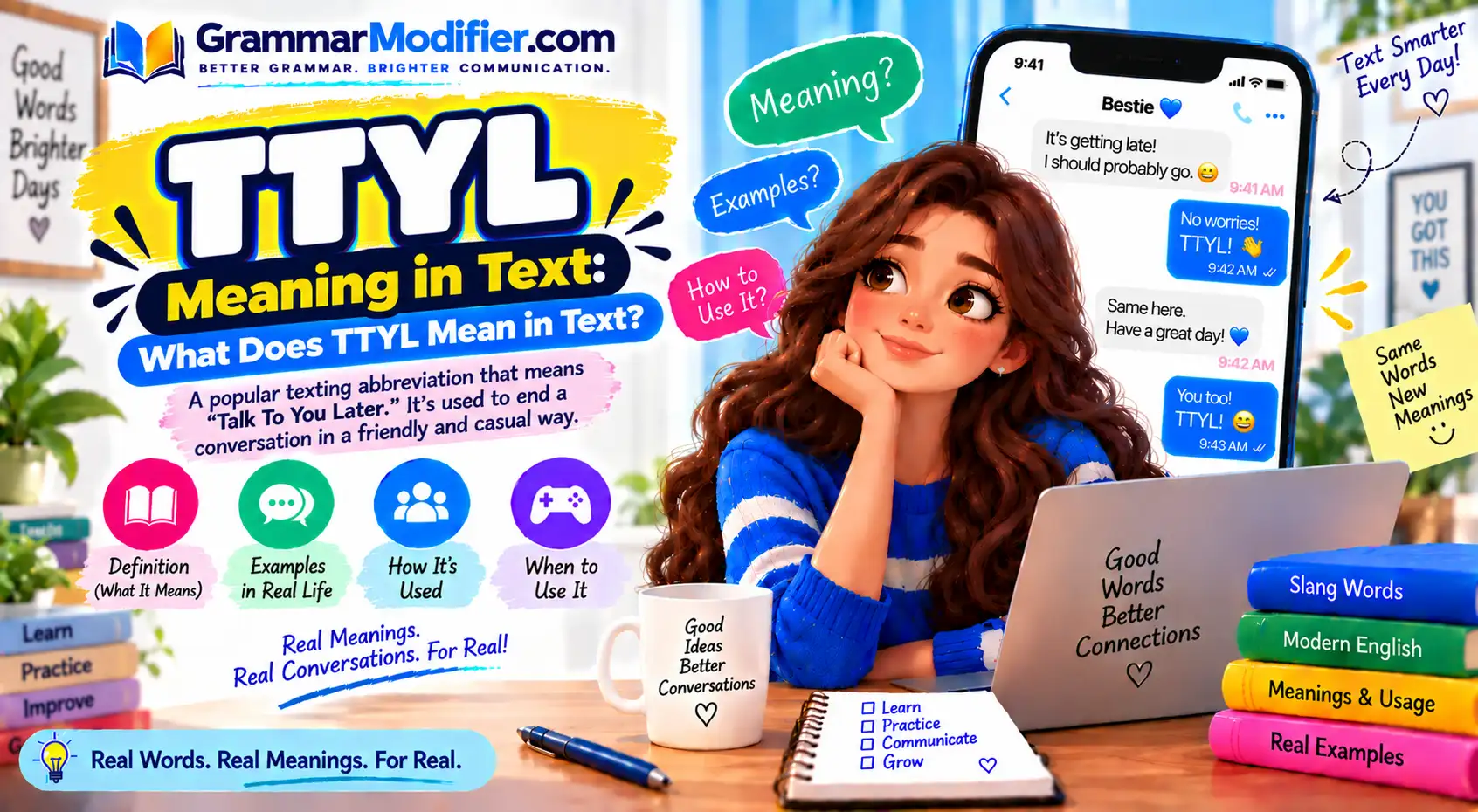
For anyone learning modern English or texting in the United States, TTYL meaning is useful to know. TTYL stands for “Talk To You Later” and is an informal way to end a conversation for now.
You may see TTYL in text messages, social media chats, gaming conversations, and casual online messages. This guide explains its tone, examples, common mistakes, related abbreviations, and natural ways to reply.
Quick Answer
TTYL means “Talk To You Later.” It is a casual abbreviation used to end a conversation while suggesting that you will communicate again later.
TL;DR
• TTYL means “Talk To You Later.”
• It is informal and common in digital conversations.
• It usually sounds friendly and relaxed.
• It does not specify exactly when you will talk again.
• Use it mainly with friends or casual contacts.
• Avoid it in formal writing unless the context allows it.
What Does TTYL Mean?
TTYL is an abbreviation for “Talk To You Later.” It is commonly used when someone wants to pause or end a conversation temporarily.
The phrase usually leaves the conversation open for another interaction. It can mean later today, tomorrow, or simply at another time.
• TTYL = Talk To You Later
• It works as a casual sign-off.
• It is especially common in messaging.
• The exact time depends on context.
• It normally suggests future communication.
• It is informal rather than formal English.
• It can appear as TTYL or ttyl.
• People usually understand both forms.
TTYL Meaning in Text Messages
In texting, TTYL usually means the sender is leaving the conversation for now. They may be busy, going somewhere, or simply finished chatting.
For example, a friend might write, “I have to finish my homework. TTYL!” The message means they are ending the conversation temporarily.
• “I have class now. TTYL!”
• “Dinner is ready. TTYL.”
• “I need to finish this project. TTYL!”
• “I’m heading out. Talk to you later.”
• “Got to go for now. TTYL.”
• “I’ll message you later. TTYL!”
• “My battery is dying. TTYL.”
• “I need to sleep. TTYL!”
Is TTYL Slang or an Abbreviation?
TTYL is an informal abbreviation used in digital communication. Dictionaries classify it as an abbreviation, while language users may also casually call it texting slang.
It comes from the first letters of the words Talk To You Later. More precisely, it can be described as an initialism because the letters represent the beginning sounds or words.
• T = Talk
• T = To
• Y = You
• L = Later
• Written form: TTYL
• Lowercase form: ttyl
• Spoken form: usually individual letters
Is TTYL Friendly or Rude?
TTYL is usually friendly and casual. Its meaning alone does not suggest anger, rejection, or dislike.
However, the surrounding message can change how it feels. A short “TTYL” after a tense conversation may sound different from “TTYL!” after a friendly chat.
• “TTYL!” can feel cheerful.
• “Okay, ttyl.” can sound neutral.
• “Fine. TTYL.” may feel colder.
• A friendly emoji can soften the message.
• Context matters more than the abbreviation itself.
• The relationship between the speakers also matters.
• Punctuation can affect perceived tone.
How Is TTYL Used on Social Media?
People use TTYL on social media when they want to step away from a conversation. It can appear in direct messages, group chats, comments, and other casual digital exchanges.
The abbreviation is not tied to one particular social platform. Its basic meaning stays the same across different forms of online communication.
• Text messages
• Social media DMs
• Group chats
• Online communities
• Casual messaging
• Gaming chats
• Instant messaging
• Informal conversations
TTYL Examples in Real Conversations
The easiest way to understand TTYL is to see how it works naturally. In most examples, it replaces a longer goodbye.
The surrounding sentence explains why the person is leaving. TTYL simply keeps the sign-off short.
• Friend: “Want to play later?”
You: “Sure! I have to eat now. TTYL!”
• Friend: “Are you still studying?”
You: “Yeah, I need to finish this chapter. TTYL.”
• Classmate: “Can you send me the notes?”
You: “Sure. I have to leave now. TTYL!”
• Friend: “I’ll tell you the rest tomorrow.”
You: “Sounds good. TTYL!”
When Should You Use TTYL?
Use TTYL when the conversation is casual and you want to say goodbye for now. It works especially well when both people are comfortable with texting abbreviations.
It is less suitable when the situation requires a formal or professional tone. In those settings, writing the full phrase or using a polite closing is clearer.
• Use it with friends.
• Use it in casual group chats.
• Use it in informal messages.
• Use it when leaving temporarily.
• Use it when future conversation is expected.
• Avoid it in formal letters.
• Avoid it in formal applications.
• Choose a professional closing for work messages.
When Should You Avoid TTYL?
TTYL is informal, so context matters. A professional email, official request, or formal school communication may call for more standard wording.
You do not need to avoid abbreviations completely. The key is matching your language to the person and situation.
• Formal email → “I’ll speak with you later.”
• Professional message → “I’ll follow up later.”
• Casual text → “TTYL!”
• Friendly chat → “Talk later!”
• Formal request → “I’ll be in touch.”
• Casual conversation → “See you later!”
TTYL vs. BRB
TTYL and BRB are both common messaging abbreviations, but they describe different situations.
TTYL means the conversation is ending for now. BRB means the person expects to return to the conversation soon.
• TTYL = Talk To You Later
• BRB = Be Right Back
• TTYL usually closes the current exchange.
• BRB usually pauses the exchange.
• TTYL does not promise a specific return time.
• BRB suggests a relatively short absence.
• Both are informal.
• Both work best in casual chats.
TTYL vs. GTG
GTG means “Got To Go.” It focuses on the need to leave, while TTYL emphasizes talking again later.
The two abbreviations can also appear together. For example, someone might write, “GTG, TTYL!” to say they need to leave now but expect another conversation later.
• TTYL = Talk To You Later
• GTG = Got To Go
• TTYL focuses on future conversation.
• GTG focuses on leaving.
• “GTG, TTYL!” combines both ideas.
• Both are informal expressions.
• Both are common in casual digital communication.
• Neither is ideal for formal writing.
TTYL vs. See You Later
“See you later” and TTYL have similar goodbye functions, but they are not always interchangeable.
“See you later” can suggest meeting again in person or speaking again. TTYL specifically emphasizes talking again later.
• See you later sounds natural in speech.
• TTYL is strongly associated with digital communication.
• “See you later” can work in formal-casual situations.
• TTYL is more informal.
• TTYL is shorter.
• Both can signal a temporary goodbye.
• Context determines the best choice.
• “Talk to you later” is the full phrase behind TTYL.
How Do You Reply to TTYL?
A reply to TTYL does not need to be complicated. A short, friendly response usually works well.
Your response can match the other person’s tone. If they use casual language, a casual reply is usually natural.
• “TTYL!”
• “Talk later!”
• “Sure, talk soon!”
• “Sounds good!”
• “Okay, later!”
• “See you later!”
• “Take care!”
• “Talk to you soon!”
Common Mistakes With TTYL
Most mistakes involving TTYL are not grammar errors. They involve tone, context, or misunderstanding what the abbreviation implies.
Remember that TTYL does not give a precise schedule. It simply suggests that another conversation may happen later.
• Treating TTYL as a formal business closing.
• Assuming “later” means a specific time.
• Thinking TTYL always signals romantic interest.
• Assuming TTYL always means “later today.”
• Using it during a serious formal exchange.
• Assuming punctuation gives one fixed meaning.
• Believing uppercase and lowercase versions have different definitions.
• Treating TTYL as a complete formal sentence in academic writing.
Can You Use TTYL in Formal Writing?
Generally, TTYL is best reserved for informal communication. Formal writing usually benefits from complete phrases and clearer professional language.
For example, an email to a teacher, employer, or organization may be better with “I’ll speak with you later” or “I’ll follow up soon.”
• Casual text: “TTYL!”
• Friendly message: “Talk later!”
• Professional message: “I’ll follow up later.”
• Formal email: “I’ll be in touch.”
• Academic writing: write the complete phrase when appropriate.
• Official communication: choose a clear professional closing.
• Job-related communication: avoid casual texting abbreviations.
Why Do People Use TTYL?
People use TTYL because it is short, familiar, and convenient. Digital conversations often favor quick expressions that communicate an idea with few characters.
The abbreviation also carries a casual tone. It can make a goodbye feel less formal than a complete sentence.
• It saves typing time.
• It fits casual conversations.
• It is widely recognizable.
• It keeps messages brief.
• It signals a temporary goodbye.
• It suggests future communication.
• It fits naturally with other chat abbreviations.
• It works in many informal digital settings.
TTYL Meaning in American English
In American English, TTYL is understood as “Talk To You Later.” Major English dictionaries list the abbreviation with this meaning and mark it as informal.
The expression is not a special grammar form. It is a shortened expression used mainly in informal digital communication.
• Standard meaning: Talk To You Later
• Register: informal
• Main setting: digital communication
• Common function: temporary goodbye
• Formal equivalent: I’ll talk to you later
• Related phrase: See you later
• Related abbreviation: GTG
• Related abbreviation: BRB
FAQs
What does TTYL stand for?
TTYL stands for “Talk To You Later.” It is an informal abbreviation used to end a conversation temporarily.
What does TTYL mean from a girl or guy?
The abbreviation has the same basic meaning regardless of who sends it. TTYL means “Talk To You Later,” and its tone depends on the surrounding conversation.
Is TTYL a good way to say goodbye?
Yes, TTYL is a natural casual goodbye in texts and online chats. It is less suitable for formal communication.
Does TTYL mean they will talk to you again?
It usually suggests another conversation will happen later. However, TTYL does not specify exactly when that conversation will happen.
Is TTYL still used?
Yes. Current dictionary references continue to define TTYL as “talk to you later,” and recent usage guides continue to describe it as an informal messaging abbreviation.
Is TTYL an acronym?
TTYL is commonly called an acronym in everyday conversation, but initialism is a more precise linguistic description because the letters are normally said separately.
Conclusion
TTYL meaning is straightforward: it stands for “Talk To You Later.” It is an informal way to end a digital conversation while suggesting that you may communicate again later.
Use TTYL naturally in casual texts, chats, and social messages. For professional or formal writing, choose a complete phrase such as “I’ll talk to you later” or “I’ll be in touch.”
Read More: