
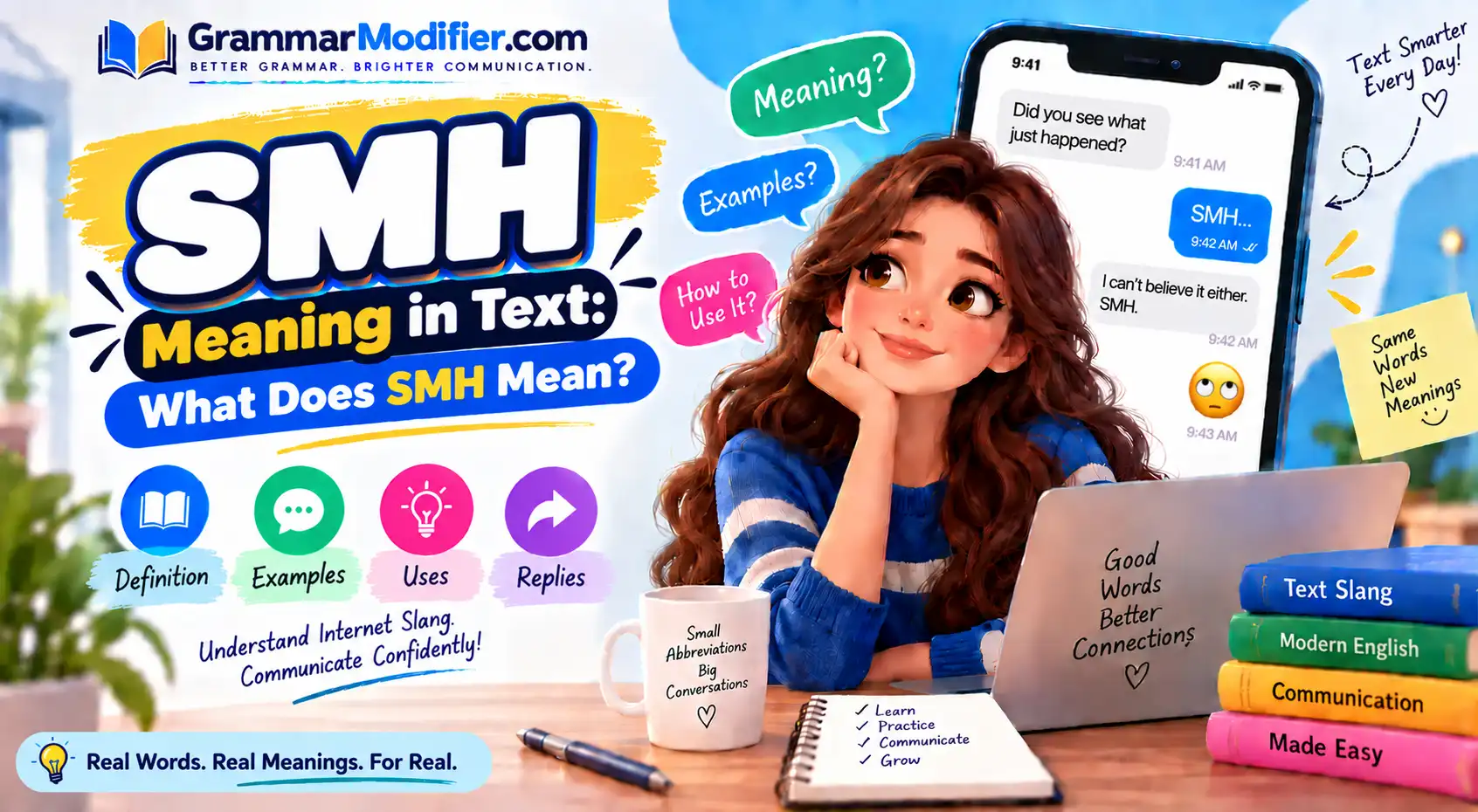
If someone sends you “SMH,” they usually mean “shaking my head.” In texting, this abbreviation expresses a reaction to something unbelievable, disappointing, frustrating, embarrassing, or simply silly.
The tone depends on the situation. A friend might write “SMH 😂” as playful teasing, while “SMH.” after a serious message may sound critical or dismissive. Understanding the surrounding conversation is the best way to interpret the message correctly.
Quick Answer
SMH means “shaking my head.” It is informal texting slang used to show disbelief, disappointment, frustration, embarrassment, or mild disapproval.
Example:
“You forgot your wallet again, SMH.”
This means:
“I can’t believe you forgot your wallet again.”
TL;DR
- SMH stands for “shaking my head.”
- It is common in texts, chats, comments, and social media.
- It can express disbelief, frustration, disappointment, or amusement.
- smh and SMH have the same meaning.
- SMDH is a stronger version that usually means “shaking my damn head.”
- A laughing emoji can make SMH sound playful.
- Use a complete sentence instead of SMH in formal school or workplace writing.
What Does SMH Stand For?
SMH stands for “shaking my head.” The phrase describes the reaction people may have when something seems ridiculous, disappointing, confusing, or difficult to believe.
In a face-to-face conversation, someone might physically shake their head. In a text message, SMH communicates that same reaction in a few letters.
The abbreviation does not always mean serious anger. It may also show:
- Disbelief: “You really did that?”
- Disappointment: “I expected better.”
- Frustration: “This keeps happening.”
- Embarrassment: “I cannot believe I said that.”
- Amusement: “That was such a silly mistake.”
- Mild disapproval: “That was not a good choice.”
The exact meaning depends on the words around it.
How Is SMH Used in Texting?
People use SMH as a quick reaction when they do not need to explain their entire response. It can appear at the beginning or end of a sentence, or it can stand alone.
Examples:
- “SMH, why would you do that?”
- “You missed the bus again, SMH.”
- “I studied the wrong chapter. smh.”
- “He forgot the meeting time. SMH.”
- “SMH, that was not a smart decision.”
A longer sentence usually makes the sender’s tone easier to understand. A single “SMH” can be more ambiguous because it gives the reader little information.
Why Do People Use SMH?
SMH is popular in casual communication because it is short and expressive. It allows someone to react without writing a complete sentence such as “I cannot believe this happened.”
People may use it when:
- A friend repeats an old mistake.
- Someone makes an unexpected decision.
- A situation becomes frustrating.
- A person shares an embarrassing story.
- The sender wants to tease someone.
- The sender is disappointed but does not want to argue.
For example:
“I locked my keys inside the car again, smh.”
This is a self-directed reaction. The sender is criticizing their own mistake rather than attacking someone else.
What Feelings Can SMH Express?
Although “shaking my head” sounds negative, SMH can express several different emotions.
Disbelief
“You finished the entire project in one night? SMH.”
The sender is surprised and may not believe what happened.
Disappointment
“We planned everything, but nobody brought the supplies. SMH.”
The message shows frustration with an outcome.
Embarrassment
“I called my teacher ‘Mom’ today. SMH.”
Here, SMH shows embarrassment or amusement about the sender’s own mistake.
Playful teasing
“You watched the movie without me? SMH 😂”
The sender may be joking rather than seriously criticizing the other person.
Mild disapproval
“SMH, that was not a kind thing to say.”
This use is more serious and may communicate disagreement.
How Context Changes the Meaning of SMH
The meaning of SMH is not fixed to one emotion. The same abbreviation can sound friendly in one conversation and rude in another.
Compare these messages:
“You ate the last cookie? SMH 😂”
This probably sounds playful because of the laughing emoji and the harmless situation.
“You ignored every warning. SMH.”
This sounds more serious because the message refers to a poor decision and contains no softening language.
The relationship also matters. Close friends often understand teasing that might sound offensive from a stranger. When the topic is sensitive, a complete sentence is safer than a short reaction.
What Does “SMH…” Mean?
The punctuation after SMH can affect the tone.
SMH
“SMH.”
This is a direct reaction. It may sound disappointed, annoyed, or judgmental.
SMH…
“SMH…”
The ellipsis can suggest tiredness, disbelief, hesitation, or stronger frustration.
SMH, seriously?
“SMH, seriously?”
This usually expresses stronger disbelief or annoyance.
SMH 😂
“SMH 😂”
The laughing emoji often makes the message feel playful or teasing.
Punctuation does not create a completely new definition, but it can change how the message feels.
Can SMH Be Used About Yourself?
Yes. People frequently use SMH after making their own mistake.
Examples:
- “I forgot my password again, smh.”
- “I left my lunch on the kitchen counter. SMH.”
- “I opened the wrong assignment file, smh.”
- “I spent ten minutes looking for my phone while holding it. SMH.”
Self-directed SMH often sounds humorous or embarrassed. It can show that the sender recognizes their own mistake.
What Does a One-Word “SMH” Mean?
A one-word “SMH” usually means:
- “I cannot believe that.”
- “That was disappointing.”
- “What were you thinking?”
- “This is frustrating.”
- “I have no words.”
However, a one-word reply can feel cold or dismissive. For example:
“I’m having a really difficult day.”
“SMH.”
The reply may sound as though the sender is judging the person rather than supporting them.
A more considerate response would be:
“That sounds really frustrating. Are you okay?”
SMH Examples in Real Conversations
Example 1: Repeated mistake
A: “I forgot my homework again.”
B: “SMH, you need a reminder.”
Example 2: Friendly joke
A: “I watched the whole film and still do not understand the ending.”
B: “SMH 😂”
Example 3: Self-directed embarrassment
A: “I waved back at someone who was waving at the person behind me.”
B: “SMH.”
Example 4: Disappointment
A: “He promised to help but never arrived.”
B: “SMH, that’s disappointing.”
Example 5: Confusion
A: “The instructions were on the first page the entire time.”
B: “SMH, I should have checked.”
Example 6: Mild criticism
A: “I made fun of someone for making a mistake.”
B: “SMH, that wasn’t necessary.”
What Does Lowercase “smh” Mean?
Lowercase smh means the same thing as uppercase SMH. The difference is mainly visual.
Lowercase SMH often appears in relaxed messages:
- “smh I forgot again”
- “that was awkward smh”
- “smh lol”
Uppercase letters can add emphasis:
- “SMH”
- “SMH, seriously?”
- “SMH 🤦”
Capitalization alone does not prove that the sender is angry. The topic, punctuation, and surrounding words are more important.
Is SMH Formal or Informal?
SMH is informal texting slang. It is suitable for casual conversations, group chats, social media comments, and messages between friends.
It is usually not appropriate for:
- Formal school assignments
- Professional emails
- Business reports
- Job applications
- Official complaints
- Academic writing
Instead of writing:
“SMH, this decision makes no sense.”
Use:
“I find this decision difficult to understand.”
Other formal alternatives include:
- “I was disappointed by this result.”
- “This situation is frustrating.”
- “I cannot believe this happened.”
- “That decision is concerning.”
- “I disagree with this approach.”
SMH on Snapchat, TikTok, and Social Media
On Snapchat, TikTok, Instagram, Facebook, Discord, and other platforms, SMH usually keeps the same meaning: “shaking my head.”
It often appears in comments or captions reacting to:
- An unexpected post
- An awkward video
- A confusing opinion
- A frustrating situation
- A silly mistake
- A surprising decision
Examples:
- “He really posted that? SMH.”
- “SMH, people never read the instructions.”
- “You ate the last slice? smh 😂”
- “This comment section, SMH.”
Because public comments lack voice tone and facial expressions, a short SMH may be misunderstood. Adding context can make the intention clearer.
SMH Versus SMDH
SMDH usually stands for “shaking my damn head.” It has the same basic meaning as SMH but often expresses stronger frustration.
| Expression | Meaning | Typical Tone |
|---|---|---|
| SMH | Shaking my head | Mild disbelief or disappointment |
| SMDH | Shaking my damn head | Stronger frustration or annoyance |
Compare:
“He forgot again. SMH.”
with:
“He forgot again. SMDH.”
The second version sounds more intense. Since SMDH includes a mild swear word, SMH is generally safer for school, family, and mixed-group conversations.
SMH Versus Facepalm
SMH and facepalm both express reactions to something frustrating, embarrassing, or unbelievable, but they are not exactly the same.
- SMH means “shaking my head.”
- Facepalm refers to covering your face with your hand because of embarrassment, disbelief, or frustration.
Examples:
“He forgot the same password again. SMH.”
“I just sent the email to the wrong person. Facepalm.”
SMH is usually written as an abbreviation. Facepalm may appear as a word, emoji, image, or physical gesture.
Is SMH Rude, Funny, or Sarcastic?
SMH can be rude, funny, sarcastic, or serious depending on the situation.
It may be funny when a friend makes a harmless mistake:
“I put my phone in the refrigerator. SMH 😂”
It may be sarcastic when someone reacts to an unnecessary situation:
“Another meeting that could have been an email. SMH.”
It may be rude when used to dismiss someone who is sharing a serious problem:
“I’m worried about what happened.”
“SMH.”
If the other person is upset, a supportive sentence is usually better than a short reaction.
How Should You Reply to SMH?
The best reply depends on whether the sender is joking, disappointed, or criticizing you.
Casual replies
- “I know, I know.”
- “My bad.”
- “You’re not wrong.”
- “Don’t judge me.”
- “I messed up.”
Funny replies
- “I’m doing my best.”
- “It seemed like a good idea.”
- “Let’s not talk about it.”
- “I blame the Monday mood.”
- “No comments, please.”
Serious replies
- “I understand why you’re frustrated.”
- “You’re right. I should have handled it better.”
- “I’m sorry about that.”
- “Let me explain what happened.”
- “I understand your point.”
If you are unsure whether the sender is joking, ask:
“Are you serious, or are you teasing me?”
Other Meanings of SMH
“Shaking my head” is the standard meaning of SMH in texting and social media. However, abbreviations can have different meanings in specialized settings.
For example, SMH may refer to an organization, publication, technical phrase, or other name outside casual communication. These meanings are less likely in an ordinary text message.
When the abbreviation appears in a work document, news article, medical context, or technical discussion, check the surrounding subject before assuming it means “shaking my head.”
Common Mistakes When Using SMH
Mistake 1: Assuming SMH always means anger
SMH may show amusement, embarrassment, or mild disbelief. Do not automatically assume the sender is furious.
Mistake 2: Using SMH during a serious emotional conversation
A one-word SMH can sound dismissive. Use a supportive sentence when someone is sharing a serious concern.
Mistake 3: Believing lowercase changes the meaning
SMH and smh mean the same thing.
Mistake 4: Using SMH in formal writing
Use a complete sentence in school, professional, or academic settings.
Mistake 5: Treating SMH as proof of a person’s feelings
The abbreviation suggests a reaction, but it does not reveal the sender’s exact emotion. Context is necessary.
FAQs About SMH Meaning
What does SMH mean in text?
SMH means “shaking my head.” It is used to express disbelief, disappointment, frustration, embarrassment, or mild disapproval.
What does SMH mean from a girl or guy?
SMH has the same basic meaning regardless of who sends it. The sender may be joking, disappointed, frustrated, or expressing disbelief.
Does SMH mean someone is angry?
Not necessarily. SMH can be playful, sarcastic, embarrassed, disappointed, or serious. The surrounding conversation determines the tone.
Is SMH a bad word?
No. SMH is not a swear word. However, it can sound rude if it is used to dismiss someone or criticize a sensitive situation.
What does SMH mean with a laughing emoji?
“SMH 😂” often communicates playful disbelief or teasing. The emoji usually makes the reaction feel less serious.
What is the difference between SMH and SMDH?
SMH means “shaking my head.” SMDH usually means “shaking my damn head” and expresses stronger frustration.
Can SMH be used in a school email?
It is better to avoid SMH in a school email. Use “I was disappointed,” “That situation was frustrating,” or another complete sentence.
What does SMH mean on Snapchat or TikTok?
SMH generally means “shaking my head” on Snapchat, TikTok, and other social platforms. It is often used to react to a surprising, silly, or frustrating post.
Conclusion
SMH means “shaking my head.” In texting, it is a short way to express disbelief, disappointment, frustration, embarrassment, or playful teasing.
The most important point is that SMH is a reaction, not a complete explanation. Look at the surrounding words, punctuation, emojis, and relationship before deciding whether the sender is joking or criticizing. Use it casually with people who understand your tone, and choose a complete sentence when clarity or sensitivity matters.
Read More: